
Trying out Escoffier red wine butter which is a red wine sauce hidden in a piece of butte
17 Video Views·Dec 23, 2022
Now, if you always thought that a bordelaise sauce
or a red wine sauce is too lengthy, too costly to make,
or perhaps too difficult,
then you want to hear that technique
because today we're gonna be making that reduction once,
but instead of using it just for one or two steaks,
we're gonna put this into a butter
to create the famous beurre mâché en vin,
aka the red wine butter.
That butter can be stored in your freezer
and you can slice the sauce away
anytime you want on steaks.
How good is this?
Let's go.
Now, sometimes I have to say,
I wonder who came up with these ideas.
Who on earth came up with the idea
of putting a red wine sauce into a butter?
I mean, that's kind of odd, but surprisingly, it worked.
And today we're gonna be making the red wine butter
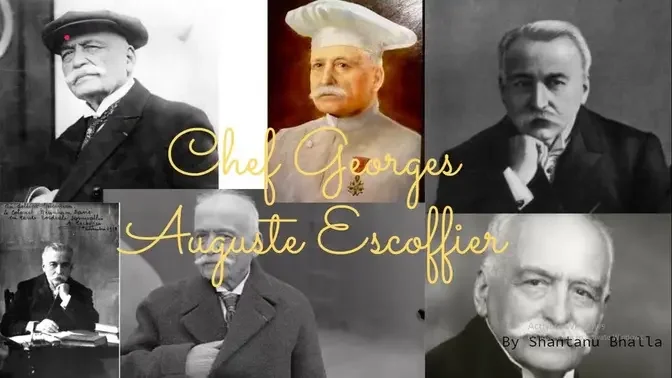
from Auguste Escoffier,
or the style of Auguste Escoffier,
which is pretty straightforward.
And these are the ingredients.
We're gonna have the red wine.
We're gonna need a bit of beef stock
and the classic tantalum,
and bay leaves, some shallots, a bit of lemon,
and a bit of parsley.
And that's about it.
But it all is already in the technique.
There's quite a few things just to be careful of.
So let's have a look.
So the first element to be careful of is the butter you use.
It has to be at least 82% fat content, good quality,
fresh butter, not an old stuff from the fridge, okay?
Very important.
You buy it, you use it.
And it's a softened butter.
The softened butter is something like this that is soft.
You may think that this is softened butter
because I can make marks with my fork, but no.
Softened butter has to be extremely soft
so that effortlessly I could smash it up into a paste
without any effort.
So this is too hard when it's like this.
You need to put it back a little bit in the microwave
until it's really soft,
and I will show you how it looks like.
Now let's have a look again.
I have softened butter in the microwave.
I've got a function for that.
And look, you see, this is what's called softened butter.
It's like a paste.
You can effortlessly mix it around.
And this is what you need.
That's very important when you make this compote,
so don't miss that step.
Now we have the butter.
What's the next thing?
Taste.
How are we going to bring a nice, intense taste
into our butter?
Because at the end of the day,
you want to have that kind of red wine sauce effect.
So the flavor is going to come from two things.
A red wine reduction.
So I've got a Cote d'Uron here, some shallots,
and like a Bordelaise, the basic.
I've got thyme, I've got a bay leaf,
and this is some beef stock.
We're going to have to reduce the beef stock to a glaze
and reduce our wine by a half.
Okay, so we've got butter, red wine reduction,
and reduced stock.
So the technique from the old days
to really bring lots of meaty flavor into sauces
was to make a glaze or a glass.
What is it?
It is simply a stock.
I've got here a homemade one
that is going to be transformed into a syrup.
We're going to reduce this very gently, medium heat,
until we're left with just a tablespoon worth
of something that looks like a caramel
or like a meat caramel.
And the stock is doing its thing.
And now we need to make the red wine reduction.
So like a Bordelaise, that's very simple.
You've got a pan.
We've got the shallots, thinly diced,
because we're going to keep them.
They're going to be shown into the butter.
And we're going to put maybe a bay leaf there, in here.
Lots of time in this kind of reduction.
Anytime you've got red wine,
it's a lot of the 200 ml of Cote d'Uron.
That's a no-frill wine.
And we're going to bring this to a light boil
and reduce this by half.
This step is optional,
but I like to add a good grind of black pepper in my wine.
The wine is ready.
I'm going to discard the aromatics.
Okay.
And I'm going to transfer the wine into another container
so that it can cool down a bit.
But you see, there's quite a lot left
and it's still quite liquid.
Now, this is important.
We're not filtering the wine.
Okay.
So I'm putting everything into a small bowl here.
I'll leave it to cool down.
Now, our glaze is ready.
And of course, in a typical me fashion,
I dropped half of it while filtering it on the bench.
So this is it.
This is how thick it needs to be.
And we just need a tablespoon,
which is just about half in here.
Okay.
As you can see here.
And this is,
I can't even start to tell you how meaty that is.
It is insane.
But this is a glaze.
That's what it's used in the old days.
And that's a whole hundred mil of stock
or more even 150 mil of stock reduced to a spoon.
And how does it look like?
And now let the magic happen.
So we've got the meat glaze, which is a beef glaze.
You've got some parsley, one tablespoon for later,
a little bit of lemon.
And this is our wine reduction.
So because this is messy and there's meat glaze everywhere,
what I'm going to do,
we're going to make the sauce
because we have the reduction,
we've got the taste, we've got everything.
So I'm going to pour that in
and then slowly grab all of the meat juices in here
to transform this into a sauce.
You see?
Yummy.
And I'm going to add a little bit.
Oh, look how dark that is.
And a bit of lemon.
Okay.
We've got that.
Just a squeeze.
It's, you know, up.
And if you haven't done it,
you can add salt and pepper.
I added salt in my glaze to make sure it was there
and the pepper was there in the wine reduction.
But if not, adjust the seasoning.
And here we are, back to square one.
We've got the butter.
If you wonder how this is looking like,
this is the sauce.
It's very dark in color.
It looks like a lot of liquid.
I'm going to trust Escoffier.
And then we've got the parsley, which is the first thing
we're going to put into the butter here.
Okay.
We're going to put all the parsley.
I'm going to put this on the side for now.
And we're going to use a whisk or a fork.
You see with the temperature,
we need to work it into a paste.
It has to be absolutely a paste.
So whisk the parsley in.
Now, as I told you, it looks like a lot of liquid to me.
I do trust Escoffier.
But when you make a butter,
my advice is instead of pouring everything
in the butter at once, go step by step.
So what I'm going to do here,
I'm going to take my red wine with my shot.
Some people like to filter the shallots out.
I'll leave them in.
Okay.
I'm going to start with half of it
and start to work this with the butter.
And see how we go.
You see, because it's, see how it goes.
So it's going to take some time to work.
Don't worry.
Don't panic.
It's going to incorporate.
So you need, it's a bit like a dough.
You know, work and work and work.
I'm just going to show you the whole thing because,
you know, and the more you work,
the more that is going to become,
like, you know, it's almost like an emulsification.
You see, a good whisk.
See the color?
Now you've got something stiff.
Ooh, can we trust Escoffier?
Can we trust him?
There's not much, there's a few tablespoon left.
Okay, I'm going to go one tablespoon at a time
to make sure we don't have a fail on our hands.
Same thing here.
You whisk gently first and then you can accelerate.
So here we are.
I've got the butter.
This is the version of the red wine butter
as per August Escoffier.
A nice color, a nice consistency, as you can see.
I'm going to give it a little taste
because we need to adjust the seasoning
with salt and pepper to finish.
Definitely needs to infuse a bit more.
And you know what?
It's not that strong.
Definitely a bit of salt.
I can feel the taste is actually infused
really in the shallot,
but it is really something I can see here
that's going to have to stay in the fridge.
So we're going to mix that seasoning here
and put this into a log and let it rest a bit.
So as with any compound butter,
you're going to take a piece of plastic film
and we're going to pour everything on here
in a kind of a log shape and then roll it up.
That's it.
So you can use your spatula.
You can try to give an initial shape,
you know, whatever length you want.
Okay, so I've pushed this more to the side
because I've just realized
it's actually going to be a nightmare to roll.
But in a nutshell,
you're going to roll this like this.
And then you do that whooshy whoosh
or whatever it's called and up.
And we're going to put this in the freezer
to accelerate the process.
Once the roll is made, you've got your log of butter.
It is imperative to leave this to rest
in the fridge for several hours,
four hours or more, ideally overnight.
This is to allow all the flavors
to be absorbed by the butter.
If you don't do this, it's going to taste like nothing.
You're going to have just the taste of butter
and some ingredients on the side.
Butter is very good at absorbing flavor,
but you need to give it time.
So if you can be patient, wait the next day.
Now for me here, because I don't have much time at all,
I still want to see how it goes,
how it looks, how it melts.
I'm going to put it in the freezer for a bit to solidify,
then in the fridge for one or two hours.
And then very briefly, try to show you the slice.
I'm going to try to put it on the steak
so we can wrap up the video
and see at least how it starts to taste like.
Right, it's been a few hours.
I've just cooked the steak and I've sliced the butter.
It is a bit early and I've virtually
just put the butter slice on there.
And you can see they're starting to melt away
because I want to see,
I want to cover that steak with this red wine butter.
Sorry, but it looks a bit messy.
Okay, everything has been melting.
So I've just briefly cooked the steak here
and I'm just going to want to see.
It does give a sauce, as you can see here.
It's interesting, not exactly a red wine sauce,
but it's actually working.
Hmm.
Not bad, not bad.
But still, I can't really taste
like, you know, the big punchy red wine flavor.
Let me try that one.
It's a good steak though.
Hmm.
All right, so let's recap.
First thing first, the good thing from Asperisco Fuelways,
the recipe works as per the ingredients.
It holds together.
And when you unpack it and you melt it,
as magic, you have a sauce with your steak,
which is something impressive.
And it does not actually taste like butter,
which is also super impressive.
Now, the other thing, is there enough flavor
and can we feel the wine?
The wine is contained really in these little shallots.
They're infused with the red wine.
But away from that, I don't really feel it.
So I think Escopierre on that occasion has been pretty safe.
It's been one of these things where it didn't go too much,
but for today's standard,
what people really like, the big punchy flavor.
If you read like, I want a red wine butter,
a red wine sauce, you're gonna want to feel that taste.
So for me, I'm gonna adjust the ingredients for you.
I'm gonna double the amount of mid-glaze
with two tablespoon, two tablespoon of parsley.
And I'm gonna also double the amount of shallots
because this is where the wine reside.
And I think that will bring much more flavor.
If you are someone with a bit of experience,
I would even recommend of reducing 300 milliliters
of red wine into 100 mil
to really, really have this super concentrated wine flavor.
But away from that, it is pretty magical.
If you can't be bothered to make a sauce,
you have this in your fridge,
you put it over your steak and boom,
you've got a delicious sauce
that is actually still very good.
But that's it.
Here's the picture of the red wine butter.
And this is the iced coffee version.
Now you can tweak it if you want.
And if you come up with your own version
and you try the things I've told you,
just let me know in the comment
and let me know what you think.
But it is an interesting thing to try.
And it's a new technique to know
that you can actually incorporate the sauce in a butter.
And when you melt it, it reappears in front of your eyes.
But that's it for the video for this week.
As always, any comments, use the comment section,
Instagram for the pictures.
And I will see you next week for another French cooking video.
Take care all.
Bye bye.