
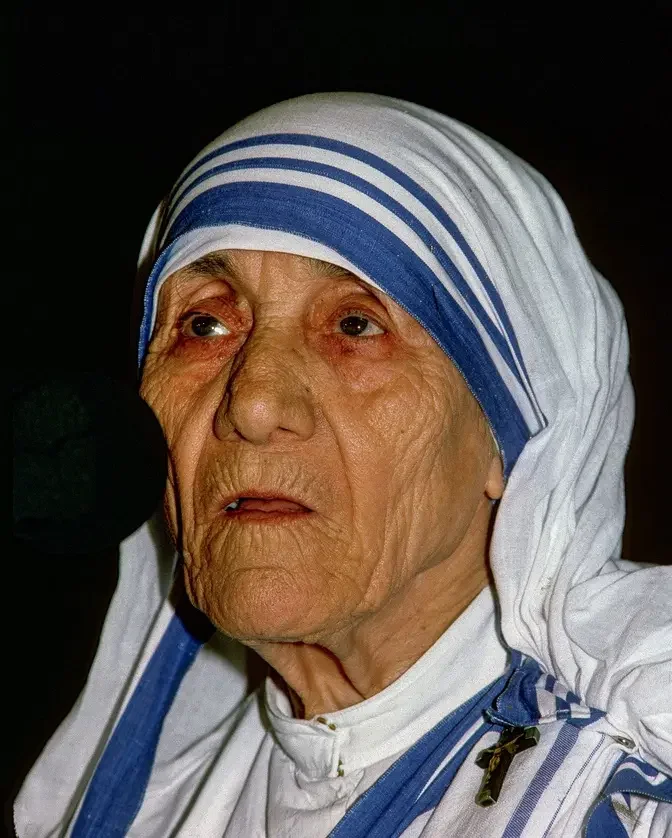
Mother Teresa of Calcutta on Irish Television, 1974
13 Video Views·Dec 13, 2022
When I was hungry, you gave me to eat. When I was thirsty, you gave me to drink. When
I was naked, you clothed me. Mother Teresa, these are words which we would all agree with,
but the difference between us and you is that we don't put them into action. We don't do anything
about them. Even though we might want to do it, we still don't. Now, all of these words don't,
to me, to you, just don't mean food and drink and clothes. They mean love. When did it all
start for you? When did you start to put these words into action? Since 1946, actually,
doing this close contact with the poorest of the poor. But before that, it was a vocation
from the time I was 12 years old, calling to belong to Jesus. Now, at that time, you were
in Skopje, in Yugoslavia, where you were born. With my own people. Was it difficult to leave
your people? That was the sacrifice that Christ asked of us, because we were a very happy and
very united family. But God asked for the sacrifice from my people and from me.
Were you a religious family? Had you been brought up to believe, as you do now,
that everything was for God? Yes, I think my mother was a very holy woman,
so she imparted that love for God and love for the neighbor very much into all her children's hearts.
Now, when you got the calling and when you realized that you had to give up everything,
what did you do then? How did you go about it? I mean, 12 was very young.
I didn't leave home until I was 18. And then I got in contact with some of our missionaries
in India. And through them, I got in contact with the Lorettanans. And then 46 years ago,
I came to Rathfarnham. And from there, I went to India in 1929 and finished my novitiate.
And I was with the Lorettanans for 20 years in India. Can I just go back a little bit to
Rathfarnham? Because in Ireland, we are a little bit interested in your time in Rathfarnham.
How much do you remember of that time? Well, I remember yesterday when I went to
Rathfarnham after 46 years, I saw the places where I had been as a young postulant. And I
remembered the community room and the chapel and the refuge. So that brought back all those
happenings that were happening at that time. Now, when you were there, had you that longing?
Did it start there for your vocation, as you call it, a vocation within a vocation?
No, it was not at that time. It was 20 years after when I was in India.
When you'd gone back to India? Yes. I left Rathfarnham only after six weeks,
and I went to India. I joined in October, and then in January, I went to India to do the novitiate
there. Now, you were a teacher, Mother. Were you a good teacher?
I couldn't tell you. I think you'll have to ask those whom I taught.
Did you enjoy teaching? But I loved teaching. I loved teaching.
Now, back in India 20 years later, when you got the feeling that you had to do something else,
you had to go out to the poor, how did you go about that? Because you had taken your final vows,
and it must have been difficult for you to give up the final vows as such, was it?
I didn't have to give up anything because vocation is belonging to Christ. The work
is only a means to put our love for Christ into action. And so I had only to change,
so to say, the way of work, the means I had to change to work for the poorest of the poor.
So my vocation was a continuation of belonging to Christ and being only His.
So you left Loretto, but you kept with you all these vows, spiritual feelings.
Yes. And then when we had our own... I left Loretto in 1948, and in 1950, the Holy Father
approved of the new congregation of the Missionaries of Charity. And then in the new
congregation, I took the vows of the new congregation of love, poverty, trust, obedience, and charity.
When you talk, Mother, of the new congregation, did you start this congregation
the second you left? It went with you. You became a Missionary of Charity instead of being Loretto.
The approval came from Rome in 1950, on the 7th of October. And since then, the little
congregation... First it became a diocesan congregation, and after 15 years, it became
a pontifical. Now we are a pontifical congregation with 850 sisters.
As many as that?
Yes.
And do you find it easy to get sisters? Because vocations have gone down for other orders.
God has been very wonderful to us. We have 182 novices in our three novitiates, one in Rome,
and one in Calcutta, and one in Melbourne. And I had news the other day from Calcutta to say
that 109 aspirants have joined last June.
Good gracious, because two would be a lot in Ireland, in the average congregation.
Tremendous gift of God for us, because we are getting vocations from all over the world now.
Now, Mother, you've decided to become a Missionary of Charity. You've gone into
the streets of Calcutta. Can you tell me how you actually went about it? Because
just to talk about somebody going into the streets and starting a new order and
helping the dying, how did you actually... What was your first contact with a dying person?
I picked up the first person from the street, and I found a woman lying in the street,
eaten up by rats and so on. And I took her to the nearest hospital. And they didn't seem to
want her there. But because I insisted so much at last, they took her in. And from there,
I decided that I will find a place for them myself and take care of them. Then I went to
the municipality and I asked for a place only, that the rest I would do myself for them. And
they took me to this Kali Temple in Calicut and offered me a place of rest that they use for the
pilgrims that come to worship the goddess Kali. And we have been there for 22 years now. And we
have picked over 29,000 people from the streets of Calcutta in these 22 years.
Now, when did your sisters start joining you? Because you were alone when you started,
when you picked up that first lady. Since 1929. Not 29, that was the year I joined,
but since 1949. And how did that happen? Did you ask somebody?
The first sisters to join were the students that I had taught in Loreto. The first group,
we were about 12 by the time the congregation was established. And since then,
girls from all over the world have been joining. What sort of girls were the Indian girls? Were
they a very high caste? Mixed. We have high, middle, and ordinary. And that is the most
beautiful part of this, young girls, so fully dedicated and determined to give their all to
Christ. They are all very anxious to live that life of poverty, because for us, it's very
important. If we really want to know the poor, we must know what is poverty. And that's why in our
society, poverty is our freedom and our strength. So that we would have poverty then, in your words,
right here, in our homes here in Ireland. You don't have to go to the streets of Calcutta,
is that what you're saying? That poverty is a lot of things?
There is two kinds of poverty. We have the poverty of material, for example,
in some places like in India and Ethiopia and other places, where the people are hungry for a
loaf of bread, real hunger. But there is much deeper, much greater hunger, and that is the
hunger for love, and that terrible loneliness, and being unwanted, unloved, being abandoned by
everybody. Some people you find in, what they call them, shut-ins, people that are sleeping
in the streets of London, and are found in the homes, maybe that kind of unwantedness, unloved.
Even in our own homes, we may have somebody who is handicapped like that, and nobody takes any
notice, nobody even recognizes that there is this child, this man, this woman, who is hungry for
love, hungry to be recognized, and to accept with respect and love the person.
When most of us, Mother, think of the appallingness of Calcutta and Rome, you know,
the poor areas of these places where you have gone into, and Bangladesh, we think,
how on earth does she do that? How on earth can one person look at all of that and say,
how can I help all of this? Do you ever feel absolutely despondent that you are doing what
the whole nation should be doing? Do you ever feel that it's a very heavy burden?
I don't feel like that, because for me, I can do only one, because Jesus is only one,
and I take Jesus at his word. He has said, you did it to me. And so my sisters and I,
and the brothers, we take one person, individual person, one person at a time.
We can serve only one at a time. We can love only one at a time. Yet the whole world, though it
sounds so big and so much and all that, yet it is but only a drop in the ocean. But if we didn't do
that little drop, that ocean would be one drop less. And so we have no reason to be despondent
or discouraged or unhappy about it, because we are doing it to Jesus. So he had said,
I was hungry, and you fed me. So in each one, you see Jesus.
It is Jesus, because Jesus has said so, you did it to me. And that's why the poor more and more
become the hope of salvation for mankind, because we are going to be judged on what
we have done to them, what we have been to them, how we have accepted them.
This is what you said to the Senate committee in Washington, that the poor with the hope of
mankind. How did they take that? They took it very well, and I think it has
had a tremendous influence, because they're already working at it to answer the call of
the poor of the world. Because I feel if the world today turns its back to the poor,
I think they are turning their back to Christ. You talked, Mother, a few moments ago about
the thousands that you have taken into your home in Calcutta. Now, Calcutta is a very large place,
and the poor are very many. How many do you turn away? How many have you not got room for?
I don't know. Up to now, we have never had to turn anybody away.
Never? Because there is always one more bed,
one more plate of rice, one more blanket to cover. How is that?
Well, I don't know. Again, we take God at His word, because we depend solely on divine providence
that comes to us through the love of the people. And so He has taken care, and He has shown such
thoughtfulness and such kindness for our people in small details. And so we have no reason but
to take, to accept what He has said, that we are more important to Him
than the birds of the air and the flowers of the garden.
There are a lot of people, Mother, particularly in America, we'll say, where you've had just
visited and talked to the Washington Committee, who have a lot of money and who probably have
very good intentions, but who would never in a million years do what you're doing, or indeed
part with any of that money, willingly. How do you get through to that type of person?
By giving them a chance to do works of love.
Such as?
Such as to help somebody in their own family first, and then next-door neighbor,
to find the poor around them. And then once that contact is made, I never ask for money,
I never ask them to give me, but I always ask them, come and see, come and touch.
And once that contact has been made, they know what they have to do.
Are you in great need of money? Because I know that you don't take any government
grants of any kind.
I have never been in need, but I accept, I never refuse what people give.
And I accept whatever. So having nothing, yet possessing all things.
Now you have co-workers all over the world, and you have them in Ireland.
Are we generous? Are the Irish good to you?
Very generous. And it's been a wonderful time now with them. Especially, I'm very,
very anxious, especially now that I've come round to meet our co-workers.
We have nearly over 40,000 around the world. And we're trying, because a co-worker is a way of
life. And we're trying to bring that love and peace and joy to our neighbour and to,
to the, in the street we live, in the town we live, and then again to the whole world.
And I think love begins at home. And if we can bring that love,
I think we will be able to overcome the world with love.
There are some girls, Mother, because you've just said the enormous number of postulants
you get every year. There are some girls who want to give a little more than just
a co-worker's love, which is quite a lot, but they want to give just that bit more.
And they want to go over to you. Now if a girl wants to give up her life,
what happens? How exactly does she do it?
Well, she has to, first of all, she must have those four conditions that are required to be
a missionary of charity. She must have health of mind and body. She must have the ability to learn.
She must have plenty of common sense and cheerful disposition. And if she has these four,
then she comes and sees the work. Like in the Gospel, our Lord said, come and see.
Where does she go now? She goes to a new...
She comes to one of our houses and comes in close contact with the poor, with the people,
with the sisters, and works with them, prays with them, stays with them. And then she decides
if this is what God wants from her, then she joins. And then she spends six months as aspirant,
six months as postulant, two years as a novice, and then six years temporary vows. And then one
year before final vow, she comes back again to the novitiate to deepen her spiritual life.
Because we are not social workers. We are trying to live a contemplative life
on spreading love and compassion of Jesus in the world by doing works of service.
Can you tell me something, Mother, about that contemplative life? Because you've just
listed a number of qualities which are almost otherworldly. They're so spiritual for any normal
girl to have. Could you give me an example of your day, for instance, a normal day in Calcutta
for you? We get up at twenty minutes to five. Then we begin our day with prayer, meditation.
We have Mass and Holy Communion because our life is very much woven with Jesus in the Eucharist.
We try to deepen our faith and our love in Jesus in the Eucharist to be able to see him
in the distressing disguise of the poor. That's the same Jesus. And then after Mass and Holy
Communion, by 7.30, some sisters go for leper work because we are taking care of nearly 46,000
lepers. And some go to the home for the dying, some to the children, some to the little schools
we have for street and beggar children. And some go to the feeding center, some visit
homes of the poor and do the most humble work for them in the houses.
But on our way going to and coming back, we pray the Rosary in the street so that we keep on
praying life because only the work is the fruit of our union with God. And so we come home and
after lunch we have again examination of conscience, Stations of the Cross,
and we say the Divine Office, and then we have spiritual reading. And again one group,
the professed, go out again, find the novices and the postulants, stay in for that afternoon,
classes, theology, scripture, and so on. Then by half past six, everybody's back again,
and then from half past six till half past seven, we have Adoration of the Blessed Sacrament.
We expose the Blessed Sacrament. This hour of prayer has been a wonderful means of deepening
our love and our faith, and at the same time bringing us very close to each other and to
the poor that we are serving. And then we have our dinner and we have recreation, and then by
half past nine they're all in bed. I should think so. My goodness, Mother, that's an extraordinary
day. Good labor. It is really. How many ordinary girls from ordinary homes can stand that? How
many would leave you in a year? Only those that we send. Any of those that have not had,
that don't have these qualities, or some if they get sick before they are professed,
we send. Otherwise we have very few leaving. They don't leave for the other reasons? No,
because it is hard. Not at all? No. You mentioned leper work. What do you do for
lepers because it seems such an impossible task? We have, many sisters have been trained to take
care of the lepers, and with the money that the Holy Father has, when he gave me the car,
we raffled the car, and with that money we have built a rehabilitation center
for lepers, and it's called a Town of Peace. And there we train the
lepers and try to bring them back to a normal citizen's life. And we have over 15,000 of them
that we take care of in Calcutta alone, but all together about 46,000. We treat them,
and at the same time we try to teach them to do things so that when they can live a normal life,
that is the greatest suffering for them because they are shunned by everybody. They are wanted
by nobody. And so we try to bring new life in them besides treating them. And we have had most
wonderful results every year. Nearly 200 of them are completely cured, if they come in time.
We have these mobile clinics all over the place in every city that we work. We have about 51
cities now in India where the sisters are working, and so we use these mobile clinics and go to them.
And for a leper that you can't cure, there must be many, what do you do?
Then we give them tender love and care, but we keep up very close contact with them. We are
trying to have these rehabilitation centers all over the place. We want to make them feel that
they are really wanted, that we are not afraid of them. And so to also to try to
segregate them without them realizing that they are being segregated.
Now to ask you this question seems almost ridiculous, but if I were to ask someone else,
how on earth do you touch the lepers? Do you go near them? Are you ever personally frightened, ever?
I mean, we take all the precautions possible to protect ourselves, to protect the sisters.
And then once they are properly trained how to take care of them, there is a very little
possibility of getting infected. But we are all, we must be ready. If it is God's will,
someday some sisters will get it. We must be ready to accept that as part of the gift of God.
Now throughout the years, Mother, you've been receiving all the awards that could possibly be
to a single person doing work for religious, in the name of religion. You've been awarded
the Nero Award, the Templeton Award, Pope John's Peace Award. What do you feel about that?
I only accept because they have to use one person, but I accept it in the name of them.
Because the work is not my work. It is the work of us all. And you and me. Because it is
his work. And so whatever people give, it is actually his. Because I am nobody in the picture.
I'm only a recipient. I'm an instrument. And so when these things come, actually,
like Nero Award, we are using all that money to give artificial legs and eyes and things like
that, and pacemakers for the heart, and heart operations for our poor people. They would not
be able to afford. So we are using that money for that. And the Templeton Award has been used
to build homes for the dying all over the world. The Templeton one was the British one.
That's right. Which Prince Philip awarded. That's right. And that's brought so much
happiness in so many places, in so many countries. And so this is carried through.
Now right through history, all the great saints, Christo Vavoli would come immediately to mind,
had great doubts about their faith. They had great moments of absolute darkness when they
wondered if there was a God at all. Have you ever had that darkness? We all have to go through it.
Yes. But that is the time when we have to take greater grip and accept it
as a sign of purification and greater love. That's the cross at that time.
When you say we have to take great grip, what exactly do you do when you have a moment?
Cling to Christ because he's the only answer. And how do you cling to Christ if you have had
a moment of darkness and you doubt his very existence? Blind faith.
And you've always had that faith? Yes. What do you say to people who come to you who say that
they have no faith, they admire what you're doing because naturally their hearts go out to the poor
and the sick and the dying, but they just couldn't do what you're doing because there
is no Christ for them? I don't believe that there is any human being who doesn't believe in God
unless they are mental. Even though they say they don't? But deep down in their heart there must be
that faith that there is God. Only it's maybe either it is covered or they are, as you say,
in darkness and they can't see. And they have not got that complete attachment to God. They
don't know him sufficiently maybe, but that they have faith deep down in their hearts.
What's your reaction, Mother, when you're passing by a suburb, a fairly wealthy suburb,
and you see the wealthy houses? Let's take you back to Calcutta again where you have the
Victoria Memorial. Victoria Memorial, which is a massive building and just lying there.
What do you think of it? I resent it because it is empty while our people are left in the street
and in overcrowded little rooms. But I still hope that one day we'll fill it up with our people.
You feel that? I think so. But I don't doubt you. I think you probably will take it over.
But something very beautiful has happened now in Calcutta. The ICI, it's an English firm that
has been working in India for many years. And they have, as a gift to the people of Calcutta,
they have given us a very big property, just as a real, for the love of God, so to say,
completely as a gift. And we have made it into a wonderful home with the help of many people.
And now we are bringing the sick and the dying to this new place where there's a nice garden and
nice space for them and plenty of space. How will we be able to take many more people?
You feed, Mother, the children, the millions of starving children in Rome and in Calcutta and in
Ethiopia and all the other countries you've gone into. There are people, and I'm sure you've heard
of them, who say that there are too many children in Calcutta. Why so many children? Why not stop
these children being born in the first instance? What do you say to those people?
That is not their concern regarding the children of Calcutta, because a child is the gift of God.
And I feel that the poorest country is the country that has to kill the unborn child
to be able to have extra things and extra pleasures and so on. And they are afraid to
have to feed one more child. In Calcutta, we are trying to fight abortion by adoption.
And also our sisters are doing natural family planning, which has helped many people
to live their life very beautifully. As the poor people told me, our family has remained healthy,
our family has remained united, and we can have a baby whenever we want. In India, actually,
they may leave the child in the dustbin, they may leave him at our door, but they would never kill
the child. And so this is what we, it's very painful to accept what is happening in the
Western countries, where the child is destroyed with the fear of having too many and to have to
feed and to educate and so on. And I think for me, they are the poorest people in the world
who can do an act like that. When you take a child from the dustbin,
as you often have, where do you take it to? You take it into your home, and then the child is
growing up. What do you do with that child? If the child is healthy, we try to get a family
to adopt the child. And lately, we have had many, many Hindu families who are taking our children
into their own homes and really adopting them legally. And then if the child is not adopted,
then we get a sponsor parent to sponsor him for education. And so at present, we have over 5,000
children who are being paid in different schools to be educated. And so their future is very,
very, we hope that their future is much more brighter and much more beautiful.
Can I have to say to you, you know, you say quite calmly to me, we get a sponsor. I bet if I took a
you said 5,000 children, if I took one in the morning, and tried to get a sponsor, I would have
the most dreadful difficulty. How do you so easily for 5,000 children get sponsors? How do you go
about it? I don't know. But that is the most beautiful part. We have these co workers also
that make the contact with the families and the families all over the world. Like for example,
here in Ireland, there are 136 children that have been sponsored for education.