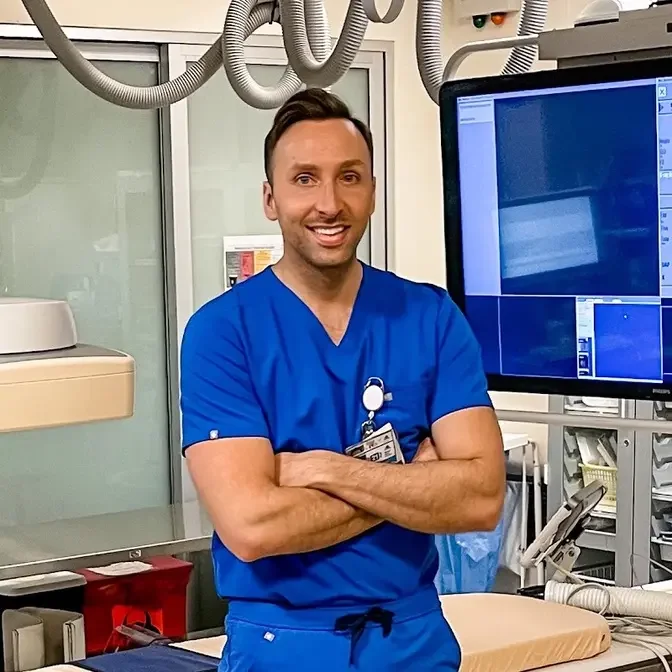
Why I chose Radiology! It is time for a much needed update since I have now finished all of my medical training! The last video was pretty bad back in 2019, but it surprisingly did well! Now, 2 years later, I have officially become an Interventional Radiologist and thought it was time for a much needed update from a slightly different perspective. In this video, I talk about 11 reasons why I chose Radiology and Why I Love Radiology! If anyone is on the fence about this specialty, please go shadow or get involved in research so you can see exactly what we do! I promise it's the best field in medicine!!
So the question I get asked the most by far is why I went into radiology.
And I think I can come up with a few reasons. So let's go.
So terrible. Welcome back to the channel everybody.
For those of you who are new around here,
my name is Michael a.k.a. Dr. Cellini and I am a diagnostic and interventional
radiologist in New Jersey.
Today I was scrolling through some of my old videos organizing some stuff and I
came across this video from January of 2000.
And I came across this video from January of 2019.
It did pretty well so far since I made that video,
but some things have changed and that video is linked up here.
It's called why radiology.
I filmed that during my third year of radiology residency or my fourth year of
residency as a whole. And, uh, some things have obviously changed since then.
Now I'm a private practice attending physician specialized in interventional
radiology, also working in diagnostic radiology.
So I figured it was time to kind of update that video and talk about what I love
about radiology and see what has changed since I was in residency.
And also if you do go watch that video,
which I think you should because it is oh so terrible.
And I have no idea how anybody watched me back then. My jokes are terrible.
Essentially I get to play like where's Waldo or where's the cancer.
My timing's terrible. Number four,
editing's terrible. So you need another reason why I chose radiology.
It's just an atrocity of a video, but if you want to see it, that's the old me.
This is the new me. Let's talk about radiology. Let's go.
All right, so let's just go ahead and jump right into it.
So the first thing I mentioned in the last video is still the reason I went into
radiology and that has not changed at all.
And that is I wanted to be exposed to all parts of medicine.
And what I mean by that is I had trouble picking a specialty because I liked so
many different things in medicine. I like surgery. I even like OBGYN.
I even like, no, I didn't like pediatrics. I even liked, uh, pathology.
I liked it all.
I like every single bit of medicine with the exception of a few fields I liked.
And I was looking for a field where I could dabble in a little bit of
everything. And then I realized that field is radiology.
And not only can I dabble in every field,
I can actually know a lot about every field. And that's what I have to do.
I have to know about every single field of medicine because I interact with
clinicians from every field of medicine.
And I read studies for those clinicians in all subspecialties,
whether it be pelvic ultrasounds for OBGYNs or MRIs.
I read head and neck CTs and MRIs for neurosurgeons and ENT doctors.
I read abdominal CTs and MRIs for surgeons.
I read brain and spine MRIs for neurosurgeons.
You do a little bit of everything for every different specialty.
And that's why I love it. And before I go any further,
I just want to like reiterate here because a lot of you are probably confused
because yes, I'm an interventional radiologist,
which means I do image data procedures mostly throughout my day.
But in private practice,
I still do diagnostic radiology or I still read studies
at home or in the hospital for the practice I work for and ultimately the
hospital I work for. So yes,
I am trained in some specialized interventional radiology,
but I still dabble in diagnostic radiology as well,
because that's what you do in private practice.
And I actually mentioned this in the prior video link up here again,
which that was very astute of me to mention that before I even knew it.
All right, let's get to the second one.
So the next reason I went into radiology and interventional radiology is because
the stress level is from up here to somewhere in this range.
And it's a little less stressful than most specialties, sort of.
It can still be pretty stressful because some people in my field have something
called list anxiety. And what that means is our studies come in on a queue.
So there'll be like three CT abdomen,
pelvises on the list and then as they get scanned or as they get imaged,
ultrasound, x-ray, MRI, they pop up on our queue or our list.
And that's the way we read studies. As they pop up, we read them.
The problem lies when multiple studies pop up at the same time or a trauma comes
in and blows up your list and you have like 10 plus studies to read at once.
And then you start getting behind and then you start getting really anxious and
developing anxiety because you want that list to be cleared and the queue to be
complete so that you can just read as they're scanned, you just read them.
But the problem is it doesn't always work that way because scanners tend to move
faster than you can read.
And sometimes you have a scheduled outpatient list to read and then a trauma
comes in and boom, 10 CTs pop up in your list and throws a wrench in your plan.
So for me, I have less anxiety.
It can get very stressful trying to get through all those studies and it can be
pretty overwhelming at times,
but it's still not as difficult or stressful as managing patients are.
So for that reason, point goes to radiology.
The next reason I chose radiology is because it is quick and to the point.
What I mean by that is when a study pops up and you have to read it,
you know the answer before you send off that report.
So within five plus minutes, you know the answer,
you send off that report and you diagnose the patient or even help treat the
patient within minutes or sometimes even seconds.
And that is very rewarding to me.
One thing I've talked about on prior videos is that I never had the patience to
sit through like eight, 10 hour plus tedious procedures,
wearing loops to look at tiny nerves or whatnot.
I just like don't have that kind of patience.
I really want like quick,
simple procedures and quick and simple studies to read because I kind of need
like instant gratification and I'm onto the next.
It's not that I get bored easily or maybe I just have ADD. I don't know,
but I just like to move on and rather than spending so much time looking at the
same thing, that's why I like it. I can move on, finish a study,
move to the next and we're good to go.
That's the same reason I chose this job working in interventional radiology
because the procedures are pretty short and not as complex as some of the ones I
did in training, which is what I love. I like to just do a procedure,
do it well, have it done pretty quickly under an hour if I can and help someone
else out. All right.
The next reason I love interventional radiology with a dash of diagnostic
radiology is because our field is fortunately a well-paying specialty.
Now it's not as good as it used to be due to all the reimbursement cuts and all
that stuff,
but it's still a pretty high paying specialty in a high paying field compared to
other fields in medicine.
You can Google how much interventional and diagnostic radiologists make.
I'm sure you can find the like Medscape data on it or whatever.
I don't like to talk about my personal salary on here because I don't think
it's really any of your business,
but I will say that it's a high paying field and that's one of the reasons I
chose it. It's not the only reason I chose it before people come at me like,
Oh, you only went into medicine for the money. Trust me.
There is no reason anybody should ever go into medicine for the money because A
is not worth it and B it takes way too long to even start making money and at
that point you're already in so much debt. It's just not worth it. Trust me.
I did not go into medicine for money could have made so much more money doing
other things. I just happen to like medicine the most out of all those things.
So the high paying salary is just an extra bonus.
The next favorite thing that I like about my field,
especially in interventional radiology is that we get to converse with a lot of
different specialties and a lot of different physicians and PAs and P's and
other specialties as well.
And I kind of touched on this a little bit prior because I like dealing with
other specialties,
but you also develop good relationships with some of your colleagues and that is
even more prevalent in private practice.
When you're making these longterm connections with some of your colleagues,
you build relationships with other surgeons because you work together on a lot
of treatment plans for some of their patients.
You may help the surgeons out with postoperative complications.
You help a lot of oncologists and OBGYNs by biopsying different types of cancers
and placing chemo ports and all this stuff.
So there's a really a lot of working together and it's very much a team sport.
Just to piggyback a little bit on that without sounding too corporate with that
phrase, we do a lot of tumor boards as well. So even in private practice,
I'm a part of the thoracic and OBGYN tumor boards,
which means we discuss different patients.
We discuss their imaging and the oncologists, the surgeons, the radiologists,
the interventional radiologists.
We all come together and talk about the treatment plan for each specific patient
and yeah, it works out. I like it. The next favorite part,
just ran into my desk. My next favorite thing about radiology is,
especially in private practice is we get a lot of time off and that is very much
important to me. Not because like I'm lazy and need time off,
but it's because I have other things I like to do outside of medicine that I've
talked about time and time again. I like to travel.
I like to hang out with my wife. I like to see my family.
I like to see my friends and I also like to do YouTube and be creative and
create other content on other platforms as well. I love medicine,
but I also love so many different things outside of medicine and luckily my
field working in private practice allows me to do other things outside of
medicine and gives me some much needed time off so that I don't get burnt out in
radiology. Ah, this is one of the ones I mentioned on my prior video,
and that's because we get to help a lot of different people every single day.
You can only see so many patients if you have an office.
So say you're a primary care physician and you see 40, 50 plus patients a day.
That's a lot of patients and that's a lot of your time spent seeing those
patients. I, on the other hand,
can read anywhere from a hundred to even 200 studies in a day depending on the
day. And I can help over a hundred plus patients every single day.
I'm reading studies, which is mind boggling.
I can see that many patients in such a short time. And I like that.
It's nice to see and help and treat and diagnose that many people every single
day at my work. All right.
Is this my favorite part about working in diagnostic and interventional
radiology? Why am I doing this? I'm like congratulating myself for this.
The biggest benefit,
which not many people talk about and it's kind of like a secret.
So come closer. We don't do any paperwork.
We don't do any paperwork in radiology or interventional radiology.
We don't chart. We don't write notes. We don't, I don't even know.
We don't do anything.
All we do is read a study and we dictate our report.
And that is our paperwork. We don't have to chart. We don't do anything.
That is our report. And that is our paperwork. Our dictation is our paperwork.
We don't need to do anything other than that. Now in interventional radiology,
it's a little different because I have to do some like brief op notes.
Sometimes write some orders,
obviously post-procedural orders and pre-procedural orders.
Sometimes I have to call in medicines and all that stuff,
but I don't really have to do long progress notes.
I used to do that in fellowship because we would do complex procedures and see
these patients for many, many days in the hospital.
But now that I'm not doing as complex of procedures,
it doesn't really require that kind of followup anymore.
So we don't really do that much if any charting, but don't tell anybody.
All right. So interventional radiology,
diagnostic radiology is arguably the most technologically advanced field in
medicine or one of them, if not the most technologically advanced field.
We get to play with a lot of cool toys. We get to have a monitor system,
very expensive monitors, very expensive imaging equipment,
very expensive floral rooms,
which you've seen on my channel before where I go in and describe them to you.
We get to work with some pretty cool toys and they do some crazy stuff.
Like have you ever actually thought of how an MRI works and what it actually
does and what it is like?
That is insane that that's something we just take for granted and read studies
on a day-to-day basis.
Like the MRI machine and magnetic resonance imaging is insane.
And that's just like breaking the surface. Nuclear medicine is crazy too.
We get to image radioactive stuff, even ultrasound.
We have contrast enhanced ultrasound. Now we have CT x-rays,
crazy stuff that obviously includes the floral guided stuff that I do.
It's just, it's a fun field and we have a lot of cool toys. All right.
So without going too crazy,
cause I could probably talk about this field forever,
but another one of my favorite things is that this desk setup, as you know,
is my home radiology desk setup.
I can actually log into the hospital system via a VPN and I can actually read
from home on my own personal workstation, which means I wake up,
make myself coffee, come to the desk in my pajamas and read.
You can't do that in any other specialty. All right.
So I'll finish on this and one of my other favorite things about radiology.
Again, I could talk about this stuff forever,
but that is the fact that when your shift is over, it's over.
It's not the same interventional radiology because obviously we have to manage a
lot of patients outside of the normal business hours.
But in diagnostic radiology,
when your shift is over or the list is clear, that's it for the day.
Nobody's calling you about other stuff.
You're not on call. You're just done. It's like being in the emergency department.
When your shift is over, you're done.
And that's pretty nice because in a lot of other fields where it's not shift
work per se, you tend to stay over and those hours add up.
I like more clear cut hours that you know when you're done.
So that officially concludes this video.
It's a little update on my old radiology video,
why radiology that I did way back when. Again,
go watch that video if you want to laugh and you'll see just how far I've come
since that video. So terrible. Anyways, let me know in the comments below,
what you love about radiology and why you will go into radiology.
If you have any questions, leave them in the comments below as well.
Make sure you smash that subscribe button, follow me on Instagram and TikTok.
And I'll see you all on the next video. Bye.