
Evidence Of An Ancient Cataclysm At Tanis In The Nile Delta Of Egypt
26 Video Views·Jul 27, 2022
Join us on an upcoming tour: https://hiddenincatours.com/tours/#major
Okay, we're at a police slash military base here in the Nile Delta. This place is very surreal.
We've been going through incredible agricultural areas,
and now this whole ancient archaeological site has basically almost nothing growing on it.
It's a huge chunk here of milky quartz.
So we're several hundred miles away from any granite or quartzite stone quarry, and yet
look at the number and size of these huge blocks here.
So Patricia, was all this stuff found buried?
Yeah, absolutely. They've moved it, lined it all up here, and you can look out here,
and you look, and look at how the desert moves, and all these lumps, everything under there.
This site is covered. We're probably only seeing two percent, if that, of what's underneath the
sands, and as you walk around, you're going to see the obelisks that they tried to take away,
and because they didn't understand the physics of it, they're broken in two all over the place.
Over here is the sacred lake, and it's built and constructed, and there's some kind of sugarcane,
but this whole site, most of it's unbelievable, but what we're seeing is unbelievable.
When I've been reading Petrie's original text, he said that there was roughly 120-foot colossi here,
one colossi, but he speculates that there should have been two, but they've only found the one,
but he said it was all into pieces, and from Ramsey's the second time, they have been carving
things out of these pieces, but said there's enough pieces that he could fit it together
into a minimum of 120 feet high. And it would have been a granitic stone? He said it was a
granitic, as opposed to being a quartzite like these ones. Any instrument on the weight? Well,
he equated it with the Ramessian. So 700 to 1000 tons, moved either from the eastern desert or
from Aswan quarry, which is at the opposite end of Egypt. That's right. But the damage is much
more on the right side than the left side. Wow. Why is it cut like that? Because the statue itself
this was used as a block. Wow. But when you look at a statue that is this big,
and you look at the size of the foot, and then look at the size of a foot like this size.
125 feet tall.
But they have a reasonable quartz content in them. So I'm not sure where they come from.
It's either going to be in Sinai or the eastern desert, but they have quite a bit of quartz in
them. So they are, look at how coarse and loose that is. They're going to break apart a lot
quicker than some of the charcoals. And we can see that it's not as perfect as the structure.
Doing dynamic video here, folks. One solid piece of granite. So this is dynastic work or
later. You can see it's limestone, small pieces. And then we have this landscape here.
Solid chunks of granite, either from the eastern desert or Aswan in the absolute south of Egypt.
And obelisks whose surface here is exceedingly heavily eroded. Lots of obelisks.
But also it has another good evidence that we can see. Look at the amount of flint.
I think perhaps that these came first because they've got the better cuts that have been
preserved. And I think it's because they're finer crystalline size and the lattice structure holds
together. So when they cut it with precision, it holds that precise angle and the smoother cut on
Well, this is travertine. And you think that it's possible that the travertine isn't even
from Egypt? Well, from what I've seen of the hot springs around here, they are fairly small hot
springs. This could be from one of the smaller hot springs because you can see the crystal size.
Whereas remember in the, in the, in Karnak, we were seeing those calcite crystals about this
thick before they hit the mudstone, that thick again mudstone.
These are very small. I think this may be, may be local or maybe just on the edge of one.
Well, see, there was a piece at the other place.
Okay.
So Susan, here's an interesting piece of stone, or something.
It's got gas bubbles in it.
I think it's a piece of slag from... I've read the Romans used to work glass here,
but it may have been something else that they were working.
But that appears to be a piece of slag.
Okay, but could it be a piece of cooked stone?
No.
No?
When you feel it, it's just way lighter. It's from the smelting process.
Oh yeah, there's way too much destruction and surface damage here.
Possible evidence of the stone being scorched.
Very cool.
Yeah.
So, the wood that's in there, that's wood.
That's wood.
Oh, my goodness.
Oh my God.
So you see the limestone, and that tells us this is likely dynastic period.
However, you have these massive slabs of granite.
And not just massive slabs of granite.
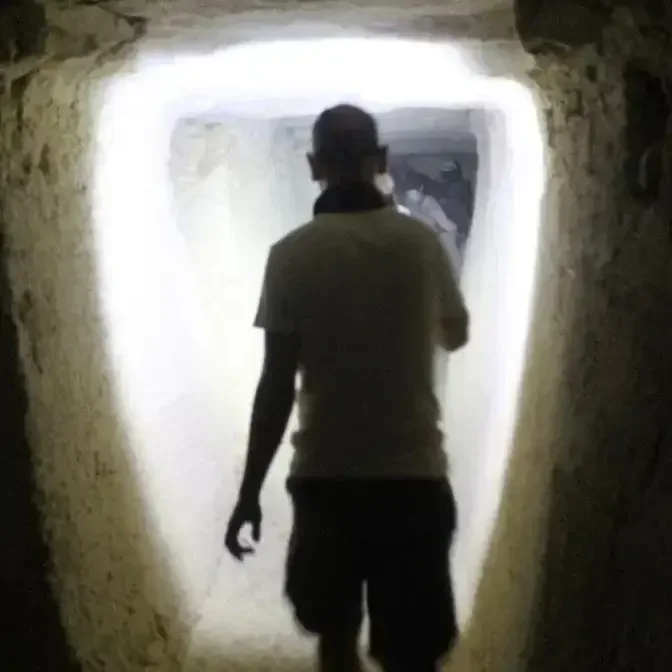
This is actually a room, or series of rooms, which are now underground,
but could have been above ground thousands upon thousands of years ago.
Solid granite room, leading on to another room.
Oh, that's a box.
With the lid on it.
So, an underground structure with giant slabs of granite.
I don't know what that is.
It might be a box.
So, this site is called Tanis.
It's located about four miles, sorry, hours north of Cairo.
Phenomenal site.
Megalithic.
Seems to have been buried as a result of a cataclysm.
It was likely dug up during dynastic times by Ramses II
in order to utilize the granite for other construction purposes.
And then the famous French archaeologist, Mariette, did some work here and others.