
Ancient Hattusa In Turkey
3 Video Views·May 1, 2026
Check out our upcoming major tours
https://hiddenincatours.com/tours/#major
Hi, this is Brian Forrester, and today we're exploring Hatusha in Turkey.
The most famous aspect of this ancient Hittite site
are these two lion figures, but we're going to see evidence
of two different levels of construction. One rough, as you can see on the right
there, and this, which is megalithic. Tight-fitting
stones, or at least they once were. This wall section was obviously victim to
a massive earthquake that pulled it apart. You can see other
parts are tight-fitting, relatively. Originally there would have
been no mortar whatsoever. Here you can see that it's tight-fitting
in this area, and there you see where it's been pulled
apart by an ancient and massive
cataclysm, likely an earthquake. Now on the right side we see
tight-fitting work, and there in the background, very rough.
So clearly two different stages of construction by two different cultures.
Here again we go from rough on the right to
megalithic tight-fitting larger stones on the left. Also evidence of ancient
drill holes. Not just these four, but we saw between
50 and 100 ancient core drills, and by looking
in detail you see lots of weathering inside, so these are
in no way modern. After that it was up a relatively
crude staircase made during the Hittite period,
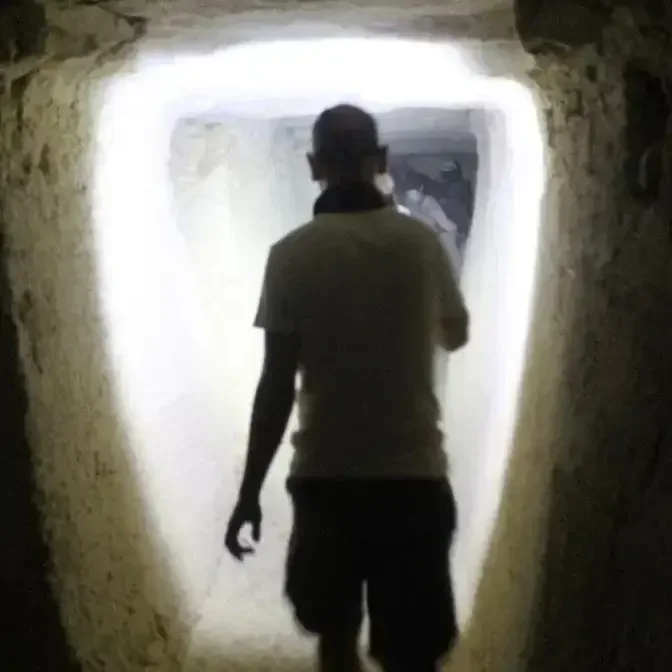
and into a massive tunnel. Now this tunnel is composed of large
megalithic blocks, but they're not particularly tight-fitting,
and so it's very likely that this, again, is from the Hittite period,
and not from the older, more high-tech
megalithic period. You can see that the wall,
that the tunnel is quite long, and what's going to be curious
is what we see at the end. It's here, once again,
a drill hole for a hinge, and on the other side
we can also see that the doors would open inward
inside the tunnel, and when we go outside,
once again, a crude retaining wall constructed
during the Hittite period. This is quite like what we see in Peru,
Bolivia, and Egypt. We see the work of the cultures we know of, such as the
Dynastic Egyptians and the Inca, but then we also see much more high-tech
work, such as here, these large arches, a set of two arches.
You can see the crease in the middle, which is heavily weathered,
and could have been done by an ancient machine, and here on the other side as
well, and look at the rougher work on the
left-hand side. Then the next set of arches, once again,
we see a crease in the stone, which looks like it
could have been done by some kind of machine,
and here, too, more of the core drill holes.
Once again, see that crease in the arch,
and then the much cruder work on the left-hand side,
and now we're walking towards a large wall,
and again, we're going to see two different styles of construction.
You see the monoliths, which look like they have
cataclysmic damage of some kind on top, and then the later,
cruder filling-in work done by the Hittites, and here further along,
these massive blocks of stone, once again,
with almost perfect core drill holes in the middle.
I think in this case, the holes were meant
to hold these large stones together. We saw about eight,
and we're going to get back to that greenstone in a moment, but again, a very
large megalithic block, almost perfectly circular
drill holes. The angle of the camera was bad in
that instance, but here you can see the core drill hole.
You can even see where the drill mark is.
Now, as we walk towards a relatively crude wall,
we're going to focus on the stone there in the center.
Here you can see four. There are three at the moment, but we're going to
see four more core drill holes, and here is the
large nephrite jade block that some believe
was brought from Egypt, though we weren't able to
positively identify Egypt as the source. Quite well polished. There are two of
them located at Petusha, and here, this is
what we believe is the epicenter area of Petusha. You can see,
again, megalithic blocks. Almost all of the stone you've seen so far
is limestone, but the inner core part is actually
granite. The granite supposedly is from at least 150
kilometers away. This is still the limestone.
You can see how eroded the surfaces are. These ones used to fit together quite
tightly, and lots more of the ancient core drill
holes with a lot of erosion even in the
inside. So this gives us indication, A, of lost ancient high technology,
and B, extreme weathering over the course
of a very extensive period of time. Here's a wall of
ancient tight-fitting blocks, at least they once were,
and now we're entering, as we see, more of the core drill holes.
As I said, we saw between 50 and 100 of them,
and we didn't actually cover the entire site.
It's quite massive, but now we're going to start moving into
the granite area. More core drills. You can see that these stones at one time
likely fit together without any mortar or cement or
filler of any kind, and now we are approaching the granite area.
Once again, in the limestone, more of the core drill holes.
This technology was not developed, as far as we know,
until about 1860 AD. So obviously we have evidence here of lost
ancient high technology at Natusha. And now
saw marks. Circular saw mark there and there. That is the granite,
the dark colored stone. Looks very similar to the limestone, but it is in
brought from Ephesus, which, as I said, is a very
long distance away. Still in the country of Turkey.
And a straight saw mark, as you can see here.
So there's more to the history of Turkey than most people realize.
Clear evidence of lost ancient high technology. There again is the
straight, or a straight, saw mark.