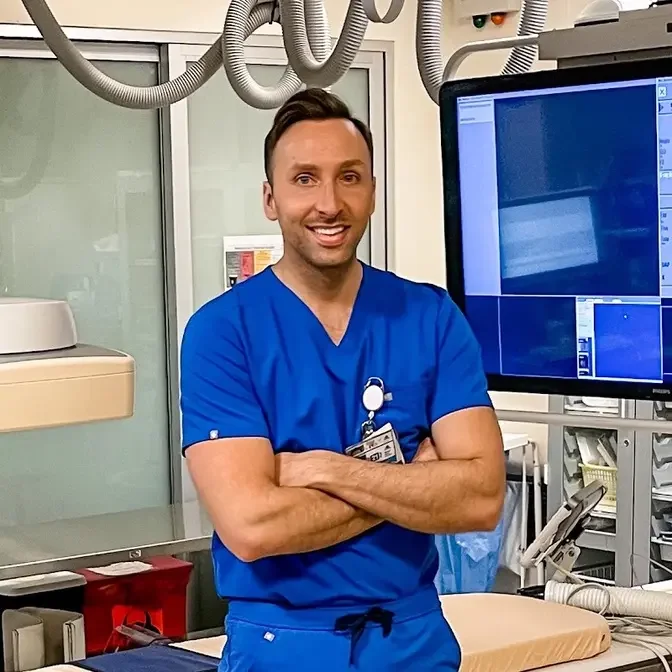
We have been getting a lot of requests to discuss the physician assistant title change to physician associate. In this video, we talk about what a Physician Assistant is, What a Physician Assistant does, how Physician assistants are helpful, and our thoughts on the name change from Physician Assistant to Physician Associate. Hope you all enjoy!
Welcome back to the channel everybody.
For those of you who are new around here,
my name is Michael, AKA Dr. Cellini,
and I'm an interventional radiologist in New York City.
To my left is my lovely wife, Andriana,
who has been a practicing PA for eight years,
and by now you've seen the title of this video,
so tell them what it's about.
So we're gonna be discussing the recent title change
of PA from physician assistant to physician associate,
and our thoughts on this title change.
We got a lot of requests for this video,
so you left us no choice, let's do it.
All righty.
As many of you already heard.
We're just going straight into it?
Yes.
Was that it?
That was the intro?
Yeah.
All right, that's our intro.
All right.
Okay.
All right, so first and foremost,
there are a lot of people still out there
that don't know what a physician assistant
or a PA actually is,
so we'll read the definition from the aapa.org website.
So PAs are medical professionals who diagnose illness,
develop and manage treatment plans,
prescribe medications,
and often serve as a patient's principal healthcare provider.
They practice in every state
and every medical setting and specialty,
improving healthcare access and quality.
Now that we know what a PA is,
let's talk about the name change.
So on May 24th, the AAPA House of Delegates
passed by majority vote a historic resolution
affirming the name change from physician assistant
to physician associate,
and we're here to kind of give our thoughts
as to what it means to me
as a PA,
and for Michael to give his opinion as a physician,
what that means in their field
or in their scope of practice.
I have my own feelings about it,
but I want to hear your feelings about it.
She's been a practicing PA for eight years
in a number of different specialties.
So physician assistant, physician associate,
how exactly do you feel?
So I'll begin by when I first started practicing as a PA,
this was maybe in the first couple of months,
I was out and someone had asked what I did for work.
And I'm like, oh, I'm a PA.
And they're like, oh, a personal assistant for who?
No, actually I'm a physician assistant.
And they're like, oh, like an administrative assistant.
They kind of interpret that
as I was like an administrative assistant
in my own medical office or in a medical practice.
People say that a lot.
Because they hear the word assistant
and they immediately think you're like in an office setting.
Right, exactly.
There has actually been always talks
about a different name for our profession
since I was in PA school.
Yale's PA program is actually a physician associate program.
So you can go look it up or we'll kind of put it on,
put a little screen right here
that their program up here,
that their program is actually
a physician associate program.
I didn't know that.
Yeah, so it's actually not a new title,
but it's not the official title.
That being said,
we are still not going by the name physician associate.
We're still physician assistant.
There's a lot of campaigns and branding
that needs to be done with this change.
So for now, I am Adriana Physician Assistant.
So what do you think about the title change?
As I mentioned recently in the Q&A,
I think it's a great way for us as PAs
to not confuse the public
when it comes to assistant versus associate.
So when you introduce yourself as a PA to a patient,
it's a little bit easier for the patient
to understand that we are their provider
and not the assistant in the office.
And we will be seeing them and treating them
and diagnosing them for whatever we may be doing.
PAs or myself are not here to replace a physician.
Our title and our scope of practice isn't changing.
We still have to practice under a physician.
I think for us, it's just easier
and a better way for us to introduce ourselves
to the public and to kind of have a better grasp
on what our profession really is.
We're not just an assistant.
We're a provider to some patients.
During the pandemic, it was shown that we needed PAs
in urgent cares, in the ERs, in the ICUs.
We needed more providers.
More help.
Yeah, more help.
I'll give my thoughts on it.
I think generally it's a better way to kind of classify PAs
because I think the term assistant is a little,
it's kind of a misnomer.
It can kind of be misconstrued as a little confusing,
but at the same time,
the word associate can also be a little confusing, right?
So technically I'm a physician.
I'm joining a private practice
with other physician colleagues
and we have associate physicians and we have partners.
So any physician in that practice
before they become a partner after a certain number of years
is considered an associate.
So technically I would be an associate physician
at my practice.
Now, with that being said,
I would never tell people outside of my practice
that I'm an associate.
I think that's where it comes into play.
It's like when you introduce yourself to your patient,
you're not saying,
hi, I'm physician associate Michael Tralini.
Right, exactly.
It's always, hi, I'm Dr. Tralini.
You're always the physician.
So I feel the term physician associate
can also be confusing as well for patients
because if you introduce yourself as a physician associate,
they may second guess and be like,
is he or she an associate physician, like to the practice?
Yeah, I don't know.
It's just confusing.
Like, are they actually an associate physician?
Are they a physician assistant
who now had the name changed to physician associate?
So I can see how it's confusing.
So it's like, on one hand, I like the change
because it takes out the word assistant
and it gives them a better title, physician associate,
which sounds like a colleague to the physician,
which they are.
But also I can see that it could potentially
cause confusion in the future as well.
Which is why we haven't even implemented this change
because that's where the AAPA stated
that there's lots of campaigns and branding
that has to be done to educate the public.
And I guess everyone, essentially,
of what the physician associate title means.
One, I think the big confusion is physician assistants,
they don't want to be doctors.
Like, do you want to be a doctor?
No.
That's what I'm saying.
They're like, oh, they're always, PAs want to be doctors
and they just want to be,
have a name that's a doctor related or whatnot,
but you don't want to be a doctor.
No, we chose this path for a reason.
And a lot of people always comment below,
like if we do a PA related video, they'll be like,
oh, she just wanted to be a doctor.
I'm like, no, she went this
because she didn't want to be a doctor.
So I wanted to touch a little bit on the article
that the AOA, American Osteopathic Association,
put out about the physician assistants name change.
I'm not going to read the whole thing,
but I'll probably put a link down below this video.
But basically what they're saying is,
regardless of the name change,
there is no replacing a physician's training
in a physician led team.
They always want a physician to be leading the team
and leading the charge in patient care.
And I 100% agree with this,
but I don't think that changing the name
from physician assistant to physician associate
would mean that they are trying to take over
as a lead role for a patient care team.
I think they were just kind of like making sure
and making sure that everybody knows.
But they kind of also incorporated with that
just all non-physician providers.
So I don't know what that has anything to do
with the name change.
Like there are a lot of doctorates, right?
There's like a doctor and nurse practitioner,
a doctor of physical therapy, a doctor of pharmacy.
There's a lot of doctor titles that aren't physicians.
And they're saying basically,
the more we start doing this alphabet soup,
word jumble, physician-esque name titles,
it can cause even more confusion for the general population,
which, you know, I get it.
I get it, 100%.
They aren't trying to replace us.
Well, there may be some select few that are, but-
I've never encountered one, but I'm sure they're-
Yeah, of course.
You always hear stories, right?
So I feel like this is a good segue now
into something else I want to talk about,
because I get a lot of comments on this as well,
saying like, I'm just a Dr. Schill who, you know-
Cause I'm a PA on his wife's P.A.s or whatever.
Like anybody who hates on the physician assistant,
physician associate, doesn't understand how important
they actually are to physicians.
Like they either haven't worked with them,
have some sort of egotistical complex
where they feel like they're inferior to them or something,
or they're a med student or resident
who has had bad experience with one
or doesn't work with them,
or it's a physician that doesn't know
how to utilize them appropriately.
So I'll give you an example.
The practice I'm going to,
there's a couple of P.A.s that work there,
and one of them was going to move out of the state
to the other side of the country.
Our practice didn't want them to leave so bad
and they basically made them an offer they can't refuse
because that's how good they were.
That's how much you needed them
and that's how much and how valuable they are to the practice
because you don't realize
using a physician assistant appropriately
allows you as the physician to free up your time
to do other things.
Having a P.A. available to other procedures
that are less complex
and frees me up to do more complex procedures
not only is better for the practice,
being able to do more patients,
but it's better for the patients as well
because they get quicker access to care.
It's a win-win.
And a lot of the P.A.s,
especially in interventional radiology,
are an extension of us
and can do a lot of things
that we just don't have time to get to.
We're only one person, so.
Yeah, that makes sense.
That happened in both your training
and in your current practice.
Sometimes residents feel a little inferior to P.A.s sometimes
especially some that have been in the hospital
working in the same place for a long time,
but you don't realize how much you can learn
from a veteran P.A. that's been in the same hospital
doing the same stuff for years and years and years
because I promise you they know what they're doing.
Some of the IR P.A.s will be doing ports
and putting ports in for years and years and years and years
10, 12, 15,000 ports in their lifetime.
As a new IR resident, you can learn so much from them
if you just allow them to teach you.
So I don't know.
I've always been pro P.A.
I think if you use them correctly,
your practice and your career and everything
is going to be way better.
So I hate when people call me a shill
and no, I don't think P.A.s are gonna replace doctors.
P.A.s don't wanna replace doctors
and I don't think they're on the same level as doctors,
but that's not the point of a P.A.
End rant.
Wow, that was very passionate.
Yeah, that was passionate.
Sorry, I wanna get off my chest
because I see so many people comment
and it drives me crazy because they just don't,
they don't know what they're worth.
Just as a P.A. in my setting, in the hospital,
I was on the floors, I was assisting in the O.R.,
the patients needed me, the nurses needed me,
the social workers needed me, the attendings needed me.
So we were always working as a team.
No one was trying to replace anyone.
Same in my derm office,
my doctor was able to see a lot more patients.
We were able to give access to the community quicker.
Like you, instead of waiting a week,
you were able to be seen that week
for your new rash that erupted or whatever the case may be.
So in the hospital,
when I first started my first year of residency in surgery,
she was a surgery P.A. at the hospital
and she taught me so much stuff
because she had been working there for years prior.
So if I didn't have her,
I would probably wanna learn a lot of stuff.
You work together to get the job done
and ensure you're delivering excellent patient care.
That's just the way it is.
And for me, in all my experiences with P.A.s,
almost every year I've worked with a ton of P.A.s,
that's always how it's been.
But I also, like all my attending physicians,
I've never had a bad encounter with any of them
where they felt that I was trying to replace them.
That's because those physicians are smart
and they realize whatever an asset you are to the team
and not just something you're worried about.
One other thing I wanna talk about
is a lot of people are worried about scope creep
and saying, they've said that because my wife's a P.A.,
he supports scope creep.
And no.
What's scope creep?
Like P.A.s or M.P.s are trying to take hold
of doctors' jobs and they practice independently
and whatnot.
We can't practice independently without a physician
or without a supervising physician, so.
Yeah, I know there are some specialties like anesthesia
where a lot of the C.R.N.A.s
are pushing to practice independently
and I think they actually are able to do that now.
But essentially, nothing will replace a physician
and if you're worried about someone replacing you
as a physician, make yourself irreplaceable.
That's all I can say.
I mean, I think that in healthcare, we need more hands.
We need more people to be present
when patients need anesthesia.
We need more people in primary care and urgent care.
Especially primary care.
In the hospitals, in the ICU.
So I think that's where the mistake is.
No one realizes why these professions came about.
It's not to replace one another,
it's just to have more hands on deck.
We're not talking about issues in New York City
where there's tons of access to healthcare.
We're talking about small towns in smaller states
where they don't have many physicians per capita.
A lot of the P.A.s and M.P.s,
they're pushing for independent practice
and they're using the guise of these smaller towns
which a lot of them don't even have physicians
in so many small towns, which is crazy, still.
Because there aren't enough
primary care physicians to go around.
So we're trying to grab at straws here
to find people who are educated enough
to be primary care providers.
All right, so if you have any questions
or comments about this video.
I feel like a lot of people are gonna comment on this.
Yeah, but I mean, like, please don't be rude.
Yeah, don't be rude.
I mean, there's actually nothing to be rude about,
but you know, I'm open to hearing
your thoughts on it, actually.
Yeah, I'm curious.
It's not like, this is not to bring negativity.
None of these videos are to bring any negative views.
We're just talking.
Yeah, it's just more of a conversation
where how I feel as a P.A.,
how Michael feels as a physician,
and how you as a P.A. or M.P. or nurse
or physician feel as well.
So, yeah, I'm curious to see your thoughts.
I'm curious to see your thoughts as well.
Leave them in the comments below.
Be nice to each other.
Keep in mind, we're all in healthcare.
We're all working together as a team.
So, you know, why talk bad about someone else's career?
That's that.
Follow me on Instagram and TikTok.
Follow Adriana on Instagram.
Trying to get her to 10K.
And yeah.
We'll see you all on our next video.
Peace.
Bye.