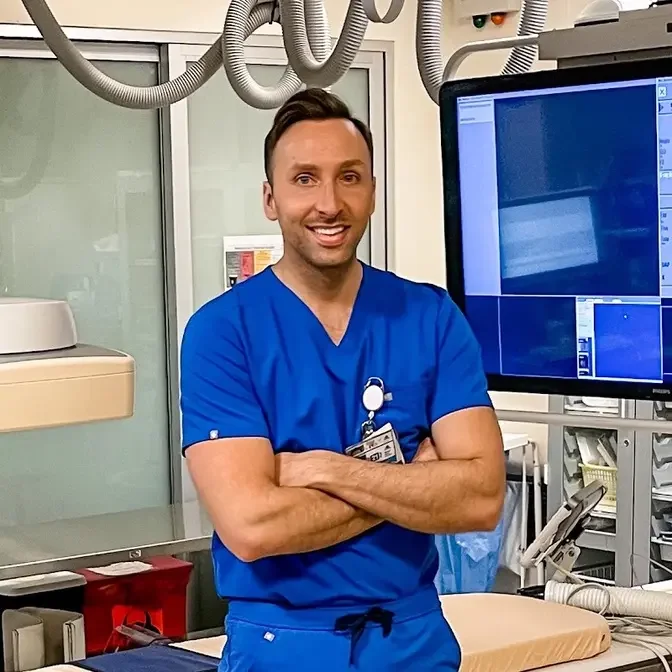
Join me for another Hospital VLOG, but this time during a Day shift! You get to see a real day in the life of a DOCTOR. I am currently on my Cardiothoracic rotation, which is a subspecialty of Radiology which focuses on imaging the Heart and Lungs! On this rotation, I read all types of studies from lung transplant patients, to Cardiac arrest patients, to Lung Cancer follow-ups. It is a wide range of Emergent studies out of the ER, and also inpatient and Outpatient studies.
I also go over a CT Venogram where we diagnose DVTs (Deep Vein Thrombosis) and also go over a CT Angiogram of the Chest where we diagnose Pulmonary Emboli (PEs).
What is a CTA Chest? What is a CT Venogram? What is a DVT? What is a PE? How does a DVT become a PE? What does a Radiologist do? What is residency like? What is Interventional Radiology?
I answer all of these questions and more!
LIKE if you want to see more of this SUBSCRIBE because I'm awesome! COMMENT if you have any questions! TURN ON POST Notifications so you never miss a video :)
What's up YouTube? Today we're going to do another vlog style video. I haven't vlogged during the day.
Those past vlogs have been over at night shifts during my second and third year. So I figured I
might as well show you guys what a daily routine is like for me. So let's get to it. And good
morning. It's about 5 30 a.m and we are doing our morning workout. And the best part about waking up
early is that when we go work out sometimes Indrana will make some scrambled eggs for me
because she goes into work 30 minutes after me. All right so I just got to work and I don't know
if you guys can tell but it is a beautiful day out which is great because I don't think I've
said this yet but it's Monday and it was raining all weekend which was miserable. And I am on the
cardiothoracic rotation which basically we just read chest x-rays and chest CTs all day.
And it's pretty cool because my attending lets us out pretty early because all of us have to
study for boards. Well the seniors do. So I usually take this way when it's really nice outside I take
this long way in through the loading dock and it's pretty disgusting because it's like all medical
waste and stuff. But I don't care. Bio waste. Morning Leon. Hey Julian, good morning. How are you? Good, how are you? Good.
It's a little dark in here today. All right so I just finished reading the first couple studies
and right when I got here this morning I had a positive pulmonary embolism scan or a CTA chest
with contrast and it was positive for PE. And if you don't know what a PE is or a pulmonary embolism
I'll show you. Before I get into the CTA chest portion to see a pulmonary embolism I want to
show you exactly where they come from. So I'm going to start by showing you the CT venogram which is a
it's essentially in a CT abdomen pelvis with extension a little lower to the knees and you
get a picture of the entire course of the veins all the way through IVC, iliac veins, femoral veins
into the popliteal veins. You get a little bit of the popliteal veins. So we have aorta here
and we have IVC here. So we're going to follow the IVC down breaks off into the common iliac vein
breaks off into the internal and external iliac vein and down into the left femoral and that's
about it. So if you look at the left common femoral vein there's a little black dot in it or
a filling defect in it but if you compare it to the right side you notice the right side is nice
and clean. So this is actually what a non-occlusive thrombus looks like or a DVT looks like in the
vein. So you can see a nice filling defect within this left common femoral vein and it extends all
the way up into the external iliac vein here as well. So what happens in a pulmonary embolism is
this actually breaks off or portions of it this clot break off and they travel up north. So imagine
a piece of this breaks off and it goes up it'll go all the way into the IVC and keep going up here
past the renal veins past the liver and up into the heart go into the right atrium right ventricle
and ultimately out the right ventricular outflow tract which isn't imaged here. So I'll show you
what that looks like on a CTHS. Before I go there let me show you what it looks like on
the coronal view. So I know it's hard to see here so let me see if I can zoom in here.
So this is actually the entire clot going all the way up the left common femoral vein.
I wish I could get it in better plane here but that's all I got and it extends up into the
external iliac vein. So again as you can see this is the heart and this is the IVC which connects
the heart to the every other vein in the body essentially. So once you get on this main highway
the little clot breaks off from the leg throws up this IVC and into the heart. Now you can see
how it can go to the lungs. So this is a CTA chest. This is your IVC right here. I know it's
not opacified that's because I've windowed it a little bit and because in a CTA chest
the pulmonary arteries and aorta are basically the only things that are opacified. The timing
is different with the contrast bolus. So I'm going to scroll up here so you can see this
IVC kind of sneaks in here. So this is the heart. We have the right atrium, right ventricle.
I'm going up up up. Now we're in the right ventricular outflow track or the pulmonary
artery. So this is where the pulmonary artery breaks off. This is the main trunk right here
and it breaks off into the left and right main pulmonary arteries. And as you can see this
filling defect right here is not supposed to be there. Neither is this one. So all this dark
signal in this in the pulmonary artery here this is all thrombus. So as you can see this thrombus
this is what we call a saddle pulmonary embolus or saddle pulmonary embolism and it kind of drapes
over the heart like this or the main pulmonary artery like this and can block out blood flow
completely to the lungs as well. This is a large thrombus burden here.
So essentially no blood flow is getting to these lungs. So you can imagine what happens to the
lungs when you get no blood flow to them. They don't like it. It's like a stroke to the lungs
essentially. So they can infarct. The patient can actually die from a large thrombus like this
which is why imaging these DVTs are so crucial and you need to catch them early to prevent this
kind of thing. So let me show you what it looks like on the coronal. So again this is the heart
right here. This is the aorta and left ventricular outflow tract. I'm gonna follow up the this is
from the right ventricle coming up the right ventricular outflow tract coming to the right
pulmonary artery left pulmonary artery branching. And as you can see this large thrombus here again
it looks very similar to what we saw in the leg the lower extremity but now it has traveled all
the way up into the heart and ultimately blocking out blood flow to the lung. This clot extends all
the way down on both sides into the segmental and sub-segmental branches of the pulmonary arteries
which can be pretty devastating to the lungs. Okay so that concludes this session on pulmonary
embolism and DVTs as it pertains to CT imaging. I hope you guys learned something. If you have
any questions about these studies leave a comment below and I'll try to answer it.
Otherwise let's get back to the video. So I hope you enjoyed that video on pulmonary emboli and how
to find them on chest CT or what they look like for that matter. It's time for me to get back to
reading some studies. Also I lifted arms this morning and holding up this phone with my arm
is like making me shake all over the place. Workout problems. So it is now 11 45 and I'm going to get
something to eat. I've pretty much just been reading studies answering phone calls like this
one. Chess Michael. Good sorry for the wait my computer shut down on me. So yeah they are calling
this little p in the lower lung here. Yeah I agree it is real. I mean it's sub-segmental so it's one
of the distal branches but it's still real. That's good enough for you? All right then. Thanks bye.
Now I'm going to get something to eat and go to our noon conference which we have every day.
I'll show you what that's like too. Also even though I worked out this morning I still gotta
take the stairs because yes they fit. Only take the elevator if you're injured or can't walk.
So I usually go with a grilled chicken sandwich but what I do is I take off the bun
and just eat the grilled chicken. We're just going pure protein today
and now we're going to conference. Let's go.
All right so it is now about 1 30. I checked in with my attending
and he doesn't need me the rest of the day so he's going to give me the rest of the day off to study
which is not normal but right now we're studying for boards and we gotta take off
pretty much any time off we can get we take so we are grateful for that.
And yeah time to go home and study the rest of the day
which I'd probably rather be working to be honest with you.
And just so you guys know this is not a common thing to get out this early. Usually we get out
around 5-ish or 6-ish but like you guys know now I'm on my chest rotation and it's really not that
busy. It's busy in the morning right now. Some days are busier than others depending on what
clinic there is. If there's the chest clinic where they just do a whole bunch of follow-up
malignancy chest cancer scans then yeah I can be pretty busy but today wasn't that bad. So I read
like I don't know 10 or 15 CTs this morning. Caught up the list. My attending helped me out along the
way so by time I went to conference the list was all caught up and I came back and he was basically
reading the whole time I was in conference and he said I can get out of here and go study so
that's exactly what I'm gonna do. And before anybody asks yes I am an interventional radiology
resident but like I said before you have to do three years of diagnostic radiology before you
can do full-time IR work and I completely agree with that because you can't be a good
interventional radiologist without having a good diagnostic background. If you don't know imaging
you can't perform image guided procedures. That's pretty much it. So yes you have to do an internship
and three years of diagnostic radiology before you do full-time interventional radiology. So I am a
PGY4 or third year radiology resident. I will do starting in July which is will be my PGY5
year. I will be doing almost like 75% IR and then a few diagnostic rotations of
mammo and nuclear medicine but for the most part I'll be doing all IR. Then my senior year after
that which is what I'm interviewing fellowship wise or my PGY6 year I will be doing mostly IR
and by mostly I mean like 99%. What better way to start my study afternoon than a nice
cup of iced coffee. You literally can't survive without it. Now it's time to be productive
for a good four-hour session of studying which is what I do every single day for like multiple
months now. It's pretty sweet right? Alright I take that back. I'm going to do a little
quick grocery shopping because as you can see I don't drink any creamer in my coffee
but Andreana does and being the husband I will go get her some creamer because we're out
and maybe pick up a few more supplies while we're at it. So off to the store and then study.
But now we're going to study. Alright so I just got home, sat down, opened my book and I will be
sitting here for the next few hours but it's really tough because it is like so sunny outside
and it's like 75 degrees, super sunny, no cloud in the sky and the pool is right down there and
all I want to do is go lay out but I have a job to do and that's part of the sacrifice of being
in medicine. Sometimes you have to study when you don't want to. Sometimes you have to go into work
when you don't want to but it's the way it goes. So I'll be studying for the next few hours.
I'll probably just study up until my wifey gets home around like 8 p.m. or so and hang out with
her the rest of the night but this is where I'll be and that's about it. Alright guys so that
concludes my Monday. Hope you guys enjoyed this daytime vlog. I'll probably do many more of these
in the future especially when I start doing full-time interventional radiology. I think you
guys will really enjoy that. As always make sure you smash that like and subscribe button. If you
have any questions leave a comment below. If I like it, I'll respond to it. If I don't, I won't.
Make sure you guys follow me on Instagram and otherwise I will see you guys on the next video.