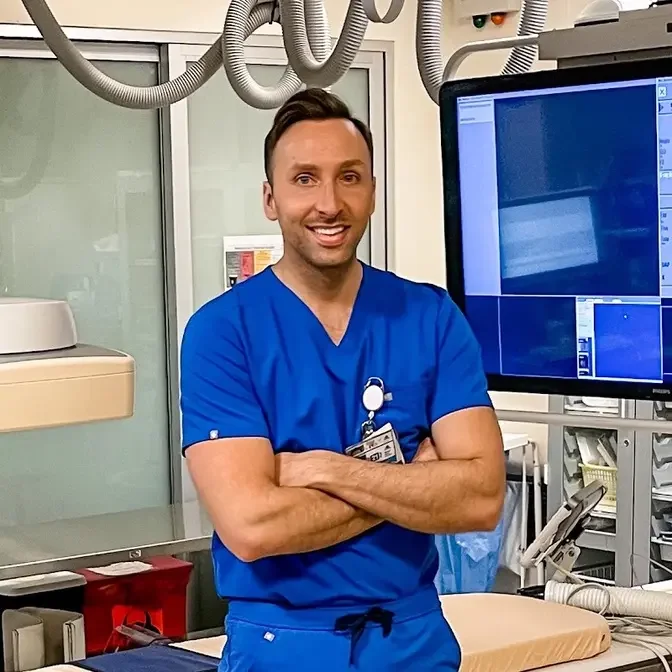
It has definitely been a while since I have done one of these videos in which I unbox equipment that we use on a daily basis in Interventional Radiology. The last video I did like this was over a year ago! Anyways, today I unboxed and explained everything there is to know about a hemodialysis catheter aka tunneled dialysis catheter aka Permcath aka vascath aka HD catheter. What makes this central venous catheter unique is that it is actually tunneled underneath the skin, which greatly reduces infection risk. This is a VERY common procedure we do in Interventional Radiology. We usually place a few of these EVERY single day.. So if you want to see more of the supplies we use and/or the different types of procedures we do, let me know in the comments below! Enjoy :) __
What is up YouTube? Welcome back to my channel.
For those of you who are new to this channel, my name is Michael,
AKA Dr. Cellini and I'm a fifth year interventional radiology resident.
Now on today's video, we are going to be doing something a little different.
I actually haven't done one of these videos since way back almost a year ago,
or maybe a little more than a year ago. Today we're doing an unboxing,
and we are unboxing an Aero hemodialysis catheter or tunnel catheter.
It is expired all the way back in 2005. Oh wait,
2008 which it's been sitting in a closet for that long.
Untouched. We keep these around just for like students and you know,
educational purposes.
So today I figured I would unbox one for you.
So let's go. All right, so what do you say we open this thing up?
This is going to be loud. So obviously we have the sterile cover,
so the tech would open or whoever would open the dialysis catheter and dump this
on the field and I would open it. So let me show you guys what's inside.
All right, so this is what it actually looks like.
So as you can see we have everything. So we have the catheter up here.
We have our guide wire, we have a clip, which we don't need.
We have our tunneler, we have our sheath and our dilators as well.
So let's open this up and see what's inside.
So as you can see, the catheter actually comes separate.
We have to actually put this together and we have to cut right here,
which I don't have scissors in the kit,
which they're usually provided with us on the table.
So let me walk you guys through this whole situation here. All right,
so the first thing we would do is we'd use our ultrasound machine.
We take a small needle as you can see right here. Hopefully that's focusing.
So this is an 18 gauge needle.
We usually access with a 21 gauge micro puncher and you actually access,
I'm not going to do it on myself, but you would access the internal jugular vein.
Once you gain access with, if you use an 18 gauge needle,
you can directly place this guide wire. I don't know if you can see that.
So you ultimately place this guide wire to the J wire and you can see as you,
this is our cheater system.
You would put this through the needle and you would thread this down the entire
length down to the IBC.
So what you would have is basically something like this and this would be kind
of hanging out of the neck.
There are plenty of videos on here that actually show the whole procedure being
done. But I'll just describe it to you without actually doing it.
So once you have the wire down into the IBC,
you can then begin to start assembling your catheter.
So I'm going to put this over here.
This is what the catheter looks like completely assembled.
So then you would make your dermatotomy site where you would tunnel to your
catheter underneath the skin, which would be just below the clavicle.
You would use this tunneling device to kind of connect the dermatotomy to the
venotomy site so that your catheter has a nice tract underneath the skin.
Once you have that done,
you can start dilating your tract up on your venotomy site.
So again,
we have our wire and we made our tunnel. We have our wire.
We put the dilator on the wire, advance down,
dilate up the tract so you can see this nice big 15 French catheter can go
through. Once we dilate up the tract,
we'll put in our peel away sheath over the wire,
peel away sheath over the wire. Once we have that in place,
we have our tunnel catheter up kind of hanging next to it.
Then what we can do is remove our inner silet of the sheath
and the wire itself.
What you want to do is put your finger over this because it'll bleed like crazy.
As you can see, you have a big hole that size in the jugular vein.
Put your finger over that.
You will then thread the split tip catheter through the
peel away sheath as you can see. So it'll be something like this.
Once you have it in that sheath, you can break apart the sheath,
peel it open like this. The catheter stays in place. It's kind of hard to do.
Peel the sheath off.
Now you have the catheter hanging just above or in the right atrium
and all of this is underneath the skin and within the chest cavity
except for this little hub right here with the two
injectable ports hanging out.
So this entire thing from here over is actually
inside the skin or under the skin.
And this part is what hangs in the right atrium. This part is on the outside.
So this is what a tunneled hemodialysis catheter looks like.
Again,
only this part is exposed so that you can use this as a,
your means of dialysis.
So that is obviously an oversimplified direction on how to place
a hemodialysis catheter and what a hemodialysis catheter actually looks like.
Again,
there are plenty of YouTube videos out there that kind of walk you through this
and show you them doing it in real time.
I just cannot film doing this on a patient.
Maybe I'll be able to do it eventually,
just not while I'm in training.
So here you go.
Hemodialysis catheter.
Hope you guys enjoyed it.
So on that note,
that concludes this video.
If you like this kind of unboxing and teaching video and a little insight
into the supplies that we use in interventional radiology and the devices we
use,
let me know in the comments below or if you want to see a specific device,
let me know in the comments as well.
Otherwise make sure you smash that like and subscribe button.
Do it now.
Follow me on Instagram if you don't already.
Otherwise I will see you guys on the next video.