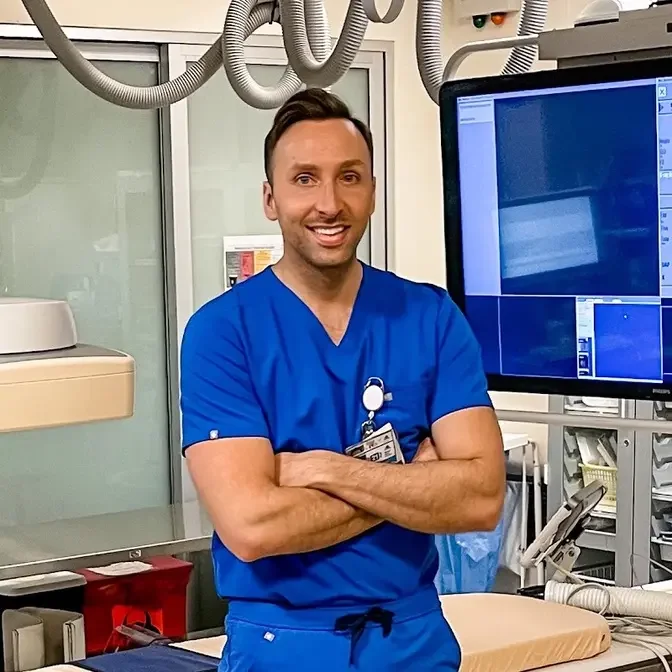
There are a TON of Myths out there about Radiology. What is a Radiologist? Are Radiologists doctors? How do you become a Radiologist? etc, etc. These are the first 5 that came to mind! Hope you enjoy :)
There are a lot of myths and misconceptions out there about radiology.
So let's talk about five of them.
Let's go.
Myth number one, radiologists aren't doctors.
The reality is, we are doctors.
We go to four years of undergrad or college, university, then we go to four years of med
school, followed by one year of internship or first year of residency, followed by four
years of diagnostic radiology residency, and then we do a one year fellowship in our subspecialty
of choice.
That's 14 total years of training.
So that myth is officially busted.
We do go to med school, we go to residency, we do a fellowship, and we're board certified
physicians.
Myth number two, radiologists get exposed to a ton of radiation.
So much that we're radioactive.
This is false.
Well, sort of.
We probably do get exposed to more radiation than the average field.
But there have been plenty of studies that prove that radiologists are not at higher
risk for cancer related illness or death compared to other specialties.
Specifically, there was a study that followed radiologists from the 1940s all the way up
until 2016 or something, and there was no increased risk of cancer related illness
in the radiologist population.
I think that study was published in 2016, and it was one of many that proved that.
With that being said, interventionalists do get exposed to more radiation than the average
radiologist, but that's a topic for another time.
Myth number three, radiologists have zero patient contact.
That could not be further from the truth.
That is so busted.
So radiologists, yes, we spend most of our time reading images, but we are also doing
procedures and seeing patients all the time.
In fact, an entire field of radiology is devoted to direct patient contact.
Mammography is 100% devoted to patient contact.
The radiologist not only sees the patient, they read the images, they do all the diagnostic
ultrasounds, and they also do the procedures.
So it's a constant patient interaction.
In addition, many radiologists do procedures and have tons of patient contact.
For instance, body imaging radiologists see patients all the time via ultrasound guided
procedures.
Neuroradiologists also see patients.
They do a lot of lumbar punctures or intrathecal administration of chemotherapy.
MSK radiologists will also do bone biopsies or other bone procedures or bone marrow aspirations,
etc.
Interventionalists obviously see patients every day, tons of them.
So the myth about radiologists not seeing any patients is pretty much busted.
Myth number four, radiologists are introverts and we like to sit in a dark room by ourselves.
I mean, I guess that's partly true.
But the reality is we talk to a lot of different people throughout the day.
We are constantly talking to other clinicians in other fields about their patients.
We are always discussing the clinical course of a patient's care.
And furthermore, if I'm in between studies or if it's a slow day, I'll just go bug one
of my other co-residents or friends and we'll just sit and chat.
So we aren't all introverts, but of course there's always going to be a few of them.
And finally, the number five myth about radiology.
And that is, radiology is easy because all we do is sit down all day.
That is wrong in so many different ways.
Here's why.
When I was an intern, I did a surgery intern year, general surgery, we worked six 12-hour
shifts a week.
I never had a weekend off.
I was exhausted all the time.
I thought when I get to radiology, I'll have a nice cush eight to five residency and I
won't be as tired.
But the reality is, I'm just as tired.
The two fields are completely different.
Surgery I was running around all day and exhausted physically and mentally.
But here in radiology, you're more mentally exhausted.
The way I describe it is, it's kind of like taking a test for the entire day you're at
work.
Because you're constantly analyzing studies.
It's like every study you open is a puzzle and you're trying to figure it out and you
can't miss anything because that's bad.
And it's very stressful in a mental sense, I guess.
When I first started residency in radiology, I was pretty shocked at how tired I was when
I got home every day.
I was almost, I was just as tired as I was in surgery.
It's just a completely different way of thinking.
So that myth is also busted.
So that's five out of five that are busted.
And last but not least, the number six bonus myth of radiology.
That is, radiologists love to correlate things clinically.
Now this is kind of funny because everybody always makes fun of radiologists for doing
this.
But you have to put yourself in our shoes.
So we are completely disconnected from the patient and only looking at a patient on imaging.
So we don't know anything that's going on with the patient.
We rely 100% on the actual notes in the system or the indication of the study.
So when someone puts in a chest x-ray and the indication for the study is other, we
don't really know what's going on with the patient.
So it makes it difficult for us and we have to be really general.
Now for that same indication, if someone were to put in fever, shortness of breath, concern
for pneumonia, I would say, hey, I know what's going on with this patient.
We're going to look for pneumonia.
And if I see something that looks like pneumonia, I'm going to call it pneumonia.
We can't go examine the patient ourselves for every single one we read.
So we kind of have to give you what it is and then kind of lay it out there for the
clinician to decide which one to go for.
So those are the limitations of radiology.
We can't be 100% precise on everything.
There are definitely some limitations, which I should probably go into on another video.
So hopefully you guys enjoyed this and you've seen a little bit of the misnomers, the misconceptions
of radiology.
Hope you enjoyed it.
I'll catch you on the next video.