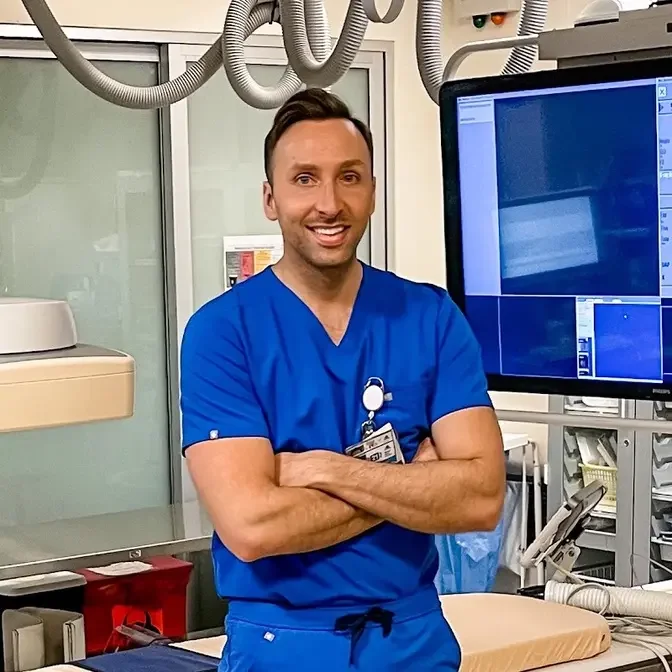
Physician Assistant video featuring my one and only favorite Physician Assistant of all time...my lovely wife! Andriana has been a practicing PA for 7+ years now so I felt she would be the right person to react to Med School Insiders "So you wanna be a Physician Assistant." I get a ton of questions asking me if they should go to PA school vs MD/DO school and maybe this video will help shed some light on some of the differences between a Doctor and Physician Assistant. If you have any questions about becoming a physician assistant reach out to Andriana!
What is going on everybody? Welcome back to my channel. Today
we have a very special guest joining us. Once again,
my wife, Andriana Cellini, who happens to be a physician assistant, and she is
going to be taking over my channel today, and you'll see why
in just a second.
Hi everyone. So the reason she's taking over my channel today is because
Med School Insiders posted another video called
So You Wanna, and this time it was So You Wanna Be a Physician Assistant, and
since I reacted to the radiologist one literally a week ago,
they seem to just be on my timeline now. So now we're going to be having
Andriana react to the So You Wanna Be a Physician Assistant video.
Let's go ahead. And let's get into it. Let's go. Hey everyone. My name is
Andriana, and I'm Michael's wife. I've been a PA for seven years in various
specialties, and I'm going to be taking over his
channel today. So you want to become a physician assistant.
You want to work in healthcare, but being a doctor seems like
overkill. Why not get most of the benefit without all the crazy
competition, super long training, and unnecessary
stress? They began this video with saying,
Why not get the most benefit without all the crazy competition?
I'm gonna have to say that PA school is super competitive, and
it's actually really hard to get into, especially nowadays. Being a physician
assistant is like being a doctor light. PAs do many of the same
things as doctors, including history and physicals,
diagnosis, interpreting labs, and even some basic procedures.
To better understand the practice of physician assistants, it helps to review
the history of the profession. Okay, before we go to the history
of the PA profession, this is a great intro. As
you can see, this video did not say a physician assistant
is a physician's assistant. We are not a doctor's assistant. We do
diagnose, treat all patients as well. The role of the PA has expanded.
PAs don't just work in primary care, but can work in any department where
physicians work, such as cardiology, plastic surgery, neurosurgery, psychiatry,
emergency medicine, and many other specialties. That is correct.
As you may know, I've been a PA for seven years in various specialties, including
dermatology, general surgery, urgent care, and now in aesthetics.
As a physician, you'll complete medical school, then residency in your desired
specialty, and then be board certified in only that
specific specialty. But as a PA, you can more easily move to another
specialty without going through several years of formal training.
Yes, that is the beauty of being a PA. In certain
specialties, you may have to complete PA fellowship,
which is like a one to two year training after
PA school. They do have those in emergency medicine,
in general surgery. If you're a new grad and you want to get into dermatology,
a lot of times the first six months of your actual job will be a training.
You may not get your full PA salary when you're training,
but in the end, it all pays off. The reason PAs can flexibly move from
specialty to specialty is because the depth of their work is more
superficial in nature. Sure, a PA can move from neurosurgery to
plastic surgery to orthopedic surgery, but they'll forever be first assist.
Yes, I agree. We are not going to be a neurosurgeon
or a general surgeon or orthopedic surgeon, but we do have the advantage of
knowing the anatomy in each of those specialties and always
being the first assist. During COVID, a lot of PAs were recruited from other
specialties. PAs were the ones that were able to
actually go from being a plastic surgery PA to an ICU PA
or being bariatric PA to an ICU PA or an ER PA.
So we do have that knowledge to be able to move to a different specialty
without having to go through a new fellowship or new training.
Our boards, every 10 years now, will cover every specialty. It's not just
on general surgery if you're a general surgery PA or primary care if you're a
primary care PA. So we always have to know all specialties
and all subspecialties. The PA, however, is
never doing any part of the actual surgery.
I will have to disagree with that statement. PAs do perform parts of the
surgery, obviously under the supervision of the
physician, but we don't just retract and suture.
We need to independently perform certain procedures, though, such as central lines,
intubations, dialysis line insertions, and arterial lines, to name a few.
Yes, agreed. We can do a ton of different procedures, including
the central lines, arterial lines. In different specialties, you'll be able to
do other procedures specifically to that specialty. For example, orthopedics, you
may be doing joint aspirations. In urgent care, you
do every single procedure on your own. In the ER, you'll do mostly those
procedures that they listed, as well as if you're in the ICU. In
dermatology, you'll do all the biopsies, all the incision and drainages there as
well. PAs don't replace doctors or take away
their work. Rather, they work in tandem with
physician supervision and help to decrease routine work for
doctors and ease their load. Yes, I agree. We're not here to replace
the role of a physician. I will be the first one to always defend
that. We are very unique in that we do help take away the workload, especially
in a private practice office. When it comes to the hospital, I already did this
on a previous video, but in the hospital, you're more
working as a team, whereas you're managing the patients on the floor,
you're assisting the surgeon in the operating room, so you're really working
with a group of other individuals. Whereas in private
practice, you may be seeing your patients on your own, but
you're never going to take away the role of a physician.
PAs can see their own patients, do their own workups, do their own simple
procedures, and interpret their own labs. I think the
most frustrating part of being a PA is the actual name. I know there have
been lots of surveys for us as physician assistants to change
our name because it pretty much sounds like a
physician's assistant and we're the assistant to the physician.
Sounds more like we're the personal assistant or the physician,
whereas our training is much more than that.
It's the physician making the final decision, not you.
Yes, you are working under the supervision of a physician,
so ultimately the physician will have the last say in the decision.
You can always give your opinion or give your
input into the decision making, but ultimately the physician will make the
last call. PAs can easily handle the simple bread
and butter like straightforward diabetes management,
but when it comes to more obscure conditions or complex
and nuanced management, PAs are not trained to that level.
I don't know what that means. I mean, I see what they're trying to say, however,
there are many physician assistants that manage
all complex disease processes. For an example, working in urgent care,
I was a solo provider, so anything that walked into the door,
I was managing. There wasn't a physician that was managing that patient. I was
making all the decisions. However, if you did
have a question, you always had your supervising physician
to call. You'll always be able to reach out to your supervising physician for
help. There we go. They said the same thing.
Don't think that it'll be a walk in the park to get into PA school,
as it's still a competitive process. Yes, agreed.
Every school, you really have to look at the schools that you're applying.
Every school may have different requirements and pre-reqs.
This is a really common question that PAs get from pre-PA students.
It really just depends on the school. As you already know, I did a four-year
combined PA undergrad program, so I did my
undergrad in two years and PA school in two years.
This no longer exists. I think now the program now is five years.
If you're thinking about being a PA while you're in college or
in your undergrad, you just take those courses, so
you're one step ahead. While medical students have more academic knowledge,
after all, they're spending several more years studying the human body in greater
depth, PA students tend to have more clinical
experience by the time they start rotating.
Yeah, I can totally agree with that. Obviously, our didactic year is one year,
whereas medical students have two plus years,
and then our clinical experience is one, one and a half years.
Medical students have two years, and then they have their residency.
Many programs require anywhere from 1,000 to 4,000 hours of direct patient
health care experience. While I was in undergrad and before I
was applying to PA school, this is a common question,
I did shadow a PA in radiology, and I did shadow a PA in a children's
hospital that was close to home. Those were my two shadowing experiences.
Median compensation is around $95,000 to $100,000 per year,
depending on the specialty. I know the common question is
how much does a PA make annually? It really depends on what specialty you go
in and if, you know, you work in private
practice or a hospital. Also, it varies state to state. Some
states are very PA friendly, other states are kind of indifferent, so
you really want to work in a PA friendly state. If there is a specialty that has
physicians, then it's likely that specialty has room
for a PA as well, from orthopedics to neurosurgery,
interventional radiology to emergency medicine,
and many more. Yes, these specialties are really PA friendly.
I feel like every orthopedic surgeon has a PA.
In neurosurgery, I know in the hospital that I worked at, there was no neurosurgery
residency, so the PAs ran all the floors and they were the
residents. In interventional radiology, I mean, Michael works hand in hand with
tons of PAs, and in the ER, you'll be bound to always
see a PA. Obviously, in certain hospitals, if they
don't have residency, the PA will do a lot more, so that is
something to consider when you're actually getting your first job.
What do the PAs do? Are they not doing any procedures? Are they doing some
procedures? So you really want to get all that information before you accept
your job. As a PA, you also won't have to take work home with you
These are all factors that come with the added responsibility of being a
physician. Yes and no. I know a lot of PAs.
I did take call on the weekends for the physician.
I know a lot of PAs that do have to take home call
or that do have to take some work home, like charting. When are you going to
chart? If you're not charting at work, then you have to take that home.
There's less stress about malpractice or things going sideways.
Yes, I mean I always worry about malpractice and I believe every PA
worries about malpractice as well. You always want to make the right decision
and do what's best for the patient. So just because you're practicing under a
supervising physician doesn't mean that I'm just gonna
do anything I want. I always try to do what's right for the patient.
You can expect to work around 40 hours per week and lastly,
you can change specialties if you get burned out or want to switch things up.
You can work three 12s, four 10s. If you want two part-time jobs, you can.
If you want to work two 24-hour days, you can.
The schedule or if you want to work a nine-to-five job, you totally can.
You can change your specialty. If you really want to try a new specialty,
you don't have to go back to residency for that. You can
go and apply for a new job. I worked in two different specialties.
When I was a full-time surgery PA, I was a part-time dermatology PA.
So you can work in two different specialties or
in three different specialties. It really doesn't make a difference.
But keep in mind, the pay is substantially less than what attending physicians make,
around one-half to one-third in comparison.
There's also less prestige and respect than what you would receive as an MD or DO.
Um, I don't think Michael is more prestigious than me.
That's what they just said!
I was just joking.
Consider it being a lifelong resident but with better hours and better pay.
I just don't like this lifelong resident. I don't consider myself a lifelong resident.
Maybe other PAs can tell me how they feel about that.
If you were in a hospital where you were essentially a lifelong resident,
but I guess it really depends on what kind of PA you want to be.
If you want to be a PA that does the same thing for 40 plus years,
then sure, maybe you are a lifelong resident.
But if you're a PA in another specialty, in a different clinic,
where you're, you know, seeing your own patients and so forth,
then I wouldn't consider myself a lifelong resident.
And there's no right or wrong here.
You have to figure out what type of life you want.
I 100% agree with this.
You really have to decide what's best for you with timing, with, you know, money.
There's a lot of factors that go into play when deciding what career path you would like to go,
whether it's becoming a physician or PA or an MP or nurse.
There's tons of different specialties that you can go into.
And see which is better suited to your personality, values, and long-term desires.
Okay, now that the video is done, I will say this is a great,
like, comprehensive overview of what the PA profession is.
There are some words that I would say that I don't agree with,
like that lifelong resident.
But really, this is a great overview of just deciding
whether the PA profession is right for you
and whether or not you would rather go the PA route,
the MD route, the MP route, or the nursing route.
But I hope you enjoyed this review.
If you have any questions, just comment below.
Or you can DM me.
Otherwise, follow Dr. Chalene on Instagram and subscribe to his YouTube channel.
And we'll see you on the next video.
Bye!