
Galileo Galilei
Galileo Galilei
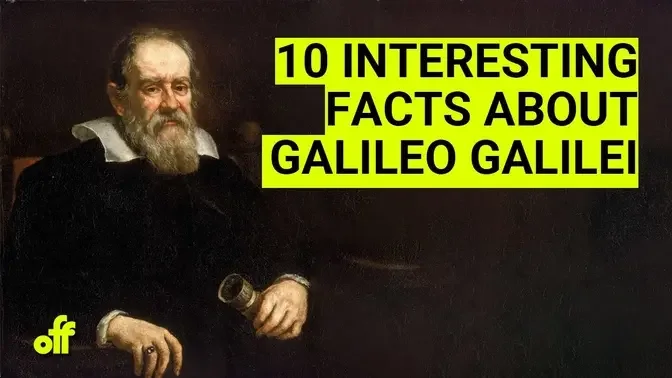
Galileo Galilei (1564–1642) was an Italian astronomer, physicist and mathematician, often called “the father of modern science” for joining careful experiment with mathematical description. Born in Pisa, he studied the motion of falling bodies, pendulums and balls rolling down inclined planes, establishing principles that later underpinned Newton's laws of motion. His turning point came in 1609, when, after hearing of a Dutch spyglass, he built improved telescopes of his own and turned them to the sky. In The Starry Messenger (1610) he reported mountains on the Moon, countless stars in the Milky Way and four moons orbiting Jupiter, and he later observed the phases of Venus and sunspots. His support for the Sun-centered model led to a trial before the Roman Inquisition in 1633, and he spent his final years under house arrest near Florence, where he completed Two New Sciences (1638), a foundation of modern physics.
Latest UpdatesLIVE




From Archimedes to Newton
Archimedes explained the law of the lever and the principle of buoyancy in the third century BC. Nearly two thousand years later, Galileo built on his mechanics and turned the telescope to the heavens, while Kepler showed that the planets move in ellipses. Pascal showed through experiments that air pressure decreases with altitude. Newton drew these threads together in his Principia (1687), with three laws of motion and universal gravitation.

 7 followers

 21 followers

 42 followers

 98 followers

 4 followers
 4 followers
 21 followers


View All
All featured content under Galileo Galilei

