


By: Renae Richardson
An intellectual property that has more than made an impact over decades is Frankenstein. Mary Shelley’s commentary on the social misgivings of her time was so resonant that to this day, artists reach back, scoop up some creative soil, and create. The newest project to appear on the radar is an upcoming Frankenstein series, not purely based on Shelley’s work, but one that would never have existed if Shelley had never put pen to paper.
The Woman Behind the Monster
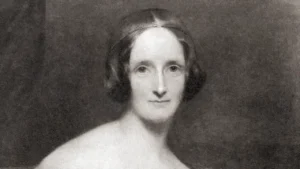
Mary Shelley. Image Source: Bettmann/Getty Images (Courtesy of Vanity Fair)
To understand why this property still bears fruit after all these years, one must look at the woman who gave it life. Shelley’s masterwork was published in 1818 and is considered the first science fiction novel according to Britannica. Shelley’s talent came earnestly; her mother, Mary Wollstonecraft, was also a noted writer. However, one can infer that the inheritance of craft was likely purely genetic, as her mother passed as Shelley entered the world. Shelley, Godwin by surname, saw her talents come together, and the world would see her craft in its earliest form via her father’s publishing house.
At age 11 she published a children’s tale, Mounseer Nongtongpaw; or, The Discoveries of John Bull in a Trip to Paris, through her father’s publishing house, a fact also noted by Britannica.
From Ghost Stories to Greatness
With such a mind toward crafting stories in her youth and growing up on the fruits of the art, it seems only fitting that her most famous work emerged from a simple storytelling challenge. The genesis of Frankenstein is pegged to an evening of ghost stories spearheaded by Lord Byron, at which her partner Percy Shelley was also in attendance. As Britannica notes,
Byron challenged his guests to a ghost story contest, which proved to be the genesis for Mary Godwin’s soon-to-be masterpiece, Frankenstein. She was primarily inspired by an 1812 French translation of the German ghost story collection Fantasmagoriana.
That evening produced what would become a seminal work.
An Ode to Mastery
More than a century and a half later, that masterful work inspired another endearing work, one that now serves as the direct source for this latest adaptation. The work is based on another project drawn from Shelley’s creative well. As ComingSoon.net relays,
A new report from Deadline states that FX has picked up the series Very Young Frankenstein, based on Mel Brooks’ classic 1974 film Young Frankenstein.
In the 1974 film, Gene Wilder portrayed the grandson of Victor Frankenstein, a man who seeks to live an existence free of his father’s reputation. A fated turn of events leaves young Frankenstein with a great inheritance. As the IMDB synopsis notes,
upon discovering the secret entrance to his grandfather’s laboratory and reading his private journals, Frederick is so captivated that he decides to resume his grandfather’s experiments in re-animating the dead. He and Igor steal the corpse of a recently executed criminal, and Frederick sets to work experimenting on the large corpse. Matters go awry when Igor is sent to steal the brain of a deceased revered historian, Hans Delbrück; startled by lightning, he drops and ruins Delbrück’s brain. Taking a second brain, Igor returns with a brain labeled “Do Not Use This Brain! Abnormal”, which Frederick unknowingly transplants into the corpse.
Tone and Creative Vision
With such a beloved comedic predecessor as its foundation, the creative direction of the new series becomes immediately clear. The mere mention of Gene Wilder gives a nod to the general direction this film is pointed in as it pertains to genres. This also provides context for what the upcoming series hopes to accomplish in terms of tone. The president of FX Entertainment, Nick Grad, solidifies this, stating that
Very Young Frankenstein blends inspiration from the fan-favorite movie with the inventive, irreverent spirit that has defined FX comedies over the years, making this a completely original take on the classic story.
A Recrafting of a Reinvisioning
Beyond tone and lineage, the creative team’s pedigree signals another layer of ambition. The creative team behind the work includes Stefani Robinson, Garrett Basch, and Taika Waititi, who were attached to the comedic vampiric series What We Do in the Shadows. Also on board is Zach Galifianakis, of The Hangover fame, attached as the series’ star.
A Story Without Fatigue
The cumulative information gathered leans toward a simple truth. We are assuredly returning to the world of Victor Frankenstein and Shelley’s monster. And regardless of the film’s outcome, this will mark another peg in the legacy of a well-written creation with brilliant reflective power. For many works, characters, or intellectual properties, “fatigue” is a word that becomes synonymous. Frankenstein, however, remains the exception.
Original article
Comments