


Authenticity and veracity
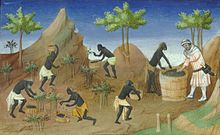
Le livre des merveilles, Bibliothèque nationale de France, fr. 2810, Tav. 84r "Qui hae sì gran caldo che a pena vi si puote sofferire (...). Questa gente sono tutti neri, maschi e femmine, e vanno tutti ignudi, se non se tanto ch'egliono ricuoprono loro natura con un panno molto bianco. Costoro non hanno per peccato veruna lussuria"[43](Translation: "People in a land of extreme heat, barely bearable. They are all dark-skinned, both men and women, and go about nearly naked, covering only their private parts with a white cloth. They see no sin in what might be considered lust.")
Since its publication, many have viewed the book with skepticism. Some in the Middle Ages viewed the book simply as a romance or fable, largely because of the sharp difference of its descriptions of a sophisticated civilisation in China to other early accounts by Giovanni da Pian del Carpine and William of Rubruck who portrayed the Mongols as "barbarians" who appeared to belong to "some other world".[44] Doubts have also been raised in later centuries about Marco Polo's narrative of his travels in China, for example for his failure to mention a number of things and practices commonly associated with China, such as Chinese characters, tea, chopsticks, and footbinding.[45] In particular, his failure to mention the Great Wall of China had been noted as early as the middle of the seventeenth century.[46] In addition, the difficulties in identifying many of the place names he used also raised suspicion about Polo's accounts.[46] Many have questioned whether or not he had visited the places he mentioned in his itinerary, or he had appropriated the accounts of his father and uncle or other travelers, or doubted that he even reached China and that, if he did, perhaps never went beyond Khanbaliq (Beijing).[46][47]
Historian Stephen G. Haw however argued that many of the "omissions" could be explained. For example, none of the other Western travelers to Yuan dynasty China at that time, such as Giovanni de' Marignolli and Odoric of Pordenone, mentioned the Great Wall, and that while remnants of the Wall would have existed at that time, it would not have been significant or noteworthy as it had not been maintained for a long time. The Great Walls were built to keep out northern invaders, whereas the ruling dynasty during Marco Polo's visit were those very northern invaders. The Mongol rulers whom Polo served also controlled territories both north and south of today's wall, and would have no reasons to maintain any fortifications that may have remained there from the earlier dynasties. He noted the Great Wall familiar to us today is a Ming structure built some two centuries after Marco Polo's travels.[48] The Muslim traveler Ibn Battuta did mention the Great Wall, but when he asked about the wall while in China during the Yuan dynasty, he could find no one who had either seen it or knew of anyone who had seen it.[48] Haw also argued that practices such as footbinding were not common even among Chinese during Polo's time and almost unknown among the Mongols. While the Italian missionary Odoric of Pordenone who visited Yuan China mentioned footbinding (it is however unclear whether he was only relaying something he heard as his description is inaccurate),[49] no other foreign visitors to Yuan China mentioned the practice, perhaps an indication that the footbinding was not widespread or was not practiced in an extreme form at that time.[50] Marco Polo himself noted (in the Toledo manuscript) the dainty walk of Chinese women who took very short steps.[48]
It has also been pointed out that Polo's accounts are more accurate and detailed than other accounts of the periods. Polo had at times denied the "marvelous" fables and legends given in other European accounts, and also omitted descriptions of strange races of people then believed to inhabit eastern Asia and given in such accounts. For example, Odoric of Pordenone said that the Yangtze river flows through the land of pygmies only three spans high and gave other fanciful tales, while Giovanni da Pian del Carpine spoke of "wild men, who do not speak at all and have no joints in their legs", monsters who looked like women but whose menfolk were dogs, and other equally fantastic accounts. Despite a few exaggerations and errors, Polo's accounts are relatively free of the descriptions of irrational marvels, and in many cases where present (mostly given in the first part before he reached China), he made a clear distinction that they are what he had heard rather than what he had seen. It is also largely free of the gross errors in other accounts such as those given by the Moroccan traveler Ibn Battuta who had confused the Yellow River with the Grand Canal and other waterways, and believed that porcelain was made from coal.[51]
Many of the details in Polo's accounts have been verified. For example, when visiting Zhenjiang in Jiangsu, China, Marco Polo noted that a large number of Christian churches had been built there. His claim is confirmed by a Chinese text of the 14th century explaining how a Sogdian named Mar-Sargis from Samarkand founded six Nestorian Christian churches there in addition to one in Hangzhou during the second half of the 13th century.[52] Nestorian Christianity had existed in China since the Tang dynasty (618–907 AD) when a Persian monk named Alopen came to the capital Chang'an in 635 to proselytize, as described in a dual Chinese and Syriac language inscription from Chang'an (modern Xi'an) dated to the year 781.[53]
In 2012, the University of Tübingen sinologist and historian Hans Ulrich Vogel released a detailed analysis of Polo's description of currencies, salt production and revenues, and argued that the evidence supports his presence in China because he included details which he could not have otherwise known.[54][55] Vogel noted that no other Western, Arab, or Persian sources have given such accurate and unique details about the currencies of China, for example, the shape and size of the paper, the use of seals, the various denominations of paper money as well as variations in currency usage in different regions of China, such as the use of cowry shells in Yunnan, details supported by archaeological evidence and Chinese sources compiled long after Polo's had left China.[56] His accounts of salt production and revenues from the salt monopoly are also accurate, and accord with Chinese documents of the Yuan era.[57] Economic historian Mark Elvin, in his preface to Vogel's 2013 monograph, concludes that Vogel "demonstrates by specific example after specific example the ultimately overwhelming probability of the broad authenticity" of Polo's account. Many problems were caused by the oral transmission of the original text and the proliferation of significantly different hand-copied manuscripts. For instance, did Polo exert "political authority" (seignora) in Yangzhou or merely "sojourn" (sejourna) there? Elvin concludes that "those who doubted, although mistaken, were not always being casual or foolish", but "the case as a whole had now been closed": the book is, "in essence, authentic, and, when used with care, in broad terms to be trusted as a serious though obviously not always final, witness".[12]
Other travelers
Further information: Europeans in Medieval China and John of Montecorvino

City of Ayas visited by Marco Polo in 1271, from Le Livre des Merveilles
Although Marco Polo was certainly the most famous, he was not the only nor the first European traveler to the Mongol Empire who subsequently wrote an account of his experiences. Earlier thirteenth-century European travelers who journeyed to the court of the Great Khan were André de Longjumeau, William of Rubruck and Giovanni da Pian del Carpine with Benedykt Polak. None of them however reached China itself. Later travelers such as Odoric of Pordenone and Giovanni de' Marignolli reached China during the Yuan dynasty and wrote accounts of their travels.[49][48]
The Moroccan merchant Ibn Battuta traveled through the Golden Horde and China subsequently in the early-to-mid-14th century. The 14th-century author John Mandeville wrote an account of journeys in the East, but this was probably based on second-hand information and contains much apocryphal information.
Footnotes
- ^ ... volendosi ravvisare nella parola "Milione" la forma ridotta di un diminutivo arcaico "Emilione" che pare sia servito a meglio identificare il nostro Marco distinguendolo per tal modo da tutti i numerosi Marchi della sua famiglia. (Ranieri Allulli, MARCO POLO E IL LIBRO DELLE MERAVIGLIE – Dialogo in tre tempi del giornalista Qualunquelli Junior e dell'astrologo Barbaverde, Milano, Mondadori, 1954, p.26)
- ^ Polo 1958, p. 15.
- ^ Boulnois 2005.
- ^ Jackson 1998.
- ^ Congress, Library of (1993). "Library of Congress Subject Headings, Volume 2". Archived from the original on 28 September 2021. Retrieved 8 January 2020.
- ^ Jump up to:a b Maria Bellonci, "Nota introduttiva", Il Milione di Marco Polo, Milano, Oscar Mondadori, 2003, p. XI [ITALIAN]
- ^ Jump up to:a b "Repertorio informatizzato dell'antica letteratura franco-italiana". Archived from the original on 21 October 2019. Retrieved 20 December 2019.
- ^ "Fragment of Marco Polo's Il Milione in Franco-Venetian language, University of Padua RIAlFrI Project". Archived from the original on 8 April 2020. Retrieved 29 April 2020.
- ^ ^ Marco Polo, Il Milione, Adelphi 2001, ISBN 88-459-1032-6, Prefazione di Bertolucci Pizzorusso Valeria, pp. x–xxi.
- ^ Taylor 2013, pp. 595–596.
- ^ Wood 1996.
- ^ Jump up to:a b Vogel 2013, p. xix.
- ^ Sofri (2001) "Il secondo fu che Marco e i suoi usassero, pare, per distinguersi da altri Polo veneziani, il nome di Emilione, che è l' origine prosaica del titolo che si è imposto: Il Milione."
- ^ Carl R. Lindahl; John McNamara; John Lindow, eds. (2000). Medieval Folklore: An Encyclopedia of Myths, Legends, Tales, Beliefs, and Customs. Vol. I. Santa Barbara: ABC-CLIO. p. 368. ABC-CLIO
- ^ The date usually given as 1292 was emended in a note by Chih-chiu & Yung-chi (1945, p. 51), reporting that Polo's Chinese companions were recorded as preparing to leave in September 1290.
- ^ Sofri 2001.
- ^ Jump up to:a b Latham, Ronald "Introduction" pp. 7–20 from The Travels of Marco Polo, London: Folio Society, 1958 p. 11.
- ^ Maria Bellonci, "Nota introduttiva", Il Milione di Marco Polo, Milano, Oscar Mondadori, 2003, p. XI
- ^ Latham, Ronald "Introduction" pp. 7–20 from The Travels of Marco Polo, London: Folio Society, 1958 pp. 11–12.
- ^ Latham, Ronald "Introduction" pp. 7–20 from The Travels of Marco Polo, London: Folio Society, 1958 p. 12.
- ^ Jump up to:a b Dutschke, Consuelo Wager (1993). Francesco Pipino and the manuscripts of Marco Polo's 'Travels'. University of California, Los Angeles. OCLC 494165759 – via ProQuest.
- ^ Jump up to:a b [Rinaldo Fulin, Archivio Veneto, 1924, p. 255]
- ^ Jump up to:a b "UniVenews, 18.11.2019, "Un nuovo tassello della vita di Marco Polo: inedito ritrovato all'Archivio"". Archived from the original on 13 July 2020. Retrieved 27 November 2019.
- ^ Jump up to:a b Alexandre, Natalis; Alexandre, Noël (1699). "Natalis Alexandre, 1699, Apologia de'padri domenicani missionarii della China". Archived from the original on 22 November 2022. Retrieved 27 November 2019.
- ^ Giovanni Michele, 1696 Galleria de'Sommi Pontefici, patriarchi, arcivescovi, e vescovi dell'ordine de'Predicatori, vol.2, p. 5
- ^ Peter Jackson, The Mongols and the West: 1221-1410 (New York: Routledge 2014), especially pp. 167-196. B. Roberg, "Die Tartaren auf dem 2. Konzil von Lyon 1274", Annuarium historiae conciliarum 5 (1973), 241-302.
- ^ Jean Richard, Histoire des Croisades (Paris: Fayard 1996), p.465
- ^ "1274: Promulgation of a Crusade, in liaison with the Mongols", Jean Richard, "Histoire des Croisades", p.502/French, p. 487/English
- ^ The exhibition in Venice celebrating the seven hundredth anniversary of Polo's birth L'Asia nella Cartographia dell'Occidente, Tullia Leporini Gasparace, curator, Venice 1955. (unverifiable)
- ^ Curtis, William Eleroy (1895). The Authentic Letters of Columbus. Chicago, USA: Field Columbian Museum. p. 115. Retrieved 8 May 2018 – via Internet Archive.
- ^ "Marco Polo, Le Livre des merveilles p. 9". Archived from the original on 22 January 2021. Retrieved 15 January 2021.
- ^ Kellogg 2001.
- ^ Jump up to:a b c d e Philippe Menard Marco Polo 15 11 07, retrieved 13 October 2021
- ^ Bibliothèque Nationale MS. français 1116. For details, see, A. C. Moule and Paul Pelliot, Marco Polo: The Description of the World (London, 1938), p.41.
- ^ Scansione Fr. 2810 Archived 11 April 2022 at the Wayback Machine, in expositions.bnf.fr.
- ^ Polo, Marco (1350). "The Travels of Marco Polo". World Digital Library (in Old French). Retrieved 25 November 2014.
- ^ "Iter Marci Pauli Veneti ex Italico Latine versum, von Franciscus Pippinus OP". Archived from the original on 27 September 2021. Retrieved 27 November 2019.
- ^ Giovanni Michele, 1696 Galleria de'Sommi Pontefici, patriarchi, arcivescovi, e vescovi dell'ordine de'Predicatori, vol.2, p. 5
- ^ Its title was Secondo volume delle Navigationi et Viaggi nel quale si contengono l'Historia delle cose de' Tartari, et diuversi fatti de loro Imperatori, descritta da M. Marco Polo, Gentilhuomo di Venezia.... Herriott (1937) reports the recovery of a 1795 copy of the Ghisi manuscript, clarifying many obscure passages in Ramusio's printed text.
- ^ "scritti gia piu di dugento anni (a mio giudico)."
- ^ "Rusticien" in the French manuscripts.
- ^ "The most noble and famous travels of Marco Polo, together with the travels of Nicoláo de' Conti". archive.org. Translated by John Frampton (Second ed.). 1937.
- ^ "Marco Polo, Le Livre des merveilles p. 173". Archived from the original on 1 October 2021. Retrieved 27 November 2019.
- ^ Na Chang. "Marco Polo Was in China: New Evidence from Currencies, Salts and Revenues". Reviews in History.
- ^ Frances Wood, Did Marco Polo Go to China? (London: Secker & Warburg; Boulder, Colorado: Westview, 1995).
- ^ Jump up to:a b c Haw 2006, p. 1.
- ^ Haeger, John W. (1978). "Marco Polo in China? Problems with Internal Evidence". Bulletin of Sung and Yüan Studies. 14 (14): 22–30. JSTOR 23497510.
- ^ Jump up to:a b c d Haw 2006, pp. 52–57.
- ^ Jump up to:a b Ebrey, Patricia (2 September 2003). Women and the Family in Chinese History. Routledge. p. 196. ISBN 978-1-134-44293-5.
- ^ Haw 2006, pp. 53–56.
- ^ Haw 2006, pp. 66–67.
- ^ Emmerick 2003, p. 275.
- ^ Emmerick 2003, p. 274..
- ^ "Marco Polo was not a swindler – he really did go to China". University of Tübingen. Alpha Galileo. 16 April 2012. Archived from the original on 3 May 2012.
- ^ Vogel 2013.
- ^ "Marco Polo Did Go to China, New Research Shows (and the History of Paper)". The New Observer. 31 July 2013. Archived from the original on 4 February 2017. Retrieved 31 October 2016.
- ^ "Marco Polo was not a swindler: He really did go to China". Science Daily.
Further reading

Delle meravigliose cose del mondo, 1496
Translations
- The description of the world (Moule-Pelliot translation) at the Internet Archive
- —; Marsden, William (1818). The Travels of Marco Polo, a Venetian. William Marsden. OCLC 56484937.

- — (1845). The Travels of Marco Polo. Translated by Hugh Murray. Harper & Brothers.
- — (1871), The Book of Ser Marco Polo, the Venetian, translated by Henry Yule, London: John Murray. volume 1, volume 2, index
- — (1903), The Travels of Marco Polo. (Yule-Cordier translation) Volume 1 at Project Gutenberg
- — (1903), The Travels of Marco Polo. (Yule-Cordier translation) Volume 2 at Project Gutenberg
- — (1903), The Book of Ser Marco Polo, the Venetian, Concerning the Kingdoms and Marvels of the East, vol. 1, translated by Henry Yule (3rd ed.), London: John Murray. volume 1, volume 2, index
- — (1958). The Travels. Translated by Ronald Latham. London: Penguin Classics. ISBN 978-0-14-044057-7.
- — (2005). The Travels of Marco Polo. Translated by Paul Smethurst. Barnes & Noble, Inc. ISBN 0-7607-6589-8.
- - (2016) Marco Polo, The Description of the World. Translated by Sharon Kinoshita. Indianapolis: Hackett Press, 2016.
- — (2019). Blanchard, Joël; Quereuil, Michel (eds.). Le devisement du monde: version franco-italienne. Genève: Librairie Droz. ISBN 978-2-6000-5900-8.
- The Travels of Marco Polo. — Engineering Historical Memory (critical English translation, images, videos)
General studies
- Boulnois, Luce (2005). Silk Road: Monks, Warriors & Merchants. Hong Kong: Odyssey Books & Guides. pp. 311–335. ISBN 962-217-721-2.
- Gaunt, Simon (2013), Marco Polo's 'Le Devisement du Monde'. Narrative Voice, Language and Diversity, Gallica, Cambridge: D. S. Brewer, ISBN 978-1-8438-4352-8.
- Haw, Stephen G. (2006), Marco Polo's China: A Venetian in the Realm of Khubilai Khan, Routledge Studies in the Early History of Asia, London; New York: Routledge, ISBN 0-415-34850-1.
- Larner, John (1999), Marco Polo and the Discovery of the World, New Haven: Yale University Press, ISBN 0-300-07971-0.
- Olschki, Leonardo (1960), Marco Polo's Asia: An Introduction to His "Description of the World" Called "Il Milione", translated by John A. Scott, Berkeley: University of California Press, OCLC 397577.
- Taylor, Scott L. (2013), "Merveilles du Monde: Marco Millioni, Mirabilia, and the Medieval Imagination, or the Impact of Genre on European Curiositas", in Classen, Albrecht (ed.), East Meets West in the Middle Ages and Early Modern Times: Transcultural Experiences in the Premodern World, Fundamentals of Medieval and Early Modern Culture, vol. 14, Berlin and Boston: De Gruyter, pp. 595–610, doi:10.1515/9783110321517.595, ISBN 978-3-11-032878-3, ISSN 1864-3396.
- Vogel, Hans Ulrich (2013), Marco Polo Was in China: New Evidence from Currencies, Salts and Revenues, Leiden; Boston: Brill, ISBN 978-90-04-23193-1.
- Wood, Francis (1996). Did Marco Polo Go to China?. Boulder: Westview Press. ISBN 978-0-8133-8998-1.
- Yule, Henry; Beazley, Charles Raymond (1911). "Polo, Marco" . Encyclopædia Britannica. Vol. 22 (11th ed.). pp. 7–11.
Dissertations
- Dutschke, Consuelo Wager (1993). Francesco Pipino and the manuscripts of Marco Polo's 'Travels'. University of California, Los Angeles. OCLC 494165759 – via ProQuest.
Journal articles
- Chih-chiu, Yang; Yung-chi, Ho (September 1945). "Marco Polo Quits China". Harvard Journal of Asiatic Studies. 9 (1): 51. doi:10.2307/2717993. JSTOR 2717993.
- Emmerick, R. E. (2003), "Iranian Settlement East of the Pamirs", in Yarshater, Ehsan (ed.), The Cambridge History of Iran, Vol III: The Seleucid, Parthian, and Sasanian Periods, Cambridge University Press, doi:10.1017/CHOL9780521200929.009.
- Herriott, Homer (October 1937). "The 'Lost' Toledo Manuscript of Marco Polo". Speculum. 12 (1): 456–463. doi:10.2307/2849300. JSTOR 2849300. S2CID 164177617.
- Jackson, Peter (1998). "Marco Polo and his 'Travels'" (PDF). Bulletin of the School of Oriental and African Studies. 61 (1): 82–101. doi:10.1017/S0041977X00015779. S2CID 159991305.
- Cruse, Mark (2015). "Marco Polo in Manuscript: The Travels of the Devisement du monde". Narrative Culture. 2 (2): 171–189. doi:10.13110/narrcult.2.2.0171. ISSN 2169-0235. JSTOR 10.13110/narrcult.2.2.0171.
Newspaper and web articles
- Kellogg, Patricia B. (2001). "Did you Know?". National Geographic. Archived from the original on 5 February 2008.
- Sofri, Adriano (28 December 2001). "Finalmente Torna Il favoloso milione". La Repubblica (in Italian). Retrieved 27 February 2019.
Comments