


Book of the Marvels of the World (Italian: Il Milione, lit. 'The Million', possibly derived from Polo's nickname "Emilione"),[1] in English commonly called The Travels of Marco Polo, is a 13th-century travelogue written down by Rustichello da Pisa from stories told by Italian explorer Marco Polo. It describes Polo's travels through Asia between 1271 and 1295, and his experiences at the court of Kublai Khan.[2][3]
The book was written by romance writer Rustichello da Pisa, who worked from accounts which he had heard from Marco Polo when they were imprisoned together in Genoa.[4] Rustichello wrote it in Franco-Venetian,[5][6][7] a literary language widespread in northern Italy between the subalpine belt and the lower Po between the 13th and 15th centuries.[8] It was originally known as Livre des Merveilles du Monde or Devisement du Monde ("Description of the World"). The book was translated into many European languages in Marco Polo's own lifetime, but the original manuscripts are now lost, and their reconstruction is a matter of textual criticism. A total of about 150 copies in various languages are known to exist, including in Old French,[9] Tuscan, two versions in Venetian, and two different versions in Latin.
From the beginning, there has been incredulity over Polo's sometimes fabulous stories, as well as a scholarly debate in recent times.[10] Some have questioned whether Marco had actually traveled to China or was just repeating stories that he had heard from other travelers.[11] Economic historian Mark Elvin concludes that recent work "demonstrates by specific example the ultimately overwhelming probability of the broad authenticity" of Polo's account, and that the book is, "in essence, authentic, and, when used with care, in broad terms to be trusted as a serious though obviously not always final, witness."[12]
History
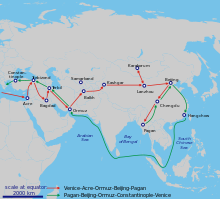
The route Polo describes.

The probable view of Marco Polo's own geography (drawn by Henry Yule, 1871).
Further information: Niccolò and Maffeo Polo
The source of the title Il Milione is debated. One view is it comes from the Polo family's use of the name Emilione to distinguish themselves from the numerous other Venetian families bearing the name Polo.[13] A more common view is that the name refers to medieval reception of the travelog, namely that it was full of "a million" lies.[14]
Modern assessments of the text usually consider it to be the record of an observant rather than imaginative or analytical traveler. Marco Polo emerges as being curious and tolerant, and devoted to Kublai Khan and the dynasty that he served for two decades. The book is Polo's account of his travels to China, which he calls Cathay (north China) and Manji (south China). The Polo party left Venice in 1271. The journey took three years after which they arrived in Cathay as it was then called and met the grandson of Genghis Khan, Kublai Khan. They left China in late 1290 or early 1291[15] and were back in Venice in 1295. The tradition is that Polo dictated the book to a romance writer, Rustichello da Pisa, while in prison in Genoa between 1298 and 1299. Rustichello may have worked up his first Franco-Italian version from Marco's notes. The book was then named Devisement du Monde and Livres des Merveilles du Monde in French, and De Mirabilibus Mundi in Latin.[16]
Role of Rustichello
The British scholar Ronald Latham has pointed out that The Book of Marvels was in fact a collaboration written in 1298–1299 between Polo and a professional writer of romances, Rustichello of Pisa.[17] It is believed that Polo related his memoirs orally to Rustichello da Pisa while both were prisoners of the Genova Republic. Rustichello wrote Devisement du Monde in the Franco-Venetian language.[18]
Latham also argued that Rustichello may have glamorised Polo's accounts, and added fantastic and romantic elements that made the book a bestseller.[17] The Italian scholar Luigi Foscolo Benedetto had previously demonstrated that the book was written in the same "leisurely, conversational style" that characterised Rustichello's other works, and that some passages in the book were taken verbatim or with minimal modifications from other writings by Rustichello. For example, the opening introduction in The Book of Marvels to "emperors and kings, dukes and marquises" was lifted straight out of an Arthurian romance Rustichello had written several years earlier, and the account of the second meeting between Polo and Kublai Khan at the latter's court is almost the same as that of the arrival of Tristan at the court of King Arthur at Camelot in that same book.[19] Latham believed that many elements of the book, such as legends of the Middle East and mentions of exotic marvels, may have been the work of Rustichello who was giving what medieval European readers expected to find in a travel book.[20]
Role of the Dominican Order
Apparently, from the very beginning Marco's story aroused contrasting reactions, as it was received by some with a certain disbelief. The Dominican father Francesco Pipino [it] was the author of a translation into Latin, Iter Marci Pauli Veneti in 1302, just a few years after Marco's return to Venice.[21] Francesco Pipino solemnly affirmed the truthfulness of the book and defined Marco as a "prudent, honoured and faithful man".[22] In his writings, the Dominican brother Jacopo d'Acqui explains why his contemporaries were skeptical about the content of the book. He also relates that before dying, Marco Polo insisted that "he had told only a half of the things he had seen".[22]
According to some recent research of the Italian scholar Antonio Montefusco, the very close relationship that Marco Polo cultivated with members of the Dominican Order in Venice suggests that local fathers collaborated with him for a Latin version of the book, which means that Rustichello's text was translated into Latin for a precise will of the Order.[23]
Since Dominican fathers had among their missions that of evangelizing foreign peoples (cf. the role of Dominican missionaries in China[24] and in the Indies[25]), it is reasonable to think that they considered Marco's book as a trustworthy piece of information for missions in the East. The diplomatic communications between Pope Innocent IV and Pope Gregory X with the Mongols[26] were probably another reason for this endorsement. At the time, there was open discussion of a possible Christian-Mongol alliance with an anti-Islamic function.[27] In fact, a Mongol delegate was solemnly baptised at the Second Council of Lyon. At the council, Pope Gregory X promulgated a new Crusade to start in 1278 in liaison with the Mongols.[28]
Contents
The Travels is divided into four books. Book One describes the lands of the Middle East and Central Asia that Marco encountered on his way to China. Book Two describes China and the court of Kublai Khan. Book Three describes some of the coastal regions of the East: Japan, India, Sri Lanka, South-East Asia, and the east coast of Africa. Book Four describes some of the then-recent wars among the Mongols and some of the regions of the far north, like Russia. Polo's writings included descriptions of cannibals and spice-growers.
Legacy
he Travels was a rare popular success in an era before printing.
The impact of Polo's book on cartography was delayed: the first map in which some names mentioned by Polo appear was in the Catalan Atlas of Charles V (1375), which included thirty names in China and a number of other Asian toponyms.[29] In the mid-fifteenth century the cartographer of Murano, Fra Mauro, meticulously included all of Polo's toponyms in his 1450 map of the world.
A heavily annotated copy of Polo's book was among the belongings of Columbus.[30]
Subsequent versions

French "Livre des merveilles" front page[31]
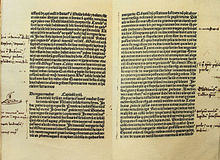
Handwritten notes by Christopher Columbus on the Latin edition of Marco Polo's Le livre des merveilles.
Marco Polo was accompanied on his trips by his father and uncle (both of whom had been to China previously), though neither of them published any known works about their journeys. The book was translated into many European languages in Marco Polo's own lifetime, but the original manuscripts are now lost. A total of about 150 copies in various languages are known to exist. During copying and translating many errors were made, so there are many differences between the various copies.[32]
According to the French philologist Philippe Ménard,[33] there are six main versions of the book: the version closest to the original, in Franco-Venetian; a version in Old French; a version in Tuscan; two versions in Venetian; two different versions in Latin.
Version in Franco-Venetian
The oldest surviving Polo manuscript is in Franco-Venetian, which was a literary language which mixed Old French with the Venetian language, spread in Northern Italy in the 13th century;[6][7][34] for Luigi Foscolo Benedetto, this "F" text is the basic original text, which he corrected by comparing it with the somewhat more detailed Italian of Ramusio, together with a Latin manuscript in the Biblioteca Ambrosiana.
Version in Old French
A version written in Old French, titled Le Livre des merveilles (The Book of Marvels).
This version counts 18 manuscripts, whose most famous is the Code Fr. 2810.[35] Famous for its miniatures, the Code 2810 is in the French National Library. Another Old French Polo manuscript, dating to around 1350, is held by the National Library of Sweden.[36] A critical edition of this version was edited in the 2000s by Philippe Ménard.[33]
Version in Tuscan
A version in Tuscan (Italian language) titled Navigazione di messer Marco Polo was written in Florence by Michele Ormanni. It is found in the Italian National Library in Florence. Other early important sources are the manuscript "R" (Ramusio's Italian translation first printed in 1559).
Version in Venetian
The version in Venetian dialect is full of mistakes and is not considered trustworthy.[33]
Versions in Latin
- One of the early manuscripts, Iter Marci Pauli Veneti, was a translation into Latin made by the Dominican brother Francesco Pipino in 1302, only three years after Marco's return to Venice.[21][37] This testifies the deep interest the Dominican Order had in the book. According to recent research by the Italian scholar Antonio Montefusco, the very close relationship Marco Polo cultivated with members of the Dominican Order in Venice suggests that Rustichello's text was translated into Latin for a precise will of the Order,[23] which had among its missions that of evangelizing foreign peoples (cf. the role of Dominican missionaries in China[24] and in the Indies[38]). This Latin version is conserved by 70 manuscripts.[33]
- Another Latin version called "Z" is conserved only by one manuscript, which is to be found in Toledo, Spain. This version contains about 300 small curious additional facts about religion and ethnography in the Far East. Experts wondered whether these additions were from Marco Polo himself.[33]
Critical editions
The first attempt to collate manuscripts and provide a critical edition was in a volume of collected travel narratives printed at Venice in 1559.[39]
The editor, Giovan Battista Ramusio, collated manuscripts from the first part of the fourteenth century,[40] which he considered to be "perfettamente corretto" ("perfectly correct"). The edition of Benedetto, Marco Polo, Il Milione, under the patronage of the Comitato Geografico Nazionale Italiano (Florence: Olschki, 1928), collated sixty additional manuscript sources, in addition to some eighty that had been collected by Henry Yule, for his 1871 edition. It was Benedetto who identified Rustichello da Pisa,[41] as the original compiler or amanuensis, and his established text has provided the basis for many modern translations: his own in Italian (1932), and Aldo Ricci's The Travels of Marco Polo (London, 1931).
The first English translation is the Elizabethan version by John Frampton published in 1579, The most noble and famous travels of Marco Polo, based on Santaella's Castilian translation of 1503 (the first version in that language).[42]
A. C. Moule and Paul Pelliot published a translation under the title Description of the World that uses manuscript F as its base and attempts to combine the several versions of the text into one continuous narrative while at the same time indicating the source for each section (London, 1938). ISBN 4-87187-308-0
An introduction to Marco Polo is Leonard Olschki, Marco Polo's Asia: An Introduction to His "Description of the World" Called "Il Milione", translated by John A. Scott (Berkeley: University of California) 1960; it had its origins in the celebrations of the seven hundredth anniversary of Marco Polo's birth.
Comments