

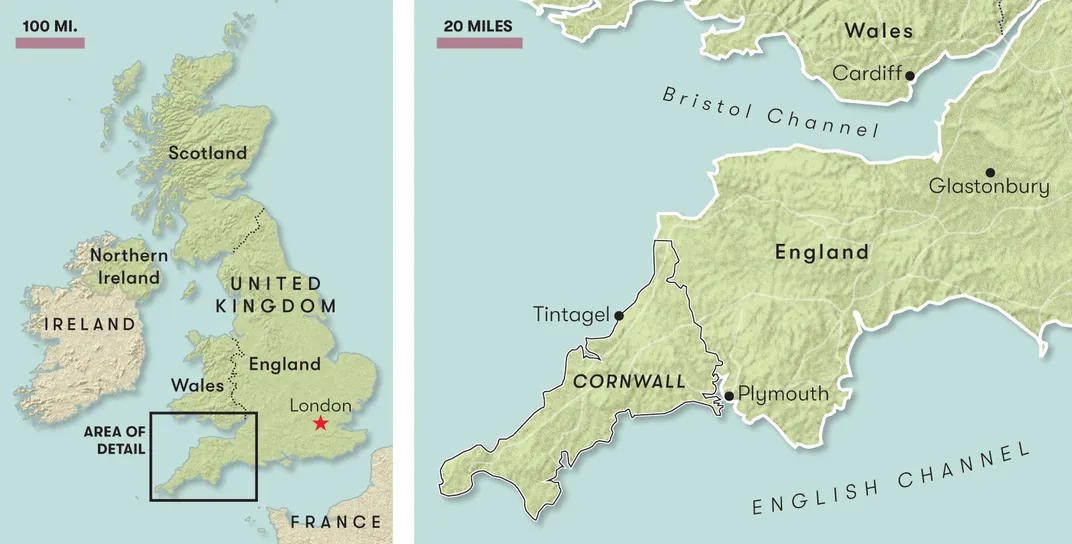
A cold, wind-driven rain soaks through my parka as I walk across a narrow foot-bridge that links the Cornwall mainland in southwest England to a rocky promontory overlooking the Bristol Channel. Far below this cantilevered span, waves crash against the cliffs and swirl inside a grotto known as Merlin’s Cave. Win Scutt, a burly, amiable archaeologist from nearby Plymouth, opens a gate and leads me down a path to the ruins of a medieval castle. Its fragmentary walls mark the lair where Richard, the 13th-century Earl of Cornwall and the brother of King Henry III, is said to have gathered with his followers to feast on mutton and ale and pay homage to a monarch who may never have existed: King Arthur.

Near the remains of Richard of Cornwall’s 13th-century castle are two grottoes. The one on the left is known as Merlin’s Cave. Jooney Woodward
The figure of Arthur first appeared in Welsh poetry in the late sixth and early seventh centuries, a hero who was said to lead the Britons in battle against Saxon invaders. But it wasn’t until the 12th century that he was first tied to this dramatic headland, known as Tintagel. In the Welsh cleric Geoffrey of Monmouth’s History of the Kings of Britain, which was written in 1136 and purported to trace Britain’s history back to its supposed founding by Trojan exiles, an almost certainly fictitious sixth-century king named Uther Pendragon sleeps with the beguiling Ygerna, the wife of a local duke, at her castle in Tintagel, after the magician Merlin turns Pendragon into a likeness of her husband. “That night she conceived Arthur, the most famous of men, who subsequently won great renown by his outstanding bravery,” Geoffrey wrote.
Scholars have universally dismissed Geoffrey’s text as a pseudo-history, woven from ancient Welsh folk tales and his febrile imagination. Still, many people at the time believed the story, and Richard, Earl of Cornwall, was so convinced Arthur was real that, in May 1233, he traded three prime estates for this treeless headland, which is separated from the mainland by an isthmus, and built a castle on it. “It had no function,” Scutt says, as he leads me through the stone ruins of the castle’s great hall. “It’s in a remote part of Cornwall that had no use to him. But he wanted to anchor his position in legend and history. He was the Earl of Cornwall—but he was also the successor of Arthur.”
Guilbert Gates
King Arthur has never relinquished his hold on the imagination. Writers in Geoffrey’s wake added their own flourishes—the magical sword Excalibur, the Knights of the Round Table, Arthur’s romantic triangle with Queen Guinevere and Sir Lancelot, and Arthur’s mortal wound at the Battle of Camlann. Arthurian tales of courtly love, magic and martial bravery have been told and retold in countless versions over the centuries, from the earliest eulogistic stanzas in Welsh poetry to T.H. White’s 1958 novel The Once and Future King, from Sir Thomas Malory’s 15th-century Le Morte d’Arthur to the 2021 film The Green Knight, starring Dev Patel as Sir Gawain, a knight at Camelot, the legendary castle where Arthur held court. “There is something in the Arthur legend for everyone,” says Leah Tether, a professor of medieval studies at Bristol University and former president of the British branch of the International Arthurian Society, which regularly brings together scholars and other enthusiasts interested in Arthurian literature. The story of King Arthur, she says, “has got flawed characters with whom we can empathize, quests to achieve impossible goals, and an adaptable story line that fits the sociopolitical landscape of the time.” Raluca Radulescu, a professor of medieval literature at Bangor University in Wales, suggests Arthur’s perennial appeal is also tied to “a standard of moral integrity” that readers find inspirational, one “they cannot find in the world around them, but will discover in the stories of King Arthur.”
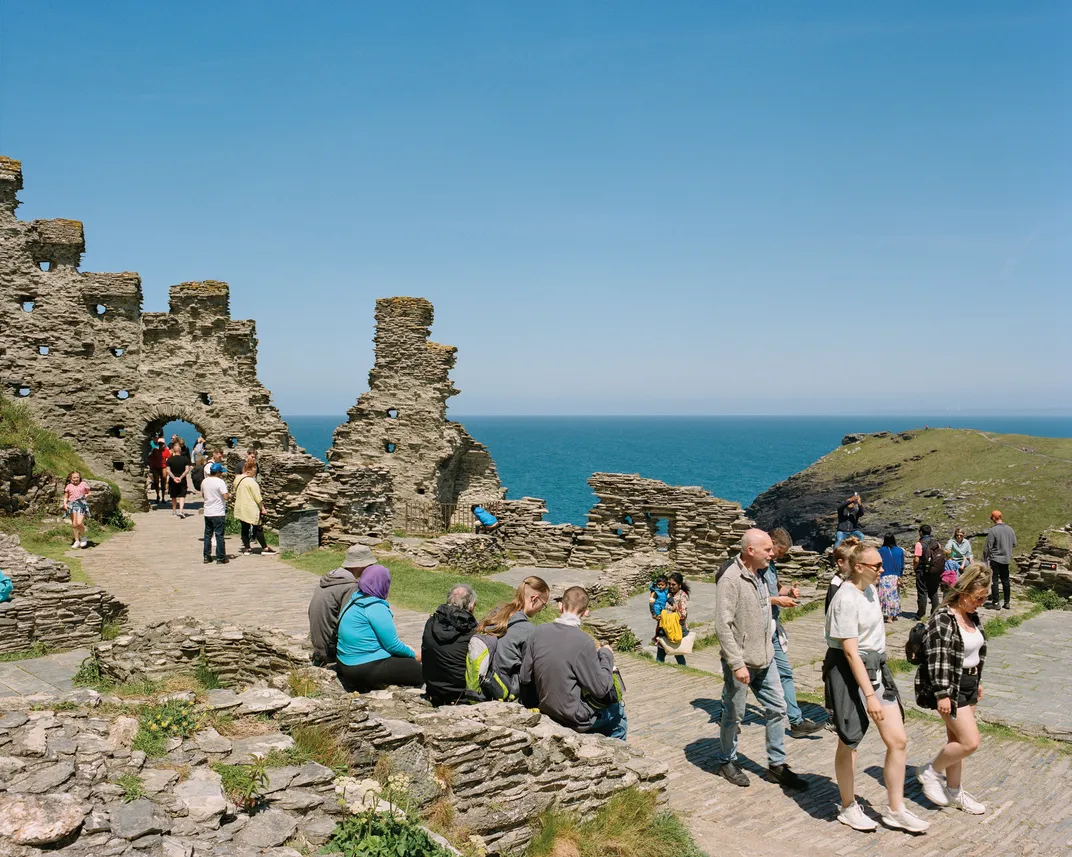
The remains of Tintagel Castle’s Great Hall, on the headland’s “island side.” The site receives a quarter million visitors each year. Jooney Woodward
The timeless popularity of the Arthur legend has overshadowed a central, unresolved question: Was there really a King Arthur, or at least a historical prototype upon whom Geoffrey’s hero is based? That’s what has brought me to Tintagel on this stormy winter morning. Scutt leads me down a grassy slope to the foundations of a dozen houses built on terraces overlooking the sea. Ralegh Radford, the English archaeologist who exposed these ruins in the 1930s, was reminded of similar structures at remote sites in Ireland, and after observing Christian symbols on ceramics found at the site he guessed the ruins were the remains of a Celtic monastery that existed between the fifth and seventh centuries.
Over the past four years, however, Scutt and his team from English Heritage, a nonprofit organization that administers more than 400 historical sites in Britain, have conducted their own research, and they’ve challenged Radford’s assessment of the site. They have excavated three additional houses and have also unearthed fragments of glass goblets from Spain, cups from Merovingian-era France, pottery from Tunisia and amphorae from Turkey used for storing wine or olive oil. Carbon dating, unavailable to Radford a century before, has confirmed the settlement existed in the sixth century. But rather than being a retreat for religious ascetics, Scutt believes that the site, with its protected position on the Cornwall coast, was a flourishing local stronghold. “This could have been home to a mercantile elite whose economy was based entirely on trade,” he says.
Tintagel, Scutt says, was likely home to several thousand people and controlled a territory that extended across modern-day Cornwall. He points out that while much of the British Isles had sunk into illiteracy and destitution during this period—commonly known as the Dark Ages—most residents at Tintagel lived in comfortable slate-roofed homes with sturdy wooden timbers and, in some cases, a second story. It’s not implausible, he argues, that a ruler or commander—perhaps one named Arthur—rose out of this society, and served as an inspiration for Geoffrey of Monmouth. The headland has given up other tantalizing clues, including a sixth-century stone slab with the mysterious word “Artognou” carved into it. Experts in Celtic, the language spoken in Britain at the time, dismiss its significance. But some insist the inscription is a variation of “Arthur.” The slab, they say, is a mark of the king’s realm.
When the legend of Arthur was born, Britain was in a state of collapse. The Roman Empire had made its first incursion into the British Isles in 55 B.C., eventually conquering much of the territory up to present-day Scotland. Its conquest and long rule was often violent, but the Romans also built roads and established towns such as Londinium and Durovernum Cantiacorum, today London and Canterbury. Throughout the Roman province of Britannia the quality of life largely improved.
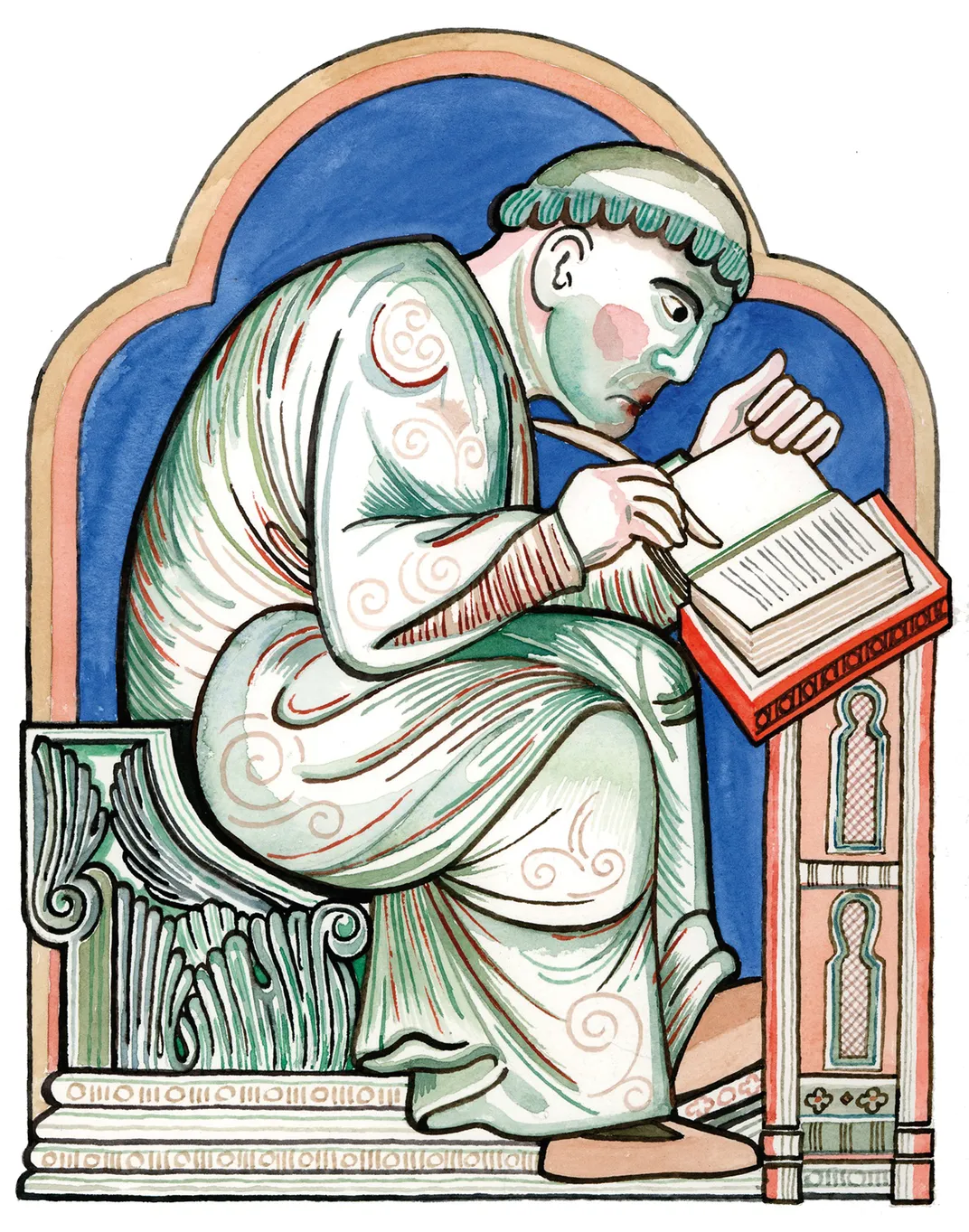
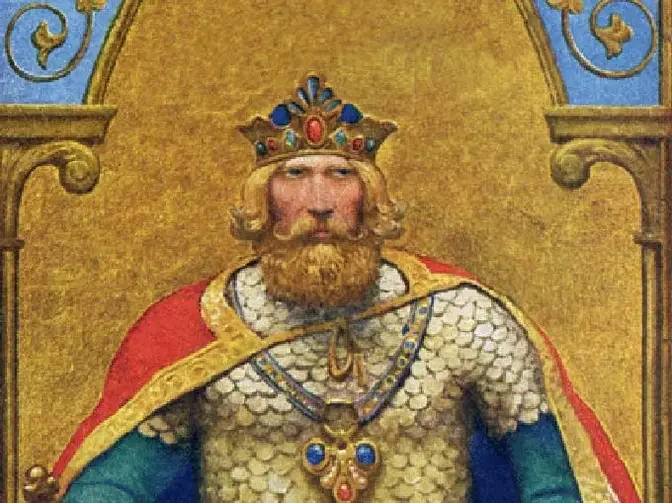
Geoffrey of Monmouth, whose 12th-century account of Arthur’s life was Europe’s most popular text after the Bible.
Fine Art Images / Heritage Images / Getty Images
Then, in A.D. 410, Rome, under siege at home from Visigoths, a Germanic tribe from Eastern Europe, withdrew its troops and plunged Britannia into chaos. Civil institutions vanished, the economy collapsed, and basic household goods became scarce. Saxon invasions terrorized the population, and Britannia fragmented into fiefdoms dominated by often brutal strongmen and their gangs. “Britain has kings, but they are tyrants . . . engaged in plunder and rape, but always preying on the innocent,” a British monk named Gildas wrote in the sixth century. Plague and drought struck the region, wiping out a significant part of the population.
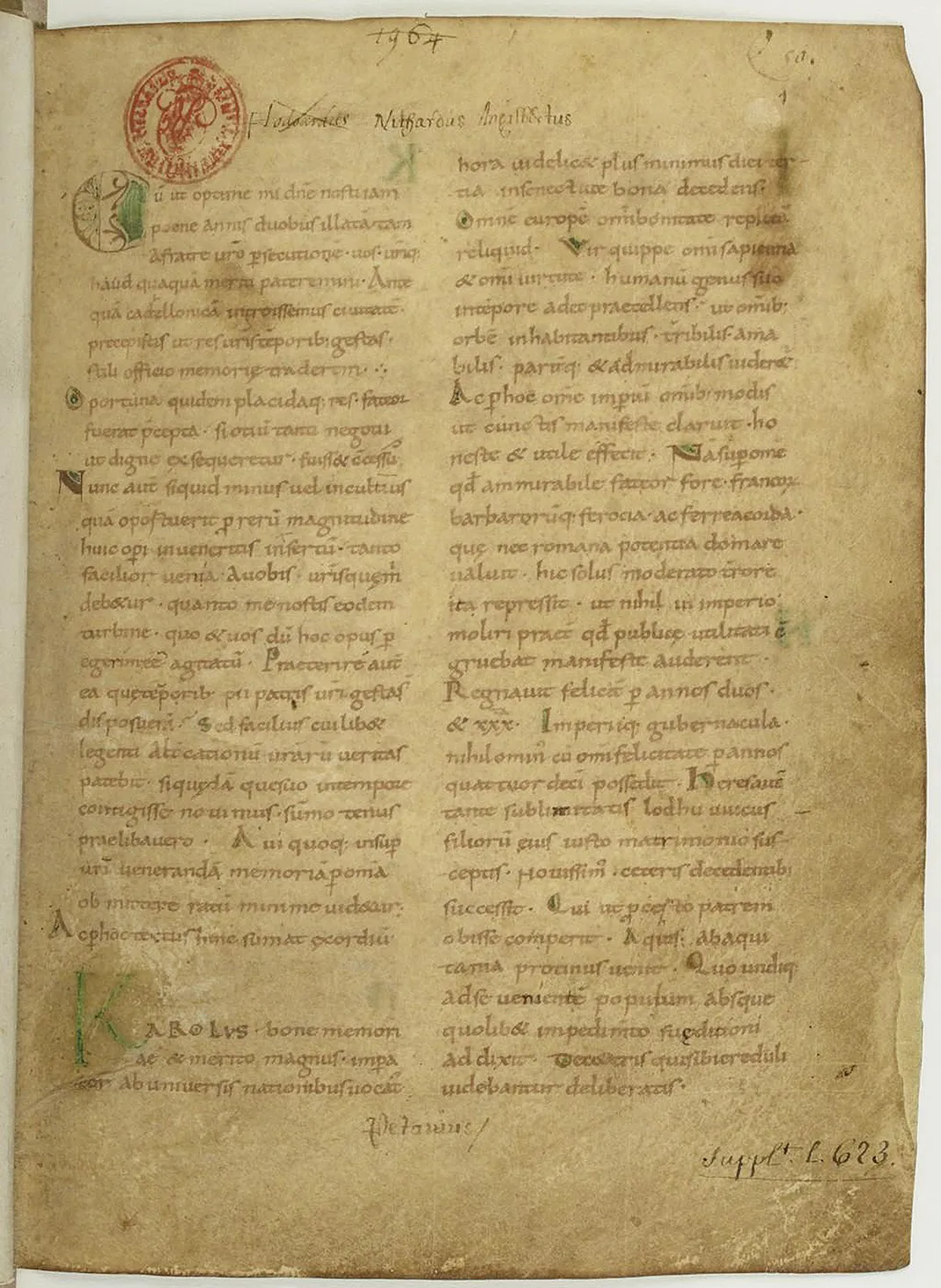
Arthur appeared in a ninth-century text by Nennius. Art Images / Heritage Images / Getty Images
“Britain was a failed state,” says Marc Morris, a British historian and author of 2021’s The Anglo Saxons: A History of the Beginnings of England: 400 to 1066. “It was a miserable time to be alive.”
Many historians believe that a heroic warrior likely rose during this period to lead the Britons, who had largely embraced Christianity, against the pagan Saxons. The Welsh poem Y Gododdin, written between A.D. 540 and 640, describes a fallen soldier by likening him to another called Arthur, which some scholars interpret as showing that a warrior named Arthur was so famous when the poem was written that the bravery of others could be measured by comparison. Around the same time, Gildas, the monk, described a British triumph at the Battle of Badon Hill, which he dated to “the year of my birth,” probably in the early sixth century. He didn’t mention Arthur (he called his hero Ambrosius Aurelianus), but three centuries later, around 830, a Welsh monk named Nennius, in his History of the Britons, described how a warrior named Arthur led the Britons to victory in 12 glorious battles against the Saxons. “The twelfth battle was on the mountain of Badon, in which there fell in one day 960 men from one charge of Arthur, and no one slew them except him alone, and in all battles he was the victor,” Nennius wrote.
Some scholars have pointed to Nennius’ account as evidence of Arthur’s existence. Yet Nicholas Higham, a retired medievalist at University of Manchester and the author of 2018’s King Arthur: The Making of the Legend, says the evidence is hardly conclusive. For one thing, the account was written 300 years after the Battle of Badon Hill was purported to take place. (Although Gildas’ text provides the only contemporaneous mention of the battle, other British histories, including the eighth-century Ecclesiastical History of the English People, describe the fighting in detail, and scholars are generally convinced that such a battle did take place.) For another, historians in the Middle Ages are widely known to have blended fact and fiction to advance a political or religious agenda. At a time when the Saxons were conquering Britain, Higham says, the Britons needed a “god-beloved warrior” to rally their spirits and restore the emergent nation to glory, and Nennius concocted a character to fit the bill. “Arthur was winning battles with the support of Jesus Christ and Mary against the Saxons,” he says. “The Saxons were presented as barbaric, dishonest and latecomers to Christianity.” To show that Arthur had roots in Roman culture, which was still widely admired, Higham argues, Nennius derived the name from Artorius, a general who gained fame in the Punic Wars in the third century B.C.
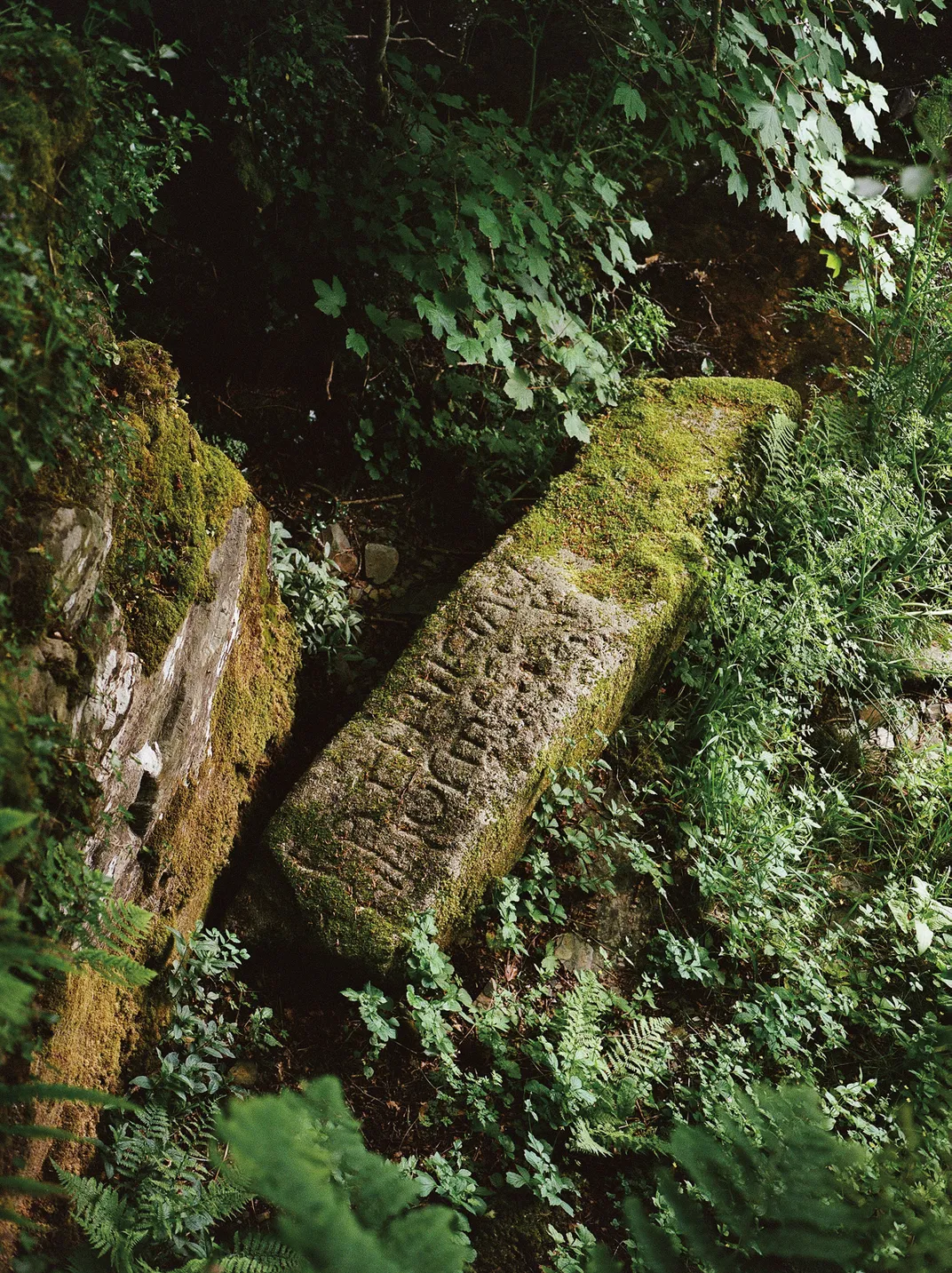
The Slaughterbridge Stone, a Dark Ages memorial slab. Some claim the Latin inscription refers to “Arthur the Great,” but numerous scholars dismiss the notion. Jooney Woodward
If Nennius established Arthur as a British hero, Geoffrey of Monmouth brought him to life. Born around 1090, possibly in Wales, and educated in Paris and Oxford, Geoffrey was ensconced as a bishop in Britain in the mid-1100s when he wrote, in Latin, perhaps the most influential book ever about Arthur. Like Nennius, Geoffrey had a political agenda: to show the superiority of the Celtic-speaking Britons, and by extension, the Welsh, who spoke the same language. “There were a lot of criticisms of the Welsh as being savages, barbarians,” says Morris. “Geoffrey invents a noble history for them, going back a hundred kings before Arthur.” A cipher in Nennius’ history, Arthur now became a Celtic-speaking warrior-king within a richly imagined narrative.
Geoffrey claimed that he’d gleaned details of Arthur’s life from an ancient Welsh history book shown to him by an Oxford archdeacon, but there’s no evidence such a book existed. There’s also no knowledge about what might have led him to set Arthur’s origin story at Tintagel, or if he ever visited the remote headland. “He would have known it as a very dramatic, rocky clifftop, a mystical place, a place that there were plenty of stories about,” says Higham. “But that’s all we can say.”
Geoffrey introduced Guinevere’s infidelity to Arthur, the wizard Merlin (a composite of earlier Welsh prophets) and a magical sword he called Caliburn (based on the Irish sword Caladbolg, a derivation of the Welsh Caledfwlch), which later became known as Excalibur. He ended the tale on an island called Avalon, where Arthur is carried by the enchantress Morgan le Fay after being “mortally injured” against the Saxons in the Battle of Camlann. Geoffrey apparently plucked this battle from The Welsh Annals, written in the late tenth century. This set of chronicles, an apparent blend of fact and fiction, established A.D. 537 as the year of “The Battle of Camlann, in which Arthur and Medraut”—or Mordred, who in later Arthurian tales becomes Arthur’s treacherous nephew and rival—“fell, and there was plague in Britain and Ireland.”
Geoffrey’s fantastical account had its share of skeptics. “It is quite clear that everything this man wrote about Arthur and his successors, and indeed his predecessors...was made up,” the medieval historian William of Newburgh wrote. Yet many Britons accepted it as the truth. In 1191 the monks of Glastonbury Abbey dug up a pair of skeletons in their churchyard and touted them as the remains of King Arthur and Queen Guinevere—a clever hoax to draw paying tourists to the abbey. By the 13th century, writes Morris in 2015’s A Great and Terrible King: Edward I and the Forging of Britain, “It was proof positive that the fabulous king about whom Geoffrey of Monmouth had written had once really existed.”
One true believer was King Edward I. In 1278, the monarch visited the grave site at Glastonbury and ordered the remains to be disinterred, partly to lay to rest the belief in some quarters that Geoffrey’s hero was superhuman and still alive—and thus could potentially challenge Edward for the throne. “There in two caskets were found the bones of the said king of wondrous size, and those of Guinevere, of marvellous beauty,” wrote a local observer. Afterward, the king and queen wrapped the skeletons in silk, placed the royal seal on them, and returned them to their graves.
From this point, the Arthur legend not only grew but became the dominant literary tale of medieval Europe. Monasteries and royal courts bought more than 1,000 copies of Geoffrey’s manuscript, making it the most popular text in the Middle Ages after the Bible. Richard Barber, an Arthurian scholar in Sussex, has personally tracked down 235 surviving copies. He might have found more, but when Henry VIII shuttered the country’s monasteries in the 1530s during his break with the Roman church, “A lot of them were torn up and used for wrapping pies,” Barber told me.
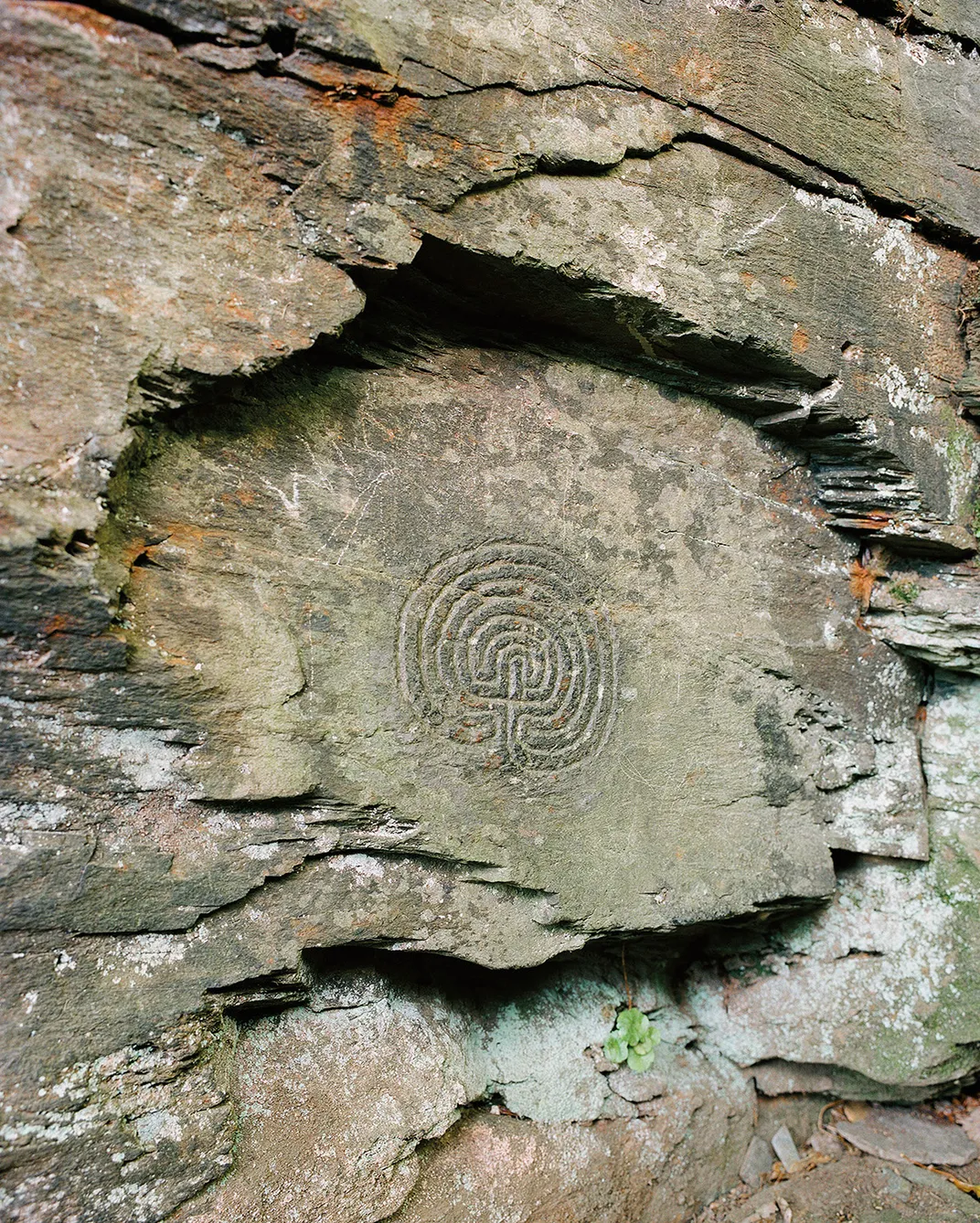
A labyrinth carving in a woodland known as Rocky Valley. Speculation about its origin ranges from the Early Bronze Age to the 1800s. Jooney WoodwardIn North Cornwall, many a landmark has inspired mystery and magical tales. This prehistoric grouping of stones is known as the Hurlers. Jooney Woodward
Meanwhile, Arthur’s legend traveled across the English Channel to France, thanks to the hugely influential 12th-century French poet Chrétien de Troyes. Possibly borrowing from Geoffrey and from Welsh folk tales, and writing under the patronage of the Plantagenets, the British-French dynasty founded by Henry II, de Troyes invented Sir Lancelot, Camelot and the Holy Grail, which he described as a “vessel” used by Jesus at the Last Supper. “The Arthur story began to take off,” says Barber. “One hundred years later, you’ve got Arthur in Germany and all around Italy.”
Manuscripts retelling the Arthur myth became so common that they were often discarded and recycled, and not only as pie-wrapping paper. One winter morning I visit the rare-book room at Bristol’s Central Library with Leah Tether, the University of Bristol medievalist. A library staff member brings us four leather-bound tomes written by the French philosopher Jean Gerson and printed in Strasbourg in the late 15th century. But what we’re really here to see is something that one of Tether’s colleagues discovered pasted inside the bindings in 2019: seven parchment manuscript pages written in Old French, dating to around 1250. These pages—discarded and recycled as protective filler inside the newer volumes—show how the Arthur legend took on embellishments and mutations as it proliferated across Europe, introducing new characters, developing story lines, and reflecting the mores and culture of the different societies in which it appeared.
Archaeologist Win Scutt has found evidence of a prosperous community at Tintagel from the fifth to seventh centuries. Did its leader provide grist for the King Arthur legend? Jooney Woodward
The seven pages come from a series of French stories known as the Vulgate Cycle, and they constitute some of the oldest known adaptations of tales by Chrétien de Troyes. I scan the thousand-year-old parchment and spot references to “Merlin” and “Gauvain,” the French spelling of Sir Gawain. Here, Tether says, Merlin advises Arthur on military tactics, leads a charge using a dragon standard that breathes real fire, and engages in an amorous encounter with Viviane, otherwise known as the Lady of the Lake, a fairy queen invented by de Troyes and further developed by later French writers. This version, says Tether, is “more chaste” than standard French medieval accounts of the relationship, which describe a spell written across Viviane’s groin that prevents men from sleeping with her; in this early version the spell is written on her ring, and prevents men from “speaking” with her. “Very little is known about de Troyes’ life, but he’s the ultimate medieval storyteller,” Tether tells me. His stories were translated into Old Norse and Swedish—the latter, Tether says, inscribed on doors across Iceland in the 12th century.
Other writers added their own touches to the Arthur story and canonized his place in literary history. Thomas Malory, a British member of Parliament and a violent criminal who probably wrote Le Morte d’Arthur while doing time in Newgate Prison for robbery or rape, created the definitive version of the Sword in the Stone story. In his account, the teenage Arthur answers a challenge inscribed on the stone—“Whoso pulleth out this sword of this stone and anvil, is rightwise king born of all England”—by performing the feat multiple times other nobles have failed. Four centuries later, Alfred, Lord Tennyson, in Idylls of the King, described the tortured romantic triangle involving Arthur, Lancelot and Guinevere that tore apart the Knights of the Round Table: “The great and guilty love he bare the Queen, / In battle with the love he bare his lord, / Had marr’d his face, and mark’d it ere his time,” he wrote. Tennyson also brought the story full circle. The Victorian poet described the waves of the Bristol Channel carrying the infant Arthur, an abandoned castaway, to the shore of Tintagel. There Merlin stashes him in the grotto—now known as Merlin’s Cave—to protect him from the enemies of his father, Uther Pendragon.
Leah Tether, a medievalist, with a set of 15th- century volumes of philosophy. Inside the bindings scholars recently discovered parchment pages from the 13th century containing early versions of
Arthurian tales. Jooney WoodwardJoe Parsons is owner and manager of the Vale of Avalon Arthurian Centre. Among its prizes is the Slaughterbridge Stone, near the Camel River. Jooney Woodward
Comments