
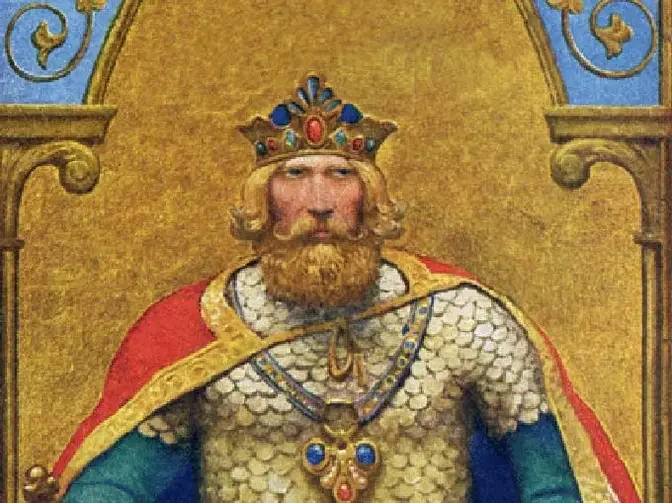

"Arthur Pendragon" redirects here. For other uses, see Arthur Pendragon (disambiguation) and King Arthur (disambiguation).

Tapestry showing Arthur as one of the Nine Worthies, wearing a coat of arms often attributed to him,[1] c. 1385
King Arthur (Welsh: Brenin Arthur, Cornish: Arthur Gernow, Breton: Roue Arzhur, French: Roi Arthur) is a legendary king of Britain, and a central figure in the medieval literary tradition known as the Matter of Britain.
In Welsh sources, Arthur is portrayed as a leader of the post-Roman Britons in battles against Anglo-Saxon invaders of Britain in the late 5th and early 6th centuries. He first appears in two early medieval historical sources, the Annales Cambriae and the Historia Brittonum, but these date to 300 years after he is supposed to have lived, and most historians who study the period do not consider him a historical figure.[2][3] His name also occurs in early Welsh poetic sources such as Y Gododdin.[4] The character developed through Welsh mythology, appearing either as a great warrior defending Britain from human and supernatural enemies or as a magical figure of folklore, sometimes associated with the Welsh otherworld Annwn.[5]
The legendary Arthur developed as a figure of international interest largely through the popularity of Geoffrey of Monmouth's fanciful and imaginative 12th-century Historia Regum Britanniae (History of the Kings of Britain).[6] Geoffrey depicted Arthur as a king of Britain who defeated the Saxons and established a vast empire. Many elements and incidents that are now an integral part of the Arthurian story appear in Geoffrey's Historia, including Arthur's father Uther Pendragon, the magician Merlin, Arthur's wife Guinevere, the sword Excalibur, Arthur's conception at Tintagel, his final battle against Mordred at Camlann, and final rest in Avalon. The 12th-century French writer Chrétien de Troyes, who added Lancelot and the Holy Grail to the story, began the genre of Arthurian romance that became a significant strand of medieval literature. In these French stories, the narrative focus often shifts from King Arthur himself to other characters, such as various Knights of the Round Table. The themes, events and characters of the Arthurian legend vary widely from text to text, and there is no one canonical version. Arthurian literature thrived during the Middle Ages but waned in the centuries that followed, until it experienced a major resurgence in the 19th century. In the 21st century, the legend continues to have prominence, not only in literature but also in adaptations for theatre, film, television, comics and other media.
Historicity
Main article: Historicity of King Arthur

"Arthur Leading the Charge at Mount Badon" 1898
The historical basis for King Arthur has been long debated by scholars. One school of thought, citing entries in the Historia Brittonum (History of the Britons) and Annales Cambriae (Welsh Annals), saw Arthur as a genuine historical figure, a Romano-British leader who fought against the invading Anglo-Saxons some time in the late 5th to early 6th century.
The Historia Brittonum, a 9th-century Latin historical compilation attributed in some late manuscripts to a Welsh cleric called Nennius, contains the first datable mention of King Arthur, listing twelve battles that Arthur fought. These culminate in the Battle of Badon, where he is said to have single-handedly killed 960 men. Recent studies question the reliability of the Historia Brittonum.[7]
Archaeological evidence in the Low Countries and what was to become England shows early Anglo-Saxon migration to Great Britain reversed between 500 and 550, which concurs with Frankish chronicles.[8] John Davies notes this as consistent with the British victory at Badon Hill, attributed to Arthur by Nennius.[8] The monks of Glastonbury are also said to have discovered the grave of Arthur in 1180.[9]
The other text that seems to support the case for Arthur's historical existence is the 10th-century Annales Cambriae, which also link Arthur with the Battle of Badon. The Annales date this battle to 516–518, and also mention the Battle of Camlann, in which Arthur and Medraut (Mordred) were both killed, dated to 537–539. These details have often been used to bolster confidence in the Historia's account and to confirm that Arthur really did fight at Badon.

King Arthur returning from the Battle of Mons Badonis (or Mount Badon). First reference to Arthur, found in early Welsh literature. Stained glass in Llandaf Cathedral, Cardiff.
Problems have been identified, however, with using this source to support the Historia Brittonum's account. The latest research shows that the Annales Cambriae was based on a chronicle begun in the late 8th century in Wales. Additionally, the complex textual history of the Annales Cambriae precludes any certainty that the Arthurian annals were added to it even that early. They were more likely added at some point in the 10th century and may never have existed in any earlier set of annals. The Badon entry probably derived from the Historia Brittonum.[10]
This lack of convincing early evidence is the reason many recent historians exclude Arthur from their accounts of sub-Roman Britain. In the view of historian Thomas Charles-Edwards, "at this stage of the enquiry, one can only say that there may well have been an historical Arthur [but ...] the historian can as yet say nothing of value about him".[11] These modern admissions of ignorance are a relatively recent trend; earlier generations of historians were less sceptical. The historian John Morris made the putative reign of Arthur the organising principle of his history of sub-Roman Britain and Ireland, The Age of Arthur (1973). Even so, he found little to say about a historical Arthur.[12]
Partly in reaction to such theories, another school of thought emerged which argued that Arthur had no historical existence at all. Morris's Age of Arthur prompted the archaeologist Nowell Myres to observe that "no figure on the borderline of history and mythology has wasted more of the historian's time".[13] Gildas's 6th-century polemic De Excidio et Conquestu Britanniae (On the Ruin and Conquest of Britain), written within living memory of Badon, mentions the battle but does not mention Arthur.[14] Arthur is not mentioned in the Anglo-Saxon Chronicle or named in any surviving manuscript written between 400 and 820.[15] He is absent from Bede's early-8th-century Ecclesiastical History of the English People, another major early source for post-Roman history that mentions Badon.[16] The historian David Dumville wrote: "I think we can dispose of him [Arthur] quite briefly. He owes his place in our history books to a 'no smoke without fire' school of thought ... The fact of the matter is that there is no historical evidence about Arthur; we must reject him from our histories and, above all, from the titles of our books."[17]
Some scholars argue that Arthur was originally a fictional hero of folklore—or even a half-forgotten Celtic deity—who became credited with real deeds in the distant past. They cite parallels with figures such as the Kentish Hengist and Horsa, who may be totemic horse-gods that later became historicised. Bede ascribed to these legendary figures a historical role in the 5th-century Anglo-Saxon conquest of eastern Britain.[18] It is not even certain that Arthur was considered a king in the early texts. Neither the Historia nor the Annales calls him "rex": the former calls him instead "dux bellorum" (leader of wars) and "miles" (soldier).[19]

Supposed former gravesite of Arthur at Glastonbury Abbey in Somerset
Details of Arthur's story are mainly composed of Welsh mythology, English folklore and literary invention, and most historians of the period do not think that he was a historical figure.[2][20][21] Because historical documents for the post-Roman period are scarce, a definitive answer to the question of Arthur's historical existence is unlikely. Sites and places have been identified as "Arthurian" since the 12th century,[22] but archaeology can confidently reveal names only through inscriptions found in secure contexts. The so-called "Arthur stone", discovered in 1998 among the ruins at Tintagel Castle in Cornwall in securely dated 6th-century contexts, created a brief stir but proved irrelevant.[23] Other inscriptional evidence for Arthur, including the Glastonbury cross, is tainted with the suggestion of forgery.[a]
Andrew Breeze has recently argued that Arthur was historical, and claimed to have identified the locations of his battles as well as the place and date of his death (in the context of the extreme weather events of 535–536),[24] but his conclusions are disputed.[25] Other scholars have questioned his findings, which they consider are based on coincidental resemblances between place-names.[26] Nicholas Higham comments that it is difficult to justify identifying Arthur as the leader in northern battles listed in the Historia Brittonum while rejecting the implication in the same work that they were fought against Anglo-Saxons, and that there is no textual justification for separating Badon from the other battles.[27]
Several historical figures have been proposed as the basis for Arthur, ranging from Lucius Artorius Castus, a Roman officer who served in Britain in the 2nd or 3rd century,[28] to sub-Roman British rulers such as Riotamus,[29] Ambrosius Aurelianus,[30] and the Welsh kings Owain Ddantgwyn,[31] Enniaun Girt,[32] and Athrwys ap Meurig.[33] However, no convincing evidence for these identifications has emerged.[2][34]
Name
Main article: Arthur

"Arturus rex" (King Arthur), a 1493 illustration from an early printed book, the Nuremberg Chronicle
The origin of the Welsh name "Arthur" remains a matter of debate. The most widely accepted etymology derives it from the Roman nomen gentile (family name) Artorius.[35] Artorius itself is of obscure and contested etymology.[36] Linguist Stephan Zimmer suggests Artorius possibly had a Celtic origin, being a Latinization of a hypothetical name *Artorījos, in turn derived from an older patronym *Arto-rīg-ios, meaning "son of the bear/warrior-king". This patronym is unattested, but the root, *arto-rīg, "bear/warrior-king", is the source of the Old Irish personal name Artrí.[37] Some scholars have suggested it is relevant to this debate that the legendary King Arthur's name only appears as Arthur or Arturus in early Latin Arthurian texts, never as Artōrius (though Classical Latin Artōrius became Arturius in some Vulgar Latin dialects). However, this may not say anything about the origin of the name Arthur, as Artōrius would regularly become Art(h)ur when borrowed into Welsh.[38]
Another commonly proposed derivation of Arthur from Welsh arth "bear" + (g)wr "man" (earlier *Arto-uiros in Brittonic) is not accepted by modern scholars for phonological and orthographic reasons. Notably, a Brittonic compound name *Arto-uiros should produce Old Welsh *Artgur (where u represents the short vowel /u/) and Middle/Modern Welsh *Arthwr, rather than Arthur (where u is a long vowel /ʉː/). In Welsh poetry the name is always spelled Arthur and is exclusively rhymed with words ending in -ur—never words ending in -wr—which confirms that the second element cannot be [g]wr "man".[39]
An alternative theory, which has gained only limited acceptance among professional scholars, derives the name Arthur from Arcturus, the brightest star in the constellation Boötes, near Ursa Major or the Great Bear.[40] Classical Latin Arcturus would also have become Art(h)ur when borrowed into Welsh, and its brightness and position in the sky led people to regard it as the "guardian of the bear" (which is the meaning of the name in Ancient Greek) and the "leader" of the other stars in Boötes.[41]
Many other theories exist, for example that the name has Messapian[42] or Etruscan[43] origins.
Medieval literary traditions
The familiar literary persona of Arthur began with Geoffrey of Monmouth's pseudo-historical Historia Regum Britanniae (History of the Kings of Britain), written in the 1130s. The textual sources for Arthur are usually divided into those written before Geoffrey's Historia (known as pre-Galfridian texts, from the Latin form of Geoffrey, Galfridus) and those written afterwards, which could not avoid his influence (Galfridian, or post-Galfridian, texts).
Pre-Galfridian traditions
The earliest literary references to Arthur come from Welsh and Breton sources. There have been few attempts to define the nature and character of Arthur in the pre-Galfridian tradition as a whole, rather than in a single text or text/story-type. A 2007 academic survey led by Caitlin Green has identified three key strands to the portrayal of Arthur in this earliest material.[44] The first is that he was a peerless warrior who functioned as the monster-hunting protector of Britain from all internal and external threats. Some of these are human threats, such as the Saxons he fights in the Historia Brittonum, but the majority are supernatural, including giant cat-monsters, destructive divine boars, dragons, dogheads, giants, and witches.[45] The second is that the pre-Galfridian Arthur was a figure of folklore (particularly topographic or onomastic folklore) and localised magical wonder-tales, the leader of a band of superhuman heroes who live in the wilds of the landscape.[46] The third and final strand is that the early Welsh Arthur had a close connection with the Welsh Otherworld, Annwn. On the one hand, he launches assaults on Otherworldly fortresses in search of treasure and frees their prisoners. On the other, his warband in the earliest sources includes former pagan gods, and his wife and his possessions are clearly Otherworldly in origin.[47]

A page of Y Gododdin, one of the most famous early Welsh texts featuring Arthur (c. 1275)
One of the most famous Welsh poetic references to Arthur comes in the collection of heroic death-songs known as Y Gododdin (The Gododdin), attributed to the 6th-century poet Aneirin. One stanza praises the bravery of a warrior who slew 300 enemies, but says that despite this, "he was no Arthur" – that is, his feats cannot compare to the valour of Arthur.[48] Y Gododdin is known only from a 13th-century manuscript, so it is impossible to determine whether this passage is original or a later interpolation, but John Koch's view that the passage dates from a 7th-century or earlier version is regarded as unproven; 9th- or 10th-century dates are often proposed for it.[49] Several poems attributed to Taliesin, a poet said to have lived in the 6th century, also refer to Arthur, although these all probably date from between the 8th and 12th centuries.[50] They include "Kadeir Teyrnon" ("The Chair of the Prince"),[51] which refers to "Arthur the Blessed"; "Preiddeu Annwn" ("The Spoils of Annwn"),[52] which recounts an expedition of Arthur to the Otherworld; and "Marwnat vthyr pen[dragon]" ("The Elegy of Uther Pen[dragon]"),[53] which refers to Arthur's valour and is suggestive of a father-son relationship for Arthur and Uther that pre-dates Geoffrey of Monmouth.

Culhwch entering Arthur's court in the Welsh tale Culhwch and Olwen. An illustration by Alfred Fredericks for a 1881 edition of the Mabinogion[54]
Other early Welsh Arthurian texts include a poem found in the Black Book of Carmarthen, "Pa gur yv y porthaur?" ("What man is the gatekeeper?").[55] This takes the form of a dialogue between Arthur and the gatekeeper of a fortress he wishes to enter, in which Arthur recounts the names and deeds of himself and his men, notably Cei (Kay) and Bedwyr (Bedivere). The Welsh prose tale Culhwch and Olwen (c. 1100), included in the modern Mabinogion collection, has a much longer list of more than 200 of Arthur's men, though Cei and Bedwyr again take a central place. The story as a whole tells of Arthur helping his kinsman Culhwch win the hand of Olwen, daughter of Ysbaddaden Chief-Giant, by completing a series of apparently impossible tasks, including the hunt for the great semi-divine boar Twrch Trwyth. The 9th-century Historia Brittonum also refers to this tale, with the boar there named Troy(n)t.[56] Finally, Arthur is mentioned numerous times in the Welsh Triads, a collection of short summaries of Welsh tradition and legend which are classified into groups of three linked characters or episodes to assist recall. The later manuscripts of the Triads are partly derivative from Geoffrey of Monmouth and later continental traditions, but the earliest ones show no such influence and are usually agreed to refer to pre-existing Welsh traditions. Even in these, however, Arthur's court has started to embody legendary Britain as a whole, with "Arthur's Court" sometimes substituted for "The Island of Britain" in the formula "Three XXX of the Island of Britain".[57] While it is not clear from the Historia Brittonum and the Annales Cambriae that Arthur was even considered a king, by the time Culhwch and Olwen and the Triads were written he had become Penteyrnedd yr Ynys hon, "Chief of the Lords of this Island", the overlord of Wales, Cornwall and the North.[58]
In addition to these pre-Galfridian Welsh poems and tales, Arthur appears in some other early Latin texts besides the Historia Brittonum and the Annales Cambriae. In particular, Arthur features in a number of well-known vitae ("Lives") of post-Roman saints, none of which are now generally considered to be reliable historical sources (the earliest probably dates from the 11th century).[59] According to the Life of Saint Gildas, written in the early 12th century by Caradoc of Llancarfan, Arthur is said to have killed Gildas's brother Hueil and to have rescued his wife Gwenhwyfar from Glastonbury.[60] In the Life of Saint Cadoc, written around 1100 or a little before by Lifris of Llancarfan, the saint gives protection to a man who killed three of Arthur's soldiers, and Arthur demands a herd of cattle as wergeld for his men. Cadoc delivers them as demanded, but when Arthur takes possession of the animals, they turn into bundles of ferns.[61] Similar incidents are described in the medieval biographies of Carannog, Padarn, and Eufflam, probably written around the 12th century. A less obviously legendary account of Arthur appears in the Legenda Sancti Goeznovii, which is often claimed to date from the early 11th century (although the earliest manuscript of this text dates from the 15th century and the text is now dated to the late 12th to early 13th century).[62] Also important are the references to Arthur in William of Malmesbury's De Gestis Regum Anglorum and Herman's De Miraculis Sanctae Mariae Laudunensis, which together provide the first certain evidence for a belief that Arthur was not actually dead and would at some point return, a theme that is often revisited in post-Galfridian folklore.[63]
Comments