

During the 7th century Tang Dynasty of China (618 – 907 CE), there arose a great Buddhist master named Xuanzang (602 – 664 CE), who became a famed monk, explorer, scholar, writer, and translator. He is particularly famous for his journey to India, which took nearly two decades to complete, from 627 – 645 CE, and his careful translation of various Buddhist scriptures.
Over the years, as the influence of his work spread, many variations of his name arose such as Tang Sanzang, Xuanzang Sanzang, Xuanzang Dashi, and Tang Seng. In fact, his story and works became influential in other Asian countries, where his name took on localised styles of pronunciation, such as Vietnam, where he is known as Huyen Trang; Japan, where he is celebrated as Genjo; and Korea, where he is called Hyeonjang. One of his greatest written works, the Great Tang Records on the Western Regions, provides stunning accounts of his travels, including the geography, customs and political descriptions of the kingdoms he visited in Central and Southern Asia. Due to his courage, perseverance, passion, and great learning, Xuanzang is considered to be one of the most illustrious figures in Chinese history.
His life story and works continue to inspire millions of people in their spiritual path more than 1,300 years after his death. Even for those who are not interested in Buddhism, the accounts from his travels still serve as valuable historical resources and provide a better understanding of the cultural, geographical and political landscapes of the places he visited.
Early Life

The present-day Henan Province where Xuanzang was born
Xuanzang was the youngest of four children, born in 602 CE to a family of respected scholars and officials in Chen He Village near present-day Henan Province. He was given the birth name Chen Yi. Several of his ancestors held respectable positions during previous dynasties in China, highlighting the fact that his family placed great emphasis on learning. Some of these ancestors include:
- Chen Shi, who lived in the 2nd century, and served as a minister during the time of the Eastern Han Dynasty
- Chen Qin, Xuanzang’s great-grandfather, who served as the prefect of Shangdang (present-day Changzhi city in Shanxi Province) during the time of the Eastern Wei Dynasty
- Chen Kang, Xuanzang’s grandfather, who worked in the Imperial Academy as a professor during the time of the Northern Qi Dynasty.
- Chen Hui, Xuanzang’s father, who served as a magistrate in Jiangling County during the Sui Dynasty. However, he resigned from his position to escape the political turmoil that marked the end of the Sui Dynasty.
After his father resigned as a magistrate, he dedicated his time to educating his children on Confucian principles, classical Chinese literature, and works on filial piety. Even as a child, Xuanzang displayed an excellent aptitude for learning and a keen intellect. By the time he was just eight years old, Xuanzang had mastered many Confucian rituals, and showed great interest in Buddhism and related subjects.
However, he did not have an idyllic childhood by any means. His father passed away in 611 CE when he was just nine years old, and his mother had passed away even earlier, when he was just five years old. Perhaps the misfortunes of his early life allowed Xuanzang a unique realisation of the impermanence of life, which would eventually lead him to renounce secular life altogether.
Ordination and Travels Around China
After his father’s passing, Chensu (who was one of Xuanzang’s older brothers and a monk), played an important role in his life. Xuanzang began visiting Jingtu Monastery in Luoyang where his brother studied, and eventually developed the aspiration to become a monk.
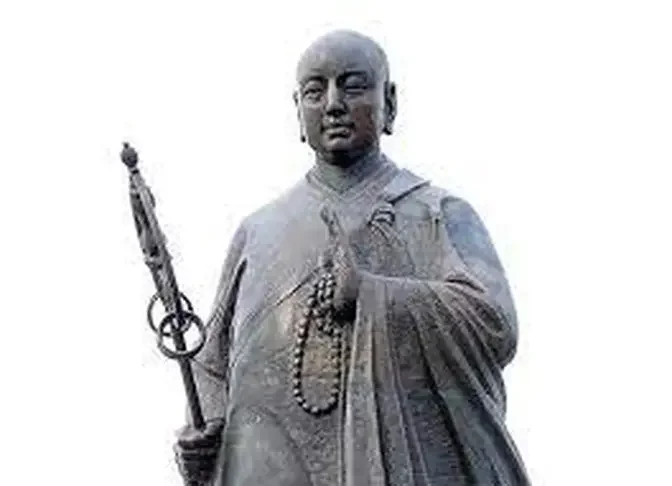
The statue of Xuanzang in his hometown near the present-day Henan Province
The requirements and examinations to become a monk were very strict, and Xuanzang was very young. However, the abbot of Jingtu Monastery, Zhen Shanguo, made an exception for Xuanzang due to his intelligence and impressive knowledge. Xuanzang received novice monastic ordination when he was just 13 years old. The two brothers lived a peaceful existence in the monastery for several years, where Xuanzang studied various Buddhist scriptures including those from the Theravada and Mahayana schools. However, he had a particularly interest in the Mahayana Buddhist doctrine. He became well-known among the Buddhist practitioners in Luoyang for his memory, intelligence and knowledge.
Unfortunately, the peaceful life did not last. The civil war that would mark the end of the Sui Dynasty broke out, and Xuanzang and his brother sought refuge in Chang’an. In 618, the Sui Dynasty fell, and Chang’an became the new capital of the Tang Dynasty.

A digital reconstruction of the Tang Dynasty’s Chang’an City
However, there was still civil unrest in Chang’an, and many of the temples in the city were destroyed. The two brothers travelled to Chengdu in Sichuan Province and spent approximately three years in Kong Hui Monastery, furthering their study on subjects like the Abhidharma-kosa Sastra or Verses on the Treasury of Abhidharma. Xuanzang received his full monastic ordination in 622 CE at the age of 20.
When studying the scriptures, Xuanzang became confused due to mistranslation, contradictions and discrepancies in the Chinese Buddhist resources available at the time. This sparked a seven-year journey of enlightenment around China during which he visited almost all of the renowned Buddhist masters of the time to seek clarification. Xuanzang became well-known in China for his passion for learning and he gained a reputation as a promising, intelligent young man.
However, the journey of enlightenment across China did not help Xuanzang to find the answers that he was seeking. In 625 CE, Xuanzang returned to Chang’an. Under the reign of Emperor Taizong (r. 626 – 649 CE) of the Tang Dynasty, stability and order had returned to the city. It was in Chang’an that Xuanzang met an Indian Buddhist monk who spoke with him about Indian Buddhism and also another monk named Silabhadra (529 – 645 CE). Silabhadra was the abbot of Nalanda Monastery in India and was reputed to have an excellent understanding of the tenets of Buddhism.
After his exchanges with the Indian monk, Xuanzang felt the need to follow in the footsteps of another eminent Chinese Buddhist monk-explorer, Faxian (337 – 422 CE). Faxian had gone to India to gain a better understanding of Buddhist teachings and to bring back precious Buddhist scriptures to China.
In 626 CE, Xuanzang began to study Sanskrit language and became particularly interested in the Yogacara School of Buddhism.
Journey to the West
Escape from China

Emperor Taizong (598 – 649 CE)
Xuanzang and several other monks requested permission from Emperor Taizong to go to ‘the West’ (India). The Chinese at the time often referred to India as ‘the West’ because India is located to the west of China. However, their request was rejected due to the political turbulence of the time. The Tang Dynasty was young and the emperor was still working to consolidate his power. In addition, there were frequent attacks from the Gokturks along the Northern border and nobody was allowed to leave the country.
Instead of being deterred by the rejection, Xuanzang became even more determined to leave China. It is said that he experienced a vision that strengthened his resolve to go to India. The opportunity presented itself in autumn of the year 627 CE when the harvest did not yield sufficient crops. The authorities allowed citizens of Chang’an to leave the city to escape famine. Xuanzang took this opportunity to leave the city to go to the West. Since he left without the emperor’s permission, he became a fugitive.
In order not to attract attention, Xuanzang travelled during the night and hid during the day. However, when he reached the city of Liangzhou (present-day Wuwei City in Ganxu Province), he discovered that, again, nobody was allowed to leave the city without official permission. At the time, Liangzhou was the one of the commercial and cultural centres of China, and Buddhist culture there was very strong. While waiting for the opportunity to leave the country, Xuanzang taught Buddhism in the city. He stayed in Liangzhou for about one month before the local authorities heard about Xuanzang and ordered him to return to Chang’an.
However, Xuanzang’s determination and noble intentions touched the Buddhist leader in Liangzhou, and he helped the young monk to slip out of the city. Xuanzang then reached the city of Guazhou, the last military town of the western border of the Tang Empire.
After his experience in Liangzhou, Xuanzang decided not to let the Guazhou authorities know that he was in the city and stayed quietly at an inn while waiting for the opportunity to leave. The situation seemed dire when a local official received a warrant for Xuanzang’s arrest. However, the local official was a pious Buddhist, and he allowed Xuanzang to leave.
After leaving Guazhou, Xuanzang prayed for guidance at the Ta’er Temple just outside of the city. At this temple, Xuanzang met a merchant, whom he later ordained as a Buddhist and his first disciple. The merchant found him a horse and introduced him to an old man who described the dangerous terrain that Xuanzang would have to navigate on his way to India.
He was not dissuaded by the old man’s advice to not continue his journey. The man then exchanged horses with Xuanzang to enable him to travel faster, and after one night, the merchant parted ways with him because he did not want to get into trouble. Xuanzang endured many difficulties during the journey as a result of travelling without a guide.

The harsh Gobi Desert that Xuanzang crossed on his journey towards greater Dharma learning
After travelling 40 kilometres into the Moheyanqi Gobi Desert, Xuanzang managed to reach the Beacon Tower which was manned by Chinese soldiers. There was only one source of water and he waited until nightfall before attempting to collect some, but was caught. Fortunately, the commander of the tower was a Buddhist who treated Xuanzang with respect. He was given food, water and helpful advice. The commander advised Xuanzang to go straight to the fourth Beacon Tower where his relative was serving as its commander. After that, Xuanzang was able to pass and get water from the fourth and the fifth Beacon Towers without difficulty.
He crossed the vast and dangerous Moheyanqi Gobi Desert to reach the first kingdom in his journey to the West, Yiwu (Hami). He almost died of thirst and experienced many mirages while crossing the vast desert. The horse saved his life once by bringing him to an oasis when Xuanzang was unable to do so himself. Xuanzang finally reached a temple and was greeted warmly by a monk of the Han ethnic group. Xuanzang mentions this temple in his biography and it is most likely the Miao’ergou Temple near the city of Hami in Xinjiang.

An ancient beacon tower in Gobi Desert
Small Kingdoms on the Way to India

The ruins of Gaochang Kingdom
When Xuanzang reached the city of Yiwu-Gaochang, the king, Qu Wentai demanded to see him. The king invited him to stay there to teach Buddhism and Xuanzang accepted. The king and Xuanzang forged a bond and they became sworn brothers. The king only let Xuanzang go after he promised to come back to Gaochang on his way back from India to teach for three years. King Qu Wentai gave the monk 25 attendants and 30 horses to accompany him on in his journey.

Snow-covered mountain in Palmir Plateau
Xuanzang’s group continued their journey to the fourth kingdom, Kucha (present-day Kucha County in Xinjiang Province), the most prominent kingdom in the ancient Western region. The famed 4th century Buddhist scholar, Kumarajiva, was born in Kucha and had gone to India to study.
Xuanzang was given a warm reception here. He noted that people with flat heads were considered attractive in this kingdom and babies’ heads, including those who were members of royal families, were pressed with planks. As a result, everybody in Kucha had flat heads. Music and dance also played an important role in this kingdom. The evidence of Kucha culture and customs can still be seen in the murals of the Kumtura Thousand Buddha Caves.
Due to unfavourable weather, Xuanzang stayed in Kucha for two months before continuing his journey through the snow-covered Palmir Plateau. On the second day of travel, they encountered Turkic bandits. Xuanzang’s group was robbed but then something unexpected happened – the bandits left after quarrelling on how to divide the goods!
Xuanzang’s party continued its journey and encountered the snow-covered Ling Mountain where the path became very treacherous and was prone to avalanches. Some of the men succumbed to fatigue and were not able to continue, and all suffered from the extreme cold.

Kumtura Thousand Buddha Caves

The ancient murals of the Kumtura Thousand Buddha Caves
Today, archaeologists still speculate over the exact path through the mountains that Xuanzang took. Most of the mountains in the area are over 5,000 metres high and it must have been an extremely difficult trek.
In the spring of 628 CE, Xuanzang and his travelling companions reached the Central Asian region on the other side of the mountains. Xuanzang’s first destination was the Issyk-Kul Lake. In his biography, he describes the lake as surrounded by mountains, with dark green water which was salty and bitter. The lake never froze and people often referred to it as the ‘hot sea’.

Issyk-Kul Lake, described by Xuanzang as salty and bitter.
During the time of Xuanzang’s travels, the Western Turkic Khaganate dominated the Central Asian kingdoms. The state religion in this region was Zoroastrianism in which they worshiped fire, a practice which was at odds with Buddhism. After leaving the Issyk-Kul Lake, Xuanzang reached Suyab, the military and political centre of the Western Turkic Khaganate.
Suyab was located in modern-day Kyrgyzstan, and its population consisted of individuals from various countries and of a range of beliefs. The city had very few trees and the weather was cold, and the people in the region wore linens and furs to keep warm. Xuanzang and his group stayed in a temple near the lake and waited for the ruling Khan of the Western Turkic Khaganate to summon him.
When he finally met the Khan, Xuanzang noted that he was living in a very luxurious yurt (large, round tent used by nomads) decorated with a pattern of flowers and inlaid with gold. A Chinese envoy also attended the reception banquet. The Khan gave a warm reception to Xuanzang because he had heard that the monk was a sworn brother of the King of Gaochang. In addition, his guest was a monk from the Tang Empire and the Khan strived to maintain good relations with the Tang Dynasty. After this meeting, the Khan selected several military officers who were proficient in several languages to escort Xuanzang on his journey.
Xuanzang continued his journey and passed through various cities and kingdoms. He came across a city inhabited by 300 Chinese households from all over China. They had been forced to live here by the Turkic people. Although the residents of the city wore Turkish attire, they maintained Chinese customs and spoke the Chinese language.
500 kilometres from that city was the Zheshi Kingdom which consisted of several cities ruled by various kings under the Western Turkish Khaganate. They passed through desert again, and this time sandstorms made progress very difficult. After travelling approximately 250 kilometres, they arrived at the city of Samarkand, one of the most ancient cities in the world.
See more: https://studio.ganjingworld.com/article/1g0n31pi9so3h9QydpSCkM22u1ob1c
Comments