
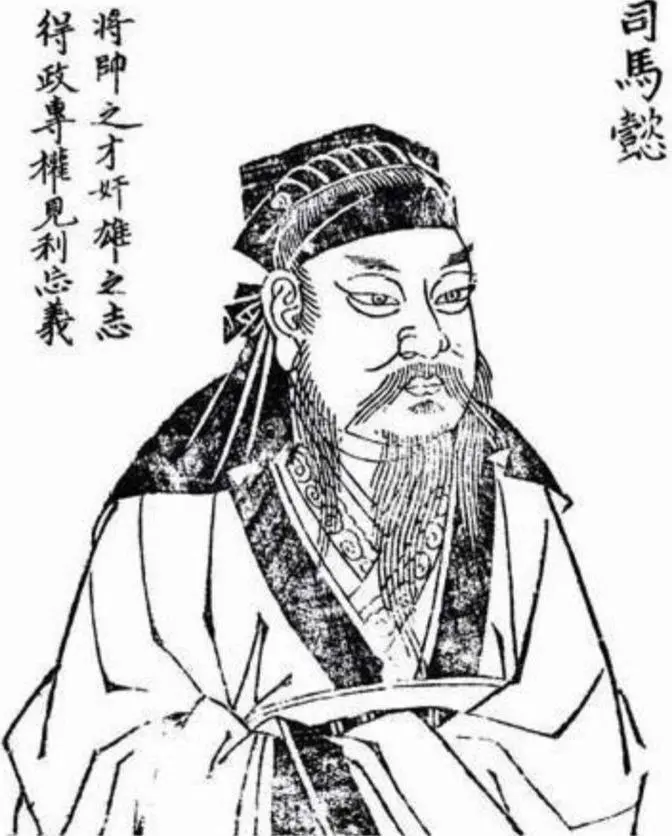

Sima Yi 司馬懿 (179–251), zi Zhongda 仲達. Late Eastern Han statesman, military strategist, and writer.
Sima Yi's ancestral home was Wen 溫 county in Henei 河內 (west of modern Wen county, Henan). His father Sima Fang 司馬防 (149–219) was a prominent scholar and official in the late Eastern Han. In the 170s, he served as magistrate of Luoyang, and one of his subordinates was Cao Cao. Sima Yi was Sima Fang's second son. As a child, Sima Yi displayed unusual moral integrity. According to his biography in the Jin shu, “he was intelligent, bright, and had numerous grand plans. He also was broadly learned and erudite, and was strongly committed to Ruist teachings.”
From an early age, Sima Yi earned the praise of prominent men. For example, Yang Jun 楊俊 (d. 222), governor of Nanyang 南陽 (modern Jiyuan 濟源 area, Henan), who was also from Henei, was known for his keen judgment of human character. Yang Jun first met Sima Yi when the latter had just reached capping age (twenty), and he remarked about his “unusual capacities.” The imperial secretary Cui Yan 崔琰 (d. 216) of Qinghe 清河 once said to Sima Yi's elder brother Sima Lang 司馬朗 (171–217), “Your younger brother is intelligent and bright, resolute and decisive, outstanding and exceptional. You are not as good as he is.”
In 201, Sima Yi's commandery recommended him accounts assistant. At that time, Cao Cao 曹操 (155–220) was serving as minister of works. He had heard of Sima Yi and tried to recruit him. Sima Yi sensed that the Han house was in decline, but he did not wish to serve Cao Cao. He declined the appointment on the pretext that he was suffering from rheumatism. Cao Cao secretly sent a messenger to spy on him at night. Sima Yi stayed in bed and did not move in order to convince the messenger that he was really ill.
In 208, Cao Cao was named counselor-in-chief. He once again summoned Sima Yi to serve as an instructor in a principaltity, presumably that of the heir designate Cao Pi 曹丕 (187–226), the future Emperor Wen (r. 220–226). He instructed the messenger saying, “If he hesitates again, you can just take him into custody.” Fearing arrest, Sima Yi accepted the offer. Sima Yi was later promoted to a number of positions, including gentleman attendant at the palace gate, court gentleman for consultation, administrator of the eastern section under the counselor-in-chief, and assistant magistrate.
In 216, the Wei kingdom was formally established. Sima Yi was transferred to the position of palace cadet in the household of the heir designate Cao Pi. Whenever Cao Pi consulted with Sima Yi, Sima Yi devised a clever strategy to deal with his query, and Cao Pi held Sima Yi in the highest regard. Sima Yi, Chen Qun 陳群 (d. 236), Wu Zhi 吳質 (177–230) and Zhu Shuo 朱鑠 (n.d.) were known as the heir designate's “Four Companions.”
Sima Yi later was promoted to cavalry commander of the army. He suggested that Cao Cao implement the policy of promoting farming as well as a strong military. This led to the establishment of garrison farms. Cao Cao approved his recommendation. As a result, grain stocks were plentiful and the wealth of the state increased.
Cao Cao died in 220, and Cao Pi succeeded him. Emperor Wen enfeoffed Sima Yi as Marquis of Hejin ting 河津亭, and appointed him to the post of administrator for the counselor-in-chief (i.e., Cao Pi himself ). When Cao Pi took the throne of the newly founded Wei dynasty in the tenth month of 220, Sima Yi was promoted to a number of positions, including imperial secretary, army commander, and palace aide to the censor-in-chief. He was also enfeoffed as Marquis of Anguo xiang 安國鄕. In 221, after completing his term as army commander, he was appointed palace attendant and vice director of the imperial secretariat. In 224, while Emperor Wen went on a imperial inspection tour in the south to review the troops stationed on the Wu border, Sima Yi stayed behind to defend the garrison in Xu. He was at this time given the noble title Marquis of Xiang Village, and given an army of 5,000 soldiers. Emperor Wen also proposed appointing him to the positions of palace steward and overseer of the imperial secretariat. Sima Yi adamantly declined the offer. Emperor Wen said to him, “I work on state affairs day and night. I cannot rest even for a moment. I do not consider these honorific titles, but rather a means by which you can help me by sharing my worries.”
In 226, Emperor Wen was gravely ill. Before he died, he entrusted Sima Yi together with Cao Zhen 曹眞 (d. 231) and Chen Qun to assist his successor Cao Rui 曹叡 (205–239), Emperor Ming 明 (r. 226–239), after his death. In the fifth month of 226 Cao Rui was installed as emperor. Cao Rui first granted Sima Yi the noble title Marquis of Wuyang. He also ordered him to lead a military expedition against Sun Quan 孫權 (182–252) in the southeast. As a reward for defeating Sun Quan's forces, he was promoted to cavalry general.
In 228, Sima Yi captured and killed the Wei general Meng Da 孟達 (d. 228) who was about to ally with Zhuge Liang 諸葛亮 (181–234) in Shu. Emperor Wen then ordered him to take charge of the armies sent to do battle with Zhuge Liang in the northwest. He also was sent in 239 to lead the forces against the separatist state of Liaodong 遼東 (modern western Liaoning).
In 240, Emperor Ming became ill. He issued five imperial decrees within three days summoning Sima Yi to see him as soon as possible. Emperor Ming was already at the end of his life's journey. Holding Sima Yi's hands, Emperor Ming said, “For entrusting you with something after my death, I even put off my death because I am waiting for your arrival. Now that i see you, I have no more regrets.” Sima Yi and Cao Shuang 曹爽 (d. 249) were entrusted to serve as co-regents for the young ruler Cao Fang 曹芳 (231–274), Prince of Qi 齊 (r. 240–254). However, Cao Shuang attempted to seize full control of the court administration, and recommended that Sima Yi be appointed commander-in-chief. However, court officials did not agree with the recommendation because all previous commanders-in-chiefs died in office. Cao Fang instead assigned Sima Yi to the post of grand mentor.
In the fourth month of 247, Cao Shuang intensified his control over court affairs, and even Cao Fang was unable to challenge him. Sima Yi reacted to this state of affairs by feigning illness and withdrawing from the court. He was reputed to have said, “I am old and am confined to bed. I will die any time now.” Cao Shuang's confidant also informed him that Sima Yi was on his deathbed and was no longer a threat.
On 5 February 249, Cao Fang visited his late father's burial site at Gaoping 高平 Mausoleum (southeast of modern Luoyang, Henan). Cao Shuang and his brother accompanied him. Sima Yi used this opportunity to present a petition to the Emperor Ming's mother, Empress Dowager Yongning 永寧 (d. 263), to have Cao Shuang and his brother removed from office. He presented another petition to Cao Fang making the following accusations: “He has disobeyed the testamentary decree, and brought ruin and chaos to the institutes of the state. Inside of the court he has usurped prerogatives, and outside of the court he monopolizes and flaunts his power.” Five days later (9 February 249), Cao Shuang and his brother were removed from their positions and put to death. Sima Yi was then named counselor-in-chief. He now had full control over the Wei court. He had his domain increased with the addition of four counties in Yingchuan 潁川 commandery in the Xuchang area of Henan. However, shortly thereafter, Sima Yi became so ill he was unable to attend court. However, he recovered sufficiently in February 251 to lead a military expedition against Wu.
In the sixth month (6 July–3 August) of 251, Sima Yi became gravely ill. He died on 7 September 251 at the age of seventy-three. Cao Fang attended the mourning rites and granted him the posthumous titles of counselor-in-chief and commandery duke. When Sima Yi's grandson Sima Yan 司馬炎 (236–290) defeated the Wei state and formally established the Jin dynasty in 265, he was posthumously awarded the title Emperor Xuan 宣 of the Jin dynasty.
The monograph on bibliograhy of the Sui shu lists Sima Yi's collected works in five juan with a table of contents in one juan. The Xin Tang shu records a collection of the same size. However, the Jiu Tang shu lists a ten-juan collection. The collection was lost in the Song. Yan Kejun has collected in Quan shanggu Sandai Qin Han Sanguo Liuchao wen fifteen of his prose writings, most of which are petitions and letters including “Da Zhuge Liang shu” 答諸葛亮書 (Answering Zhuge Liang's letter), “Da Cao Shuang shu” 答曹爽書 (Answering Cao Shuang's letter). Sima Yi's only extant poem is included in his biography in the Jin shu (1.10). He composed the piece in 239 when he stopped in his home area of Wen. After feasting with relatives and old friends, he composed a tetrasyllabic poem in ten lines.

Comments