
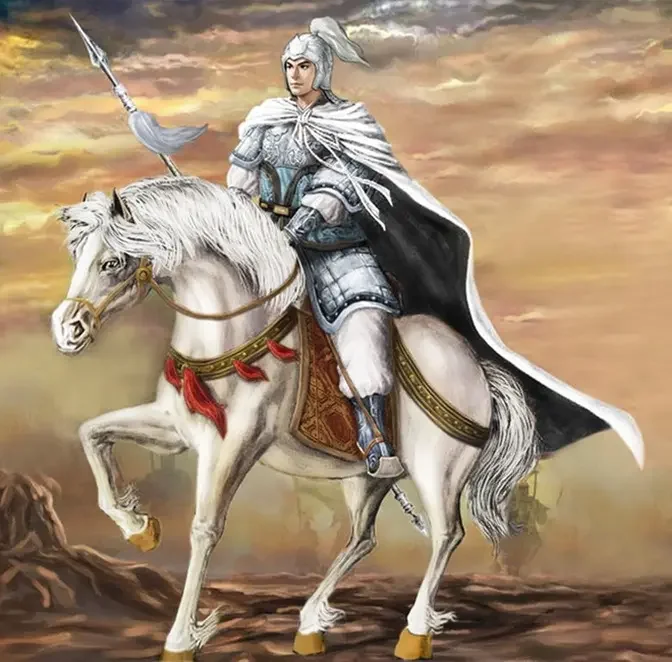

The Biography of Zhao Yun
(Translated from Sanguo Zhi, including texts by both Chen Shou and Pei SongZhi (裴松之, 註引雲別傳)
Zhao Yun, courtesy name Zilong, hailed from the City of Zhending (真定), County of Chang Shan (常山). Literary sources suggest he was 6’2” tall, and describe him as very good-looking with a commanding presence.
Around late 191 AD or early 192 AD, he was elected by his county to lead a group of volunteer soldiers to join the force of Gongsun Zan, a warlord who had great influence over the region. At that time, Gongsun Zan and Yuan Shao, another warlord, were engaged in a feud over the ultimate control of the State of Ji, Jizhou (冀州). The two military powers clashed over the years (from 191 to 199 AD), resulting in one bloody battle after another. Gongsun Zan was concerned that many people from the region went to serve Yuan Shao. He asked Zhao Yun upon his arrival, “People from your state all wish to join Yuan Shao, but you chose me wisely. Is that because you realized that the others have made the wrong decision going to Yuan?” Zhao Yun replied, “The whole country is in chaos and nobody knows who (which warlords) is right and who is wrong. People are suffering as if they were being hanged upside down. Folks from our state have had great discussions about the situation, and have decided we should follow where the righteousness and humanity may lie.”
Zhao Yun began serving under Gongsun Zan, and it was then he met Liu Bei, who was also under the command of Gongsun Zan. The two befriended each other. When Liu was sent by Gongsun to battle against Yuan Shao, Zhao Yun was put in charge of Liu’s cavalry. Soon afterwards, Zhao’s brother passed away, and he requested a leave of absence from Gongsun. Liu Bei realized that Zhao Yun would never return to Gongsun Zan, so upon saying farewells to Zhao, he would not let go Zhao Yun’s hands. Zhao Yun told him firmly, “I would never betray you.” (Note: Second way to translate: "I will never betray justice/righteousness.")
In 200 AD, Liu Bei was defeated by Cao Cao, and took asylum under Yuan Saho in the City of Ye (鄴). Zhao Yun went to Ye, and the two old friends were reunited. There, Liu Bei and Zhao Yun shared the same bed. Liu Bei sent Zhao Yun to secretly recruit hundreds of men, and instructed them to call themselves old members of Liu’s personal militia. Yuan Shao never found out the truth. Later, Liu Bei traveled down to the State of Jin, Jinzhou (荊州). Zhao followed him there.
In 208 AD, Cao Cao soundly defeated Liu Bei in the Battle of Changban. Liu Bei abandoned his wives and children, and escaped south with merely scores of men. Zhao Yun carried Liu Shan, Liu Bei’s one-year-old son, in his own arms, and protected Lady Gan, Liu Shan’s mother, rescuing both. During the battle, someone claimed that Zhao Yun rode north, possibly to defect from Liu Bei. Liu Bei hit the person who made such claim with his sword and said, “Zilong would not have deserted me.” Moments later, Zhao Yun safely returned with both Liu Shan and Lady Gan. Because of his heroism, Liu Bei promoted him to generalship, “General Yamen” (牙門將軍).
After the battle of Red Cliff, Zhao Yun played a major role in conquering territories south to the Yangtze River for Liu Bei. He was named “Pian General” (偏將軍) and was appointed the Administrator of the City of Guiyang (桂陽太守). The former Administrator, Zhao Fan (趙範), had a widowed sister-in-law, Lady Fan (樊氏), whose tremendous beauty could ruin countries and cities. He proposed her to Zhao Yun. However, Zhao Yun politely turned Zhao Fan down, “I share the same surname as you. Therefore I consider Your brother my brother.” (Note: At that time, it was a rule that one should not marry people with the same last name, a rule still stands in parts of Asia today.) Many people thought it would be a great match and suggested to Zhao Yun that he should take Lady Fan as his wife. Zhao Yun explained to them, “Zhao Fan surrendered only recently. His intentions are not yet clear. Besides, there are plenty of women in this world.” In the end, he did not marry Lady Fan. His worries turned out to be true. Zhao Fan later indeed fled from Guiyang. Zhao Yun was not implicated at all in Zhao Fan’s affairs.
Earlier (207 AD), Zhao Yun participated in the Battle of Bowang (博望) against Xiahou Dun (夏侯惇), a general serving Cao Cao. During the battle, Zhao captured Xiahou Lan (夏侯蘭). Zhao Yun and Xiahou Lan were from the same hometown, and they had known each other since childhood. Zhao Yun went to Liu Bei and pled for Xiahou Lan’s life. He suggested to Liu Bei since Xiahou Lan was an expert in law, he could be appointed as an army judge. Liu Bei gave him the consent. However, Zhao Yun never kept Xiahou Lan close to him. He was always very cautious and disciplined.
When Liu Bei entered the State of Yi, Yizhou(益州), he appointed Zhao Yun as the main officer to oversee his base (Liuyin Sima, 留營司馬) in the City of Gongan (公安). Liu’s wife then was Lady Sun (孫夫人), Sun Quan’s sister. Emboldened by her brother’s power and influence, she and her militia often ran wild, breaking many laws. Liu Bei considered since ZhaoYun was serious, firm and unwavering, he must be able to bring everything under control and maintain order. Therefore, Liu Bei gave Zhao Yun the special authority to oversee the internal affairs of Gongan (to keep an eye on Lady Sun and her followers at the same time).
In 214 AD, Liu Bei summoned Zhao Yun along with Zhuge Liang and Zhang Fei into Yizhou. From Jiangzhou (江州), Zhao Yun led a separate force and conquered Jiangyang (江陽), Jianwei (犍為), and later re-joined the other two and Liu Bei at Chengdu (成都). Zhao Yun was named General Xu Jun (詡軍將軍) after Liu Bei claimed Yizhou. Around that time, some made suggestions to Liu Bei that all the generals should be awarded estates/plantations around Chengdu so they could settle in. Zhao Yun argued against the idea. Quoting from the famous Han general Huo Qubing(霍去病), he said, “Huo Qubing once said, ‘The Huns have yet been destroyed, what one needs a home (family) for?’ Right now the enemy of the state is not merely Huns, we cannot settle down with content. It is appropriate for us to wait until after the entire country is united in peace (to settle down). Then we can return to our hometowns to farm our own lands. People of Yizhou have just suffered through many wars. We should return their lands back to them to make them feel grateful. Only then can we levy them and draft them for service.” Liu Bei accepted his advice.
In 219 AD, Liu Bei and Cao Cao were battling over the control of Hanzhong ( 漢中). Cao Cao had huge supplies of rice stocked up near the North Moutain. Zhao Yun sent his soldiers with Huang Zhong, one of Liu Bei’s great generals, to attack Cao Cao’s army and to take the rice. Huang Zhong did not return on time. Along with dozens of men, Zhao Yun went out of his camp to look for Huang. Cao Cao’s main force was marching at that time; Zhao Yun ran into Cao’s vanguards. Not soon after the two sides commenced to engage in battle, Cao Cao’s main force arrived. The situation became very perilous for Zhao Yun, as he and his men were greatly outnumbered. He decided to attack the frontline of Cao Cao’s army. Cao’s men were surprised by the attack and momentarily dispersed. However, they soon regrouped and surrounded Zhao Yun. Zhao Yun fought his way out toward his own camp. When he found out his lieutenant general Zhang Zhu (張著) was wounded and fell behind, he went back to rescue him.
Cao's army pursued Zhao Yun to his camp. At that time, the Administrator of Mianyang (沔陽), Zhang Yi (張翼), was at Zhao Yun’s camp. Zhang thought it best to have all the gates closed in order to defend the camp. However, upon entering the camp, Zhao Yun ordered all the flags to be dropped and hidden, all drums to be silenced, and the gates to be left open completely. Suspicious of an ambush, Cao’s army hastily retreated. Zhao Yun ordered his drummers to beat drums as loudly as they could, and his archers to rain down arrows on Cao’s men. The stunned Cao Army was completely routed. Trying to escape, Cao soldiers rushed toward the River of Han (漢水), and in confusion and panic many were pushed into the river, and drowned.
The day after the battle, Liu Bei arrived to inspect the battlefield. He exclaimed, “Zilong has valor through and through.” He ordered a celebration, complete with wines and music until late that night, in honor of Zhao Yun. From then on, Liu Bei’s army called Zhao Yun "General Huwei", (虎威將軍), “The General with Courage of a Tiger.”
In 221 AD Liu Bei proclaimed to be the Emperor of Shu. At the same time he declared war on Sun Quan’s Kingdom of Wu, out of revenge for the death of Guan Yu and loss of Jingzhou. Zhao Yun made an attempt to dissuade Liu Bei from entering the war. “The enemy of the state is not Sun Quan, but Cao Cao. If we defeated Cao’s Kingdom of Wei first, Sun would have to pay tribute to your majesty. Although Cao Cao is now dead, his son just stole the throne. Your majesty should follow the wills of the people, first conquer Guanzhong (關中), then march to the upper Yellow River and Wei River to combat the true evil (Cao). If we do so, those courageous men from Guandong would come in droves to volunteer for your righteous army. We should not go to war with Wu while leaving Wei untouched. Besides, it is not easy to end a war once it is started.” Liu Bei refused to take the advice and subsequently waged war against Wu. He left Zhao Yun behind to be in command of Jiangzhou. After Liu Bei was defeated in Zigui (秭歸), Zhao Yun’s troops advanced to Yongan (永安). At that time, Wu Army had already retreated.
Liu Bei died in 223 AD. His son Liu Shan succeeded the throne. That year, Zhao Yun was named General Zheng Nan (General who conquers the South, 征南將軍), and Zhong Hujun (Central Military Commander, 中護軍). He was also bestowed the title YongChangTing Hou (Marquis of Yongchang Ting, 永昌亭侯). Soon after, he was promoted to General Zhen Dong (general who guards the east, 鎮東將軍). In 227 AD, Zhao Yun followed Zhuge Liang into Hanzhong to prepare for the first of Northern Expeditions. The next year, Zhuge Liang sent Zhao Yun to Jigu (箕谷) as a decoy against the main force of Wei led by Cao Zhen. Zhuge Liang’s main force suffered a decisive defeat at Jieting(街亭). At the same time and against a far superior force, Zhao Yun was also unable to muster a victory. However, he was able to limit the loss to the minimum by gathering his men immediately and defending his positions steadfastly.
After the whole Shu Army retreated back to Hanzhong, Zhuge Liang asked Deng Zhi(鄧芝), Zhao’s co-commander, “When the main force retreated from Jieting, it was total chaos. Soldiers and commanders could no longer locate each other. However, the retreat from Jigu was orderly and there was no loss of men. What is the reason for the difference?” Deng Zhi answered, “Zhao Yun himself stayed behind to stop Wei Army from pursuing us. Because of him, all the military supplies were saved, and there was no reason for any loss of men.” Zhuge Liang decided to award Zhao Yun and his men with the supplies returned safely by Zhao Yun. Zhao Yun turned down the offer, “Our military just suffered a loss, why should there be any rewards for any of us? Please store the supplies in the warehouses of Chi-an (赤岸) until the winter. Then we can distribute these supplies to the entire army.” Zhuge Liang was very moved by Zhao Yun’s words. However, due to the defeat of the whole Shu army, Zhao Yun was still demoted to General Zhen Jun (General who guards the whole army 鎮軍將軍). (Note: It is also said that burning a 30 mile-long passage along the mountains near Chi-an to prevent Cao Zhen’s pursuit was perhaps the main reason for his demotion.)
Zhao Yun died in 229 AD and was posthumously honored with the title of Shun Ping Hou (Marquis Shun Ping, Smooth and Even, 順平侯). Liu Shan’s order to have Zhao Yun honored said, “When Zhao Yun was serving the late Emperor Liu Bei, his contributions were already remarkable. When I was young, I relied on his loyalty to save me from great danger. That’s why I am bestowing him the honor.” At that time, the Great General Jiang Wei and some other Shu officials also argued that Zhao Yun should be honored. They said, “When Zhao Yun was serving the Late Emperor, his contributions were grand. He helped the late emperor to manage the country, and always followed the laws and rules. His achievements could be written into history books. At the Battle of Changban, he exhibited extraordinary gallantry and chivalry. He was always loyal to his lords, and the Lords remember to award him; He was also gentle toward his fellow officers, so that we almost have forgotten that he had passed away. (Note: a second way to translate: Being loyal to the Lord will be remembered by the Lord when the rewarding time comes, and the lord rewarding his followers accordingly should make his followers more willing to sacrifice their lives). Knowing that such a person and deeds would be granted the highest honor, those in death shall live in eternity, and those who are still alive would be grateful to sacrifice their own lives. According to the rules, (Zhao Yun was)gentle, noble, kind and calm, thus fitting the meaning of “Shun (順).” He was disciplined and orderly in carrying out his duties, thus fitting the meaning of “Ping (平).” He prevented many disasters and quenched many enemies, thus also fitting the meaning of “Ping (平).” Therefore, we should honor him with the title of Shun Ping Hou.” --Only twelve Shu officials were awarded noble titles posthumously. It was considered a great honor by Shu people at that time.
Zhao Yun’s elder son, Zhao Tong (趙統), inherited his title. He became a commander of the Imperial Guards (虎賁中郎) and later a commander for the Central Army (行領軍). Zhao Yun’s second son, Zhao Guang (趙廣), was Lieutenant General Yamen (牙門將 ) and a subordinate of Jiang Wei. He went with Jiang Wei into Tazhong (沓中), and died in combat around 262 AD.
See more :
https://www.ganjing.com/news/1ft9aco3kd44zYW3K9NH2bHc01eg1c
Comments