

Death and posthumous honours[edit]
Zhao Yun died in 229. Zhao was posthumously honoured as "Marquis Shunping" (順平侯; Shùnpíng hóu) by Liu Shan in April or May 261.[63][64]
During Liu Bei's reign, only Fa Zheng received posthumous honours. In Liu Shan's time, only three consecutive heads of government – Zhuge Liang, Jiang Wan and Fei Yi – received posthumous titles. Later, Liu Shan also posthumously honoured Chen Zhi, whom he favoured, and Xiahou Ba, a Wei general who defected to Shu. Guan Yu, Zhang Fei, Ma Chao, Pang Tong, Huang Zhong and Zhao Yun were also awarded posthumous titles by Liu Shan as well. At the time, it was a great honour for a person to receive a posthumous title.[65]
Liu Shan's imperial edict for awarding Zhao Yun his posthumous title read: "Zhao Yun followed the Late Emperor and he made outstanding contributions. I was young then and experienced many difficulties, but I relied on his loyalty and faithfulness to get out of danger. I bestow this posthumous name on him to recognise him for his meritorious service and also because there were others who advised me to do so."[66]
The name of Zhao Yun's posthumous title was suggested by Jiang Wei and others – shun (順; shùn; literally "obey / follow") because he was virtuous and kind, ping (平; píng; literally "peace / pacify") because he performed his duties up to standard and overcame chaos, so shun and ping became "Shunping".[c][68]
Family[edit]
Zhao Yun's eldest son, Zhao Tong (趙統; Zhào Tǒng), served as an officer in the huben (虎賁) division of the imperial guards.[69]
Zhao Yun's second son, Zhao Guang (趙廣; Zhào Guǎng), served as an Officer of the Standard (牙門將). He accompanied the Shu general Jiang Wei in the campaigns against Wei, and was killed in action in Tazhong (沓中; northwest of present-day Zhugqu County, Gansu).[70]
Appraisal[edit]

Zhao Yun (center) surrounded by Cao Cao's generals in the Battle of Changban, from a 2015 Peking opera performance by Shanghai Jingju Theatre Company at Tianchan Theatre, Shanghai.
Chen Shou, who wrote Zhao Yun's biography in the Sanguozhi, commented on Zhao Yun as follows: "Huang Zhong and Zhao Yun were fierce and mighty warriors, just like claws and teeth. Were they the successors to Guan and Teng?"[71]
In Romance of the Three Kingdoms[edit]
Many of Zhao Yun's actual exploits were highly dramatised in the 14th-century historical novel Romance of the Three Kingdoms. In the novel, Zhao Yun is portrayed as an almost perfect warrior – one who possesses powerful combat skills, unwavering loyalty to his lord, tremendous courage, keen intelligence, and serene charisma. These traits have often been reflected in nearly all modern materials about Zhao Yun to date.
See the following for some fictitious stories in Romance of the Three Kingdoms involving Zhao Yun:
- Battle of Changban#In Romance of the Three Kingdoms
- Battle of Xiaoting#In Romance of the Three Kingdoms
In popular culture[edit]

Mask of Zhao Yun used in folk opera
Zhao Yun has been featured prominently in Chinese and Japanese popular culture, literature, art and anecdotes. Zhao Yun was already a relatively well-known hero from the Three Kingdoms period, as folktales about his exploits have been passed down through centuries. He became a household name due to the popularity of the 14th-century historical novel Romance of the Three Kingdoms.
Religion[edit]
Zhao Yun sometimes appears as a door god in Chinese and Taoist temples in Henan, usually in partnership with Ma Chao.
Folklore[edit]
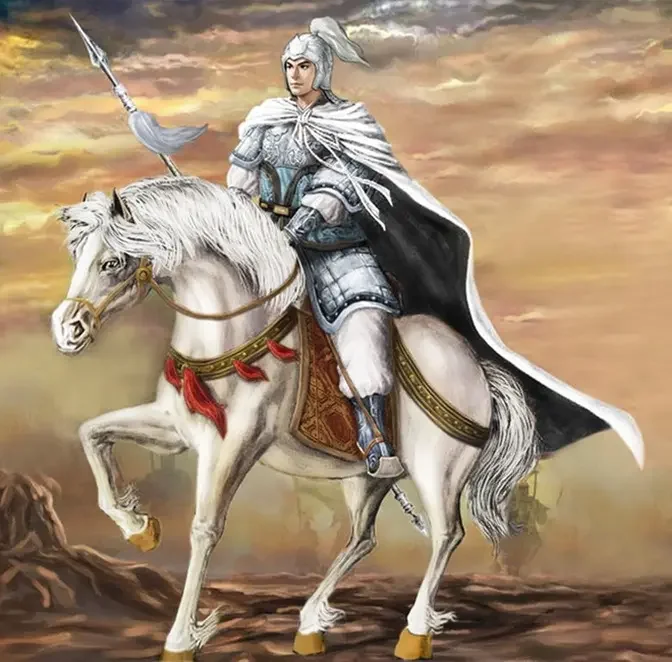
Zhao Yun is strongly associated with the color white in several Three Kingdoms media, which is a callback to his appearance as stated in Romance of the Three Kingdoms. People can see an interpretation of him in the Summer Palace, which has a famous painting of his heroics at Changban.[citation needed] White is linked to several positive traits within various fictional mediums, including honesty, virtue, purity and so on.[citation needed] One other reason for Zhao Yun being linked with the color may be due to a myth regarding the horse the general favored.[citation needed] A quick steed in its own right, it is fabled to run one thousand leagues during the day and five hundred leagues at night. The horse's name is supposedly the "White Dragon Horse" (白龍駒, Bailongju).[citation needed]
Another strong image for Zhao Yun in various Three Kingdoms fiction is the idea of him wielding a spear, often said to be a long spear.[citation needed] Its name is roughly translated as "Shore Edge Spear" (涯角槍, Yajiaoqiang) in legends and it allegedly makes an unnamed appearance in the Sanguozhi Pinghua.[citation needed] The weapon's revered namesake means that it "[has] none surpassing it, even in the heavenly sea of stars". Measuring in at a length of nine chi (approximately three meters or ten feet in modern conversions), Zhao Yun is said to have wielded it with magnificent skill.[citation needed] If one is to believe the tales, Zhao Yun used the same spear to defeat Zhang Fei in a duel. At times, Zhao Yun is associated with one of Cao Cao's twin swords from Romance of the Three Kingdoms. In this tale, he killed Xiahou En while rescuing A Dou from peril.[citation needed]
There is a Chinese folktale about Zhao Yun's death which is not mentioned in the 14th-century novel Romance of the Three Kingdoms.[citation needed] In this story, Zhao Yun had never been wounded in battle before so there were no scars on his body.[citation needed] One day, while he was taking a bath, his wife pricked him with a sewing needle out of mischief.[citation needed] Zhao Yun began to bleed profusely and eventually died of shock.[citation needed]
Comments