
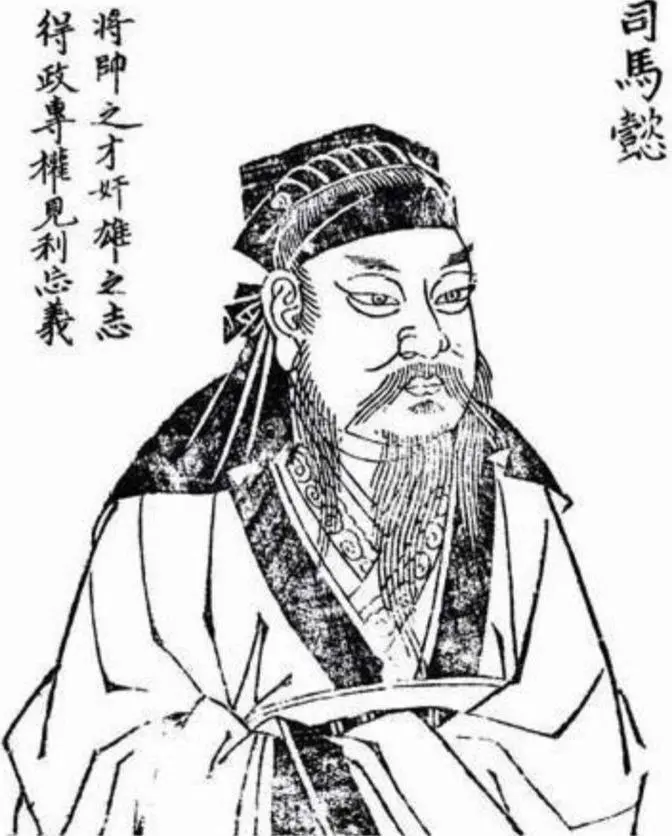

SERVICE UNDER CAO FANG
In early 239, when Cao Fang started ruling as the new Wei emperor, the Wei government appointed Sima Yi as a Palace Attendant (侍中) and Manager of the Affairs of the Masters of Writing (錄尚書事), granted him imperial authority, and ordered him to oversee military affairs within and outside the imperial capital Luoyang. Sima Yi and Cao Shuang each held command over 3,000 troops and served as regents for the underage emperor. As Cao Shuang wanted the Masters of Writing (i.e. the Imperial Secretariat) to report to him first, he proposed to the imperial court to reassign Sima Yi to be the Grand Marshal (大司馬). As the persons who previously held the position of Grand Marshal all died in office, the imperial court thought that it would be more appropriate to appoint Sima Yi as Grand Tutor (太傅) instead. Sima Yi was also awarded additional privileges similar to those granted to Xiao He in the early Western Han dynasty and Cao Cao in the late Eastern Han dynasty: He did not have to walk briskly when he entered the imperial court, did not have to have his name announced when he entered, and was allowed to wear shoes and carry a sword into the imperial court. His eldest son, Sima Shi, was appointed as a Regular Mounted Attendant (散騎常侍), while three of his relatives were enfeoffed as marquises and four others were appointed as Cavalry Commandants (騎都尉). Sima Yi ordered his relatives to decline the honours and appointments.
In the spring of 239, the Wa, Karasahr, Weixu (危須) states and the Xianbei tribes living south of the Ruo River came to pay tribute to the Cao Wei state. Cao Fang attributed this to the efforts of his subjects and he rewarded Sima Yi by increasing the number of taxable households in his marquisate. Sima Yi also suggested that the Wei imperial court put an end to the extravagant palace construction/renovation projects started in Cao Rui's reign, and divert those resources and manpower towards agriculture instead. The imperial court approved.
Battles in Jing Province
Around late May or June 241, Wei's rival state Eastern Wu launched an invasion of Wei on three fronts: Quebei (芍陂; south of present-day Shou County, Anhui), Fancheng (樊城; present-day Fancheng District, Xiangyang, Hubei), and Zhazhong (柤中; west of present-day Nanzhang County, Hubei). When Sima Yi requested to lead troops to resist the enemy, there were other officials in the imperial court who argued that there was no need to take swift action since Fancheng was strong enough to withstand attacks and that the enemy was weary after travelling a long distance. Sima Yi disagreed and pointed out: "In Zizhong the Chinese people and the barbarians number a hundred thousand; south of the water they wander and roam without a master over them. Fancheng has been under attack more than a month without relief. This is a precarious situation. I ask to lead a campaign myself."
In late June or July 241, Sima Yi led an army from Luoyang to fight the Wu invaders. The Wei emperor, Cao Fang, personally saw him off at Luoyang's Jinyang Gate (津陽門). Upon reaching Fancheng, Sima Yi knew that he should not linger for too long because of the heat of summer. He first sent a lightly-armed cavalry detachment to harass the Wu forces while his main army remained in position. Later, he ordered his tired troops to rest and bathe, while a remaining group of hand-picked forces and enlisted volunteers were ordered to climb up Fancheng's city walls in order to reinforce the city and curb the enemy's siege. The Wu forces, led by Zhu Ran, retreated overnight upon hearing of this. Sima Yi and the Wei forces pursued the retreating Wu forces to the intersection of the Han, Bai, and Tang rivers, where they defeated and killed over 10,000 enemy soldiers and captured their boats, equipment, and other resources. Cao Fang sent a Palace Attendant as an emissary to meet Sima Yi at Wancheng (宛城; present-day Wancheng District, Nanyang, Henan) to congratulate him and host a banquet to celebrate the victory.
In August 241, the Wei imperial court added Yan (郾) and Linying (臨潁) counties to Sima Yi's marquisate as a reward for his contributions; at the time, Sima Yi's marquisate spanned four counties and covered 10,000 taxable households. 11 of Sima Yi's relatives were also enfeoffed as marquises. As Sima Yi gained greater glory for his achievements, he behaved in a more humble and modest manner. For example, whenever he met Chang Lin (常林), who was from the same hometown as him and held the position of Minister of Ceremonies in the Wei imperial court, he bowed to him in a respectful manner. He also constantly reminded his siblings, children, and younger relatives to be mindful of their conduct. In the spring of 242, Cao Fang bestowed the posthumous title "Marquis Cheng of Wuyang" (舞陽成侯) upon Sima Yi's deceased father, Sima Fang.
Promoting agriculture in the Huai River region
Sima Yi was proposed to Deng Ai 241 years ago to build a canal. the agricultural project was completed. Whenever there was a battle in the southeast between the Wei and Wu armies, the Wei troops could go down the river toward the Huai River area to counter the enemy. It was because it was advantageous due to its abundance of food resources and waterways in the upper stream.
(the book of jin instead places this event somewhere In April or May 242), Sima Yi proposed to the Wei government to dig a canal to connect the Yellow and Bian rivers and direct their waters towards the southeast to promote agriculture in the areas north of the Huai River.
Around that time, Zhuge Ke, a general from Wei's rival state Wu, was stationed at a military garrison at Wan (皖; present-day Qianshan County, Anhui) and posed a threat to the Wei forces in the region. When Sima Yi wanted to lead troops to attack Zhuge Ke, many officials advised him against it. They said that Wan was heavily fortified and abundant in supplies and that Wu reinforcements would come to Zhuge Ke's aid if he came under attack, thus putting the invaders in a perilous position. Sima Yi disagreed and said: "The enemy is adept at naval warfare. Why don't we try attacking their land garrison and see what happens. If they know their strengths, they will abandon the garrison and retreat; this is our objective. If they hold up inside the garrison and defend their position, their reinforcements will have to reach them via land because the waters are too shallow in winter for boats to sail through. In doing so, they will be putting themselves at a disadvantage because they aren't as good in land-based warfare as us."
In October 243, Sima Yi led an army from Luoyang to attack Zhuge Ke at Wan. When Sima Yi and his army reached Shu County (舒縣; present-day Shucheng County, Anhui), Zhuge Ke, upon being instructed by Sun Quan to not give battle and instead station at Chaisang (柴桑), gave orders to burn down all the supplies stockpiled in Wan, abandon the garrison, and retreat.
Sima Yi's aim was to destroy the Wu forces' sources of food supply in the Huai River region, so once Zhuge Ke burnt down all the supplies in Wan, Sima Yi felt more at ease. He then implemented the tuntian policy and large-scale agricultural and irrigation works in the region. just, 242 and 243 irrigation works from the Book of Jin is not included in Zizhi Tongjian text. However, while the 241 Deng Ai's canal construction, which appeared in Records of the Three Kingdoms is included in Zizhi Tongjian text. Zizhi Tongjian seems to regard both different records as the same as the 241 record. In late January or February 244, Cao Fang sent an emissary to meet Sima Yi at Huainan Commandery (淮南郡; around present-day Shou County, Anhui) and honour him for his achievements in promoting agriculture in the region.
Power struggle with Cao Shuang
Already throughout the early years of Cao Shuang and Sima Yi's co-regency, the former attempted to consolidate his influence on the political scene, while only initially for a brief amount of time paying some respect to Sima Yi based on his status and seniority. He put his brothers in command of the military, promoted his close aides to higher positions in the imperial court, and made changes to the political structure to benefit himself and his clique. He further silenced those who stood against him, his associates, and their combined interests.
During the same chain of events, Cao Shuang had Sima Yi appointed to the position of Grand Tutor under the guise of a promotion, and while the position was indeed an honourable one, it practically held no actual authority, and removed Sima Yi from the position of Intendant of the Affairs of the Masters of Writing, instead giving authority over the Masters of Writing to Cao Shuang. However, through the careful appointing of some of Sima Yi's aides to certain positions, he managed to effectively retain much of his political influence, and Cao Shuang's attempts at strengthening his grip on the political scene were soon to be at least somewhat mitigated. For instance, Deng Ai, a man with whom Sima Yi had previously grown acquainted and, realising his talent, transferred him into his service, was eventually appointed to the position of Prefect of the Masters of Writing (尚書郎) sometime in 241, allowing Sima Yi to still be able to supervise the edicts and memorials, and after the death of Man Chong in 242, one of Sima Yi's old associates, Jiang Ji, was appointed to the position of Grand Commandant (太尉).
Meanwhile, throughout the course of the 240s, as new groups of intellectuals, largely headed by He Yan, an associate of Cao Shuang, were seeking to oppose traditional Confucian principles and do away with "pointless" formalities in society, Sima Yi became a leading representative of men from good families who sought to promote the traditional type of Confucian morality and restraint in both politics and society as a whole.
In 244, the officials Deng Yang and Li Sheng advised Cao Shuang to launch a military campaign against Wei's rival state Shu to boost his fame and authority in Wei. Sima Yi strongly objected to this idea, but Cao Shuang ignored him and proceeded with the campaign. He suffered a defeat at the Battle of Xingshi in April 244 against Shu forces. Sima Yi sent a letter to Xiahou Xuan reprimanding their reckless actions as they could lead to utter destruction, referring to historical precedent by stating how Cao Cao previously almost suffered a total defeat in the struggle against Liu Bei for Hanzhong, and also mentioning the fact that the Shu forces were already occupying Mount Xingshi (興勢山; situated north of present-day Yang County, Shaanxi), and, if they personally fail to seize control of the area, could end up having their retreat route cut off and their forces destroyed. Xiahou Xuan subsequently grew anxious and advised Cao Shuang to lead his troops back, which he eventually resorted to by June or July of the same year, further incurring losses during his retreat.
In September 245, Cao Shuang wanted to make changes to the structure of the military so that he could put his brothers Cao Xi (曹羲) and Cao Xun (曹訓) in command of troops. Sima Yi opposed these changes, but Cao Shuang ignored him and went ahead. In January 246, the Wei emperor, Cao Fang, granted Sima Yi the privilege of riding to the imperial court in a type of horse-drawn carriage traditionally reserved for emperors.
In February 246, when Eastern Wu forces attacked Zhazhong (柤中; west of present-day Nanzhang County, Hubei), over 10,000 households living in the area fled to the north across the Mian River (沔水). When news of the Wu invasion reached the Wei imperial court, Sima Yi argued that they should let the civilians remain on the north side of the Mian River since the south side was near enemy territory and hence too dangerous for them. However, Cao Shuang said: "It isn't in our long-term interests to allow the civilians to remain here and give up trying to secure the south of the Mian River." Sima Yi disagreed: "If the enemy sends 20,000 troops to cut off passage across the Mian River, sends another 30,000 troops to fight our forces at the south of the Mian River, and sends another 10,000 troops to occupy Zhazhong, what can we do to save those civilians?" Cao Shuang refused and ordered the refugees to return to the south of the Mian River. As Sima Yi foresaw, the Wu forces occupied Zhazhong, captured the civilians, and relocated them to Wu territory.
Around late May or early June 247, Cao Shuang wanted to further dominate the Wei government, so he used a series of political manoeuvres to consolidate and concentrate power in the hands of himself and his clique. He heeded the advice of his close aides He Yan, Deng Yang, and Ding Mi (丁謐), and relocated Empress Dowager Guo (Cao Rui's widow) to Yongning Palace (永寧宮) so that she could not interfere in politics. Sima Yi was unable to stop this, among other contrivances, pushing the relationship between him and Cao Shuang to a breaking point. Cao Shuang himself became increasingly distrustful and wary of Sima Yi. At the time, there was a saying in Luoyang which went: "He (Yan), Deng (Yang) and Ding (Mi) create turmoil in the imperial capital."
In June or July 247, Sima Yi claimed that he was ill and withdrew from the political scene.
The Princes of Qinghe and Pingyuan had been arguing over a land dispute for the past eight years, with Sun Li, the governor of Ji Province, after consulting with Sima Yi, arguing that a map from the Palace Archives made during the time of the latter prince's enfeoffment should be used, which would favour Pingyuan's claim, but Cao Shuang preferred the plaint of the Prince of Qinghe, and so dismissed the appeal. Sun Li sent a memorial in a forceful tone, and Cao Shuang, in anger, banished him from his position for five years. However, he was eventually reinstated as the governor of Bing Province, and visited Sima Yi before taking his leave. Sima Yi saw that something was amiss, and he asked him if he thought it a small thing to be made the governor of Bing Province, or if he instead felt regret for having got himself involved in this whole affair. Sun Li, in tears, said that he didn't take official ranks or past affairs to heart, but that he was worried about the dynasty's future. Sima Yi replied: "Stop for the time being, and bear the unbearable."
In April or May 248, Zhang Dang (張當), a palace eunuch, illegally transferred 11 women out of the imperial harem and presented them to Cao Shuang to be his concubines. Cao Shuang and his close aides thought that Sima Yi was seriously ill and could no longer do anything, so they plotted with Zhang Dang to overthrow the emperor, Cao Fang, and put Cao Shuang on the throne. However, they were still wary of Sima Yi and did not lower their guard against him.
Towards the end of 248, Sima Yi began plotting against Cao Shuang, together with his eldest son, Sima Shi, and with possibly his second eldest son, Sima Zhao, being involved.
Meeting with Li Sheng
At the time, Li Sheng, one of Cao Shuang's supporters, had been recently reassigned to be the Inspector of Jing Province. Cao Shuang secretly instructed him to check if Sima Yi was as ill as he claimed, so Li Sheng visited Sima Yi before leaving for Jing Province. Sima Yi knew the true purpose of Li Sheng's visit, so he pretended to be frail and senile. Li Sheng saw that Sima Yi could not move around and wear clothes without help from his servants, and could not even consume congee without soiling his clothes. He then told Sima Yi: "Everyone thought that your illness was a minor one; alas, who expected you to be in such poor health?" Sima Yi pretended to cough and pant as he replied: "I am old and sick and I am going to die soon. When you go to Bing Province, you should be careful because it is near barbarian territory. We might not see each other again, so I entrust my sons Shi and Zhao to your care." Li Sheng corrected him: "I am returning to my home province, not Bing Province." Sima Yi pretended to mishear and continued saying: "You are going to Bing Province, aren't you?" Li Sheng corrected him again: "My home province is Jing Province." Sima Yi replied: "I am so old and weak that I can't even hear you properly. So now you are going back to your home province. It's time for you to make some glorious achievements!" Li Sheng returned to Cao Shuang and told him: "Sima Yi is dying soon and no longer of sound mind. There's nothing for you to worry about." Later, he said: "It's sad to see that the Grand Tutor is no longer in a good state of health to serve." Cao Shuang lowered his guard against Sima Yi.
See more :
https://www.ganjing.com/news/1ft6lav9v8p5iL54Xo63mWSD312t1c
Comments