
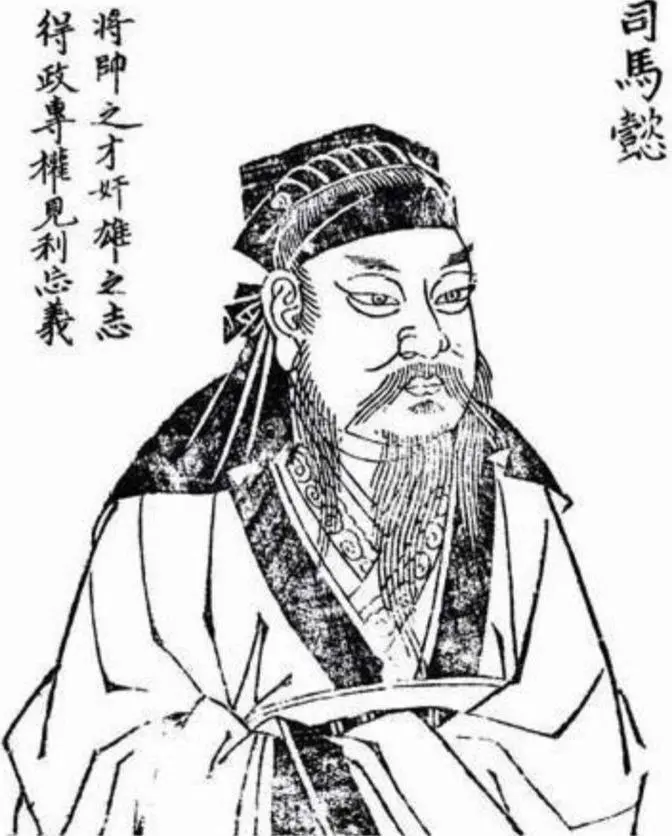

Around that time, the Wei government observed that since the Shu army was far away from its base at Hanzhong Commandery, it would not be in its interest to fight a prolonged war in enemy territory, so it would be better for the Wei army to adopt a defensive posture against the Shu invaders. The Wei emperor, Cao Rui, thus ordered Sima Yi to hold his position and refrain from engaging the Shu forces in battle. Zhuge Liang attempted to lure Sima Yi to attack him; on one occasion, Zhuge Liang supposedly sent Sima Yi women's ornaments to taunt him. Sima Yi, apparently feeling enraged, sought permission from Cao Rui to attack the enemy, but was denied. The emperor even sent Xin Pi, bearing the imperial sceptre (a symbol of the emperor's authority), to the battlefield to make sure that Sima Yi followed orders and remained in camp. Zhuge Liang knew that Sima Yi was pretending to be angry because he wanted to show the Wei soldiers that he would not put up with the enemy's taunting, and to ensure that the Wei soldiers were ready for battle.
According to the Book of Jin, when Sima Fu wrote to Sima Yi to ask him about the situation at the Wuzhang Plains, Sima Yi replied by saying: "Zhuge Liang has big ambitions but he fails to recognise opportunities. He is full of wits but not decisive. He likes leading troops into battle even though he does not have much authority over them. Even though he has 100,000 troops under his command, he has already fallen into my trap and I'll certainly defeat him." When Zhuge Liang's envoy visited Sima Yi's camp, the latter allegedly inquired about his sleeping and eating habits, along with how busy he was. When told how Zhuge Liang consumed little and didn't sleep much, Sima Yi said to his men: "Zhuge Kongming takes little food and does much work; how can he last long?"
Meanwhile, Sima Yi also provokes Zhuge Liang. Sima Yi made some 2,000 people cheer on the southeast corner of the compound. When Zhuge Liang sent a man to find out, he said, "Eastern Wu's envoy came and said he would surrender." Zhuge Liang knew this and said, "Eastern Wu will not surrender. Sima Yi is an old man who will soon be 60 years old, does he need to use this trick?"
After a standoff lasting more than 100 days, Sima Yi heard from civilians that Zhuge Liang had died from illness and the Shu army had burnt down their camp and retreated. He then led his troops to pursue the enemy and caught up with them, but withdrew when the Shu forces got into battle formation. Some days later, Sima Yi surveyed the remains of the Shu camp and thereafter reportedly exclaimed: "He was a genius." He also concluded that Zhuge Liang was indeed dead when he saw that the Shu army had hastily retreated. Xin Pi felt that they could not be certain about Zhuge Liang's death yet, but Sima Yi said: "The most important things in an army are its documents, troops, horses, and supplies. (Zhuge Liang) has abandoned all of them. How can a person lose his five most important organs and still be alive? We should quickly pursue (the enemy)." The ground in the Guanzhong region was full of devil's weed so Sima Yi sent 2,000 men wearing wooden clogs with flat soles to clear the path before his main army advanced and continued pursuing the enemy, although he retreated when he eventually encountered the Shu forces. When Sima Yi reached Chi'an (赤岸), he asked the civilians living there about Zhuge Liang and heard that there was a saying: "A dead Zhuge (Liang) scares away a living Zhongda." When Sima Yi heard that, he laughed and said: "I can predict the thoughts of the living but I can't predict the dead's."
In 235, Sima Yi was promoted to Grand Commandant (太尉) and had the number of taxable households in his marquisate increased. In the same year, when the Shu general Ma Dai led troops to invade Wei, Sima Yi sent Niu Jin to lead Wei forces to resist the invaders. Niu Jin defeated Ma Dai and killed more than 1,000 enemy soldiers. However, This account from the Book of Jin is not included in Zizhi Tongjian text. When a famine broke out in Guandong (關東; referring to the area east of Hangu Pass), Sima Yi had more than five million hu of grain transported from Chang'an to Luoyang to aid in disaster relief efforts.
Around this time, Sima Yi established a military market at Chang'an. When an official named Yan Fei (顏斐) reported that the soldiers were insulting the people living there, he summoned the market captain and personally flogged him 100 times in front of Yan Fei, and thereafter strictly supervised the conduct of all the officials and soldiers.
Liaodong campaign
In 236, Sima Yi caught a white deer, which was regarded as an auspicious animal, and presented it to the Wei emperor, Cao Rui. Cao Rui said: "When the Duke of Zhou assisted King Cheng in governance, he presented white pheasants to the king. Now you are in charge of Shaanxi and you present a white deer. Isn't this a sign of loyalty, cooperation, long-lasting stability, and peace?" Later, when Cao Rui asked for capable and virtuous men to be recommended to him, Sima Yi chose to recommend Wang Chang.
Around that time, Gongsun Yuan, a warlord based in Liaodong Commandery (in present-day Liaoning) who previously pledged allegiance to the Wei state, started a rebellion and declared independence, defeating the general Guanqiu Jian in an engagement.
In January 238, Cao Rui summoned Sima Yi back to the imperial capital Luoyang to lead a campaign against Liaodong. When asked by the emperor as to how Gongsun Yuan will respond, Sima Yi stated that there were three choices available: to flee, to resist, and to defend his capital city, with the last being the worst choice, and the one he was most likely going to employ against Sima Yi after putting up some initial resistance. When further asked by the emperor on how long it will take, Sima Yi said that he needed only one year in total to lead the troops to Liaodong, to suppress the revolt, and to then return and repose. At the time, the Wei government had forced many men into military service or recruited them for manual labour to work on Cao Rui's palace construction/renovation projects. Sima Yi felt that doing so would increase the burden on the common people and make them resent the Wei government, so he advised Cao Rui to halt the projects and focus on dealing with the more pressing issues.
Thereafter, Sima Yi set out with an army of 40,000 men from Luoyang to attack Liaodong, with Niu Jin and Hu Zun (胡遵) serving as his subordinates. Cao Rui personally saw him off at Luoyang's Ximing Gate (西明門), where he ordered Sima Yi's brother Sima Fu and son Sima Shi, as well as other officials to attend the ceremony. During the extensive and lively festivities, in which Sima Yi met with elders and old friends, he began sighing and, feeling emotional and dissatisfied, sang a song:
Heaven and Earth unfold and open up, (the) Sun and Moon are very bright.
Coming to a border meeting, a final effort in distant lands.
(I am) about to seep away the dirty pack, returning to pass by the old hometown.
Respectful and pure for ten thousand li, all equally in every direction.
Announcing success and returning in old age, awaits not in Wuyang. [Wuyang was his fief]
Thereupon he finally advanced with the army, which would later be reinforced by Guanqiu Jian's own forces in You Province, which included the Xianbei auxiliary led by Mohuba (莫護跋), ancestor of the Murong clan. The Wei army reached Liaodong in June 238, and as Sima Yi had anticipated, Gongsun Yuan had sent his Grand General Bei Yan (卑衍) and Yang Zuo (楊祚) to face him. They built their camps along the Liao River in anticipation of him. The Wei generals wanted to directly attack the enemy on the banks of the river, but Sima Yi reasoned that attacking the encampment would only wear themselves out and deplete their valuable resources; on the other hand, since the bulk of the Liaodong army was at the Liao River, Gongsun Yuan's headquarters at Xiangping (襄平; present-day Liaoyang), the capital of the Liaodong Commandery, would be comparatively empty and the Wei army could take it with ease. Sima Yi therefore decided to dispatch Hu Zun with a contingent of his army south with numerous banners and drums, so as to indicate that he was going to make a sortie there with a large force. This deceived Bei Yan and his men, who pursued the decoy unit, whereby Hu Zun, having lured the enemy out, crossed the river and broke through Bei Yan's line, while Sima Yi managed to secretly cross the river to the north, sink the boats, burn down the bridges, build up a long barricade along the river, and then march for the capital itself. Once the opposing generals realised they had fallen for a feint, they started marching back in haste towards the capital, and in the night while heading north to intercept Sima Yi, as had been expected of them, they caught up at Mount Shou (首山; a mountain west of Xiangping), where Bei Yan was ordered to give battle, and was subsequently routed and crushed by Sima Yi and his army. Sima Yi then marched towards Xiangping unopposed, and started besieging it.
Along with the month of July came the summer monsoons, which had impeded Guanqiu Jian's campaign a year ago. There was a constant heavy downpour for more than a month, so that even ships could sail the length of the flooded Liao River from its mouth at the Liaodong Bay up to the walls of Xiangping. Despite the water being several feet high on level ground, Sima Yi was determined to maintain the siege regardless of the clamours of his officers who proposed changing camps; threatening to execute those who advocated for the idea, such as one of the officers, Zhang Jing, who violated the order. The rest of the officers subsequently became silent.
Because of the floods, the encirclement of Xiangping was by no means complete, and the defenders used the flood to their advantage to sail out to forage and pasture their animals. Sima Yi forbade his generals from pursuing the foragers and herders from Xiangping, and upon being questioned by one of his subordinates, stated: "Meng Da's multitudes were small, but he had food and supplies for a year. My generals and soldiers were four times those of Da, but with provisions not even for a full month. Using one month to plot against one year, how could I not be quick? To use four to strike against one, if it merely makes half be eliminated, I would still do it. In this case, I consider not calculations on death and injuries, I compete against provisions. Now, the rebels are numerous and we are few; the rebels are hungry and we are full. With flood and rain like this, we cannot employ our effort. Even if we take them, what is the use? Since I left the capital, I have not worried about the rebels attacking us, but have been afraid they might flee. Now, the rebels are almost at their extremity as regards supplies, and our encirclement of them is not yet complete. By plundering their cattle and horses or capturing their fuel-gatherers, we will be only compelling them to flee. War is an art of deception; we must be good at adapting ourselves to changing situations. Relying on their numerical superiority and helped by the rain, the rebels, hungry and distressed as they are, are not willing to give up. We must make a show of inability to put them at ease; to alarm them by taking petty advantages is not the plan at all."
The officials back in the Wei imperial court in Luoyang were also concerned about the floods and proposed recalling Sima Yi. The Wei emperor, Cao Rui, being completely certain in Sima Yi's abilities, turned the proposal down. Around this time, the Goguryeo king sent a noble (大加; taeka) and the Keeper of Records (主簿; jubu) of the Goguryeo court with several thousand men to aid Sima Yi.
On 3 September, a comet was seen in the skies of Xiangping and was interpreted as an omen of destruction by those in the Liaodong camp. A frightened Gongsun Yuan sent his Chancellor of State Wang Jian (王建) and Imperial Counsellor Liu Fu (柳甫) to negotiate the terms of surrender, where he promised to present himself bound to Sima Yi once the siege was lifted. Sima Yi, wary of Gongsun Yuan's double-crossing past, executed the two, explaining his actions in a message to Gongsun Yuan that he desired nothing less than an unconditional surrender: "In ancient times, Chu and Zheng were classed as states of equal footing, yet the Earl of Zheng nevertheless met the Prince of Chu with his flesh bare and leading a sheep. I am a superior Ducal Minister of the Son of Heaven, yet Wang Jian and his following wanted me to raise the siege and withdraw my men. Is this proper? These two men were dotards who must have failed to convey your intentions; I have already put them to death (on your behalf). If you still have anything to say, then send a younger man of intelligence and precision."
When Gongsun Yuan sent Wei Yan (衛演) for another round of talks, this time requesting he be allowed to send a hostage to the Wei court, Sima Yi dismissed the final messenger as a waste of time: "In military affairs there are five essential points. If able to fight, you must fight. If not able to fight, you must defend. If not able to defend, you must flee. The remaining two points entail only surrender or death. Now that you are not willing to come bound, you are determined to have death; there is no need of sending any hostage." Apparently, Sima Yi's previous suggestion of further negotiations was nothing more than an act of malice that gave false hope to Gongsun Yuan while prolonging the siege and placing further strain on the supplies within the city.
When the rain stopped and the floodwater got drained away, Sima Yi hastened to complete the encirclement of Xiangping. The siege carried on day and night, which utilised mining, hooked ladders, battering rams, and artificial mounds for siege towers and catapults to get higher vantage points. The speed at which the siege was tightened caught the defenders off guard: since they had been obtaining supplies with such ease during the flood, there apparently was not any real attempt made to stockpile the goods inside Xiangping, and as a result, famine and cannibalism broke out in the city. Many Liaodong generals, such as Yang Zuo, surrendered to Sima Yi during the siege.
On 29 September, the famished Xiangping fell to the Wei army. Gongsun Yuan and his son Gongsun Xiu (公孫脩), leading a few hundred horsemen, broke out of the encirclement and fled to the southeast. The main Wei army gave pursuit and killed both father and son on the Liang River (梁水; present-day Taizi River). Gongsun Yuan's head was cut off and sent to Luoyang for public display. A separate fleet led by future Grand Administrators Liu Xin (劉昕) and Xianyu Si (鮮于嗣) had been sent to attack the Korean commanderies of Lelang and Daifang by sea, and in time, all of Gongsun Yuan's former holdings were subjugated.
After his army occupied Xiangping, Sima Yi erected a pair of guideposts to separate recent and long-time serving government officials and military personnel of Gongsun Yuan's disestablished regime, and thereafter ordered a systematic purge of some 2,000 officials. He also had some 7,000 men aged 15 and above from within the city executed and raised a victory mound (京觀) with their corpses, while pardoning all the remaining survivors. In total, Sima Yi's conquest gained Wei an additional 40,000 households and over 300,000 citizens, although Sima Yi did not encourage these frontier settlers to continue their livelihoods in the Chinese northeast and instead ordered that those families who wished to return to central China be allowed to do so. Sima Yi also posthumously rehabilitated and erected mounds over the graves of Lun Zhi (倫直) and Jia Fan (賈範), two officials who had attempted to stop Gongsun Yuan from rebelling but were executed by him, and also freed Gongsun Gong, the previous Administrator of Liaodong, who had been imprisoned by his nephew Gongsun Yuan, with all of this being carried out under an order which stated: "During the ancients' attacks on states, they executed their fiercest enemies [literally: "whales" (鯨鯢)], and that was all. Those who were deceived and misled by Wenyi, all are forgiven. People of the Central States who desire to return to their old hometowns are free to do so."
At the time, as it was winter, many soldiers were suffering from the cold and wanted extra clothing to keep themselves warm. When someone pointed out that they had a surplus of ru (襦; a type of short coat) and suggested giving them out to the soldiers, Sima Yi said: "The padded coats are the property of the government. No one is allowed to give them to others without permission." Sima Yi did, however, memorialise that all soldiers aged 60 and above, numbering over 1,000 men, to retire from their service, and for the dead and wounded to be sent home. As Sima Yi led the troops back to Luoyang from Liaodong, Cao Rui sent an emissary to meet them in Ji County (薊縣; in present-day Beijing) and host a party to celebrate the victory. He also added Kunyang County (昆陽縣; present-day Ye County, Henan) to Sima Yi's marquisate, so Sima Yi had a total of two counties as his marquisate.
Appointment as regent
When Sima Yi arrived at Xiangping, he allegedly dreamt that Cao Rui requested him to look at his face, and upon witnessing it, saw that it appeared different than usual, and Sima Yi sensed that something was wrong. Later, when Sima Yi was in Ji County (汲縣; in present-day Xinxiang, Henan), Cao Rui issued an imperial order instructing him to return to Luoyang via a faster route through the Guanzhong region. When Sima Yi reached Baiwu (白屋), he received another five orders within three days. Sensing the urgency of the situation, he boarded a zhuifengche (追鋒車) and travelled overnight across the Baiwu region over a distance of more than 400 li, while stopping only once for a brief moment of rest, and reached Luoyang by the following day. Upon arrival, he was led to the bedroom of the Jiafu Hall (嘉福殿) in the imperial palace to meet Cao Rui and saw that the emperor was critically ill. With tears in his eyes, Sima Yi asked Cao Rui about his condition. Cao Rui held Sima Yi's hand and told him: "I have matters to entrust you. Now that I meet you one last time before I die, I have no more regrets." Cao Rui called into his chambers the Prince of Qin, Cao Xun, and the Prince of Qi, Cao Fang, and while pointing towards Cao Fang stated: "This is he. Look at him carefully and do not make any mistake." Cao Rui had Cao Fang subsequently embrace Sima Yi's neck. Sima Yi hit his forehead on the floor and started weeping. Cao Rui thereafter designated Sima Yi as a regent for the young Cao Fang, along with another co-regent, the general Cao Shuang, who himself had already been designated for the position at a prior date.
Before his death, Cao Rui had initially planned to exclude Sima Yi from the regency and instead appoint Cao Yu, Xiahou Xian (夏侯獻), Cao Shuang, Cao Zhao, and Qin Lang as the regents. However, two of his close aides, Liu Fang (劉放) and Sun Zi (孫資), who were not on good terms with Xiahou Xian and Cao Zhao, managed to persuade him to not just exclude those two, but Qin Lang and Cao Yu as well, thereby simply having Cao Shuang and Sima Yi appointed as the regents instead.
See more :
https://www.ganjing.com/news/1ft6ku1bims4AX61BDrULNzdp1ar1c
Comments