
Light and Luscious: Jacques Pépin: More Fast Food My Way | KQED
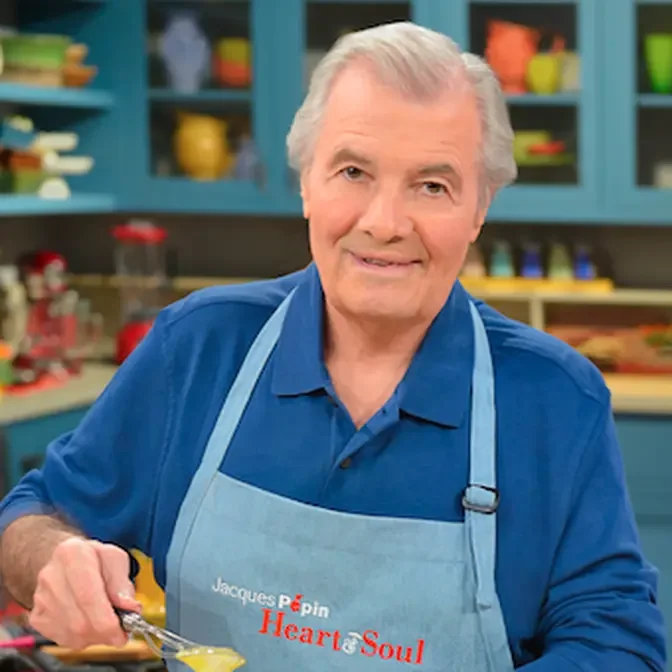
I'm always looking for a small hors d'oeuvre to serve with aperitifs. This is a great one and
it's easy. With a vegetable peeler you cut strips of zucchini, a little bit of smoked salmon. I have
smoked salmon at my supermarket. A little bit of cream cheese in the center. You spread it here
and there and then you roll it into a tight roll this way. You can serve it this way but it's even
better if you cut it in half. More impressive this way. And put it right on cracker or with
a little sprig of thyme in the center. Look can be deceiving. This is really a one time
minute recipe. I'm Jacques Pepin and this is fast food my way. Happy cooking.
Production funding for this series has been brought to you by
Cuisinart, with the next generation of food processors. From bread dough to pizza to stir
fries, we do the work to save you time. Cuisinart, the next generation. And by Scharfenburger,
makers of fine artisan dark chocolates. Recipes available at scharfenburger.com.
And by Spectrum Organics, a purveyor of fine culinary oils and condiments. Spectrum,
the taste of goodness. And by OXO Good Grips, makers of kitchen tools that make everyday living
easier. I have a very light, luscious and eclectic menu today for you. A meal which
we are less in a sense is more and all the flavors are shining through. We're going to start with a
rigatoni with lettuce, an eggplant, anchovy filet, garlic, then a steam basket of fish and shellfish.
Very lean and beautifully fresh with two different types of sauce and pan-fried endive in a julienne.
And finally some roasted fig and blueberry for dessert. So the first thing is to start with
the eggplant. Sometimes I peel the eggplant, sometimes I don't, but in that case I think I
will peel the eggplant. This is a male eggplant and the male eggplant, which is a long line here
rather than at that, it says to have much less seed than the female eggplant. So I tend to prefer
that one. So we're going to peel it. Here we have a large vegetable peeler. I often also use those
either Japanese or Chinese eggplant, the thin one, long one. And sometimes as I say, I don't peel them
and I cut them in thin slice again and put them in the oven in the same way. So this is cut in about
good inch thing. You see this one is pretty good with the seed here. Must be a male. And this way
across. You know, when you cook this directly into a skillet with the oil, this can absorb like
a cup and a half of oil. So that's why I do it in the oven. It's a bit leaner with less
oil. So we're going to put that in there. I have about four, five cup here and it will cook
in about the same amount of time than the pasta cook. I want it in the oven, you know, a good 400
degree oven for like a good 14, 15 minutes, you know. I'm going to put some salt on it.
A bit of salt and that trickling of a good olive oil there would go. That's it.
So that will go into my oven for like 14, 15 minutes.
Okay, good. Now cleaning up. Always cleaning up. But my wife told me I was well trained.
So I think I can start on the pasta now because it will take that amount of time before
my eggplant is finished. This is a rigatoni and I have three quarter of a pound here
and the water is boiling. Let's check if the water is salted, which is good. Now I don't need the
the lid anymore and I can start the rest of the sauce. Now the rest of the sauce is going to be
made of a lot of garlic, anchovies fillet, pepper flake and lettuce. Now I can use any type of
lettuce. I cook a lot of lettuce, especially when I have in my garden. Sometimes all the green of
lettuce I cook. This happened to be escarole. A bit tougher too. Slight bitter taste to it. I like
that type of lettuce very much. Well, I like all lettuce. So here we are. Olive oil. You can be
generous with your olive oil because it's going to flavor the pasta. And the garlic in that case
is going to be sliced. Very often I crush it, but in that case here we're going to slice it.
I have a considerable amount of garlic here. I'm going to fry the pepper flake. The pepper flake
it's a bit up to you, you know, but I'll put that much. I'm going to use the oil of the anchovies
as well later on. I just want to brown this a little bit. Okay, the lettuce. Now the lettuce,
very coarse. You see very often I buy lettuce in the market and often I serve more of the center
part of it, which is wider and more tender. But all the green one there, I do a soup with it or
pasta or things like this. Now in that case, I want to burn the garlic. I'll put this in there.
And then I twist, I turn it around like this. You can do it with a pincher so that your garlic
is kind of on top so it doesn't burn underneath, you know. So here it is. We're going to add the
eggplant to that later on. So let's see the oil from the anchovies. I have about
one and a half cup, one and a half can rather of anchovies here, which is about three,
three, three and a half ounces anchovies fillet. Okay, now you cut that into small pieces.
Now the anchovies will have a tendency anyway to melt. It's going to melt with the oil and
you don't really see the pieces of anchovies by the time it finishes cooking. So you can see that
that type of sauce or garnish is quite assertive because I have anchovies, I have a lot of garlic,
I have the pepper flake there. So that's going to flavor not only the pasta but the eggplant as well.
Okay, I'll put a lid on top of this and there is enough moisture here so that is going to melt
down. I'm going to lower the heat for this and that's fine. My pasta is doing fine too, good.
And now I'm going to work on the dessert. It's a bit of a different type of dessert. I like to
work with fig, especially dry fig. Some people like my French uncle loves fig, the fresh one.
I do too, but actually I think I like the dry fig even better than the fresh one. So there we have
a couple of tablespoons of butter in there and what I want to do is to actually cut those figs.
You could use the black mission fig as well, you know, but those are nice. And what you put,
you put half a walnut and you embed it directly into the flesh here, you know, that's it.
So the sauce that I have that I'm making here is done with some butter and I'm going to put
some honey in there, about a third of a cup of honey. I could actually pour it in it but I like
to use that thing here. That should be about a third of a cup. And white wine. Now I have,
I gave you some in here, which is not, which is a very spicy,
delicate wine. So about a half a cup, make a sauce out of this. And we put, we put the fig in it.
Going to soften them and that cook pretty fast. I mean, three, four minutes, the juice will be
reduced and we'll have a sauce. Okay. The last one is for the chef. Cover it.
And with the fig here, I love to serve a Madeira. And the mamsle, after it's a very, very sweet one
that you have with dessert, it's very chocolaty. Let's see, this is cooking and it's reducing now.
The sauce with the honey will get thicker, you know, as it, as it cool off. And
I'm going to taste it. We can mix with butter and honey and a bit of white wine. That's good.
Of course, you want to cool that off. I mean, cool that off. I like to serve it at room
temperature. I wouldn't serve it ice cold, but certainly at room temperature. So let's see that.
It's a nice little dessert.
And you can serve what about four or five, you know, it's interesting because when you look at
it close up like this, you think actually then the nuts is in the shell, you know, the shell of the
nut itself. When in fact, of course it is the half, the half fig, you know, but it look a little bit.
So this, as I say, will thicken as it, as it cool off. And what we are going to
serve with this is some blueberry that we can pile up some certainly in the center
with some blueberry here and a couple of blueberry on the outside.
Okay. A very simple dessert, delicious with a glass of Madeira. Now let me check.
This is ready. So I'm going to shut it off. Okay. I think the pasta is cooked now. I'm going to
drain it out right in there. I may use a little bit of the pasta water and I'm going to check
on the eggplant. Okay. It's fine. You see. So the eggplant and the eggplant will have a tendency
to stick, you know, so it's really nice on those, on those silicone type of liner, you know,
nothing stick to it. It's great. Here it goes in there. I'm going to need a little bit of the pasta
water. So I'm going to put it this way. I always use probably at least half a cup of pasta. So
here is the rest of it. I think it'd be better to use that. Okay. Yeah. All of the good stuff on top
here. Looks good. I'm going to put some cheese in there and maybe an extra cheese on top. I have
Parmigiano Reggiano here and a grater can do directly on top of your pasta. I'll put some
inside and a little more on top. This is a nice one because this one does little flake. Well,
the other doesn't really matter, but remember, I haven't really put any salt in there because of
the anchovies. I'm going to taste it. That's fine. There is enough salt. And of course in the pepper,
I put the pepper flakes, which is fine. Okay. Here we are. Big bowl of pasta. This looks great
and hot. A bit more cheese on top. You see it melt as you touch it. It's beautiful.
And maybe a little bit of extra virgin olive oil on top. It never hurts, you know. That's it. Okay.
Here is the rigatoni with the lettuce in there. We add anchovy filet and we have the eggplant
and pepper flake and a lot of garlic. Okay. And now another vegetable dish, which I could actually
use with the pasta are andai, Belgian andai, which I love to cook. And I cook in many different ways.
Those are just going to be julienne and sauté. And they are great to serve also with the pasta,
even mixed into the pasta. They are fine. So what I do there, I just slice them
into thin slice with the root attached, you know. I want to cut them thin. Piece of butter
to sauté them. I think I'll put a little bit of a good olive oil on top.
And those andai, you know, called Belgian andai very often. But when you're in Belgium,
those are called chicons, like chicory, you know, the Belgian call them.
And on the other hand, what we call chicory here, you know, which is a salad, like the salad that I
used before in the pasta in Belgium, this is called andai. So it's a bit confusing.
But this is actually the root, the root of the chicory, which is bitter, which is plant in the
dark, in sand, covered. So there is no, there is absolutely no photosynthesis coming from the sun.
And it comes out of the ground just beautifully white like this. There is some liquid which will
come out of your andai. So as is here, I'm putting some salt on top and a good dash of sugar,
you know, which will help not only in the caramelization, but it's standard with andai
to put a dash of sugar to counteract, you know, the bitter taste of the andai.
So here they will get wilted after I cover them. Good. I'm going to lower the heat a little bit.
And now a very simple, very elegant type of shellfish dish. I have here beautiful cod,
you can use crud, cod, any type of fillet. I have those large sea scallops. I have the shrimp
with the shell on, but the shell should be up. So this is the way you remove it,
back and forth. And in that particular case, we can leave the tail.
So I'm going to use those Chinese bamboo steamer and using a little bit of that seaweed.
I use that when I do clam bake in Connecticut. This is a specific seaweed,
which I always forget the name. So I forget it again, but I mean, you can recognize it. This
is considered the best when you do clam bake, because if you look at it very closely here,
you have those bubbles here and those bubbles are soft and they are full of water. I mean,
the water spills out when you do that. And this release moisture, you know, when you do
your clam bake or cook something that I'm doing here. So we line up four baskets with this.
You can smell the sea right there. And on top of this, we are putting one piece of fish for each.
Couple of scallops, two scallops. So that would be, of course, be a main course.
A couple of shrimp. Here we are. We'll stock this in the seaweed as well.
Like two, three, four mussels per person. Another piece. And that's it. Now we don't put any salt
or anything on it. I'm going to put that directly this way and steam it with, of course, the lid on
directly in a pot of water. And that will take about seven, eight minutes.
So I'm going to do a couple of different sauces with that. So olive oil and another one with
butter. Both of them with lemon. A little bit of the rind even to put in it. So I'll use that
plain here. And you can see that really gives you a lot of... So I put a little bit in the butter,
a little bit here for the oil. Let me check on this. You can see that the endives are being
caramelized now. You can see the bottom part of it, especially with the dash of sugar. So that's
great. Now I will leave it open like that to caramelize them a little more. So lemon juice
in there, in the melted butter. A good one, one and a half, two tablespoons of lemon juice.
I have about two, three tablespoons of butter there. A good dash of salt. This is, of course,
unsalted butter. A good dash of cracked pepper. You want to emulsify it together.
Keep it there. It's a bit warm. And I'm going to do the same thing with the olive oil.
An emulsion of olive oil. And when you have a great quality also in the oil, you will see
that the emulsion, especially if the oil is unfiltered, it will bind together.
Okay. I should have a tablespoon, a good tablespoon of each of the sauce per person.
In addition to this, a little bit of chives. There we are. Nice taste. A great way of doing
endive. A little different, but great. Okay. I think the baskets are ready now.
Here is the butter sauce. You bring that here. Yeah, that's it. You can see it's happened
and all that. Beautiful. So you would want to serve that directly in there. Maybe with the
thing on the side, you can put probably a little bit. I probably would have the olive oil sauce
on top. A little bit like this. And the fleur de sel here. Remember, we didn't put anything
there. So that would be right there with the sauce. This is the oil. This is the butter.
And this is the fleur de sel that we have there. And this is it. A very simple,
straightforward, but the quality of the fish is absolutely imperative here.
I think I'm going to bring my endive with the pasta because you can eat it on the side as well,
but you can really actually mix it. There is already another type of endive in it, which we
call, you know, the escarole. So here it is. A flavorful, very simple meal. You do have to
remember the simple pleasure of the table. That's what makes life so great. Happy cooking.
Visit our website at kqed.org slash morefastfoodmyway to learn more about Jacques Pepin.
You can watch shows online, view extra clips of Jacques in the Kitchen,
print selected recipes from the series, and meet some of the people behind the scenes.
Call 1-800-937-5387 or log on to channel9store.com to order the book with over 100 recipes and color
photographs for $32 plus shipping or to order the complete series of all 26 shows on DVD
for $39.99 plus shipping. Production funding for this series has been brought to you by
Cuisinart, with the next generation of food processors. From bread dough, to pizza,
to stir fries, we do the work to save you time. Cuisinart, the next generation. And by
Scharfenburger, makers of fine artisan dark chocolates. Recipes available at scharfenburger.com.
And by Spectrum Organics, the purveyor of fine culinary oils and condiments. Spectrum, the taste
of goodness. And by OXO Good Grips, makers of kitchen tools that make everyday living easier.
A KQED television production.