
Jesus said, "I AM" Part 1
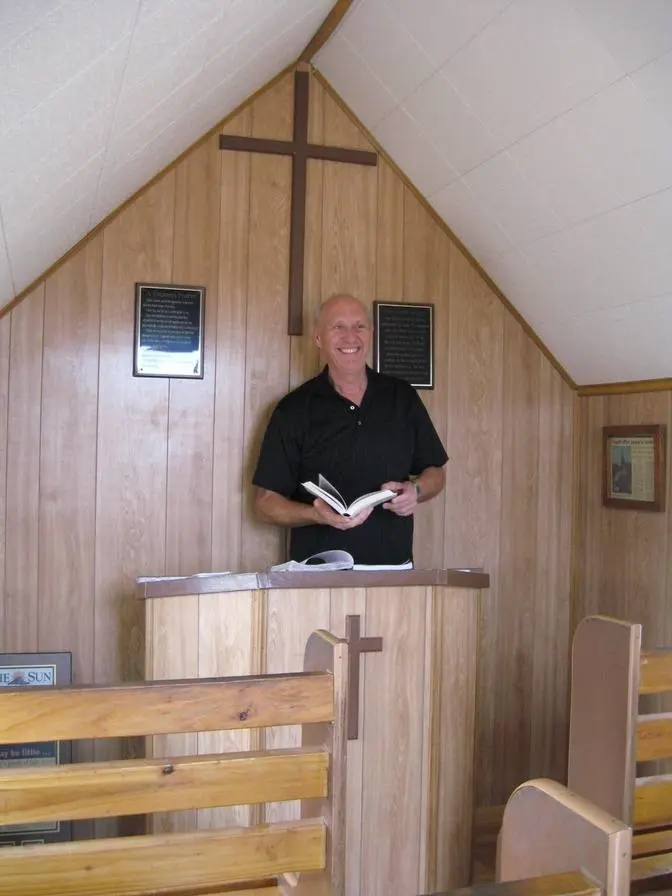
3 Video Views·Oct 25, 2025
Is Jesus equal with the Father, or is He a lesser God?
Our loving Father in Heaven, once again, it is our privilege to kneel in your presence.
We thank you for being a God of love and mercy and forgiveness.
And we thank you, Lord, for coming to this sin-cursed earth to give us an opportunity
to develop our character so that when you come, we can go home with you.
Help us to realize what a precious gift it is and what a sacrifice it's been.
And we're thankful that you are a high priest.
And we get comfort knowing the fact that you have been down here on this earth, and you
know what it's like.
And so we have a friend and an advocate in Heaven, and we're thankful for that.
Please be with those who are not here today.
Be with those who are in pain for whatever reason.
May they have at least a day of peace and freedom from what they experience on a daily
basis.
We love you.
We thank you.
In Jesus' name, amen.
A couple of weeks ago, I was asked to present a sermon about the differences, if any, between
the God of the Old Testament and the God of the New Testament.
And so I thought I would tackle that subject this morning.
And by the way, if you have a particular subject that you would like for me to present sometime,
let me know.
And I'll be glad to dig into it and share with you what I've been able to find.
Over the years, I have talked and corresponded with numerous people about this question regarding
the God or gods of the Old and New Testaments.
And I have discovered that many people are sincerely confused.
And some of them are in danger of being deceived.
And so because there seems to be some misconceptions about this, I thought it might be a good idea
for us to review what inspiration teaches.
I would say that the most controversial person who has ever lived on this planet was Jesus
Christ.
Would you agree?
The unbelieving Jews called him a blasphemer, and they accused him of casting out demons
by the power of Beelzebub, the prince of the demons.
And others thought he was one of the prophets, or just a good man.
Some said he was nothing more than a troublemaker, and still others said that he was the Son
of God.
One day after a season of prayer, Jesus came to his disciples with a question, and that
question is recorded in Matthew chapter 16, if you want to turn there with me.
Matthew 16, beginning with verse 13.
Matthew 16, 13.
When Jesus came into the coasts of Caesarea Philippi, he asked his disciples, saying,
Whom do men say that I, the Son of Man, am?
And they said, Some say that thou art John the Baptist, some Elias, and others Jeremiah's
are one of the prophets.
He said unto them, But whom say ye that I am?
And Simon Peter, spokesman for the twelve, as usual, answered and said, Thou art the
Christ, thou art the long-looked-for Messiah, thou art the Anointed One, the Son of the
living God.
Even though the disciples had it right, after Jesus ascended to heaven, many of his followers
began to disagree about his teachings, and not only about his teachings, but about his
identity.
And that raging debate still goes on today.
And because of that, Jesus still remains a very controversial figure.
If he was not who he himself claimed to be, then he's the greatest liar who ever lived.
But if he is who he claimed to be, then we have to come to the conclusion, if we believe
what the Bible says, that without him we have no hope.
God's word leaves absolutely no wiggle room about the identity of Christ.
Jesus is either the Savior of the world, or he is the world's greatest imposter.
It has to be one way or the other.
Now, there are many people today who teach that since Jesus is the Son of God, then there
must be a time somewhere way back in eternity when he was not.
That he had a beginning somewhere way back in the eons of time.
But if that were true, then that brings to my mind a couple questions.
First of all, if Jesus did not always exist, could his sacrifice be adequate to atone for
sin?
In 1 John 3, verse 4, it says that sin is the transgression of the law.
And in Romans 7, verse 12, it says that the law is holy, just, and good.
Now that's a pretty good description of the character of God, isn't it?
Holy, just, and good.
Also in 1 John 5, verse 3, it says this is the love of God that we keep his commandments.
Also in 1 John 4, verse 8, it says God himself is love.
And so we see how the Ten Commandment law is a transcript, or an exact copy of God's
character.
And this is true with both the Father and the Son.
Because in John 15, verse 10, Jesus calls them his Father's commandments.
And in Revelation 22, verse 14, speaking of Jesus, John says, blessed are they that do
his commandments.
And while Jesus was here on earth, in John 14, verse 15, he said, if you love me, keep
my commandments.
And so the question is, because Jesus is called the Son of God, and all sons have fathers,
how could he be equal and eternal with God the Father when he came along sometime afterward?
How could he be equal with the Father's character and his eternal qualities, if that were the
case?
And how could he be able, therefore, to reconcile fallen human beings to his great standard
of righteousness, which is the Ten Commandment law?
Simple logic tells us that there's something wrong with that picture.
And as we put this all together in our study this morning, we're going to see very clearly
that there is a oneness and an equality between the Father and the Son, and thus their likeness
and character, and the ability of Jesus, then, to be our only means of salvation.
Go with me in your Bibles to Isaiah 1 and verse 18.
This is a text that's familiar to most of us.
Isaiah 1, 18.
This is God speaking.
He says, come now, and let us reason together, saith the Lord.
Though your sins be as scarlet, they shall be as white as snow.
Though they be red like crimson, they shall be as wool.
As we reason this through with God this morning, can one who is not equal with the Father in
every way be able to make your bright red-colored sins as white as snow?
And the deep, dark, red sins of your past, that nobody else knows about except God, as
carded wool?
I don't think so.
This is not possible unless Jesus and the Father are totally equal, and I'll elaborate
a little bit more on that as we go along.
The other question that comes to my mind is this.
If there was a time when Jesus was not, could there ever be a time in the future when He
will not be?
Is that a fair question?
And what about those He has redeemed?
Would they be safe and secure for all eternity?
I would say that if you did a door-to-door survey right here in town, and you asked the
people about this subject that we're talking about right now, I would think you would find
that most people that believe the Bible would probably say that the Father is the God of
the Old Testament, and Jesus is the God of the New Testament.
The Father, in most people's minds, is severe and harsh, and probably more willing to kill
people that don't obey Him, but Jesus is kind and loving and wouldn't hurt a flea.
But as we're going to see in a minute, Jesus is actually the God of both the Old and the
New Testaments.
But before we prove that from the Bible, I'm going to read you something from a paper that
was written over a hundred years ago and explains it better than I can.
It's from Review and Herald, March 2, 1886.
It says, The typical sacrifices and offerings of that dispensation, talking about the Old
Testament, represented Christ, who was to become the perfect offering for sinful man.
Besides these mystic symbols and shadowy types pointing to a Savior to come, there was a
present Savior to the Israelites.
He it was who, enshrouded in a pillar of cloud by day and a pillar of fire by night, led
them in their travels, and He it was who gave direct words to Moses to be repeated
to the people.
Those who sneer at the old dispensation and professedly accept Christ in the new do not
discern that this same Christ was the ancient leader of Israel, and that from His lips came
all the commands, all the rules and regulations to govern more than a million people.
He who was equal with the Father in the creation of man was commander, lawgiver, and guide
to His ancient people.
And now let's prove it from the Bible.
Go with me to John, the Gospel of John, chapter 1, beginning with verse 1.
It gets real interesting when you look up words in the Concordance in the original Greek
and kind of stick those words in there as you're reading sometimes.
John 1.1, in the beginning, that is, before anything else existed, farther back than we
can even imagine, before there were any angels or human beings or any other life forms created,
in the beginning was the Word.
The word Word means the divine expression.
In the beginning was the divine expression.
And the divine expression was with God.
The word God means supreme deity or highest in authority.
In the beginning was the divine expression, and the divine expression was with supreme
deity, and the divine expression was supreme deity.
All things were made by Him, and without Him was not anything made that was made.
In Him was life, that is, eternal life.
In 1 John 5.11 it says, and this is the record that God has given unto us, eternal life,
and this life is in His Son.
So we're talking eternal life here.
In Him was life, and the life was the light of men.
And the light shines in darkness, and the darkness comprehended it not.
There was a man sent from God whose name was John.
The same came for a witness to bear witness of the light that men through him might believe.
He was not that light, but was sent to bear witness of that light.
That was the true light which lights every man that comes into the world.
He was in the world, and the world was made by Him, and the world knew Him not.
He came unto His own, and His own received Him not.
Now usually when we read that, we think of the Jews.
They were His own people, right?
Chosen people.
He came to them, and they totally rejected Him.
Not only rejected Him, but killed Him.
But there's a much more broader meaning here.
It says He came to His own, meaning the world, and the whole world rejected Him, correct?
But there's some hope.
Verse 12, but as many as received Him, to the few who accepted Him as supreme deity,
to them gave He power.
That is, freedom, if they so choose, to become the sons of God, even to them that believe
on His name, which were born, not of blood, nor of the will of the flesh, nor of the will
of man, but of God.
And the word, the divine expression, was made flesh, fallen flesh, just like we have.
And dwelt among us, and we beheld His glory, the glory as of the only begotten of the Father.
Full of grace and truth.
And so the question is, how can Jesus have no origin, or beginning, and yet still have
a Father?
We're going to touch on that a little bit more as we go along, but for now, what I want
you to notice is that Jesus created everything.
He is the creator.
And He is the sustainer of all life.
Now flip over a couple pages to John chapter 5.
John chapter 5 and verse 39.
John 5, 39.
This is Jesus speaking, I believe, to the unbelieving Jews.
He says, search the scriptures.
What scriptures?
The Old Testament, that's all they had, right?
Search the scriptures, He said, for in them you think you have eternal life.
And they are they which testify of me.
You see, the Jews believed that the way to have eternal life was by acquiring knowledge
through the scriptures.
And I'm not knocking that, we need to study the scriptures.
But the problem with them was that even though they were Bible scholars, life stood right
before them, and they didn't recognize it.
So we need more than Bible study, don't we?
We have to come to Christ.
Because in verse 40 He says, and you will not come to me that you might have life.
So life itself is in Christ.
And the Old Testament scriptures are about Him, about how He was the one who was the
God of Abraham, Isaac, and Jacob.
Go also to Colossians chapter 1, Colossians chapter 1, 16 and 17.
Colossians 1, 16 and 17.
For in Him, speaking of Jesus, were all things created that are in heaven and that are in
earth, visible and invisible, whether they be thrones or dominions or principalities
or powers.
All things were created by Him and for Him.
And He is before all things, and by Him all things consist, or all things hold together.
And so these verses take Jesus all the way back to Genesis 1, 1, don't they?
In the beginning, God created the heavens and the earth.
Go also back to the Old Testament, Isaiah 48, Isaiah 48, verses 12 and 13.
Isaiah 48 and verse 12.
From the text that we've already read, this has got to be Jesus talking.
He's the one who led the children of Israel in the Old Testament.
He says, hearken unto me, O Jacob and Israel, my called, or my church.
I am He, I am the first, I also am the last.
Does that sound familiar?
Like Revelation 22, 13, where Jesus said, I am Alpha and Omega, the beginning and the
end, the first and the last.
This is unmistakably talking about Jesus.
Verse 13, my hand also hath laid the foundation of the earth, and my right hand hath spanned
the heavens.
When I call unto them, they stand up together, or they come into being.
Now flip back a little bit to Isaiah 45, and verse 18, Isaiah 45, 18.
For thus saith the Lord.
You know what the word Lord here is?
It's Jehovah.
It means self-existent one.
He saith, the Lord that created the heavens, God, the supreme God, or exceeding God himself,
that formed the earth and made it, he hath established it, he created it not in vain,
he formed it to be inhabited, I am the Lord, I am the self-existent one, and there is none
else.
Go down to 21.
Tell ye, and bring them near, yea, let them take counsel together, who hath declared this
from ancient times.
Who hath told it from that time?
Have not I the Lord?
And there is no God else beside me, a just God and a what?
A Savior.
Who is the Savior?
Jesus.
You remember what the angel told Mary in Matthew 1.21?
Thou shalt call his name Jesus, for he shall save his people from their sins.
And then it says, there is none beside me.
That means there is no other Savior besides Jesus.
Verse 22, look unto me, and be ye saved, all the ends of the earth, for I am God, and there
is none else.
Let's look at one more here in Exodus chapter 20, it's another one we are very familiar
with.
Exodus 20 verses 8-11, speaking of the fourth commandment, we should know this one by heart.
Remember the Sabbath day to keep it holy, six days shalt thou labor and do all thy work,
but the seventh day is the Sabbath of the Lord thy God.
It's the Sabbath of the self-existent supreme God.
In it thou shalt not do any work, thou nor thy son nor thy daughter, thy manservant
nor thy maidservant, nor thy cattle nor thy stranger that is within thy gates.
For in six days the Lord, the self-existent one, Jesus, made heaven and earth, the sea
and all that in them is, and rested the seventh day.
Wherefore, the Lord Jesus blessed the Sabbath day, and he hallowed it.
So it was Jesus who walked and talked with Adam and Eve in the garden in the cool of
the day.
It was Jesus who said to Job, where were you when I laid the foundations of the earth?
It was Jesus who said to Abraham, I am almighty God, walk before me and be thou perfect.
It was Jesus who said to Moses, I am that I am.
And so without a doubt, Jesus is the God of the Old Testament.
Go also to Hebrews chapter 1, Hebrews chapter 1, there's really quite a lot of information
on this subject when you start digging.
Hebrews 1 and verse 5, now I'm going to share something with you that was relatively new
information to me, it might be to you.
Hebrews 1, 5 says, For unto which of the angels said he, that is the Father, at any time,
thou art my son, this day have I begotten thee.
And again, underscore the word again, because we're going to come back to that in a little
while.
And again, I will be to him a father, and he shall be to me a son.
This passage indicates that there's going to be a different kind of relationship now
between two members of the Godhead that didn't exist before.
I will be to him a father, and he shall be to me a son.
That's future tense, correct?
But the question is, what day is being referred to when he says, this day have I begotten
thee?
He was quoting from the Old Testament.
Go to Psalm 2, Psalm 2 and verse 7.
Words are very important in the Bible.
In this verse, Psalm 2, 7, it says, I will declare the decree.
Now that's future tense, isn't it?
I will declare the decree.
This is a Messianic prophecy.
The Lord has said unto me, thou art my son, this day have I begotten thee.
Now go to Acts chapter 13, because Luke refers to this same decree.
Acts chapter 13, and beginning with verse 30.
Acts 13, 30.
But God raised him from the dead, speaking of Jesus, so the context is his resurrection.
And God raised him from the dead, and he was seen many days of them which came up with
him from Galilee to Jerusalem, who are his witnesses unto the people.
And we, what?
Declare unto you glad tidings, how that the promise which was made unto the fathers.
In Psalm 2 and verse 7.
Verse 33.
God hath fulfilled, he has fulfilled it.
The same unto us, their children, in that he hath raised up Jesus, what?
Again.
There's the word again I told you to underscore.
As it is also written in the second Psalm, thou art my beloved son, this day have I
begotten thee.
This day is in the reference to the resurrection of Jesus Christ.
And the verse says that he has raised Jesus up again.
The first time Jesus was declared to be the only begotten of the Father was when he was
born of Mary.
The second time he was declared again at his resurrection.
So that's what this is referring to.
Now go to Romans chapter 1, verses 3 and 4.
Romans 1, 3 and 4.
Concerning his son Jesus Christ our Lord, which was made of the seed of David according
to the flesh, and so we're talking about Jesus when he became a human being here, his birth.
In verse 4, and declared, there's that word again from Psalm 2, 7, and declared to be
the son of God with power according to the spirit of holiness by the resurrection of
the dead.
And so Jesus, according to this verse, was declared to be the son of God at his birth
before he was declared again at his resurrection as we just read a minute ago.
One more text here, Luke 1, 35.
Luke 1, 35.
And the angel answered and said unto her, that is Mary, the Holy Ghost shall come upon
thee, and the power of the highest, that would be the Father, shall overshadow thee, therefore
also that holy thing which shall be born of thee shall be called the Son of God.
Again, the words shall be imply a future promise.
In other words, when Jesus was born into this world, he literally became the only begotten
of the Father.
The foreordained plan that Jesus would take a subordinate position in the Godhead became
a reality when he was birthed by Mary.
Now let me share another thought with you.
In the mind of the all-knowing God, Jesus has always been thought of and recognized
as the Son.
Why?
Because the plan of salvation was not an afterthought.
Go in your Bibles to 1 Peter, 1 Peter chapter 1, 1 Peter chapter 1, beginning with verse
18, 1 Peter 1, 18.
For as much as you know that you were not redeemed with corruptible things as silver
and gold from your vain conversation received by tradition from your fathers, but with the
precious blood of Christ as of a lamb without blemish and without spot, who verily was
foreordained, and so Jesus was appointed in advance to be our Savior, before the foundation
of the world, but was manifest or made known to be such in these last times for you and
for me.
In other words, when sin entered God's perfect universe, he didn't say, hmm, I wonder what
I'm going to do now, how are we going to take care of this problem?
No.
God always knew that sin was going to happen and what he was going to do about it when
it did happen.
And in that sense, now listen to me carefully, in that sense, Jesus has always been the Son
in anticipation of the day when he would be born into this world as the Savior of mankind.
And so it really doesn't matter to me whether a person says that Jesus was the only begotten
Son before or after he was born of Mary, because if we view it rightly, both views are correct.
Just don't tell me that there was a time when Jesus didn't exist, because that's to rob
me of my Savior, and that's to rob Jesus of his glory.
The title, Son of God, simply refers to the state of submission that Jesus would take
in order to become an acceptable sacrifice, so that he entered that submissive state in
order to save us.
That God had used the illustration of the Father-Son relationship to show that Jesus
would take a subordinate position just as we do in our earthly relationships.
He wanted us to understand that point.
He is not a lesser God.
He is not an inferior God.
He is not a less experienced God, and he's not a younger God.
Jesus has always existed.
And just like the Father and the Holy Spirit, he is one member of the Godhead.
Philippians 2, beginning with verse 5.
Philippians 2.5.
The Apostle Paul says, Let this mind be in you which was also in Christ Jesus.
And think of this in terms of submission and humility.
Let this mind be in you that Jesus had, who, being in the form of God, thought it not robbery
to be equal with God.
He didn't have to steal or borrow divinity.
He already had it.
Or covet it.
He didn't think it was robbery to be equal with the supreme deity.
But made himself of no reputation, and he did it voluntarily.
That's the wonderful thing.
He did it voluntarily.
Made himself of no reputation.
If you look up the word reputation in the Greek, it gives a couple different definitions.
One is emptied himself.
Jesus emptied himself.
The other one says neutralized.
He neutralized his former position in the Godhead by becoming a human being, by becoming
our Savior.
But made himself of no reputation, and took upon him the form of a servant, and was made
in the likeness of men.
And being found in fashion as a man, he humbled himself and became obedient unto death, even
the death of the cross.
You know friends, I don't think we understand, I'm sure we don't understand or comprehend
the step down that Jesus took in order to become a human being to save us.
This is selflessness in the highest sense.
Now who was it that led the children of Israel out of Egyptian bondage and all through the
wilderness wandering?
Jesus.
Very easy to prove that point.
First Corinthians chapter 10, 1-4.
First Corinthians 10, beginning with verse 1.
Moreover, brethren, I would not have you to be ignorant about Christ being the God of
the Old Testament, because that's the context.
Not that you should be ignorant how that all our fathers were under the cloud and all passed
through the sea, and were all baptized unto Moses in the cloud and in the sea, and did
all eat of the same spiritual meat, and did all drink of the same spiritual drink.
For they drank of that spiritual rock that followed them, and that rock was Christ.
That's so clear it doesn't need any comment.
Now go to Exodus chapter 6, Exodus chapter 6, beginning with verse 1.
Exodus 6, verse 1.
Then the Lord said unto Moses, who said unto Moses?
The Lord, Jesus, the self-existent one, that's Jehovah, now shalt thou see what I will do
to Pharaoh, and remember we just read in the New Testament that Jesus was the one who led
Moses and saved Israel from Pharaoh in the Red Sea, that's what we just read.
So here he is talking.
You will see what I will do to Pharaoh, for with a strong hand shall he let them go, and
with a strong hand shall he drive them out of his land.
And God, supreme deity, Jesus, spake unto Moses and said unto him, I am the Lord.
I am the self-existent eternal God.
You know, if Jesus didn't always exist, he couldn't either be self-existent or eternal.
Could he?
Because the word eternal goes backward without end, as well as forward in time.
Verse 3.
And I appeared unto Abraham, unto Isaac, and unto Jacob, by the name of God Almighty.
That means that there is no God mightier than Jesus, period.
But by my name Jehovah, same as Lord in verse 2 and 1, but by my name Jehovah was I not
known unto them.
And so even the Old Testament patriarchs didn't fully understand, didn't fully comprehend
that the Savior to come was the same one who was leading them all through their journey
down here on earth in Old Testament times.
2,000 years ago, Jesus ordained 12 of his closest friends to become like him in character.
And hasn't he chosen us today for the same purpose, to become like him in character?
In Revelation 22 and verse 13, I already mentioned this.
It says of Jesus, Jesus himself said, I am Alpha and Omega, the beginning, and the end,
the first and the last.
And as you know, Alpha and Omega are the first and last letters of the Greek alphabet.
It represents nothing before, nothing after, and everything in between.
That's who Jesus is.
Don't we use letters from the alphabet to form words that communicate information?
Therefore Jesus is the beginning and the end of all information about God.
He is God's thought made audible.
Really the fact that Jesus is the eternal God of the Old Testament shouldn't be a mystery
to us.
The Bible makes it pretty plain.
The real mystery is why.
Why the Almighty God would condescend to become one with sinful human beings.
That's the mystery.
And not just for a few years, but for as far into the future as he has been here in the
past.
And that's a long, long time.
What love.
What sacrifice.
What a mystery.
And one that we're going to study for all eternity and never exhaust.
And I want to be one of the redeemed that will have the opportunity and the privilege
to look further into this great mystery as the years of eternity roll on, don't you?
You know, it's important for us to understand who Jesus is.
This is the reason I presented this subject this morning.
It is really important that we understand who he is.
And what it means for us to know that heaven gave its best to save us.
Think of it this way.
If Jesus was not the best gift that God could give to redeem a fallen race, then someone
could use that as an excuse if they end up being lost.
They would be able to say that God is to blame because he didn't do everything possible
for my salvation.
He could have done more, they would say, but he refused.
But nobody will ever be able to charge God with a thing like that because the heavenly
trio, Father, Son, and Holy Spirit, have done everything possible to save every human being
who is ever born into this world.
Friends, Jesus is God Almighty.
He is God Almighty.
And I think we ought to thank him this morning for such a great sacrifice, for coming down
here to this sin-cursed earth to give us the opportunity to go to heaven.
A greater sacrifice couldn't be made.
And for someone to say that Jesus was somehow inferior or just a God and not the God is
blasphemy, really, when you think about it.
It's to rob God of the glory that's due to him only.
And I would like to have us kneel together this morning and let's just thank God for
the gift and let's re-consecrate our lives.
Our loving Father in heaven, what a gift.
Not only the gift that Jesus gave, but you were willing to allow that to happen.
And the Holy Spirit was in agreement.
And all three of you have done everything imaginable, everything possible to save us
from the consequences of sin.
And Lord, we don't have to be a genius to know that you're coming soon.
The signs of the time are screaming at us today to get ready.
We realize that character, the kind of character we need to be ready when Jesus comes, doesn't
develop overnight.
And so I pray that you would help each one of us to use whatever precious moments we
have left to become like you in character.
We know that when that happens, you're coming back.
And we want to be a part of that redeemed crowd.
We are so thankful that heaven gave its best.
Not one will ever be able to say that God did not do everything possible to save them.
And if we are lost, it's because we have chosen to be lost.
But Lord, I pray that as we are kneeling here before you this morning, and lots of different
thoughts are probably going through all of our minds, we want to consecrate ourselves
to you anew.
Please forgive us of all our past mistakes.
Please help us to have victory over the sin that so easily besets us.
We know that the remedy is in Jesus.
We know that he is life.
In order to have it, we have to have him dwelling within.
And we thank you for that possibility.
And we thank you for your love, for your mercy, for your forgiveness.
Please help us to be like you, so that when we meet other people, we will have words of
truth, words of comfort, that we would give the trumpet a certain sound, and that they
would know that you are speaking to their hearts, and that they would surrender all.
Thank you for being here with us.
Thank you for your sweet spirit that has been manifest here, and I pray that you would give
us a unity, the kind of unity Jesus prayed for in his last and longest prayer before
he left this earth, that we would be one.
And this is the way that people around us will know that we belong to you, because we
have loved one for another.
Thank you.
Thank you for your love.
We know that we love because you first loved us.
And all glory goes to you, and we thank you for everything in the name of Jesus.
Amen.