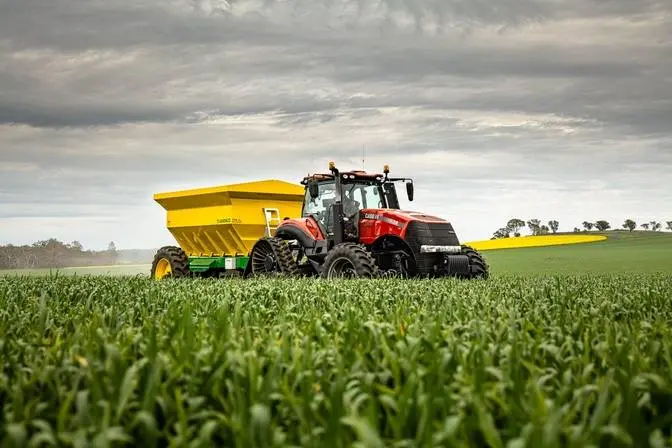
Ever wonder how the tomatoes in your favorite sauces, soups, and ketchup are grown?
Come with me to explore California agriculture! 🚜
In this episode of FIELD TRIPS with Tara, we're heading to Colusa, California, to learn all about processing tomatoes!
But this isn't just a one-day field trip! We're following the journey of a tomato crop from beginning to end.
First, we visit the farm to see how processing tomatoes are planted and learn what it takes to get a crop started. Then, 4.5 months later, we return to the very same farm to watch those tomatoes being harvested!
From tiny transplants to fields full of ripe red tomatoes, we're getting a firsthand look at the hard work, equipment, and people behind one of California's most recognizable crops.
Whether you love agriculture or have never stepped foot on a farm, there's something for everyone to learn!
Come along and discover where your food comes from!
Don't forget to LIKE, COMMENT, and SUBSCRIBE for more FIELD TRIPS with Tara as we explore the incredible diversity of California agriculture!
This video explores the lifecycle of processing tomatoes at River Vista Farms in Colusa, California. Guided by fifth-generation farmer Mitchell Yerxa, the segment covers the transition from planting high-tech transplants to the large-scale mechanical harvest of tomatoes used for paste, ketchup, and sauces.
Hold on, hold on, hold on. We can do this.
Hold on, hold on. Okay, it's tomato paste.
It's also tomato sauce. It's also ketchup.
There's a ketchup joke in here if you want it.
Uh...
Hold on. Hey everyone and welcome back
to Field Trips where I take you along with me to explore
California agriculture. Today we are in Colusa,
California where we are going to learn all about
tomato planting
and tomato harvest.
Let's go.
Today I am with
Mitchell Yerxa.
from River Vista Farms
and we're going to be learning all about tomatoes. Processing tomatoes.
Processing tomatoes. I know because we could talk about
the different kinds of tomatoes as well
while we're out there because there are a lot of different types.
It's not a one-size-fits-all.
Do you want to tell us a little bit about you know where you're
from, how you ended up here,
why you're farming, why tomatoes? Absolutely.
My name is Mitchell Yerxa. I'm a fifth generation
farmer here in Colusa, California
and actually the piece of ground you're standing on is a
A piece of family ground that was here for over 100 years.
So we've been farming the same ground, same soil,
same water, same ditches for over 100 years.
Today we're looking at
Processing tomatoes for tomato paste.
So your ketchups, your barbecue sauces, your pasta sauces,
anything that requires a tomato paste.
And what's cool about this is,
is even though things like the soil and the barn
and the oak tree are the same,
so much about how the farm functions
has changed dramatically over those hundred years.
I think my favorite statistic to talk about
is my dad's dad, my grandfather,
who farmed here, passed away in 1991.
Okay.
The highest yield he'd ever received
on a tomato farm per acre was 31 tons per acre.
We're now averaging 60 tons per acre on the same ground.
Wow.
Same soil, different technology, different genetics.
At the end of the day, a lot more.
Pretty cool.
So what is the importance
of this and not just planting it into flat ground?
We plant over 7,000 transplants per acre in a single line.
Every single one of these transplants
was transplanted by hand, usually by a lady,
in a carousel planter that puts these plants
into the ground at a very specific distance.
You can get a hell of a lot better job cultivating
and they'll have a certain root system at that point.
Then you're not worried about not pulling
I'm pulling them out of the ground.
Exactly.
I think that part to me that's incredibly unique about
a tomato versus something else
is we'll have spent $5,000 per acre on cost of plants,
labor, harvest, planting, transplants,
greenhouses, sprays, cultivation,
you name it, before we ever get to harvest.
Every decision we make every day has to positively affect the plant.
It's a gamble, but it's also really rewarding.
I mean, when you're watching
those tomatoes flow into that truck at harvest,
it's a pretty special feeling.
But again, it all starts with, and I'd be remiss in saying this,
it all starts with really good genetics.
By planting this tomato plug in the ground versus tomato seed,
It helps you not to worry about frost,
doesn't have to worry about hard rains.
There's all these things you can avoid.
And I noticed there's not this much sticking out of the ground.
Is it true that tomatoes is one of the plants
that the roots will come out of the green or is that not?
No, I mean, you're going to have the roots come out of here.
You can have this part freeze right here above ground,
but because this is all protected,
this will actually regrow underneath
and continue living because you've got good health.
in these roots right here, correct?
So we now pay for the seed itself.
Okay.
Then we pay somebody to grow it in a greenhouse.
Okay.
And then we pay somebody to plant it.
So I just kind of want you to see.
So these are trays of tomatoes.
So each one of these trays has a set number of plugs
and those plugs are what they pull from.
And then these gals are placing the tomatoes
at a very specific height within this carousel planter.
And those fingers close, hold the plant.
Put the soil in the ground, put the plant in the ground,
put the transplant in the ground,
and then come back around.
And those fingers are spaced so specifically
so that mathematically each plant
is a certain distance from each other
to let the plant get a certain size.
Do you have drip tape or anything in this?
Yes, we have one line of drip tape
that's exactly in the middle of these beds.
Is it already in or does it go in on the planter?
It's already in.
Okay, it's already in there.
In California, for people who have drip tape,
they'll usually leave their drip tape underground
for five or six seasons.
Oh my gosh, how do you like not disk it up and stuff?
With the GPS, we're able to run our shanks,
we're able to run our shanks on either side of that tape
and never hit the tape.
That seems like so stressful.
Growing anything in California
has gotten just dramatically more expensive.
Yeah.
Our cost of diesel in two months has gone up 90 cents
of red dye diesel.
Our cost of fertilizer has gone up in one month
has gone up 20%.
So in one month we've increased all these prices
Yet what we're being paid as growers is not increasing.
The only thing that does for you as a grower
is makes you better at your job.
It makes you more considerate about the choices you're making.
So even though our costs are higher,
we have understood so much more
of how to utilize the resources we do have.
You look at this little tiny plant and you go,
there's no way that plant's gonna produce
what I need it to produce in three months or four months.
I know, that little guy. And then sure enough,
it just,
It explodes.
It grows.
Yeah.
So right now behind us we have our little babies.
We just dropped them off from the nursery,
but when we come back, they'll be all ready
for saw school.
Paste school.
They'll be ready to be full grown.
They'll be adult tomatoes.
Oh.
That's good.
We'll be right back.
All right, we are back in the tomato field,
but it is four and a half months later
in that split second that we switched,
and now the tomatoes are being harvested.
So what are we seeing here that's quite a bit different
than the day we saw them being planted?
So I think when we saw you last,
you were holding a single tomato plant
that the plug was about that big in size,
and now you can see that they're this big in size.
Kind of the cool art of all this is
you went from planting 4,000 little tomato plugs per acre
to having a field that's producing right now,
I just measured it right now,
this field is doing 120,000 pounds of tomatoes per acre.
And is that pretty average for you guys?
That is exactly what we need to be at for contract.
So we're quite happy.
And your dog approves.
Yes.
She's brought me another one.
I think she wants to keep playing fetch.
Oh, good.
How do you know that they're ready to harvest?
Like, what's kind of the build up to, you know, the growing season
to being like, OK, we're ready to hit the go?
I've actually been waiting four and a
half months for you to ask this question.
Because this will be the most entertaining
part of my week watching you do this.
So, the thing that's fun to do is when you have a tomato plant like
this that's completely ripe and ready for harvest,
you can give with one shake, you can get all
the tomatoes out in one shake.
We shake two plants on the ground.
We count all the red, all of what's called a breaker, you know,
not quite ripe but not quite green, and all the green.
And when your percentage is...
As close as you're going to get to 100%,
then you say, okay, I know that in this many days,
I'll be ready for harvest.
Is there a technique?
Yeah.
Okay, show me.
Gravity.
Here, I'll show you.
Oh, okay.
That's what I have to do.
Oh, no.
My arm muscles.
Stand right over, and all you want to do is just grab it
and just give it a nice...
Oh, my gosh.
There you go.
I was worried it wasn't going to happen.
I'm up for the challenge now.
I was feeling a little nervous.
I think I can do it.
Yours was a big one.
Well, I can get you a bigger one.
No, no, it's okay.
Oh, and it weighs quite a bit too.
Just up and then down.
There you go.
Wow.
Pretty good.
These are a very tough tomato.
I was thinking that.
I was like, oh my gosh, they're so hard.
There's 25 tons of tomatoes in those trailers.
Well, 12 and a half per trailer.
So that's a lot of mass, a lot of weight.
And you know, you go to home and you pick up your heirloom
and heirloom is just such a soft.
I was thinking like you've touched the tomato
the wrong way at home and it splits.
So Heinz is their own variety?
They have their own breeding division,
their own breeding sector that makes what they want.
So just like wines, you know,
you have certain grapes and certain vintages and certain
regions that they feel make a certain flavor profile or color profile.
That's what we're doing.
I think more importantly,
I think we're getting closer to harvest.
But I think that the thing that you have to like really appreciate is
these machines, when you see them,
they have knives that come underneath and they cut off
Right at the soil line, they bring every bit of the plant up the chain,
it goes up the chain in,
but it has these tines
or these teeth that basically are able to pull the vine away from
the fruit, then the fruit goes across belts,
and then they go through sorters, and the sorters
are basically able to take anything that's,
you know, leaf, dirt, anything that's not a
green or red tomato, kick it out,
and then the red tomatoes go through, and then
They're in a trailer.
So it's really, it's a pretty phenomenal machine
to be able to do it
because a lot of the stuff used to be done by hand,
obviously.
So anything we can do to speed it up
is a really, is a really unique thing.
If someone wants to get into this industry,
what advice would you give them
if they have no ag background?
Probably an internship.
for a local farm in your area would be a great place to start.
Okay, you have to you have to realize I'm fifth generation
so I haven't thought about
I know and I am too.
I am too which is why I asked this question because a lot of us are
multi-generational but then you
also think you have you hear every day about how many people
are quitting farming. So I do think it's important
that we get a new generation of farmers that maybe
have no ag background and we're like come join us you want to do this.
this right we have to tell them how to do it
because a lot of people feel like
unless I came from AG I can't get in it
and I want to break that I think the
number one thing you have to have
to be a good farmer especially a farmer of a an
edible product this is a food
that your family's gonna eat I think the number
one thing you have to have in order to do this is a passion for food
If you have a passion for a man,
you have a great memory of a great meal with family and friends,
to me, that is the number one step of, okay,
my brain associates good food with being grown locally
in California or wherever you live.
How do I then say I want to now do that for a career or even as
a part-time thing? And I think to me,
the reason I'm passionate about growing high quality tomatoes
is I'm passionate about having great meals with friends.
And when you have that meal where you go, hey,
I brought these tomatoes to the dinner table.
We're going to do a caprese salad
or tomatoes with burrata or whatever the thing is.
Or even just as simple as a hamburger,
you know, with a great slice of tomato on it.
People go, man, this is a really great tomato.
And it's like, thank you.
I grew that.
Yeah.
And I think to me, the farm
to fork movement isn't about locality and freshness.
It's about the quality of what we
as the growers are producing for the consumers.
All right, do you feel like we've covered everything?
We did it. We did it. We made it. Thank you so much.
I appreciate your time. Thanks for teaching us about tomatoes.
I hope you guys enjoyed today's episode.
I hope you enjoyed seeing the entire process of tomatoes
all in one video. We were actually here four
and a half months ago so it was really exciting
for us to see this entire process and how they got harvested
and I'll see you guys next month.