
40 UNESCO World Heritage Sites You Need to Visit Before You Die | 4K Travel Documentary
#Travel
From a city carved into a desert cliff to a stone city above the clouds, here are 40 of the most extraordinary places on the UNESCO World Heritage List, counted down from number 40 to number 1. Which one would you visit first? Tell me in the comments.
By https://www.youtube.com/@EarthscapeAtlas
In the deserts of Jordan,
a city is carved straight into the face of a cliff.
Its trade faded, earthquakes struck,
and for 600 years the outside world forgot it was there.
In the jungles of Cambodia stands
the largest religious monument on earth.
The forest swallowed the city around it.
And high in the Andes, a city of stone sits above the clouds,
its finest walls cut without iron tools and fitted without mortar.
These are three of the 40 places you're about to see.
Every one of them is on the UNESCO World Heritage List.
But only one of them can be number one.
That are number 40,
Cinque Terre, Italy.
Its real wonder isn't the villages.
It's the walls behind them, the coast of Liguria.
Five tiny villages cling to cliffs above the Mediterranean.
For most of their history,
the only way between them was by boat or on foot.
What earned this coast?
Its place on the list is the hillsides behind them.
Over about a thousand years, farmers built dry stone walls to hold
terraces of vines and lemons on slopes that are almost vertical.
Arrive in Manarola at sunset
and the pastel houses turn gold above the water.
Stand on the harbour rocks
and you'll hear the waves knocking against the fishing boats,
while the smell of lemons drifts down from the terraces.
Number 39. Hoi An, an ancient town in Vietnam.
This town was saved by a river that let it down.
down.
400 years ago this small river port was one
of the busiest trading posts in Southeast Asia.
Merchants came from China, Japan and Europe and many of them stayed.
Then the river silted up and trade moved on.
That was its luck because almost nothing was modernized.
More than a thousand of its old timber buildings survived.
Each month on the night of the full moon the town dims its lights.
Silk lanterns glow along the streets
and paper candles drift down the river.
Walk the old streets at night and you'll hear the river lapping,
smell incense from the family
temples and watch the lantern lights shiver
on the water. Number 38, Mont Saint-Michel, France.
Twice a day the sea comes to take this island back off
the coast of Normandy. A granite island
rises out of a bay of sand,
crowned by an abbey that seems to grow out of the rock.
Monks first built here in the 8th century.
The tides here are some of the biggest in Europe,
rising and falling by more than 14 meters.
When the sea sweeps in across the flats, it moves fast.
Climb the narrow main street up to the abbey,
and the wind off the bay carries
the cries of gulls and the smell of salt.
On the highest tides, Mont-Saint-Michel becomes a true island again,
the way it was a thousand years ago.
Number 37, Kotor, Montenegro.
To see this town properly, you'll have to earn it.
At the end of a winding bay on the Adriatic,
mountains rise so steeply that the bay is often mistaken for a fjord.
At the very bottom sits Kotor,
a walled medieval town of stone lanes and small squares.
Its walls climb the mountainside in a zigzag,
up more than 1,300 steps to a fortress high above the sea.
From the top, the whole bay opens up below you.
Red roofs and still water between the mountains.
Back down in the old town, cats doze in the squares.
Church bells ring across the stone,
and the evening air smells of the sea.
Number 36,
Pamukkale, Turkey.
Every visitor here has to take their shoes off.
From a distance, it looks like a frozen waterfall.
It's neither ice nor snow.
Pamukkale, a cotton castle,
is a cascade of white terraces formed by hot springs.
Water is full of dissolved calcium.
As it cools, it leaves the mineral behind as white stone,
layer by layer, building pools that step down the hill.
On top sit the ruins of Hierapolis,
a Roman spa city.
Visitors still swim in its ancient pool over fallen marble columns.
Walk the terraces barefoot, as every visitor must,
and you'll feel warm water running over
the white stone beneath your feet.
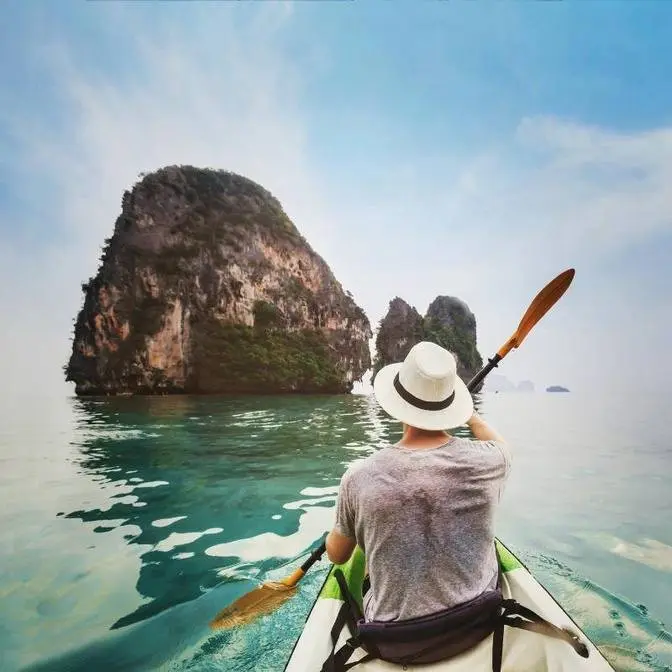
Number 35, Ha Long
Bay, Vietnam.
Legend says dragons made this bay.
In the Gulf of Tonkin,
close to 2,000 limestone islands rise from emerald water.
Many are hollow, carved over millions of years into caves.
Long means descending dragon.
In legend, dragons spat out jewels that became these islands,
a wall against invaders from the sea.
People still live on the water here, in floating fishing villages.
The best way to see the bay is slowly,
by boat, as the islands fade into the mist.
Out on deck at dawn, the only sounds are the low hum of the engine
and the splash of a fisherman's oars.
Still to come, a city built on millions
of wooden piles driven into a lagoon,
and a temple so vast the jungle hid it.
Number 34. The old
and new towns of Edinburgh, Scotland.
This city sits on a volcano, and it was split in two on purpose.
Edinburgh is really two cities side by side.
The old town runs down a ridge from the castle,
which sits on an extinct volcano.
In the 18th century, the old town became so crowded
that the city planned something new across the valley.
Wide streets, elegant squares, and Georgian terraces
laid out on a grid.
From Calton Hill at dusk, you can see both at once,
the jagged old skyline and the orderly new one.
Walk the Royal Mile, and you'll hear bagpipes
echoing down the narrow closes
and smell the rain
on old stone.
Number 33.
The rice terraces of the Philippine Cordilleras.
Oh my gosh.
Some people call these terraces the eighth wonder of the world.
High in the mountains of northern Luzon,
the Ifugao people carve rice fields into slopes so steep
that the terraces rise like the steps of a giant stadium.
They were built by hand, and they still work.
Water from the forested peaks flows
down through canals and bamboo pipes,
from one terrace to the next.
In the morning, when the mist lifts off the valley,
the green steps look much as they have for generations.
Stand on the edge of a terrace, you'll hear water trickling everywhere,
running down the mountain from one field to the next.
Number 32, Sydney Opera House, Australia.
Its architect never saw it finished.
This is one of the youngest places on the whole list.
In 1957, a Danish architect named Jørn Utzon won a design competition
with a sketch that engineers didn't yet know how to build.
Costs soared, politics turned sour,
and Utzon left in 1966, never to see it finished.
It opened in 1973, its shells covered in more than
a million tiles that cleaned themselves in the rain.
In 2007, it became a World Heritage Site,
while its architect was still alive.
Sit on the harbour steps at sunset
and the white shells turn pink as the ferries slide past below.
Number 31, the historic centre
of Prague, Czechia.
In this city, a clock has been ticking for more than 600 years.
Prague is called the city of a hundred spires.
Over a thousand years of architecture stands here almost untouched,
street after street.
Above the river rises Prague Castle,
one of the largest castle complexes in the world.
Crossing the river is the Charles Bridge,
lined with 30 statues of saints.
In the old town square an astronomical clock has
been ticking since 1410.
Every hour a crowd gathers to watch
its apostles parade past the windows.
Cross the Charles Bridge at first light before the crowds
and you'll have the statues,
the river and the castle almost to yourself.
Number 30, Yosemite National Park, USA.
In 2017, one man climbed this cliff with no ropes at all.
In California's Sierra Nevada,
glaciers carved a valley with walls of solid granite.
El Capitan rises nearly 900 meters straight up from the valley floor.
In 2017, Alex Honnold climbed it without any ropes.
In 1864, during the Civil War,
President Lincoln signed a law to protect this valley for the public.
It was one of the first times any government set land aside simply
because it was too beautiful to lose.
Here we go.
Stand in the meadows in spring,
and you'll hear the waterfalls before you see them,
pouring off the cliffs with melted snow.
Number 29, Hallstatt, Austria.
This village ran out of room for its dead.
Squeezed between a steep mountain and a deep alpine lake,
Hallstatt has barely enough flat ground to stand on.
Its houses are stacked up the slope.
People came here for one reason, salt.
The mine above the village is thought to be the oldest still in use,
worked for around 7,000 years.
Space is so tight that the cemetery couldn't hold everyone.
For centuries bones were dug up,
painted with names and flowers, and kept in a charnel house.
More than 600 painted skulls are still there. In the early morning,
the lake is so still that the whole
village hangs upside down in the water.
Still ahead, a wall that runs more than half the way around the earth.
Number 28. The Alhambra, Granada, Spain.
Legend says a sultan wept when he lost this palace.
On a hill above Granada stands the last great palace of Muslim Spain.
From outside, it looks like a plain red fortress.
Inside, it's something else entirely.
Its rulers covered the walls in carved plaster as fine as lace
with geometric tiles and lines of Arabic poetry.
In 1492, the last sultan handed Granada over
and legend says he wept as he looked back.
Water still runs through the palace in channels and fountains
the way its builders designed it.
Step into the Court of the Lions,
and the only sound is water running from the fountain
through narrow channels in the floor.
Number 27, Paris, Banks of the Seine.
The most famous tower in the world
was meant to be torn down.
UNESCO didn't list all of Paris.
It listed the river, a stretch
of the Seine about eight kilometers long,
and almost everything that lines it.
It runs past the Louvre, once a royal palace,
around the island where Notre Dame has stood
for more than eight centuries,
past the Eiffel Tower, built for the 1889 World's Fair
and meant to be taken down after 20 years.
The best way to see it is from a boat after dark,
as the bridges light up one by one.
Then, on the hour, the Eiffel Tower bursts
into thousands of sparkling lights.
Number 26, Komodo National Park, Indonesia.
There are real dragons on these islands.
Among the islands of eastern Indonesia lives
the largest lizard on earth.
The Komodo dragon can grow to around three meters long,
and its bite carries venom that stops blood from clotting.
Only a few thousand are left in the wild.
But the sea around them is just as remarkable,
with manta rays, turtles and reef sharks over coral gardens.
And on Padar Island,
a short climb gives three bays curving side by side,
each with sand of a different color.
Snorkel off the pink sand beach, and the reef is so close beneath you
that you can hear parrotfish crunching on the coral.
Number 25, the Sagrada Familia,
Barcelona, Spain.
This is the most famous building site in the world.
Seriously, what have you done?
Construction began in 1882 and it still isn't finished.
Antoni Gaudi spent the rest of his life on it.
Asked about the slow pace, he supposedly replied,
my client is not in a hurry.
Gaudi designed its columns to branch like trees,
so the inside feels like a stone forest.
Sunlight through the stained glass turns one side green and blue
and the other red and gold.
Stand in the nave in the late afternoon and the colored light
moves slowly across the stone as if the forest were alive.
Number 24, Plitvice Lakes National Park, Croatia.
These lakes are still building themselves.
themselves.
Sixteen lakes sit in a forested valley,
one above the other, linked by waterfalls.
The water shifts from green to deep turquoise with the light.
What makes Plitvice special is that it's still growing.
As water flows over moss, it leaves behind limestone,
building natural dams that keep raising the lakes.
Wooden boardwalks wind across the water.
Swimming isn't allowed, which is why it stays
so clear you can watch fish moving over the bottom.
Walk the boardwalks early and you'll hear nothing
but falling water all around you
and feel its cool spray
on your face.
Number 23. The old city of Dubrovnik, Croatia.
In 1991 this city was shelled. Today you can barely tell.
For centuries this walled city on the Adriatic
was the capital of a tiny independent republic.
It survived among empires by trade and diplomacy
and it abolished the slave trade in 1460.
Its walls run for almost two kilometers around the old city.
Inside the main street is paved
with limestone polished smooth by centuries of footsteps.
The city was shelled in 1991 and carefully restored.
Walk the walls today and the new roofs
and old ones are almost impossible to tell apart.
Up on the walls, swallows dart over the terracotta roofs
and the Adriatic glitters far below.
Still to come, a waterfall the locals call the smoke that thunders
and a valley where a hundred balloons rise at dawn.
Number 22. The Acropolis, Athens, Greece.
The most perfect building of the ancient world isn't straight.
On a rocky hill above Athens stands the Parthenon,
a temple to Athena, finished in 432 BC.
It looks perfectly straight, but it isn't.
Its columns lean slightly inward, and its floor curves up in the middle
to make it look perfect from below.
In 1687, during a siege, a cannonball set off gunpowder stored inside,
and the explosion blew out its middle.
Restoration is still going on, stone by stone.
Climb up early in the morning and the marble glows the color of honey
while the whole city spreads out below you,
all the way to the sea.
Number 21. Borobudur Temple, Java, Indonesia
The largest Buddhist temple on earth was once lost under volcanic ash.
Built around the 9th century,
Borobudur is the largest Buddhist temple in the world,
made from around 2 million blocks of volcanic stone.
Pilgrims circle it clockwise, climbing through nine levels,
past more than 2,000 carved panels.
At the top, 72 stone bells each hold a statue of the Buddha.
For centuries, it lay under volcanic ash and jungle.
Come at sunrise, when mist fills the valley
and volcanoes appear behind the stupas.
Climb the terraces in the dark, and you'll hear roosters calling
from the villages below as the sky turns pink.
Number 20,
Mount Fuji, Japan.
Japan's most famous mountain is an active volcano.
Fuji is the tallest mountain in Japan,
an almost perfect cone of snow
rising alone above the plains.
On a clear winter day, you can see it from Tokyo.
It's an active volcano.
It last erupted in 1707,
but UNESCO listed it as a cultural site,
a sacred place, and a source of art.
Every summer, hundreds of thousands of people climb through
the night to watch the sunrise from the summit.
Stand by Lake Kawaguchi on a still morning, and you'll see
two fujis, one in the sky and one upside down in the water.
Number 19. Victoria Falls, on the border of Zambia and Zimbabwe.
In the dry season, people swim right on the edge of this waterfall.
Here, the Zambezi River, nearly two kilometers wide,
suddenly drops into a narrow chasm more than a hundred meters deep.
The local name is Mosi-oa-Tunya, the smoke that thunders.
In the wet season, the spray rises hundreds of meters into the air
and can be seen from 50 kilometers away.
In the dry season, swimmers can sit in Devil's Pool,
right on the edge of the falls, held back by a lip of stone.
Walk the rainforest path facing the falls
and the spray drifts over you like warm rain
while the roar shakes the ground beneath your feet.
Number 18.
The Galapagos Islands, Ecuador.
On these islands, the animals aren't afraid of you.
About a thousand kilometres off South America, in 1835,
a young naturalist named Charles Darwin spent five weeks
on these volcanic islands.
What he saw here helped shape his theory of evolution.
Wildlife is famously fearless
because it evolved with almost no land predators.
Sea lions sleep on park benches.
Marine iguanas dive for seaweed.
Blue-footed boobies dance for their mates,
lifting their bright blue feet one at a time.
time.
Swim off the shore and young sea lions will spin around you,
curious, playing in your bubbles.
Number 17. The historic monuments of ancient Kyoto, Japan.
In one garden here, 15 stones are
placed so you can never see them all.
From 794 to 1868, Kyoto was the imperial capital of Japan.
Seventeen of its temples, shrines and castles are listed together.
There's the Golden Pavilion,
its upper floors covered in gold leaf above a still pond.
And the Rock Garden at Ryoan-ji,
fifteen stones placed so that from anywhere on the platform,
at least one is always hidden.
During the Second World War, Kyoto was on the early list
of targets for the atomic bomb.
It was removed partly because of its cultural value.
Stand on the wooden stage of Kiyomizu-dera in autumn
and the hillside below you burns red
and gold with maple leaves.
Still ahead, monasteries built on top of stone pillars
and a canyon whose deepest rocks are two billion years old.
Number 16.
Yellowstone National Park, USA.
Let's see.
Every year someone here tries to pet a bison.
In 1872, Yellowstone became the first national park in the world.
Beneath it lies one of the largest volcanic systems on Earth,
powering more than half of the world's geysers.
Old Faithful erupts roughly every hour and a half.
Grand Prismatic Spring is ringed
with bands of orange, yellow and green,
made by heat-loving microbes.
Oops.
Bison have lived here since prehistoric times.
Please don't pet them.
Every year someone tries.
Stand on the boardwalks and you'll smell the sulphur,
hear the mud pots bubbling and feel the ground breathing beneath you.
Number 15.
The Amalfi Coast, Italy.
High above this coast runs a trail called the Path of the Gods.
Thanks.
South of Naples, mountains fall almost straight into the sea.
Villages like Positano
and Amalfi are stacked one house above the other,
linked by a single winding road.
A thousand years ago,
Amalfi was a maritime republic that traded across the Mediterranean.
The slopes are lined with lemon groves grown under wooden frames,
and high on the cliffs,
a trail called the Path of the Gods looks down on the whole coast.
Take a boat out at sunset,
and Positano rises above you like a stack of pastel boxes,
its windows lighting up one
by one.
Number 14, the historic areas of Istanbul, Turkey.
This city stands on two continents at once.
Istanbul was the capital of two
of the longest lasting empires in history,
the Byzantine and the Ottoman.
Its old city sits where Europe faces Asia across the Bosphorus.
Hagia Sophia was finished in 537,
and for almost a thousand years it
was the largest cathedral in the world.
Its dome seems to float on a ring of light.
Below the streets lies the Basilica Cistern,
an underground hall of 336 marble columns.
At dusk, the call to prayer rises from one minaret after another,
echoing across the water between two continents.
Number 13. The historic center of Rome, Italy.
In Rome, there's a 2,000-year-old building where it rains indoors.
Rome's historic center holds almost 3,000 years of history,
from the Roman Forum to the palaces of the Renaissance.
The Colosseum opened in the year 80 and held around 50,000 spectators.
Beneath its arena, tunnels and lifts sent animals
and gladiators up through trap doors.
The Pantheon, nearly 2,000 years old,
still has the largest unreinforced concrete dome in the world.
Oh, my God.
Stand inside and look up.
A single round opening at the top lets in a moving circle of sunlight
and, when it rains, the rain.
Number 12.
Meteora, Greece.
Visitors to these monasteries used to be hauled up in a net,
the plains of Thessaly.
Sandstone pillars rise hundreds of meters into the air,
and on top of them, monks built monasteries.
From the 14th century, monks climbed up here to escape the world.
At their height, there were 24 monasteries.
Visitors were hauled up in nets,
and legend says the ropes were only replaced when they broke.
At sunset, the pillars turn gold.
Meteora means suspended in the air.
Today, steps are cut into the rock,
and from the top, all you hear is the wind,
the birds, and the monastery bells.
Number 11.
The Pyramids of Giza, Egypt.
For almost 4,000 years, nothing people built was taller than this.
The Great Pyramid was built for the pharaoh Khufu,
around 4,500 years ago.
For almost 4,000 years,
it was the tallest building made by people on earth.
It's the only one of the seven wonders
of the ancient world still standing.
Its sides line up almost perfectly with north, south, east and west.
And workers' tombs found nearby suggest it wasn't built by slaves,
but by paid teams who were fed and housed.
Ride out onto the plateau at sunrise,
and the pyramids stand dark against a sky turning orange,
just as they have for 45 centuries.
And now
The top 10.
Number 10, Venice and its lagoon, Italy.
This city should not exist.
Venice was built where no city should be,
on 118 small islands in a marshy lagoon.
To make solid ground,
its builders drove millions of wooden piles into the mud.
Instead of streets, it has around 150 canals,
crossed by more than 400 bridges.
For a thousand years, Venice was the capital of a republic
that ruled the trade between Europe and the East.
Its merchants brought home silk, spices, and glass,
and built the palaces that line the Grand Canal.
On high tides, St. Mark's Square floods.
Since 2020, giant barriers can rise from the seabed
to hold the sea back.
Step away from the main squares, and Venice goes quiet.
There are no cars and no scooters.
Just footsteps echoing on stone, water lapping at doorsteps,
and a gondolier calling out before he turns a corner.
Number 9.
The Great Wall of China
Almost everything you've heard about this wall is a little bit wrong.
It isn't one wall.
It's many, built by different dynasties over 2,000 years.
All added up, a survey measured them at more than 21,000 kilometres.
That's more than half the way around the Earth.
Soldiers could pass a warning hundreds of kilometres in hours,
with smoke by day and fire by night.
The most famous stretches were built by the Ming dynasty
in brick and stone, with watchtowers along the ridges.
One myth says you can see it from space with the naked eye.
You can't.
But from the ground, it snakes over
the mountains as far as you can see.
Hike a wild section, where the wall crumbles
and trees grow out of its stones,
and you'll climb steps so steep you need your hands.
From the top of each tower, the wall unrolls ahead of you,
ridge after ridge, into the haze.
Number 8.
Grand Canyon National Park, USA.
At the bottom of this canyon is a village where the mail comes by mule.
Over five to six million years,
the Colorado River cut a canyon around 450 kilometers long
and almost two kilometers deep.
Its walls are like the pages of a history book.
The rocks at the bottom are close to two billion years old.
People have lived in and around the
canyon for thousands of years.
The Havasupai still live deep inside it. In a village where
Where the mail arrives by mule.
The canyon is so large it makes its own weather.
At sunset, the walls glow red, orange,
and purple, changing minute by minute.
Stand on the south rim before sun lies, in the cold and the dark.
Then the first light hits the far walls, and the canyon rises out
of the shadow, layer by layer, deeper than seems possible.
Number seven,
the Taj Mahal, Agra, India.
This is a love story, built in marble.
In 1631, the emperor Shah Jahan lost his favorite wife, Mumtaz Mahal.
He decided to build her a tomb unlike anything the world had seen.
It took about 20,000 workers, more than 20 years.
The four minarets lean very slightly outward.
So if they ever fell, they would fall away from the tomb.
The white marble is inlaid with flowers made of precious stones,
jasper, jade and lapis lazuli,
cut so finely that the petals look painted on.
When Shah Jahan died, he was laid to rest beside her.
Its colour shifts through the day,
pink at dawn, white at noon, gold at sunset.
Walk in through the great gateway
and the Taj appears framed in its arch,
floating above the long reflecting pool,
so perfect that for a moment it doesn't look real.
Number six, Iguazu National Park, Argentina and Brazil.
When Eleanor Roosevelt first saw these falls,
she reportedly said just two words.
On the border of Argentina and Brazil,
the Iguazu River pours over a cliff in a horseshoe
nearly three kilometers wide.
Depending on the season,
it splits into as many as 300 separate falls.
The most powerful is the Devil's Throat.
Walkways take you out right above it,
close enough to feel the roar in your chest.
When Eleanor Roosevelt first saw it, she reportedly said,
Poor Niagara.
The falls sit inside subtropical rainforest,
home to toucans, coatis and clouds of butterflies.
All right.
On the Brazilian side, a walkway runs out over the river into the mist.
Rainbows form all around you, the roar fills everything,
and within seconds, you're soaked to the skin.
Five left,
but five.
The Dolomites, Italy.
These mountains were once at the bottom of a tropical sea.
In the north of Italy rise pale, jagged towers of rock
that look like broken cathedrals.
They began as coral reefs in a warm tropical sea
around 250 million years ago.
At dawn and dusk, the peaks glow pink, then red, then violet.
Locals call it Enrosadira.
In the First World War, the front line
ran right through these mountains.
Soldiers' paths became the iron routes with cables and ladders
that hikers still climb today.
Hike to the three peaks of Lavaredo,
three great towers of rock standing side by side,
and you'll hear cowbells ringing across the high meadows
and the crunch of stones underfoot.
At night, from a mountain hut,
the sky fills with more stars than you've ever seen.
Number four, National Park
and the rock sites of Cappadocia, Turkey.
Beneath these valleys, whole cities are hidden underground.
Millions of years ago, volcanoes buried central Anatolia in ash,
which hardened into soft rock.
Wind and water wore it into cones and towers called fairy chimneys.
Because the rock is soft,
People carved homes and churches straight into it
and underground there are whole cities.
Peace.
Derinkuyu goes down around 85 meters
and may have sheltered thousands of people.
In the rock churches of Göreme,
monks painted the walls with frescoes about a thousand years ago
and in some the colors are still bright.
Just after dawn, on calm mornings,
a hundred or more balloons rise together over the valleys.
Be in the basket before sunrise.
The burner roars above you, then falls silent,
and you drift up, weightless,
over a landscape of stone chimneys turning pink
in the first light.
Number three.
Petra, Jordan.
Remember the city carved into a cliff from the very beginning?
This is it.
More than 2,000 years ago, a desert people called the Nabataeans
grew rich on the caravan routes that carried incense across Arabia.
Their capital was carved straight into rose-red cliffs.
Gifts.
The way in is through the Seek,
a narrow gorge more than a kilometer long.
At the very end, it opens,
and the first thing you see is the treasury, cut from the living rock.
After its trade faded and earthquakes struck,
Petra was forgotten by the outside world
until a Swiss explorer found his way there in 1812.
Beyond the treasury, the city opens into a wide valley of royal tombs,
a theatre for thousands, and streets lined with columns.
Climb more than 800 rock-cut steps to the monastery,
even bigger than the treasury,
and watch the sun set the cliffs glowing red.
On some nights, the Siq is lit by more than a thousand candles.
But to Angkor, Cambodia,
and the temple the jungle swallowed,
In the 12th century,
the Khmer king Suryavarman II built a temple to the god Vishnu.
Angkor Wat covers around 162 hectares,
the largest religious monument in the world.
It was the heart of what may have been the largest city
on earth before the industrial age.
Laser scans from the air have revealed roads,
canals and reservoirs hidden under the forest.
Angkor Wat was built as a model of the universe in stone.
Its five towers stand for the peaks of Mount Meru, home of the gods,
and its wide moat for the ocean around the world.
And at Ta Prohm, the roots of giant trees
pour over the walls like slow waterfalls,
arrive in the dark, and wait by the reflecting pond.
As the sky turns from black to orange, the five towers appear,
doubled in the water, while the jungle wakes up around you.
Number one, the historic sanctuary
of Machu Picchu, Peru.
The city above the clouds,
almost two and a half kilometers up in the Andes,
on a ridge between two mountains,
the Inca built a city around the middle of the 15th century.
Why build here? No one is completely sure.
Most historians think it was a royal estate
for the emperor Pachacuti,
a retreat in the mountains with temples, palaces,
and homes for a few hundred people.
The Inca used no iron tools and no wheels.
Yet their best walls are cut
so precisely that a knife blade can't slide between the blocks.
The Spanish conquerors never found it.
The city sits on top of fault lines and the Inca built for
it. Their walls lean slightly inward
and the stones fitted without mortar are thought to
shift in an earthquake and settle back into place.
Much of the work is hidden underground,
deep foundations and drainage that keep the city
from sliding off the mountain in the rain.
The Inca also watched the sky.
In the Temple of the Sun, on the morning of the June solstice,
the sunrise shines through a single window,
straight onto a carved stone.
It was brought to the world's attention in 1911,
guided by local farmers who had known it all along.
Walk in through the sungate at dawn,
the way the Inca did on the old trail.
The clouds pour over the ridge, then thin out,
Below you, the terraces step down the mountain,
the stone city waits on its ridge,
and Huayna Picchu rises behind it, exactly as it did 500 years ago.
Llamas graze on the grass between the ruins.
And for a moment, everything is silent.
Stand there as the clouds lift off the peaks,
and you'll understand why so many people put it first.
Forty places, from a town lit by silk lanterns,
to a city in the clouds.
If you could visit just one, which would it be?
Tell me in the comments.
And subscribe because there's a lot more of the Earth to see.