Does Red Meat Increase Your Diabetes Risk by 63%? The Strange Sugar Explained!
Could a molecule found in beef, lamb, and pork increase your risk of developing type 2 diabetes? A new study has researchers looking at a little-known sugar called Neu5Gc.
Presented at the European Association for the Study of Diabetes (EASD) meeting in Milan, the study followed nearly 90,000 adults and found that people with the highest estimated Neu5Gc intake had a 63% higher relative risk of developing type 2 diabetes compared with those with the lowest intake.
But does this mean you need to give up steak forever?
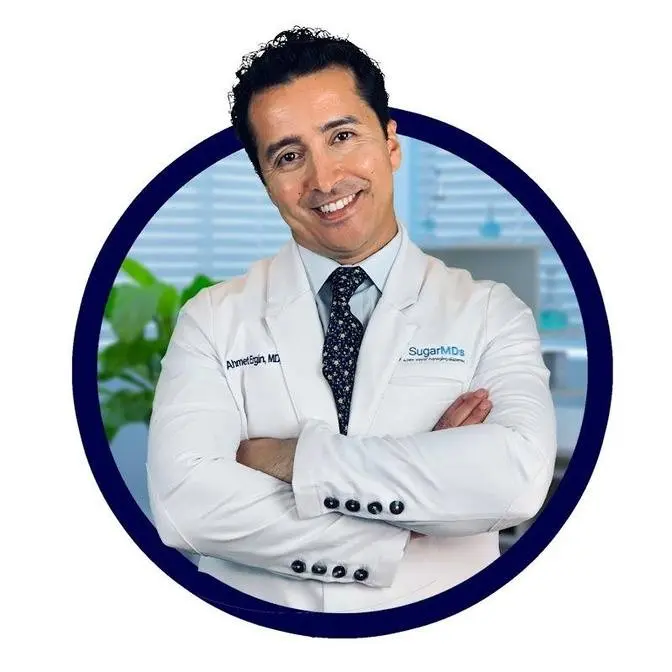
In this video, endocrinologist Dr. Ergin breaks down the science behind Neu5Gc, explains the connection between red meat, chronic inflammation, and insulin resistance, and separates the actual research findings from alarming headlines.
In this video, you'll discover:
- What Neu5Gc is and why humans cannot naturally produce it. - How this unusual sugar may trigger an immune response called xenosialitis. - What the study of nearly 90,000 adults actually found. - Why a 63% increase in relative risk doesn't tell the whole story. - The important limitations of the research. - Whether grass-fed beef contains Neu5Gc. - How to enjoy red meat while making more blood-sugar-friendly food choices. - Why Mediterranean-style eating and walking after meals matter. - How berberine may support metabolic health.
Should you stop eating red meat?
Not necessarily. Dr. Ergin explains why moderation, portion control, dietary variety, and an overall healthy eating pattern matter more than reacting to a single alarming headline.
Birthday brisket? Enjoy it. Daily brisket? Let's talk!
SUPPORT YOUR METABOLIC HEALTH
Explore SugarMD Super Berberine and other blood-sugar support supplements:
Subscribe for evidence-based insights on diabetes, insulin resistance, blood sugar management, and metabolic health.
💬 What's your favourite alternative to red meat? Let us know in the comments!
DISCLAIMER: This video is for educational and informational purposes only and is not intended as medical advice. The study discussed is observational and does not establish that Neu5Gc causes diabetes. Consult your healthcare professional before making changes to your diet, medications, or supplement routine.
Dr. Ergen analyzes a study linking Neu5Gc, a sugar molecule found in red meat, to a 63% increase in type 2 diabetes risk. He explains that while the headline is alarming, the absolute risk is low and the study is observational. He advises moderation of red meat and emphasizes a vegetable-rich, Mediterranean-style diet to manage blood sugar.
All right, so my phone has been blowing up with this headline.
Scientists link a strange sugar
in red meat to a 63% higher diabetes risk.
And patients keep asking me if they need to
throw out their steaks.
Somebody even asked, I'm not kidding, if you could still have his
birthday biscuit. Hi, I'm Dr. Ergen.
I'm an endocrinologist at the Diabetes Thyroid and
and Hormone Center of the Treasure Coast
in Port St. Lucie and Vero Beach.
And here on this video, SugarMD,
we like to actually show the study before we panic.
So let's do that together.
First, what is this strange sugar?
It's called Neu5Gc.
If you want to impress somebody, you can definitely talk about
this study while you're eating steak.
It is a sugar molecule that sits
on the surface of cells in most mammals.
Cows, sheep, pigs.
But here's the weird part.
Humans cannot make it.
Somewhere back in our evolution, we lost the gene.
It's called CMAH.
So, our bodies don't produce it,
or God decided that we should be a little bit different than
animals.
So, when we eat a lot of beef or lamb,
we are taking in this molecule our body sees
as kind of foreign.
The theory is, and this is a theory,
that it can build into our own tissues, and the
immune system reacts to it with low-grade inflammation.
Researchers have a fun name for that.
It's called xenosialitis and chronic inflammation.
Diabetes inflammation, as you know,
is a big driver of insulin resistance, so that's why
it matters.
So today, the study,
this was presented at the European Association for the Study of
Diabetes meeting in Milan this fall.
A French group, the lead author, Dr. Leopold Fizeau,
used a big cohort called NutriNet
Sante, almost 80,000 adults, median follow-up about seven years.
And during that time, 960 people, the
Developed type 2 diabetes.
Now they split everybody into five groups by how much new 5GC they ate.
The top group compared to the bottom group had a hazard ratio of 1.63.
That is your 63 increased risk.
Now here's where I put on my honest hat.
The 63 is a relative risk.
Out of almost 90,000 people, 960 got diabetes over seven years.
That is roughly one in a hundred.
So when you hear 63 higher,
You're talking about a percentage of a fairly small number.
The study summaries did not report the absolute numbers per group.
So I am not going to make one up here.
But the absolute difference is a lot smaller than
that headline makes you feel.
Secondly, this is observational.
They asked people what they ate.
Do you remember what you ate yesterday?
Three days of food records and estimated the new 5GC.
They did not measure it in anybody's blood either.
Either third and
And this is the big one.
When they adjusted for total red meat intake,
the new 5GC link was no longer statistically
significant.
So we really cannot tell if it is the sugar
or the saturated fat or the heme iron or the
processed meat.
Just the fact that people eating 97 grams
of red meat a day might be eating fewer vegetables.
That's also a possibility because a lot of people are meat
and potato people and they
end up with diabetes because they don't eat vegetables.
There's a lot of compounding factors.
Also, interestingly,
new 5GC from dairy showed no association with diabetes.
So cheese lovers, you can breathe.
So what does this mean for you?
Honestly, it lines up with what we already knew.
Loss of red meat, especially processed red meat,
is tied to more type 2 diabetes in a
lot of studies.
This is not the first one.
This just gives us one more possible reason why.
And here's what I tell my patients.
You don't have to go vegan.
You don't have to turn into a rabbit.
it. Unless you want to, that's fine.
Think of red meat as a side guest, not the headliner. A couple
of times a week is reasonable.
A reasonable portion, unprocessed, grass-fed, grass-finished
is perfectly fine. Just get your vegetables in 8 to 10 servings.
That sounds a lot, but a lot of
Americans are eating two servings on average.
So if you're an average American, you are eating
broccoli occasionally, but 8 to 10 servings is what you're looking for.
Now, the grass-fed beef
the new 5G story, but it is what it is.
It is a mammal thing, not a farm. Now, on the other days...
You can do like fish, chicken, eggs, beans, lentils.
So make sure that your diet has a good variety.
Now, in the PREDIMED trial,
a Mediterranean-style pattern lowered diabetes risk
compared to a low-fat controlled diet.
And that is the kind of eating I would lean into.
And this is also a big one here.
What you eat with your steak matters.
Put a big salad next to it or before it.
Vegetables, fiber, olive oil.
Go for a 10-minute walk after dinner
because your muscles soak up glucose when you move.
free medicine. For my patients
who are already insulin resistant or pre-diabetic, I also often
add sugar MD super berberine into their regimen
because it contains dehydroberberine, which is a
lot better absorbed form of berberine.
It doesn't affect the gut microbiome. As you know, berberine
and dehydroberberine works on AMP kinase.
Think of it as your cell's fuel gauge and helps your
muscles pull sugar out of the blood.
It's not a license to eat 20 ounces of ribeye every night,
But it is a good support for
for the lifestyle work that you're already doing.
So, birthday brisket, yes, enjoy.
Daily brisket, let's talk about it.
Now, if you want more on how to eat for blood sugar
and you wanna check out SugarMD Super Berberine
or other blood sugar support supplements,
go to SugarMDS.com.
While you're on the YouTube channel, drop a comment.
Tell us, what is your favorite red meat swap?
I'm always looking for new ideas.
See you next time, thank you for watching.