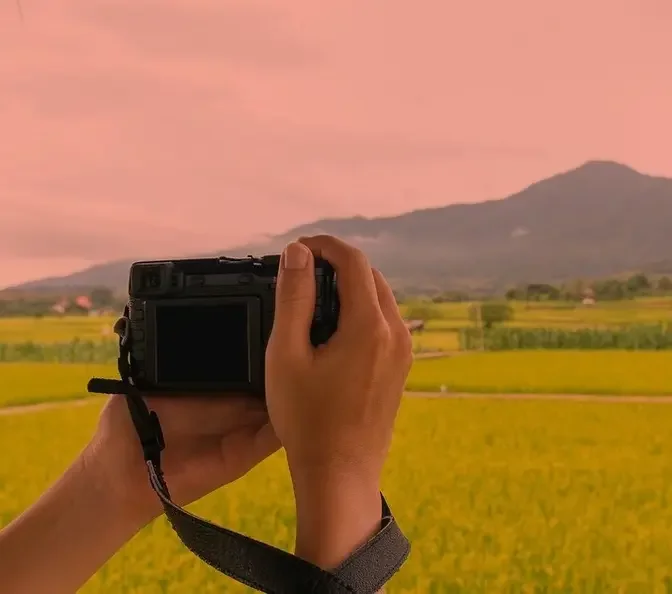
The DJI Pocket 4P is a significant upgrade over the Pocket 3, primarily due to the introduction of LOFIC sensor technology and D-Log 2, which vastly improve dynamic range and skin tone reproduction. With a new zoom lens, enhanced tracking, and better usability, it serves as a versatile, inconspicuous tool for high-quality BTS and vlogging.
Now, this might be the most important camera of 2026,
and I'm not saying that to be dramatic,
but we're getting a glimpse into the future.
Like I just talked about the A7R6 dynamic range
and the dual gain output,
but the LOFIC sensor technology that's in this camera
that's responsible for the high dynamic range
is that, you know, we've been hearing
about a million times on Instagram.
Unlike DGO, this technology physically adds more capacity
to hold on to light that would have otherwise been lost.
This is a relatively new tech
that will inevitably make its way to larger sensors,
and to me, that's exciting.
Now, for this video, I partnered with DJI
to bring a more practical look at the 4P
and what it offers, okay, forget about,
I don't do travel films or any of that.
What does it offer somebody that just wants
to capture BTS of themself in a, you know,
that's high quality when you're on location
or in a studio environment like I am right now?
Now, for me, the Pocket 4P fixes some of the biggest issues
that I had with the Pocket 3.
And the first one and the most important one
is image quality.
Now, if you've had the Pocket 3,
you know that sometimes you're wowed by the footage
and sometimes it's very underwhelming.
See, with the Pocket 3, I never really liked
how it handled artificial lighting.
I never liked how it handled bright highlights
and skin tones.
And part of that was just the highlight roll-off
wasn't great.
And that is primarily due to D-Log M
and the lack of dynamic range that it had.
Also, nailing exposure was extremely hard, okay?
I had to set the in-camera meter to negative 0.7
or negative one, or else skin tones would look muddy,
especially if, you know, if you're using auto exposure.
I can't just put my Pocket 3 in auto mode
and just film something
because I don't like how my skin looks.
It's usually overexposed,
which means that I'm always having to set it to minus one EV
for my skin to look good.
And then it always has like a plastic, mushy look to it.
I was never a fan.
That is a big reason why I didn't pick up the Pocket 3
as often as I wanted to,
because I have an A7C2 camera right behind here.
I would rather,
but I would rather shoot on a smaller camera
because I feel like it's more approachable.
I still get them pre-recording jitters
or when I press record, I start to feel,
you know, I start to forget everything
I was gonna say.
And with smaller cameras,
I feel like there's less production value.
It's almost like being on FaceTime.
So it's easier to get my words out.
And now we are in manual settings.
So this is how I would get the best image
out of the Pocket 3.
And this is what you should expect from D-Log 2.
What does it look like?
Do the skin tones look better?
Yes, Manny.
Yes, yes, they do.
They look a lot better.
The new D-Log profiles,
my skin has a nicer, more organic texture to them.
Whereas on the Pocket 3,
it has a more crunchy look to them.
Another reason why I didn't pick up the Pocket 3
as much as I wanted to was its lack of versatility.
I don't always wanna be locked in
at 20 millimeter for everything.
It does have a 2X lens,
but you know, you can't use D-Log M with that.
On the new Pocket 4P, you obviously have the zoom lens.
Right now I'm at 3X
and I'm able to get a different kind of look.
You know, I don't want my shots to always look the same.
Usually I would have to bust out my bigger camera
to put a longer lens on.
See, being able to move the camera around
and get different looking shots of yourself.
And I use the remote control to compose them.
Like there's just nothing else out there
that can match this kind of versatility and convenience.
Right, so the telephoto lens is a 60 F1.8,
which full frame equivalent is like a 60 millimeter F6.3.
So you're not gonna get a lot of background blur,
nor is it gonna blow you away with the sharpness,
but it still looks really solid.
Now I've always loved the usability of these cameras,
but this one is a pretty substantial upgrade
over the Pocket 3.
Right now you have those two physical buttons
under the screen, which are to zoom
and I custom mapped one so that it puts me into D-Log 2.
And I press it again, it puts me back to D-Log.
That essentially unlocks the zoom feature.
So I really like being able to do that
without having to go into settings every single time.
The ActiveTrack 8.0, night and day better
than the one in the Pocket 3.
The new wireless remote that comes with the Creator Combo
makes composing shots a million times easier
than pulling out your phone and connecting to the DJI app
while you're in the middle of a shoot.
Now I can use it to start and stop record,
compose my shot, use it to zoom in and out,
start subject tracking.
It's really small and lacks a lot of features,
but I appreciate how small it is.
I could just toss it in my pocket after I'm done using it.
One thing I was really happy to see
was that a lot of the accessories
that I purchased for the Pocket 3
are cross-compatible with the Pocket 4P.
You know, you don't realize it,
but a lot of these little accessories,
they're like $20, $30 a pop and they're so small.
That adds up, it adds up to a couple of hundred dollars.
A lot of these accessories,
including my teleprompter accessory
that I have for the Pocket 3,
where it's what I use when I'm trying to read off,
reading off specs of a camera,
or I just wanna make sure
I'm not talking all over the place.
That helps me keep, stay in line where I'm going here.
I could probably use a teleprompter right now,
but I really love the cross-compatibility
and the small form factor that they were able to maintain
on the new Pocket 4P.
Obviously the camera module is larger,
but the overall size of the camera is still very pocketable.
Another huge upgrade to the Pocket 4P
is the built-in storage.
Every camera needs to have built-in storage at this point.
Not necessarily to rely on it,
but to use, to have as a backup,
just in case you leave the house
without a memory card in your camera
or a memory card that is almost full,
or you don't wanna overwrite anything,
you don't wanna have to delete things on the fly.
I mean, being able to just pick this up and just use it
and not worry about that so much,
makes like, hello.
So is this a worthy upgrade to the Pocket 3?
I will say this.
If you are a casual user that shoots in standard profile,
save your money, the Pocket 3 is still great.
But if you shoot in log
and you care about having the best image quality
and you care about that extra lens,
my answer is absolutely.
Like this is a no brainer kind of upgrade.
I know that a lot of our bigger cameras,
they aren't really moving the needle right now, right?
They're just getting incremental updates.
But this one is different.
You know how they say, right?
That the best camera is the one that you have with you.
I mean, you can pretty much take this camera
anywhere you go.
It's about the same size as my phone.
I mean, the fact that the camera is this small,
this versatile, with the kind of quality
that you get out of it,
in such a tiny inconspicuous package,
if you're a shy guy like me,
like you're filming in public, you get shy.
This is the most inconspicuous kind of camera
that you can buy.
You know, and I would say in terms of quality,
you know, just for the D-Log alone,
it is a pretty big quality jump from the 3.
But that D-Log 2 is what really separates this camera, right?
Where it's utilizing that Lofic center tech.
Yes, even though there are some pretty stiff limitations
on the D-Log 2,
but in those situations
where you don't have your big camera,
this is what you got.
And image quality is your priority.
This is the number one,
that this is image quality.
The fact that you have that option
is amazing on this camera.
The biggest problem with this camera,
and this camera is not perfect.
It has like a lot of little quirks,
although it's very polished.
It's gotten polished over the years.
There are quirks.
The biggest problem is obviously being able
to get it in the United States.
This is where you gotta start getting creative.
You know, use that creativity
and find a way to get this camera
because it is outstanding.