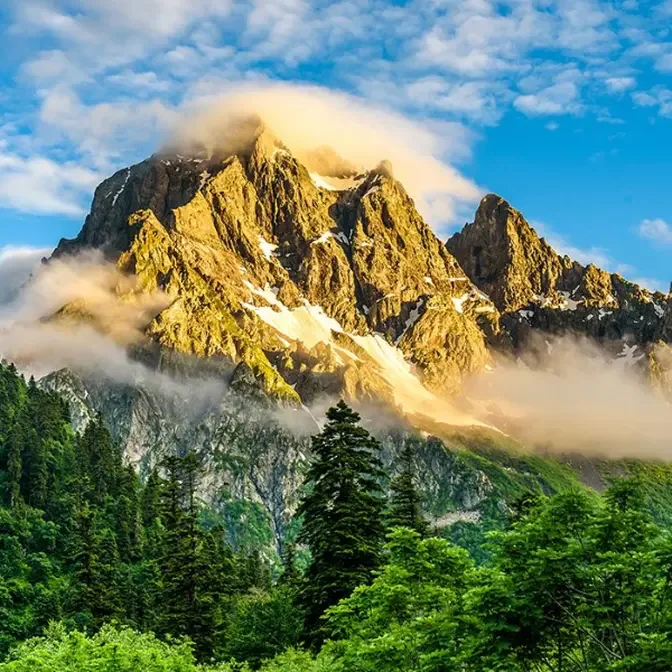
Antarctica is the largest desert on Earth, and it's made entirely of ice. It holds 70 percent of the world's fresh water, it has a glacier that appears to bleed, and it was once covered in forests with dinosaurs walking across it.
This is the full deep dive. Four parts, one video. How this place got so extreme, what actually survives down there, what the ice has been quietly recording for millions of years, and who wants to own it next.
AI Generated·May contain errors
Video Summary
AI Generated
This video explores Antarctica, detailing its extreme geography, unique wildlife, and geological history. It debunks common myths while explaining the continent's role as a global climate regulator and a scientific time capsule, concluding with the geopolitical tensions and environmental risks associated with its melting ice.
This is a real photo of what looks like an intense snowstorm in Egypt.
But these pictures were actually taken in Antarctica.
Hold on. Pyramids in Antarctica? You need to hear this.
Antarctica is the biggest desert on Earth.
And it's made entirely out of ice.
Now most people will picture a desert made out of sand and heat.
But a desert is really just a place with almost no rain.
And parts of Antarctica haven't seen snow or rain in almost 2 million years.
Welcome to episode 1 of a deep dive into Antarctica.
First we gotta talk about how big this place really is.
Antarctica is larger than the United States and Mexico combined.
And sitting on top of it is a sheet of ice up to 4.8 kilometers thick.
Now for reference, that's about 6 Burj Khalifa's stacked on top of each other.
And that ice is so heavy that it's actually pushing the continent down.
Picture like a bowling ball on a mattress.
That one ice sheet holds 90% of all the ice on the planet.
And about 70% of the world's fresh water.
Now here's what that means.
If even half of that ice melted, global sea levels would rise up to 30 meters.
So cities like Miami, New York, Venice, Shanghai, pretty much all underwater.
And that's just if only half melted.
Now we're gonna look more into that later in the series.
Antarctica is the coldest place on Earth.
The lowest temperatures ever recorded here was minus 89 degrees Celsius.
Now that is so cold that it would hurt to breathe.
Satellites have actually spotted pockets of the ice that have dropped closer to minus 98.
Now just to help you understand how cold that is,
a tray of water would take about 3 hours to freeze in your kitchen freezer.
In Antarctica, that same tray would turn to solid ice in under half an hour.
The wind speeds can hit up to 320 kilometers per hour.
That's stronger than a category 5 hurricane.
That's strong enough to flip a truck without much effort.
Now no country owns Antarctica, not one.
It's the only continent on Earth with no government, no cities, and no permanent residents.
And we are still discovering what's below that ice.
Scientists have found entire mountain ranges buried down there.
Now back to that pyramid I showed at the start of the video.
The internet likes to think that that is signs of a lost civilization.
It's actually a mountain that's been carved into that shape by ice over millions of years.
But it gets wilder.
Inside of these mountains, scientists have found fossils of sea creatures.
Which means this frozen wasteland was once warm, green, and full of life.
There were forests here.
There were even dinosaurs.
So how does a continent freeze over like this and never thaw again?
This is real footage of an ice fish.
The only creature on Earth with clear blood.
And it lives in Antarctica.
Now when you picture animals living in Antarctica, we often think penguins.
But let's forget about the penguins.
Because the real residents that live in Antarctica look like they're from a completely different planet.
What could possibly survive those conditions?
Let's start with that ice fish.
It's the only animal with a backbone that has no red blood cells at all.
It's blood runs completely see-through.
Filled with a natural antifreeze.
That stops it from icing over in water cold enough to pretty much kill anything at all.
But it is not the biggest thing living down there.
Look at this nightmare fuel.
In the freezing black water below lives the colossal squid.
It's the largest invertebrate on the planet.
Up to half a ton.
It's eyes are bigger than a human head.
In fact, it's the largest eyes of any animal that's ever existed.
It also has these rotating hooks on it's arms.
So that it could lock onto whatever it catches.
And it's blood isn't red either.
It's blue.
Instead of iron, it uses copper to carry oxygen.
And that copper blood works far better in freezing low oxygen water.
We have never been able to film a fully grown one alive.
That is how deep and dark it's world is.
Now before I get to the next one, please be sure to like and follow.
So that more of this content pops up on your feed.
Okay, moving on.
Then there's possibly one of the strangest things in Antarctica of all.
A glacier that appears to be bleeding.
In one frozen valley, there's a waterfall of deep red that pours straight out of solid white ice.
And for hundreds of years, nobody knew why.
This isn't blood.
It's actually ancient salt water.
And it's trapped underneath the glacier for around 2 million years.
In fact, it is so salty it never freezes.
And it's so rich in iron that the moment it hits air, it rusts and turns this brownish red color.
Now that's not just rusty water.
It is very much alive.
There's tiny microbes that are still surviving inside of it.
These have been sealed off from the world in total darkness with no sun and no oxygen.
They've been trapped down there since before the first humans ever walked the earth.
Now, speaking of humans, nobody lives permanently in Antarctica.
There's no cities, which means there's no locals.
There's just scientists that rotate in and out.
When I looked further into this, there has actually been people that have been born in Antarctica.
The first was a baby boy in 1978.
Argentina decided to fly down a pregnant mother on purpose,
betting that a birth on the ice would strengthen their claim to the land.
But the next question isn't what lives on Antarctica.
It's what this frozen continent has been hiding.
Because underneath and inside all of this ice is essentially a recording of the past millions of years.
This is a real piece of ice pulled from deep under Antarctica.
And if you zoom in, you can see that there's air trapped inside that's older than the human race.
You see, Antarctica is the world's largest time capsule.
Out on the ice sheet, snow falls every year,
trapping tiny pockets of air and sealing it into the ice.
So when scientists drill down and pull up a core,
they're holding a frozen atmosphere, some of which is up to 6 million years old.
If you were to crack open one of these ice samples and breathe in the air that's inside of these bubbles,
you would technically be breathing in air that is millions of years older than the first breath a human ever took.
Here's a wild thought. Antarctica wasn't always frozen.
If you go back far enough, it was covered in forests with dinosaurs walking across it.
And we know this because their fossils are still being found in the rock there.
Now to understand how Antarctica became frozen, we gotta go back to Pangaea.
Every continent on Earth was once a single landmass, and Antarctica was in the middle of it.
It was tucked under Africa and India, with Australia locked onto one side and South America on the other.
Then Pangaea broke apart.
All the other countries drifted north towards warmer parts of the planet,
but Antarctica didn't get so lucky.
It stayed at the bottom of the world, but still, for millions of years, it was still green there.
The whole planet was warmer, and warm ocean currents were still able to reach it.
Then Australia and South America pulled away for good.
And when that happened, it opened up a gap that let the ocean fully circle Antarctica completely,
sealing it off from every warm current on Earth.
Alone, at the bottom of the world, it froze, and it never came back.
But some of the stuff this continent is holding didn't even come from Earth.
Out on the ice, there's a windswept patch of blue called the Allen Hills.
This is the same place where the ancient ice cores come from, and it is covered with rocks from space.
You see, dark meteorites will stand out instantly against endless white,
making Antarctica the best place in the world to find space rock.
In fact, in 1984, a team on snowmobiles picked up a 4-pound rock out of that ice.
It turned out to be 4 billion years old, and it wasn't from Earth.
It came from Mars.
It was blasted off the surface of Mars by an impact.
It then drifted through space before it finally landed right there in Antarctica.
And when scientists looked inside, they found tiny shapes that looked like fossilized microbes,
a.k.a. possible evidence of life on another planet.
In fact, it was taken so seriously that in 1996,
the president of the United States went on TV and announced it to the world.
Today, Rock 84001 speaks to us across all those billions of years and millions of miles.
It speaks of the possibility of life.
Now, later studies argued that those shapes could have been formed without life,
so the case stayed unproven.
Antarctica looks like a frozen wasteland, but it's essentially like a diary for Earth,
with millions of years of data frozen right there.
This is a real photo of a Nazi seaplane being lowered off of a ship in Antarctica.
The plan was to fly over the continent and photograph it, and they took over 11,000 photos.
In 1938, German seaplanes mapped 600,000 square kilometers of coastline.
And get this.
While flying over Antarctica, they dropped metal darts stamped with swastikas on them,
using those as physical markers claiming the land from the air.
Now, each one of these darts was over a meter long.
Picture the size of a golf club.
Now, this is where the internet starts to take over.
There are claims that there's a secret base underneath the ice,
that Nazi leaders were hiding there after the war,
and there were flying saucers driving off the US Navy in 1946.
None of which happened.
But what did happen is still pretty wild.
You see, back then, there were no rules yet.
Countries would just simply claim parts of Antarctica.
And five days before this German ship made it to Antarctica,
Norway had already declared that exact same piece of land that they tried to claim with the metal darts.
Essentially, Germany spent a fortune trying to claim land that was already claimed.
But there's way more.
If you guys are enjoying this content, give this video a like.
And toss a follow if you want more videos like this popping up on your feed.
Let's keep going here.
In 1959, a group of countries got together and signed the Antarctic Treaty,
which basically said no mining, no military, and no one's allowed to own it.
Just science.
And it's still in effect today.
Now, there are some claims online saying this actually expires in 2048.
It doesn't.
2048 is just the first year that any of those countries are allowed to ask for a rule change.
And to have any of those rules change, there would have to be a unanimous decision.
But the real question is, who would even want Antarctica?
This frozen, barren wasteland?
The answer is everybody.
Antarctica is sitting on a fortune.
One part of the Ross Sea alone may hold up to 50 billion barrels of oil.
There's coal, iron, copper, and the rare earths that's in every phone and battery.
On top of all that, Antarctica is home to 70% of the world's fresh water.
In the future, if clean water is ever at a shortage, clean water would become the most valuable resource on Earth.
So if it's sitting on a fortune, why doesn't a country just come in and take it?
There's nobody standing guard.
What's really stopping all this? The cost.
Drilling through kilometers of moving ice, thousands of kilometers from anywhere, is brutally expensive.
Taking Antarctica just isn't profitable yet.
So that's the future of Antarctica.
But what about the rest of the world?
Because on the west side, there sits a glacier the size of Florida.
And scientists call it the Doomsday Glacier.
Picture a giant piece of ice that's sliding off the land.
And the only thing holding it back is an ice shelf that is cracking.
Now once that breaks, that glacier will enter into the water and raise sea levels by about 2 feet.
Not only that, it's holding back the rest of West Antarctica.
And if that goes too, you're talking closer to 10 feet.
If you live in a coastal city, not to freak you out, but scientists are giving this decades, not centuries.
So Antarctica may be the emptiest place that we have here on Earth.
But it's also one of the most important pieces we have too.
Now if you guys enjoyed this series, I've got one on the Amazon Rainforest.
And also one on North Sentinel Island, which you can watch right now.
Thank you so much for watching, and I'll catch you in the next one.