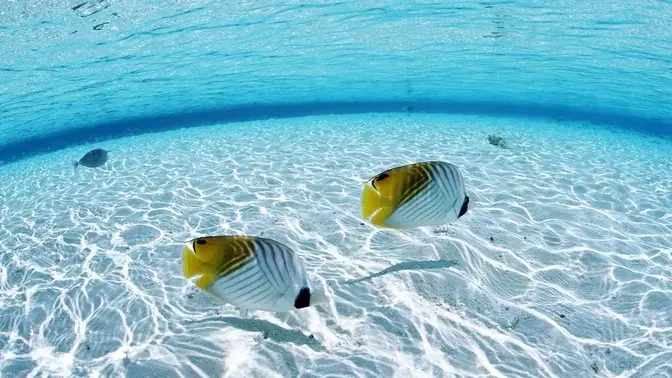
🌊 Dive beneath the waves and discover some of the incredible creatures that call our oceans home! 🐠🦈🐙
From colourful fish and powerful sharks to strange deep-sea animals, the ocean is packed with fascinating wildlife. How many of these sea creatures do you recognise? 👀
💬 Comment your favourite sea animal below! 👍 Like if you love ocean wildlife. 🔔 Subscribe for more amazing animal facts!
🎯 Love discovering amazing animals? Subscribe and join us for fascinating wildlife from around the world!
The ocean is hiding creatures you won't believe exist.
How many of these incredible sea creatures can you name?
Or don't scroll, these ocean animals get stranger as you go.
This mysterious silver fish lives hundreds of meters beneath the ocean.
Argentine Fish Facts
Scientific name, Argentina spherina, also known as the Greater Argentine.
It occurs in the northeastern Atlantic Ocean and Mediterranean region.
It has a slender body covered in bright silvery scales.
Its relatively large eyes are useful in the dim waters where it lives.
It is generally a deep-water fish, commonly occurring at depths of hundreds of meters.
It can grow to roughly 35 to 40 centimeters long, although many are smaller.
Its diet includes small crustaceans and other small marine animals.
Females release eggs into the water, where fertilization and early development take place.
The Greater Argentine belongs to the Argentinidae,
a family commonly known as Argentines, or herring smelts.
This armored fish can walk across the ocean floor.
Armored Sea Robin Facts
Armored Sea Robins belong to a group of bottom-dwelling marine fishes.
Their bodies are covered with hard, bony plates that act like armor.
They have large heads and prominent spines that give them a prehistoric appearance.
Modified rays near their pectoral fins help them move along and investigate the seabed.
They hunt small crustaceans and other bottom-dwelling animals.
Many species live in deeper waters and spend much of their time close to the ocean floor.
Looks like a spider, but it's actually a crab.
Arrow Crab Facts
Arrow crabs are named after their long, pointed, arrow-shaped heads.
Their extremely long, thin legs give them a spider-like appearance.
They live around coral reefs, rocky areas, and crevices.
They eat tiny crustaceans, worms, and other small animals, and may also scavenge.
Their long legs help them carefully navigate around complex reef habitats.
Despite their intimidating appearance, arrow crabs are relatively small.
Their legs make them look much larger.
This squid can blast through the ocean like a living torpedo.
Arrow Squid Facts
Arrow squid have long, streamlined bodies built for fast swimming.
They move using jet propulsion, forcing water from their bodies to shoot forward or backward.
Like other squid, they have eight arms and two longer feeding tentacles.
They are active predators that hunt fish, crustaceans, and other squid.
Their skin contains chromatophores, allowing rapid color and pattern changes.
They can release a cloud of ink to help escape predators.
Arrow squid are also prey for larger fish, seabirds, and marine mammals.
This tiny ocean predator has a head full of grabbing spines.
Grabbing Spines
Facts
Arrow worms, or catagnaths, are tiny marine predators found throughout the world's oceans.
Most have long, transparent, arrow-shaped bodies.
They have sharp, grasping spines around their mouths for catching prey.
They mainly hunt small planktonic animals such as cope pods.
Many species have small eyes that can detect changes in light.
They can dart rapidly through the water to attack prey.
Arrow worms are an important part of marine food webs,
both as predators and as food for larger animals.
Their evolutionary history stretches back hundreds of millions of years.
This ocean predator is built like a torpedo, and it's seriously fast.
Atlantic Bonito
Facts
The Atlantic Bonito sarda sarda belongs to the mackerel and tuna family.
It lives in the Atlantic Ocean, Mediterranean Sea, and Black Sea.
Its streamlined body makes it a fast, powerful swimmer.
It has distinctive dark diagonal stripes along its upper body.
Atlantic Bonito hunt small schooling fish, as well as squid and crustaceans.
They often chase prey in fast-moving schools.
Adults commonly reach around 50 to 80 centimeters long,
although larger individuals occur.
Females can release hundreds of thousands of eggs during spawning.
This fish can actually make a croaking sound underwater.
Atlantic Croaker Facts
The Atlantic croaker gets its name from the croaking or drumming sound it produces
by vibrating muscles against its swim bladder.
Scientific Name
Micropogonius undulatus
It lives along the Atlantic and Gulf coasts of North America.
It feeds on worms, shrimp, crabs, mollusks, and small fish.
Small barbels beneath its chin help it search the seabed for food.
It usually lives around sandy or muddy bottoms in coastal waters and estuaries.
Adults are commonly around 20 to 35 centimeters, 8 to 14 inches long,
although larger individuals occur.
Atlantic croakers generally move toward deeper offshore waters to spawn.
This giant flatfish can grow longer than a person.
Atlantic Halibut Facts
Scientific Name
Hippoglossus hippoglossus
Atlantic halibut are flatfish with both eyes on the right side of the head as adults.
They can grow to over 2.5 meters, 8 feet long,
making them among the world's largest flatfish.
Exceptional individuals can weigh more than 300 kilograms, 660 pounds.
Young halibut begin life swimming upright,
with an eye later migrating to the other side as the body flattens.
Adults eat fish such as cod, haddock and herring, as well as squid and crustaceans.
They inhabit the cold waters of the North Atlantic, often spending time near the seafloor.
Their dark upper surface helps them camouflage against the seabed,
while the underside is much paler.
Atlantic halibut can be long-lived, with some reaching several decades of age.
This tiny fish can gather in schools containing millions.
Facts
The Atlantic herring, Clupea harengus, lives throughout the North Atlantic.
It forms enormous, tightly coordinated schools for protection from predators.
Its silvery sides help reflect surrounding light, providing camouflage in open water.
Atlantic herring mainly feed on plankton, including tiny crustaceans.
They are important prey for whales, seals, seabirds and larger fish.
Females can produce tens of thousands of eggs, depending on their size.
Schools may move vertically through the water as feeding conditions change.
Atlantic herring have supported important commercial fisheries for centuries.
This fish is built for speed and almost never stops swimming.
Facts
The Atlantic mackerel, Scomber scombrus, lives in the North Atlantic Ocean.
Its streamlined body makes it a fast, powerful swimmer.
Its back has distinctive dark, wavy stripes over a blue-green color.
Atlantic mackerel form large schools, sometimes containing thousands of fish.
They feed on plankton, small crustaceans and smaller fish.
They are important prey for larger fish, sharks, seabirds and marine mammals.
Females can release hundreds of thousands of eggs during a spawning season.
Schools undertake seasonal migrations between feeding and spawning areas.
Adults commonly reach around 30 to 40 centimeters, 12 to 16 inches long.
This little fish helps feed some of the Atlantic Ocean's biggest predators.
Facts
The Atlantic menhaden, Brevortia tyrannus, lives along the Atlantic coast of North America.
It travels in huge, tightly packed schools.
Menhaden are filter feeders, straining plankton and tiny particles from the water.
They are an important food source for sharks, tuna, striped bass, seabirds and marine mammals.
A distinctive dark spot behind the gill opening is often followed by several smaller spots.
Adults commonly grow to around 30 to 38 centimeters, 12 to 15 inches.
Females can produce hundreds of thousands of eggs during spawning.
Young menhaden often grow in estuaries and coastal bays.
Their abundance and role as prey make them an important link in coastal marine food webs.
This fish is so shiny it looks like a swimming mirror.
Facts
The Atlantic moonfish, Salanus edipinus, is a silvery marine fish found in the western Atlantic.
Its extremely shiny, compressed body helps give it its moon-like appearance.
It occurs in coastal waters, including areas around bays and estuaries.
Young Atlantic moonfish can have elongated fin rays that become less prominent as they mature.
They feed on small fish, crustaceans and other small marine animals.
They may gather in schools, particularly when young.
They can grow to roughly 60 centimeters, 24 inches, although many are smaller.
Their range extends from parts of the eastern United States,
through the Gulf of Mexico and into South America.
Like many marine fish, they reproduce by releasing eggs into the water.
This fish has a mouth like a needle and can leap right out of the water.
Facts
The Atlantic needlefish, Strongylura marina, has an extremely long,
narrow body and distinctive beak-like jaws.
Both jaws contain numerous sharp teeth used to catch prey.
It occurs in coastal waters of the western Atlantic, including estuaries and bays.
It mainly hunts small fish, along with some crustaceans.
Needlefish commonly swim close to the water's surface.
They can make rapid bursts of speed when chasing prey.
Needlefish are capable of leaping out of the water, particularly when startled.
Atlantic needlefish can grow to around 1 meter, 3.3 feet long, though many are smaller.
Their eggs have special thread-like structures that help them attach to underwater vegetation
and other objects.
This ocean genius has three hearts, blue blood, and can change color in seconds.
Facts
The name Atlantic octopus can refer to several octopus species found in Atlantic waters.
One well-known example is the common octopus, Octopus vulgaris.
Octopuses have three hearts.
Their blood appears blue because it uses copper-containing hemocyanin to transport oxygen.
They can rapidly alter their color and skin texture, helping with camouflage and communication.
Octopuses are highly intelligent and can solve problems, explore objects, and learn.
Their eight flexible arms contain powerful suckers used to grip and investigate their
surroundings.
They commonly hunt crabs, shellfish, and other marine animals.
When threatened, many can release a cloud of dark ink to confuse predators.
With no rigid skeleton, an octopus can squeeze through remarkably small openings.
Ever seen a fish that looks like it's made of silver?
Meet the Atlantic pomfret.
Facts
The Atlantic pomfret, Brahma brahma, lives in the Atlantic, Pacific, and Indian oceans.
It has a distinctive deep, flattened body with shiny, silvery coloring.
It is a strong swimmer and spends much of its life in the open ocean.
It feeds on small fish, squid, and crustaceans.
Adults can grow to around one meter long, although many are smaller.
Atlantic pomfrets are highly migratory, moving through large areas of ocean.
They reproduce by releasing eggs into the water, where the young begin life as tiny,
drifting larvae.
Meet one of the ocean's fastest predators, with a giant sail on its back.
Facts
The Atlantic sailfish, Istiophorus albicans, lives in warm and temperate Atlantic waters.
Its enormous dorsal fin resembles a sail, giving the fish its name.
Sailfish are exceptionally fast and agile swimmers.
Although famous claims of speeds around 68 miles per hour,
110 kilometers per hour, are not considered well-established.
They hunt small schooling fish and squid.
Their long bill can be used to slash or stun prey, making fish easier to capture.
Sailfish can rapidly change the appearance of their body colors,
especially during hunting and excitement.
Large Atlantic sailfish can reach roughly 3 meters, 10 feet in length.
They have been observed hunting cooperatively, taking turns attacking schools of fish.
Imagine swimming thousands of miles through the ocean,
then finding your way back to the river where you were born.
Facts
The Atlantic salmon, Salmosilar, lives in the North Atlantic and rivers flowing into it.
Most Atlantic salmon hatch in freshwater rivers,
migrate to sea and later return to freshwater to reproduce.
They have an extraordinary ability to navigate back toward their natal river,
using environmental cues including smell.
During their upstream spawning migration, salmon can overcome strong currents and obstacles.
At sea they feed on animals, including small fish and crustaceans.
Large individuals can grow to over 1 meter long.
Females create nests called reds in gravel, where they deposit their eggs.
Unlike many Pacific salmon species, some Atlantic salmon can survive spawning and reproduce again.
Don't let the word shark scare you.
This little ocean predator is usually only about 1 meter long.
Facts
The Atlantic sharp-nosed shark, Rhizoprionodon terrienovae,
gets its name from its long, pointed snout.
It lives in the western Atlantic, including coastal waters from North America
into the Gulf of Mexico and Caribbean region.
Most are relatively small, generally reaching around 1 meter, 3 feet in length.
It feeds on small fish, shrimp, crabs, squid and other marine animals.
Females give birth to live young rather than laying eggs.
It commonly inhabits warm coastal waters, including bays and estuaries.
Young sharks can have distinctive white spots along their sides.
Despite being an active predator,
its small size means it is not generally considered dangerous to people.
Why does this fish look like it's wearing prison stripes?
Meet the Atlantic spadefish.
Facts
The Atlantic spadefish, Catedipterus faber, lives in the western Atlantic Ocean.
Adults have a silvery body marked with distinctive dark vertical bands.
Its deep, flattened body resembles the spade symbol on playing cards, inspiring its name.
They are commonly found around reefs, wrecks, docks and other structures.
Their diet includes small crustaceans, mollusks, worms, jellyfish and other invertebrates.
Atlantic spadefish often gather in large schools.
Large individuals can reach around 90 centimeters, 3 feet in length.
Juveniles look quite different and may imitate floating leaves or debris,
helping them stay hidden.
Did you know a puffin can carry a whole mouthful of fish without dropping the ones it already caught?
Facts
The Atlantic puffin, Fratercula arctica, lives around the North Atlantic Ocean.
It mainly catches small fish, diving beneath the surface to hunt.
Puffins use their wings to fly underwater while chasing prey.
Their famous colorful bills become especially bright during the breeding season.
They usually nest in burrows or rocky crevices on coastal islands and cliffs.
A breeding pair normally raises one chick per year.
Outside breeding season, Atlantic puffins spend much of their time far out at sea.
They are long-lived birds and can survive for 20 years or more.
Thank you for watching.