LEBANON: Far From What Most People Think | 4K Travel Documentary
Just a small dot on the map, but it became the prey of many empires. From the Phoenicians who crossed the sea to build the first maritime civilization, to the Romans, Arabs, Byzantines, Ottomans and French, each empire turned Lebanon into a battlefield. The truth is that this small land did not sink, but turned itself into a crossroads of 18 different religions and communities. Even under the rhythm of modern life, the 5,000-year-old ruins in Lebanon still silently shape the present.
Subscribe: / @trueglobe66
#traveldocumentary#documentary#trueglobe#4Ktraveldocumentary ► See More: The Real Morocco Most People Never Discover | 4K Travel Documentary • The Real Morocco Most People Never Discove... The Real IRAN Most People Will Never See • IRAN: The World’s Most Misunderstood Place... ►Best Playlist: • Asia Travel Documentary ►Subscribe: / @trueglobe66
Lebanon is a historic crossroads where diverse empires and 18 religions have converged over 5,000 years. From the resilient capital of Beirut and the massive Roman ruins of Baalbek to the ancient Cedars of God and the spiritual Qadisha Valley, the land blends breathtaking natural wonders with a deep architectural and spiritual heritage, serving as a living museum of human civilization.
Just a small dot on the map, but it became the prey of many empires.
From the Phoenicians who crossed the sea to build the first maritime civilization,
to the Romans-Arabs, Byzantines-Ottomans and French, each empire turned Lebanon into a battlefield.
The truth is that this small land did not sink but turned itself into a crossroads
of 18 different religions and communities.
Even under the rhythm of modern life, the 5,000-year-old ruins in Lebanon
still silently shape the present. And to understand why faith is so deeply
rooted in the Lebanese soul, you need to start at the crossroads of all-life Beirut.
Long before Beirut became a modern capital, it was a sacred crossroads,
a meeting place of empires, languages and even the earliest ideas of God.
When the Romans arrived, they turned it into the empire's greatest law school,
and the first Christian scholars passed through the harbor,
carrying the first Bibles, leaving behind whispers of a new faith.
Century after century disaster tried to wipe out the city.
Earthquakes, fires and wars reduced it to rubble again and again.
Six times Beirut disappeared from the map, and six times it was rebuilt,
as if an invisible hand would not let it disappear.
Today, in the heart of Beirut, the Mohammed Al-Amin Mosque
rises with its brilliant blue domes like a prayer etched into the sky.
The towering, straight and slender towers, visible from afar,
guide you to the city center as surely as any compass.
The story of Baalbek doesn't begin with the ruins you see today.
It begins with a question no one has really answered.
The temple rises like a stone horizon.
The 22-meter high columns are intricately carved from base to capital.
The massive walls are nearly 30 meters high,
made of blocks of stone so perfectly aligned
that time, weather and earthquakes have barely moved them.
Every groove carved on the groove shafts is perfectly aligned every block,
so tightly fitted that not a piece of paper can pass through.
The Temple of Bacchus still stands almost intact,
its facade carved with images of God's vines and lions,
every detail still sharp after two millennia.
Stepping through the nearly 13-meter high archway,
the site's geometry exudes a confident mathematical feel.
Massive window ceilings carved like constellations rooms
designed to manipulate light and shadow with the elegance of a modern stage.
It is generally believed that the temple was built by the Phoenicians.
They called the site Baalbek, with Bek meaning city,
and Baal being the name of the Phoenician and Canaanite sun god.
The Phoenicians, who later lived here, mysteriously disappeared,
and the Romans took over the site, turning it into a Roman site.
It is the foundation of the Temple of Jupiter that reveals the most astonishing thing.
Beneath it lies an architectural mystery.
The ancient world has never explained stone blocks weighing between 600 and 1,000 tons,
arranged with a precision that defies modern engineering.
These are some of the largest blocks of building stone ever quarried by man,
and yet they still lie here aligned to the millimeter.
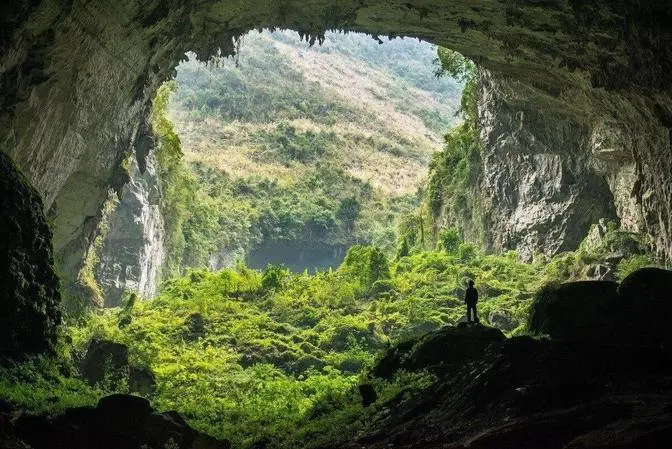
The Jeta Cave is revealed not by the grandeur of its entrance,
but by the overwhelming awareness of what lies beneath the mountains of Lebanon.
It is one of the oldest limestone systems in the Middle East, formed over 400 million years ago,
and each interior surface bears the imprint of time
on a scale that human history has scarcely matched.
The river flows more than nine kilometers underground,
and explorers have yet to reach its end.
Inside, the chambers open up like natural amphitheaters,
glowing softly, almost crystal clear.
The stalactites are shaped by mineral-rich droplets,
in spirals, spikes, and ridges so precise they seem to have been created.
Hovering above you is the world's longest-known stalactite,
stretching 8.2 meters a mineral drop,
repeated a million times until it becomes a monument to patience.
And then the real mystery begins.
The lower cave is only accessible by boat
gliding over a seemingly bottomless black river.
The silence here is eerie.
Even the cave's name carries a story.
Jeta, from Aramaic, means the roar of the waters,
a hint left by the ancients who knew these mountains
long before modern Lebanon was born.
The Qadisha Valley does not immediately reveal its significance,
a rugged scar carved into Mount Lebanon.
The rocks are so steep and narrow
that sunlight only penetrates a few spots for a few minutes each day,
creating an atmosphere closer to a holy site than a valley.
For more than 1,500 years, monks have lived here in caves
that cling to the near-vertical rock,
choosing hardship over exile to defend their faith.
Many of these caves still bear the traces of lamps that burned centuries ago.
The Qojair Monastery is like a deep cut into Lebanon's history,
deep in the Qadisha Valley, a place where hermits once fled.
To find absolute solitude,
the monastery appears like a fortress clinging to the cliffs,
both fragile and proud.
The rough, moss-covered stone walls
are supported by the majestic natural landscape of Qadisha,
where steep mountains and deep green valleys
echo like a never-ending prayer.
Part of the monastery is carved directly into the cliffs,
opening up dimly lit corridors
that feel like stepping into a world outside of time.
The cave chapel is the heart of Qojair.
It is damp cold and so quiet you can hear your own breath.
The Maronites believe that this is where prayers are held,
as if the rock has witnessed enough fear,
hope and salvation over the centuries
to become part of the collective memory.
Although destroyed in the 16th century,
the monastery was rebuilt almost immediately by the people
as if they could not bear to let this place disappear.
The Corniche Road winds along the Mediterranean,
leading you to the famous Pigeon Rocks.
They stand like ancient guardians of Beirut's coastline,
shaped by waves and wind over thousands of years.
In the evening light, the rugged rocks glow amber and gold,
and the surrounding water changes from deep blue to turquoise at high tide.
Fishermen stand barefoot on their boards,
casting their lines with calm, practiced movements.
Some guide tourists through the narrow passages,
steering boats into the dark archway
that cuts through one of the towers,
a moment that is both cinematic and quietly intimate.
The smell of salt hangs in the air,
and seabirds circle overhead,
landing on the warm rocks before plunging into the water.
Byblos is one of the oldest surviving cities on Earth,
inhabited continuously since around 5000 BC.
Before the rise of mighty empires,
the Phoenicians made it one of their most important ports.
Over the millennia, empires have come to this land,
ancient Egyptian-Greek, Roman-Byzantine-Arab, and Ottoman.
Each civilization that arrived here added another layer to the city,
leaving its own mark rather than erasing the past.
Among these remains, the most prominent is the old city of Byblos,
also known as Ghibelle Castle,
built in the 12th century during the Crusades.
Its thick stone walls square watchtowers,
and deep moats still remain,
carrying with them the military strategies and worries
of the armies that once defended this place.
High on the slopes of Mount Harissa,
the shrine of Our Lady of Lebanon
carries an angelic story that stretches back more than a century.
When the Maronites built the icon in 1908,
they set in stone and bronze a prayer for the country's protection.
The 28-meter-tall bronze statue of Mary,
arms outstretched, gaze turned toward the Mediterranean,
as if welcoming anyone who comes burdened,
curious, or simply looking for a moment of silence.
The church bells of the Maronite Basilica ring softly,
mingling with the murmur of prayers from visitors.
While families of both Christian and Muslim traditions
line up to light candles together.
This is one of the few places in the Middle East
where devotion naturally transcends boundaries,
as if the hillside itself has learned to endure
centuries of conflict and still bring peace.
At Batara Gorge, the ground does not stretch out to both sides,
but suddenly cracks open a giant deep hole,
like a gate leading straight into the ground.
This is the Three Bridges Sinkhole,
a masterpiece of nature's sculpture that has existed for millions of years.
From the top of the cliff, a waterfall suddenly appears,
not flowing down the mountainside,
but plunging vertically into the 255-meter-deep abyss,
like a silver blade.
This is the moment when the story becomes magical.
The water does not pour into the cliff wall,
but falls perfectly through the center of all three stone bridges,
creating a vertical dance of water and air.
Standing in front of Batara Gorge,
you are not just admiring a natural phenomenon,
you are looking at a geological time machine.
The three stone bridges are the remains of a giant Jurassic cave,
carved when the world still belonged to the dinosaurs.
They are silent witnesses to millions of years of water flow, erosion, and collapse.
Walking through the ruins of Tyre is a journey through many worlds
where the echoes of empires mingle with the waves of the Mediterranean.
Before you is the Roman Chariot Racing Arena,
one of the largest and best-preserved structures ever built.
Stand in the center and imagine the roar of the crowd,
the pounding of horses' hooves on the dusty racetrack.
A little further on, the Arc de Triomphe stands as a portal to the past,
and the colonnaded Marble Road still stands worn by the footsteps
of legions merchants and philosophers.
All are testament to an era of undeniable prosperity and luxury.
Tyre was the darling of the Phoenicians,
a maritime power that derived its unparalleled wealth
from a secret of the sea-royal purple dye.
This legendary color, extracted from thousands of sea snails,
has made Tyre a target for every empire.
But amid the stories of power and conquest,
there are quieter footprints that have been deeply etched in history here.
It was on this land that Jesus stopped his compassion,
healing the daughter of a pagan woman.
Years later, the Apostle Paul also walked these roads
carrying a message that would change the world.
Every year, right on this shore, the rare green and caretta turtles
still come to nest.
They are ancient creatures that have quietly observed
the entire symphony of human history.
In the middle of the Lebanon mountains,
at an altitude of nearly 2,000 meters,
there exists a small cluster of forests
that carry the weight of millennia, the cedars of God.
Some trees are estimated to be over 2,000 years old.
They predate the Roman Empire's domination of the sea.
Cedar wood was used by the Phoenicians, Assyrians,
and even King Solomon to build temples.
The Bible repeatedly mentions the tree
as a symbol of strength and longevity.
Built in the 17th century under Ottoman rule,
Meselha Fort rises sharply atop a narrow limestone ridge,
guarding the ancient route between the coast
and the northern mountains of Lebanon.
Its silhouette appears almost improvised by nature,
stone walls blending seamlessly into the rock beneath them,
as if the fortress grew out of the land itself.
Originally constructed by Emir Fakhreddin II to defend the region,
it later became a watchpoint over trade and movement
along the Batroun Pass.
Despite its modest size,
the fort offers one of the most striking examples
of strategic architecture in the Levant.
No lavish design, only rugged fortifications
designed to dominate the valley with minimal presence.
Running the length of the country,
the Lebanon mountains form a rocky wall
parallel to the Mediterranean coast
reaching heights of over 3,000 meters in places.
In winter, many peaks are completely covered in snow,
while less than an hour away,
the coastal region remains temperate.
In summer, the snow melts to reveal green valleys
and steep slopes where cypress oak and some cedar trees
thrive in the challenging terrain.
In the valleys and low plateaus of the Lebanon mountains,
sheep grazing continues in a traditional pattern
that has lasted for generations.
Herds of sheep roam freely along the mountain slopes.
The shepherds walked ahead,
slowly, unhurriedly,
as if they had been following this route all their lives.
They guided the flock with short, sharp sounds,
hardly calls, but a series of signals
that only those born into a herding family could understand.
Turn around and you'll see a stone palace before you,
built in the early 19th century
by Emir Bashir Shihab II,
Beytadin Palace, the most powerful ruler
in the Lebanon mountains at the time.
It was a statement of ambition and sophistication
for a native dynasty that even the Ottomans feared.
It is said that Bashir chose the Chouf Mountains
because he did not believe any city
was safe enough for his power.
A palace, built to be seen,
but deliberately placed in a place that was out of reach.
The architecture of Beytadin betrays an obsession with beauty.
The limestone gates are hand-carved,
but expertly crafted.
The stone-paved courtyard opens onto three levels,
each representing a different part
of life reception government and privacy.
Light floods through the domes,
as if calculated to soften the skin.
Go deeper and you'll find rooms
decorated with thousands of mosaics,
so small it's hard to believe
they were made by hand in the 19th century.
Ottoman motifs, Italian influences,
Arabic patterns, and Levantine techniques
blend together in a way that's rarely seen before.
Lebanon's Tripoli is an ancient city
that time seems unable to erase.
Stepping into the historic center,
you feel like you are turning pages of a vivid book
about the Middle East in the Middle Ages,
all converging in a small space,
but dense with the imprint of civilization.
The most prominent in the Tripoli skyline
is the Raymond de Saint-Gilles Castle,
a 12th century crusader fortress
perched on a high hill overlooking the entire city.
Its massive stone walls,
rough watchtowers, and dark corridors
tell the story of sieges, of merchants,
knights, and dynasties that have passed.
Standing on the fortress,
you can observe the whole of Tripoli,
the close-knit rooftops,
the spiderweb alleys,
and the deep blue Mediterranean in the distance.
Below the hill, in the crowded old town,
the Mansouri Grand Mosque rises
as the soul of Mamluk-era Tripoli.
Built in the 13th century
from the ruins of a crusader church,
the structure is a symbol of religious fusion.
Ancient yellow stone walls,
elegant domes,
and a square, Mamluk-style minaret.
When the afternoon sun shines
on the 700-year-old stone,
the mosque almost glows,
beautiful, quiet, and divine.
Lac Luc Lakes appears as a series of sky mirrors
across the slopes of Lebanon,
where the deep blue of the water
meets the silvery-gray limestone.
From above, the round and oval lakes
scattered across the rugged terrain
look like fragments of an ancient meteorite,
but are actually a strange combination
of nature and man.
They act as water reservoirs in the sky,
helping to maintain groundwater
and irrigate a series of villages
down in the valley,
a vital survival system
in a Lebanon increasingly affected
by climate change.
Under the afternoon sunlight,
the lake surface turns a deep blue,
while the mountain ranges
running along the horizon
are dyed a warm yellow.
Amidst the wild, almost harsh landscape
of the ancient mountain range,
embellished by natural lakes
interspersed with artificial lakes,
creating a unique geomorphological picture
that is hard to find anywhere else
in the Mediterranean.
In the middle of the Beqaa Valley,
about 50 kilometers from Beirut,
there exists a city cut off by time.
Anjar was built in the early 8th century
under the Umayyad dynasty
and was virtually abandoned
just a few generations later.
For more than 1,200 years,
no urban settlement
has succeeded to this position.
The site covers more than 114,000 Ahni,
a system of two-meter-thick walls
plastered with mud,
laid on a foundation
of broken bricks and rubble.
Large natural stones were used
for the exterior smaller blocks
for the interior,
a technique that reflects
the military thinking and speed
of construction during the Umayyad period.
Four watchtowers and a main gate
led to a 20-meter-wide central road
with two parallel rows of columns
that bisect the city.
From the north-south
and east-west intersections,
you can observe the remains of a palace,
a public bath, and a mosque,
all laid out in the Roman style
but with early Islamic
architectural features.
The presence of inscriptions
from the Umayyad prince
carved directly into the walls,
affirming the power in the area
where the Byzantine Empire
and Syria met in the Middle Ages.
The Fidar Crusade,
fortress or Fidar Castle in Lebanon,
is one of the least mentioned
but most curious
of the crusader strongholds
in the Levant.
Situated on a rocky outcrop
overlooking the Mediterranean Fidar
was a strategic fortress
controlling the sea route
north of Byblos.
This position allowed the crusaders
to observe all ships coming and going,
a vital control point
during the period
when empires competed for power
in the Levant.
The structure of the fortress
shows a clear blend
of crusader architecture
and eastern Mediterranean influences,
low stone arches,
thick defensive walls,
still standing despite the passage
of nearly 900 years.
A small fortress
but containing a bloody chapter of history.
Lying quietly off the coast of Tripoli,
Palm Islands appear
as a pristine slice of the Mediterranean
where the sea wind and life
still follow the ancient rhythm of nature.
Without noisy resorts,
without the sound of crowded boat engines,
this archipelago exists
as a pristine paradise
reserved for creatures
struggling to find their last refuge.
The appearance of the Mediterranean monk seal
a marine animal so rare
that less than 700 individuals
remain worldwide.
They hide under the rocky outcrops
of the island
only emerging
when they feel absolutely safe.
It is their appearance
that makes Palm Islands
one of the most valuable
marine conservation areas
in the Middle East.
The sea here is so clear
that you can see through the reefs
where small fish gather in schools
and seabirds circle above.
During the migration season,
hundreds of bird species
stop on the island
turning it into a bustling rest stop
during their long journey
across the Mediterranean.
Among the ancient inhabited cities
in the eastern Mediterranean,
Sidon is considered
one of the earliest.
Archaeological evidence
shows that traces of habitation here
can be traced back
to around 4000 BC.
Sidon was once
the most important maritime trading base
of the Phoenicians
when they controlled the sea routes
through Cyprus-Egypt-Carthage
and the western Mediterranean.
From here,
their maritime trade network spread
laying the foundations
for humanity's first cross-sea trade.
The most prominent of the ancient complexes
is the Sea Castle
built in the 13th century
by the Crusaders
on the foundations of an older structure.
Unlike other forts located deep inland,
this structure was built
directly on a strip of coastal rock
separated from the mainland
by a shallow stretch of water
connected only by a narrow stone walkway.
At high tide,
the foundations are almost half submerged
giving the castle
the appearance of floating on the water.
The structure is built facing west
where the sun sets
allowing observers at the fort
to see the entire ancient harbour
where thousands of Phoenician ships
once departed.
On a high point overlooking the valley,
the Cedar Cross,
a cross built into the rock,
marks a strong bond
between nature and faith.
From this location,
one can observe the route
to the Cedars of God,
one of Lebanon's oldest forests.
At the end of the day
when the sun shines diagonally
across the mountainside,
a cross stands out against the rock,
a symbol of eternal spirituality.
Amik Wetland is the largest inland wetland
in the country,
not thanks to a large river system
but thanks to an underground water source
blocked by ancient geological structures
which plays a vital biological role
in Lebanon.
In the Amik Wetland,
the clearest signs of ecological resilience
are not in the large animals
but in the most overlooked creatures.
Levant frogs,
Pelophylax bedriagae,
are often seen at the edges of shallow water
especially at dawn
when humidity is high.
They can reach more than 10 cm in length,
much larger than common frogs
in the Mediterranean region.
Their greyish-blue skin and dark spots
help them blend in almost completely
with the water surface
covered with aquatic plants.
In the distance,
Levantine green lizards,
Phaenicola schurta,
Laevis,
on the dry banks surrounding the floodplain
where they bask in the early morning sun
before moving quickly into crevices of rocks
or dry roots as temperatures rise.
Their bright green scales reflect light
making them stand out
against the pale brown vegetation.
Shari is one of Lebanon's
most beautiful mountain towns
perched precariously on Mount Lebanon
where winters are blanketed in snow
and summers are filled with the scent
of ancient pine trees.
It is the birthplace of the poet Kahlil Gibran
and a gateway to the Qadisha Valley,
a sacred land of Maronite hermits.
In the middle of the town
is the Church of Saint Saba,
an important religious symbol
of the Maronite community
in the Lebanon mountains.
With its honey-yellow limestone façade,
semi-circular domes
and two 53 meters high minarets
bearing crosses,
it stands majestically
in the mountain town.
Inside,
light filters through stained glass windows
illuminating the rough stone walls
and ancient religious icons
creating a sacred and cozy atmosphere.
The architecture of Saint Saba
is a subtle blend
of traditional Maronite style
and 20th century modernity
making the building
as rustic as Bashari's history
yet as solemn
as a miniature European cathedral.
Located at an altitude
of 1,200 meters above sea level,
Afka is not only a scenic spot
but also the birthplace
of Mediterranean legends.
From a giant cave
opened on a steep limestone cliff,
the Adonis River,
now the Ibrahim River,
gushes out powerfully,
pouring down in white cascades
amidst the majestic mountain scenery.
The ancients believed
that this was where Adonis,
the god of beauty and rebirth,
breathed his last
in the arms of his lover Aphrodite.
The beauty of Afka
is both wild and sacred.
Standing before the rushing power
of the waterfall
and the silence of the moss-covered ruins,
you will feel the full spirit of Lebanon,
where nature and mythology
are never separated.
Lebanon is a gem of the Middle East,
small on the map
but containing a treasure trove
of heritage that is rarely found
anywhere else in the world.
A country where the sea
and the mountains meet,
where 7,000 years of history
appear in the rhythm of modern life,
where the conquering empires
are now just layers of memories
mixed into the lives of the people.
And when you leave this land,
you will realize
the smallest thing
can contain a universe
of magical stories.
If you continue to want to explore
exciting journeys like this,
follow our channel
to step into new lands.