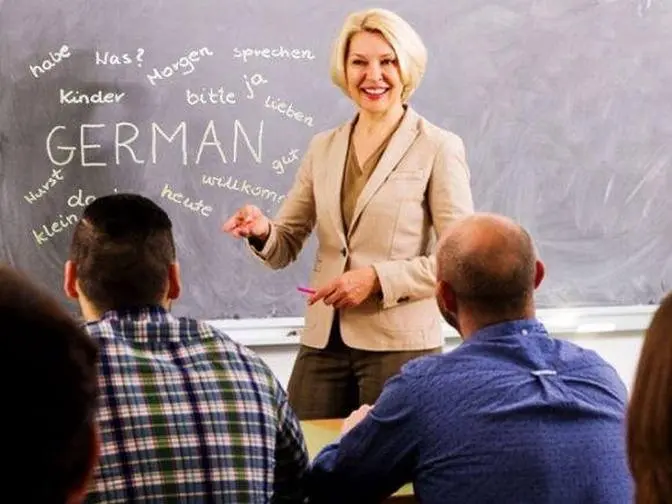
Ever feel like your brain freezes when someone asks you a question in German? You're trying to build the perfect sentence, but the moment is gone before you can speak.
In this lesson, we'll show you the Zero Grammar Technique—a way to answer almost any German question using just keywords, reflex words, and "gap fillers." We'll cover:
Lückenfüller (Gap Fillers): How to use the question's grammar to your advantage. Reflexwörter: Instant words for agreeing, reacting, and buying yourself time. Der Notausgang (The Emergency Exit): What to say when you simply don't know the answer. The goal is to become fluent first, and perfect later. This technique keeps the conversation moving while your "real" German catches up!
Join our community for more.
Please note: there will be no podcast or summary for this video. Become a Member today! www.youtube.com/learngermanoriginal/join
This lesson introduces the \"zero grammar technique\" for German learners, designed to overcome the panic of trying to construct perfect sentences during conversations. By focusing on keywords and context rather than complex grammar, learners can maintain the flow of a conversation and build confidence before striving for grammatical perfection.
Hello everyone and welcome to Learn German.
Today's lesson works from A1 all the way up.
Let's dive in.
Someone asks you a simple question in German and you freeze.
Your brain starts building the perfect sentence, subject, verb, the right ending.
And by the time it's ready, the moment is already gone.
What if I told you that you don't need full sentences at all?
Today, we'll show you the zero grammar technique.
How to answer almost any question in German using just keywords.
Deutsch sprechen ohne Panik.
Speaking German without the panic.
Los geht's.
Das Problem.
First, the problem.
Unter Druck wollen Lernende den perfekten Satz bauen.
Under pressure, learners try to build the perfect sentence.
And it sounds like this.
Sounds familiar?
Here's the hard truth.
Bis die Grammatik stimmt, ist der Moment vorbei.
By the time the grammar is correct, the moment is gone.
But here's the good news.
Auch Deutsche sprechen nicht in ganzen Sätzen.
Even Germans don't speak in complete sentences.
Der Kontext trägt die Bedeutung.
Du sagst nur das Neue.
The context carries the meaning and you only say what's new.
Listen to this.
Kaffee?
Klar.
One word each and it works perfectly.
That's the whole idea.
You only need three tools.
Number one, Reflexwörter.
Reflexwords that fire instantly.
Second one, Lückenfüller.
Fillers where you just give the missing piece.
And the third one, der Notausgang.
The emergency exit for when you have no idea.
Let's take them one by one.
The question already gives you the grammar.
You just fill the gap.
When are we meeting?
Tomorrow morning.
How was the exam?
Exhausting.
No verb, no sentence, just the new information.
Hast du Hunger?
Total.
Wer kommt mit?
Nur ich.
Was machst du am Wochenende?
Sport.
Wohin fährst du im Urlaub?
Nach Spanien.
Tool two, Reflexwörter.
The first group is Zustimmen.
Agreeing.
Klar.
Genau.
Logisch.
Auf jeden Fall.
Use these words to agree to something instead of making complete sentences.
Let's look at a few examples.
Klar.
Wir treffen uns um acht.
Genau.
Kommst du zur Party?
Auf jeden Fall.
The next group is Reagieren.
Reacting.
Words that help are
Echt.
Ach so.
Quatsch.
Mist.
Ich war letztes Jahr in Japan.
Echt?
Der Bus fährt heute nicht.
Ach so.
Der Zug ist gerade weg.
Mist.
The third group is when you want to buy yourself time.
Zeit gewinnen.
Words that help are
Mal sehen.
Komm drauf an.
Schwer zu sagen.
And here are a few examples.
Kommst du mit ins Kino?
Mal sehen.
Magst du am Wochenende mit?
Komm drauf an.
Wer gewinnt das Spiel?
Schwer zu sagen.
And if you want to level up, try
Ehrlich gesagt.
A perfect little opener before you give your opinion.
And remember,
This technique ist ein Selbstvertrauenswerkzeug, kein Grammatikersatz.
A confidence tool, not a replacement for grammar.
Es hält das Gespräch in Gang, während dein echtes Deutsch aufholt.
It keeps the conversation going while your real German catches up.
Erst flüssig werden, dann perfekt.
First become fluent, then perfect.
Here are a few examples.
Wie findest du den Film?
Ehrlich gesagt, etwas langweilig.
Magst du das Essen?
Ehrlich gesagt, nicht so wirklich.
Kommst du noch mit?
Ehrlich gesagt, ich bin hundermüde.
And finally, tool three.
Der Notausgang.
Your emergency exit for when you simply don't know.
Keine Ahnung.
Weiß nicht.
Egal.
Let's look at a few examples.
Wann kommt der Bus?
Keine Ahnung.
Welcher Film läuft heute?
Weiß nicht.
Pizza oder Pasta?
Egal.
No panic, no silence.
You just keep the conversation moving.
So there it is, the zero grammar technique.
Reflex words, fillers, and your emergency exit.
Now, probier's aus.
Try it out.
Schreib in die Kommentare dein Lieblings-ein-Wort-Deutsch.
Drop your favorite one-word German answer in the comments.
By the way, if you're serious about learning German, don't forget.
We offer completely free and well-structured courses for beginners and intermediate learners.
You can learn at your own pace, access plenty of materials,
and join a community full of real success stories.
Just check out the links below and start your journey today.
See you in the next lesson, and happy learning!
If you liked this video and want more of these, do let us know in the comments.
Become a member today and gain access to extra content for this video and much more.
You can also get a free worksheet by joining our Patreon page.
Danke.
Thanks for watching this video.
If you liked this video, do give it a thumbs up and share it with your friends.
Don't forget to subscribe to the channel if you still haven't.
You can click on the bell to receive notifications whenever we upload a new video.
If you have any comments or questions, you can leave them in the comment section below.
Tschüss!
Auf Wiedersehen!