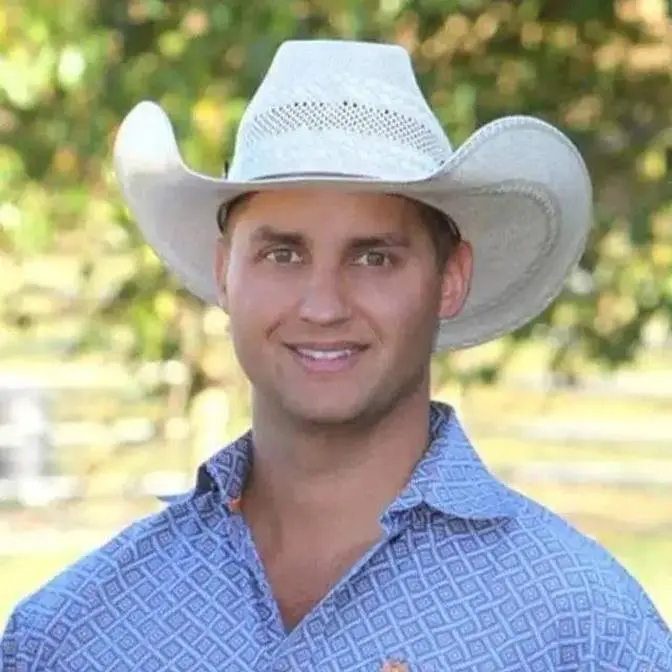
Ryan Rose assesses a young, pushy colt that struggles with respecting personal space and responding appropriately to pressure. As the session unfolds, Ryan encounters a reaction he wasn't expecting, creating a challenging moment that requires him to adapt his approach in real time.
Watch as Ryan works through the colt's confusion, energy, and resistance while demonstrating the importance of timing, feel, and adjusting to the horse in front of you. Horse training doesn't always go according to plan, and this session offers a valuable look at how experienced trainers handle setbacks, learn from mistakes, and help young horses find understanding. Patreon: https://www.patreon.com/ryanrosehorsemanship/
A trainer demonstrates how to establish boundaries and discipline with a two-year-old colt named Sam Colt. The session focuses on the distinction between steady and driving pressure, the importance of \"owning your space\" to correct pushy behavior, and the necessity of building mental depth on the ground to ensure safety and reliability when riding.
Cause even this is showing me he's more sensitive
than I was giving him credit for.
So I don't mind if he gets bothered,
but I'm not going to let him go forward.
He is very much like wants to be in your space.
And one of the things that makes him different
than the fillies that I've raised,
they were a lot more like if you said,
get out of my space, like they would respect that.
And he's more left brain like.
So I struggle with that on like trying to get him to yield.
And I feel like I do more and more and more.
And then I just, I don't ever really get the results I want.
Let's check them out.
All right, thank you.
What's his name?
Sam Colt.
You can call him Sam.
Sam Colt.
So steady pressure, it tells them the answer
and tells them what to do.
And every horse has to learn to accept steady pressure
because we use it for like everything.
But driving pressure, like there,
when he's crowding and I wave the stick,
I'm not telling him to be back there.
I'm making it uncomfortable for him to be right here.
Now I'm making it uncomfortable for him to be over there.
So nothing told him to go there.
He just found that there was less pressure over here.
So that choice, that conscious decision
that he's making to be there
is where you build more connection to your idea.
And so driving pressure is also my intention.
So my intention here is to ask him to move
and then he did it really nice.
I didn't need the stick.
That's still driving pressure.
I really think he's doing great.
So you're asking me to find what else we could be doing
or what's not working.
But when you can bring out a two-year-old after a long haul
and then just walk around
and they're calm and connected with you,
you're doing great.
I know, I'm just so disappointed.
Because I'm like, why aren't you being a little jerk?
Because that's how he is at home.
Let me show you the main thing that you can do
if the horse is being a little jerk,
which I think is being mouthy and on top of you, right?
So with the idea of him being a little pushy,
which I kind of observed,
just take him for a walk and stop.
And then own your space.
And you notice I didn't give him any warning
that that was coming.
So what I did is I put my bubble out to here.
And when I have a new horse in training,
especially one that has some bad habits,
that bubble is all the way out there.
You can see now he's trying to be away from me, right?
It scared him a little bit.
He's like, whoa, I just ran into pressure.
But if I keep doing it,
he'll figure out that all he has to do
is stay out of my bubble.
But you can see how effective the stick is
compared to just bumping him with the halter
or doing little things.
So when I show somebody this,
it's almost a guarantee.
Nine out of 10 or 9.9 out of 10 people
are gonna go like this.
They're here, they're like, I did it.
Cause like, oh, he's out of my space now,
but they just avoid touching him.
Or I'm just like, oh, I'm gonna touch whatever's there.
In fact, I didn't even look to see what I was gonna touch.
Cause essentially in my mind, like,
well, this stick could get lively
and start wiggling around at any minute.
It's his job to not be in that bubble.
And as long as he's out of that bubble,
it's never gonna touch him.
So I got a spring tightened.
Well, this is the first like glimpse of,
you can tell he's not used to having boundaries
set that firmly.
And so he's like, whoa, that was a lot of pressure
cause it surprised him.
And I probably should have done it softer than I did.
So every time I put pressure on a horse
and touch them with something,
in my mind, I'm gonna take a measurement of that.
I'm gonna say, what did I do?
And what result did it get?
And to me, the result was more of a reaction.
And so that's why I'm doing this now.
Cause I said, I'm saying to myself,
I did a little, I swung it a little too much.
There, then you got comfortable with it
and I'll leave it alone.
So next time I go to do it, I'll do it a little softer.
If there's no response,
well, then I turn it up a little bit.
You could say that's a mistake.
Like Ryan just made a mistake and did too much pressure.
Or you could say, I didn't know.
Once you know, and you do it again, then it's a mistake.
And so I'm always just being ready to change.
I call it the balance, changing the balance of pressure.
Sometimes you're gonna do too much.
Sometimes you're gonna do not enough.
And then you, hopefully you're adjusting it as you go.
That's horse training, horsemanship.
The next game is I'm gonna pick a line
and you can see like,
he already like respects my space when I walk through it.
I'll pick a line and I'll be consistent with it.
So we'll say from that tree to the roping dummy.
And the idea is that right now he's following behind me.
So I waved the stick on my line and he stepped off of it.
Notice I changed the balance of pressure.
I did it a little slower, a little softer.
My goal of like, I'm gonna,
the idea would be that you would do this
until when you turn around, he gets off that line.
Hey guys, real quick,
I wanna thank the sponsor of today's video,
Montana Premium Forage.
We've been feeding their products for a long time now
and they are just fantastic.
One of the things that makes them extra special and unique
is they only use premium ingredients.
Montana Premium Forage uses only their best hay
to make their pellet tip.
Timothy pellets, as well as Alfalfa pellets.
But check out this hay.
I mean, this is one of their compressed bells that they sell.
I mean, this hay just looks and smells incredible.
And it's like giving your horse a treat
when you give it to them.
They absolutely love it.
What a lot of people don't realize
is when you're feeding a lot of other brands
of pelleted feed,
there's pounds of clay in every bag that you're feeding,
which is why it doesn't break down into water that well.
And so we soak ours just for a few minutes
and it starts to loosen up
and kind of swell up a little bit
as it absorbs some water.
And the horses absolutely love it.
So if you're in the need for some good feed,
check out Montana Premium Forage.
I think you're just kind of in a stage
of going from treating him like a baby to a horse, you know?
Because even this is showing me he's more sensitive
than I was giving him credit for.
And then because you don't use the stick and string
pretty much, and I was only using it to drive him,
like if I was to work with him again another time,
I would start with this,
not spank him and get him moving around
because he's showing me now that he's actually
more sensitive than I was giving him credit for.
So this will build a little bit more depth to it
because he was more startled.
So he's just been sheltered a little bit.
Like he's just sheltered a little bit.
So some of the things that you had going
were just a little bit surface level
because they were done at home where it's comfortable,
where he feels safe, you know, all that sort of thing.
So I don't mind if he gets bothered,
but I'm not gonna let him go forward.
I'm not gonna try to make him stand still,
but I'm gonna keep interrupting the forward idea to it.
Oh, there he thought about it.
So he was starting to just run around on autopilot.
Like he was not trying to figure out if it was okay
or not okay, if I was asking him to move
or not asking him to move.
And so that's where I started setting
bigger boundaries to it.
I didn't ever quit at the perfect time
when he was finally okay with the string,
but I finally was like, he's just doing this.
Like it's not so much the string,
it's just like, he's just locked up mentally.
And so by, he needed me to interrupt him
more than he needed me to just keep throwing
the stick and string over.
He wasn't trying to figure out what I was doing.
He was just like, I'm gonna do this.
Not that it was like a deliberate, intentional thing.
He just, where he was at mentally.
So he needed me to block him more than he needed me
to just keep throwing the stick and string
until he quit running around.
Cause it's not like I quit the string
when he finally stood still.
It's like, I finally was like, okay.
I was kind of figuring that out
cause I kept switching sides thinking
that that would interrupt it, but that wasn't enough.
I'd had to like get up in his business a little bit.
To me, that was good to see because that's like,
you wouldn't want that to happen while you're riding him.
I would almost guarantee it wouldn't be something you did.
It would be something else in the outside environment
that bothered him, but now you're in the middle of it.
You know, and so that's something
you gotta be mindful of,
of building a little bit more depth on the ground
so that you have a little bit higher tolerances
in the saddle.
When I'm working with horses, I'm constantly deliberating.
Is this a get to situation where I don't try
to push it too far?
Or is it like, nope, we need to push it a little bit here.
Cause to have a horse get truly well-trained
or say they could be successful in ranch versatility,
they need depth there.
So at some point you gotta ask them to do something
they don't really feel like doing at that time
and work through it.
Well, I think that's part of the thing though,
about like, so, you know, I've done the stick and string
and I've like thrown a rope around him.
And then I think, well, in one sense,
I do think he's underexposed,
but then it's like, am I like over or dulling you out
on certain things?
Because like, he doesn't give me a reaction.
Yeah.
Then am I supposed to like increase my energy
so that I kind of see where that-
No, you increase, yeah, the pressure, the stimulus
with your intention still staying low.
For a colt that doesn't really have any baggage or problems,
they shouldn't be taking, even a bigger deal thing
to take on should be five minutes or less.
If it takes more than that, maybe it was like
either bad technique or it was way too much.
So my personal preference is to just set them up
for success along the way.
I'm challenging them and I'm building depth,
but I'm not trying to overexpose them.
That's a fine line though.
Sometimes we end up going there and we didn't mean to.
All right, well, thank you.
Yeah, thanks.
It was fun to work with them.
Hey, thanks for watching.
If you guys want to see more detailed training videos
and be able to have me answer your questions
about your horses, check out my Patreon page.
There's a seven day free trial.
I'll leave a link in the description below.
Hope to see you there.