
getting dressed 1840s-1860s
7 Video Views·May 25, 2026
AI GeneratedMay contain errors
Video Summary
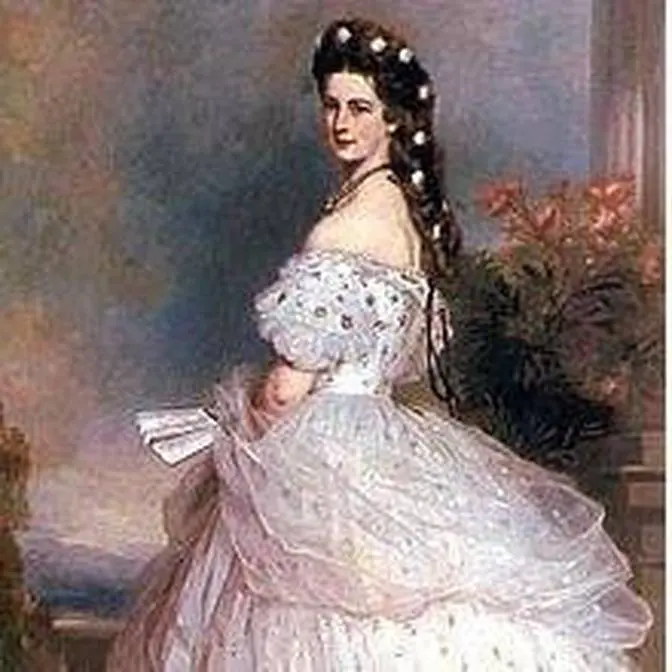
AI GeneratedThis video explores the evolution of women's fashion from the 1840s to the early 1860s. The presenter demonstrates the layering process, highlighting how undergarments, corsetry, and outer silhouettes shifted from the soft hourglass shapes of the 40s to the dramatic, structured dome shapes of the 60s, emphasizing the transition from heavy petticoats to the cage crinoline.
You might have heard that fashion was fairly stagnant in the mid-19th century,
which it absolutely was, but that doesn't mean that fashion didn't change at all during this
time period. So hello and welcome, I'm Maria from SewThroughTime, and this time we're taking a look
at how fashion changed from the 1840s to the early 1860s, and I'm going to get dressed in
each of these eras and I'm going to show you the differences in all the layers. Throughout the
This is the next to skin layer, the layer that gets washed the most frequently,
and then you have stockings that are held up by garters. Throughout this time, stockings tended
to be neutral colors like whites, creams, and blacks. The 40s ones are wool, the 50s ones are
cotton, and the 60s ones are silk, but all of these materials would have been used throughout
all of these eras. Chemises in these eras have sleeves and they were fairly simple,
fairly wide garments. For the 40s, they're still fairly long and rectangular, whereas by the 60s,
they have mostly gotten more short and more fitted. They are always white and either in
cotton or linen in these eras. This allows them to be boiled as a part of the laundering process
to make sure that they are extra clean. And the next layer we add is your corset. This is your
foundational layer. This is your bra. This is the one that creates the shape also. In the beginning
of the 1840s, the hourglass corset is a fairly new invention and it is still pretty much in
its infancy and it doesn't give it a very exaggerated shape. Boning in this type of corset
is fairly minimal and most of the shaping comes from just sturdy fabric and some cording. And
even though the split busk, that thing that opens and closes in the front, was invented in the late
1830s, it didn't become standard for all corsets until the 1860s. And while the general shape is
an hourglass in all of these eras, for the 40s and 50s, as you can see, it is much softer, much
more gradual, and much less dramatic than it is in the 60s. By the 60s, corsetry had advanced to
a lot more dramatic silhouette, and to keep these more dramatic silhouettes from collapsing on the
body, a lot more boning was used. And in all of these eras, corsets would have been boned mostly
with baleen, what is also referred to as whalebone, even though it is actually basically the cartilage
that is like teeth. If you're interested in learning more about the Victorian era corset
and how it changed through the time, I have a separate video on it which I will link down below.
But here I'd like to mention that corsets are not torture devices. The silhouette is mostly done by
illusion rather than actually extreme body modification. And a well-fitting corset that is
made to your body will be comfortable. Here you can see that the biggest difference is in the bust.
In the 60s, it's a lot more defined and separated than previously. And next comes your drawers.
These are split in the crotch, and the reason why they come on top of your corset is also to reduce
bulk, but also so that your chemise goes inside them, so that that means that you don't accidentally
flash somebody if you would fall on your face. And though drawers of this era have a fairly slim
appearance, they do actually have plenty of room for tucking in that chemise. Also, if your thighs
are sensitive to chafing, this really helps because you can really control whether fabric
goes this way. And they're typically worn just below the narrowest part of your waist to decrease
bulk. Then we start with the silhouette building skirt layers. For the 1850s, that means a corded
petticoat. In the 1860s, this is a hoop skirt, also referred to as a cage crinoline. In the 1840s,
we start with a pocket. Throughout these eras, a pocket can be a sewn-in garment or a separate
garment. The 1850s silhouette is a very full skirt, but because the cage crinoline with the metal hoops
is invented in 56, prior to that it would have been done with layers and layers of petticoats
instead, with the bottom one usually being a corded petticoat, both in the 50s and in the 40s.
The cording works as a stiffening, helping keep the skirt out. Since the invention of the hoop
skirt in 56, the hoops are fairly evenly around up until about 61, when they are at their biggest
and create that dome bell shape that can be seen here in the 60s version. And after two layers of
petticoats, I put on my tie-on pocket for the 50s dress. The specific order of this doesn't really
matter, but you want a few layers of petticoats, at least one on top of the pocket, so that it isn't
To help create volume and add more body to the petticoats, they are oftentimes starched
quite strongly, and oftentimes can even stand on their own when they're freshly starched.
The only thing is that when these starched petticoats are in the closet for a while,
they do get crumpled up, so you do need to floof them back out. And if you're counting,
this is the third layer of petticoats for my 50s look. And the reason why I like doing ties
for my waistband is so that I can layer them so that they are at a slightly different part,
so that they don't create a bulk at my waist length. And while the 40s and 50s use multiple
petticoats, at least one petticoat has to be worn over the hoop skirt to hide that hoop shape from
being visible underneath your skirt. It all depends on the thickness of your outer skirt.
With a thicker skirt, you need less petticoats. With a thinner skirt, you need more and thicker
petticoats to cover that line. In the 40s, typical amount of petticoats is two to three,
while in the 50s, you can have as many as five. So you can clearly understand why women were
excited when the hoop skirt came and you didn't need all those petticoats. It was much less
cumbersome and a lot cooler. But this is also an era where the corset is an absolute necessity,
not only to create that proper silhouette, but also to carry the weight of all those skirts.
Can you imagine how fast that would become painful when all of that weight from all of
those skirts would be only concentrated on that tiny little area at your waist?
Whereas here, the corset takes the weight of the petticoats and distributes it evenly on your body
so that you don't really even notice it. And for the 50s, now comes my skirt.
The 50s is also the first time in the 19th century that the separate skirt and bodice becomes
again norm. Though one-piece dresses continue to be popular, especially amongst more elite women,
the idea of having one skirt and a day and an evening bodice for that same skirt emerges during
this era. Because fabric economy is definitely a concern even among the more elite women.
Because this is very much an era when frugality was seen as a virtue. And this is why by the time
we get into the 1860s, it is very common to have one skirt with several different bodices for
daytime and evening time. And next for the 1850s come my undersleeves. These are typically made
out of fine materials and held up with an elastic or a tie at the bicep. These were oftentimes made
out of cotton muslins and laces and even different sorts of tools and nets. They could be as practical
as the wearer wanted or as impractical and just pretty. Their main function was to cover up that
lower part of the arm that would be visible in a pagoda sleeve. They could be just decorative or
they could be sun protection or cold protection. And next comes my chemiset. The main purpose of
this garment is to cover up the upper chest area and keep the outer clothing clean by not having
skin touching the outer fabrics. But also it was a cheap way to add interest to a dress by just
changing out the chemiset you could have a completely different look. And though these
oftentimes came in matching sets with the undersleeves, they didn't necessarily need to
match. And though this was a cheap item to buy, women would also oftentimes make them themselves
because they were relatively easy to make but you could still show off your needle skills and your
personal taste with different sort of embroidery embellishments. 1840s dresses are typically
one piece and oftentimes closed down the back, though there is an option where the bodice closes
in the front and then the skirt at the side. But because people during the 19th century didn't
really live alone, it's not really a problem because you always had help if you needed. And
here I want to point out that for the 60s I didn't wear the separate pocket because it has one built
in. And here for the 50s you can see the bodice has the most prevalent sleeve of the mid-19th
century, the pagoda sleeve. It starts off fairly small at the arm side and then bellows into this
huge fan shape. These ones are fairly moderate sized and as you can see they leave a huge
portion of the lower part of the arm exposed, hence the undersleeves. These first start appearing
in the 1840s and then they become the main fashion trend of the 50s and go well into the 60s,
though for most of the 40s the tight sleeve you can see in my 40s gown was more typical for that
time period. And though the pagoda sleeve remains hugely popular in the early 60s, the first few
years of the 60s also see the rise of that tight sleeve again, usually embellished with these two
upper sleeve puffs that you can see here. These would have been around from 1860 to 61, after that
they disappear in favor of newer sleeves. For jewelry, the 40s get its large cameo brooch,
which would have been popular throughout these eras. While the 50s gets a watch on an extremely
long chain, that would again be fashionable throughout the era and this would be either
pinned at the waist or go in a small pocket at the waist. And while chemisets would have been
popular throughout these eras, for the 60s I opted instead for a separate lace collar that
has been pinned on with straight pins. While the 40s gets the last available option for different
neckline treatments in these eras, in a form of a tucker. This is a ruffle of lace or sheer fabric
that is sewn onto a piece of tape that then is attached to the neckline, that then can be taken
out for easy laundering. And to finish off the 1860s neckline, I add a silk ribbon and a mosaic
brooch. For the 50s, I chose fingerless silk lace mitts. For shoes, the standard for the 40s and 50s
is square-toed heel-less shoes. In the 60s, the square toe continues, but heels start to emerge.
And as you can see, you can sit in a crinoline just fine. It just does take up a lot of room.
Can you tell that putting on shoes is the puppy's cue that we're going outside?
The other glove options for these eras are neck gloves and leather gloves. And here are the
finished looks. Though bonnets were the prevailing hat style of this era, they did change a little
bit gradually. In the 50s, the decorations were focused on the lower half of the inner brim,
whereas during the 60s, they're focused on the upper portion of the inner brim. And during the
1840s, you can find a bunch of etiquette guides that would complain about women's habit of going
bareheaded, about how inappropriate it was, and how it would lead to sunburn and skin damage,
and how just vulgar it was in general. Which of course means that a bunch of women did it. And
as you can see, the pockets can easily be accessed through the slits in the skirts. So there you have
it. Even though the general style is very similar during these eras, there is a lot of nuance and
difference in styles. I'd love to hear down in the comments below, which one do you prefer?
Well, that's it for today. I hope you enjoyed this and I hope to see you again next time. Bye!