
The Han Dynasty: Foundation of Chinese Identity
16 Video Views·May 21, 2026
AI GeneratedMay contain errors
Video Summary
AI GeneratedThe Han Dynasty was a pivotal era that established the foundations of East Asian civilization. Spanning 400 years, it transitioned from the brutal Qin rule to a golden age of expansion, innovation, and cultural unification. Through the Silk Road, Confucian governance, and inventions like paper, the Han created a lasting ethnic and political identity that continues to define China today.
If you asked most people to name the great empires of the ancient world,
their answers will be Rome, Greece, Egypt, and maybe Persia.
But at the exact same time as Rome, on the other side of Eurasia,
roughly the same size, roughly the same population, arguably the same power,
there was a Chinese dynasty, and most people have never really heard its full story.
I'm talking about the Han Dynasty. 400 years. About 60 million people.
An empire stretching from Korea to Vietnam to the edges of Central Asia.
The dynasty that invented paper. That opened the Silk Road.
That made Confucianism the foundation of East Asian civilization for the next 2000 years.
The dynasty. That is the beginning of the single largest unified ethnic identity on Earth today.
So what happened during the 400 years of Han rule?
How does this single dynasty shape a civilization so deeply that its name never really went away?
Let's talk about the entire history of the Han Dynasty.
To understand where the Han Dynasty came from, we have to understand what it was replacing.
And that was a disaster.
In 221 BC, the king of the state of Qin had conquered all the other warring states
and unified China under one ruler for the first time.
He gave himself a new title, Qin Shi Huang, the first emperor,
and immediately set about remaking the entire country in his image.
Some of what he did was genuinely visionary.
He standardized weights and measures across the empire.
He built roads and canals.
He unified the writing system so people from different regions could communicate on paper.
He even started building the first sections of what would eventually become the Great Wall.
But he also ran the empire like it was a machine, and the people were the parts.
Forced labor for massive construction projects,
thousands died building the wall, building palaces,
building his enormous tomb complex guarded by the famous terracotta warriors.
He burned books to control what people could think.
He had scholars buried alive for disagreeing with him.
Taxes were crushing.
Punishments were brutal.
Minor infractions could cost you your hands, your nose, your life.
When he died in 210 BC, the empire started falling apart almost immediately.
Within four years, rebellions had broken out across the country,
and the Qin dynasty was finished.
China shattered into 18 separate kingdoms, all fighting each other for control.
Out of that chaos, two men rose to the top.
Xiang Yu was the first, an aristocrat from the old state of Chutum.
A military genius, physically imposing, charismatic,
the kind of general who inspired fierce loyalty.
His nickname was the Conqueror of the West.
He was, by most accounts, the superior commander.
The other was Liu Bang.
He was a commoner from a peasant family, a low-ranking village official,
reportedly fond of drinking, known for being charming and persuasive,
rather than brilliant or disciplined.
He had no noble blood.
No military training to speak of.
No real claim to rule anything.
They fought for four years.
A conflict Chinese history calls Chuhan Xiangzheng, in English, the Chuhan Contention.
Xiang Yu won most of the battles.
Liu Bang lost most of them.
But Liu Bang was patient.
He picked better advisors,
and he treated the people in territories he captured with far more decency than his rival did.
The decisive moment came at the Battle of Gaixia in 202 BC, in what is now Anhui province.
Liu Bang's forces surrounded Xiang Yu's army.
The Chu soldiers began to hear Han soldiers singing the songs of their homeland.
A psychological tactic, designed to make them feel the war was already lost.
Xiang Yu, seeing no way out,
reportedly recited a famous poem lamenting that even his horse could not be saved,
and then killed himself.
Liu Bang had won China.
He took the title Emperor Gaozu and set up his capital at Chang'an,
along the Wei River in one of the few surviving Qin palaces.
And the Han Dynasty began.
Gaozu's first challenge was simple, but also enormous.
The country was exhausted.
Years of war, Qin's oppression before that.
The population had dropped.
Farmland was abandoned.
People were starving.
He needed to give China a chance to breathe.
His solution was essentially to do the opposite of everything the Qin had done.
He cut taxes drastically.
At one point, reducing the land tax to as little as one-fifteenth of a household's crop.
Later, even lower.
He eased the brutal legal code.
He disbanded most of the army and sent soldiers home to farm.
He adopted a philosophy sometimes called Huanglaodao,
a Taoist idea that the best government is one that largely leaves people alone to live their lives.
He kept the Qin's basic administrative structure.
The empire was divided into commanderies controlled by appointed officials, because it worked.
But he also recognized that he needed to reward the generals and allies who'd helped him win.
So he split the eastern two-thirds of the empire into semi-autonomous kingdoms
and handed them to his most loyal followers.
Most of those he eventually replaced with members of his own Liu family,
hoping that blood loyalty would be stronger than political loyalty.
It was a reasonable calculation, but didn't entirely work.
The Liu family kings had their own ambitions,
but that problem would take a generation to come to a head.
The problem that came to a head immediately was the Xiongnu.
The Xiongnu were a vast confederation of nomadic horsemen living on the steppes north of China.
They were superb cavalry fighters, fast and mobile,
capable of raiding deep into Han territory and disappearing before any response could be organized.
They'd been raiding Chinese borders for generations,
and by the early Han period, their leader, a chieftain called Mo Dudan Yu,
had unified the various tribes into a confederation that was genuinely dangerous.
In 200 BC, Gaozu personally led an army to deal with them.
That went badly.
Mo Dudan Yu lured the Han forces into a trap at a place called Baideng,
in what is now Shanxi province,
and surrounded Gaozu's entire army for seven days in freezing winter conditions.
The founding emperor of Han and his army was trapped in the cold,
waiting to see if he'd be allowed to leave.
He was, through negotiation,
reportedly by bribing the Xiongnu chieftain's wife with gifts and flattery.
From that point on, Han's official policy towards the Xiongnu
was called Heiqin, harmony through kinship,
meaning, send them tribute, send them silk and grain and wine.
Send them Han princesses to marry into the Xiongnu ruling family.
Keep the peace by paying for it.
It was humiliating for an empire that liked to think of itself as the center of civilization.
But it bought time.
Time to rebuild.
Time to grow strong enough to actually fight back.
Gaozu died in 195 BC,
and what followed was one of the uglier chapters in early Han history.
His wife, Empress Lu Ji,
was determined to control the succession.
And she did.
She had Gaozu's favorite concubine, Lady Qi,
mutilated and left in a privy,
then reportedly showed the result to her own son,
the new emperor,
as a demonstration of her power.
She murdered several of Gaozu's other sons.
She dominated the court for 15 years,
placing members of her own Lu family in high positions,
essentially turning the Han court into a family business.
When she died in 180 BC,
the Lu family rallied, executed the Lu clan,
and put Gaozu's son on the throne as Emperor Wen.
Emperor Wen and his son, Emperor Jing,
their joint reigns remembered as the rule of Wen and Jing,
continued the light-touch governing of early Han.
More tax cuts, less forced labor, agricultural investment,
the population grew, the treasury filled.
The historians who wrote about this period
described an empire slowly healing.
Though one problem remained.
Those semi-autonomous kingdoms in the east
were getting too powerful.
In 154 BC,
seven of them rebelled simultaneously against Emperor Jing.
The so-called Rebellion of the Seven States,
Qi Guo Zhu Luan in Chinese.
It was put down within three months.
After that, Jing systematically reduced the kingdom's power,
turning them from semi-independent states
into essentially decorative titles with no real authority.
The Han throne was now, finally, clearly in charge.
The stage was set for the reign that would define the dynasty.
In 141 BC,
a 16-year-old named Liu Che became emperor.
He would reign for 54 years,
a record that would not be broken for 18 centuries.
He would expand the Han Empire to its greatest extent,
open the Silk Road,
make Confucianism the foundation of Chinese civilization,
and nearly bankrupt the empire doing it.
He is known to history as Emperor Wu,
the Martial Emperor.
When Wu took the throne,
Han China had spent 60 years following a philosophy of restraint.
Light government,
low taxes,
minimal foreign entanglements.
That had served the dynasty well.
The treasury was full,
the population had grown,
agriculture was productive.
Wu looked at all of that accumulated wealth and energy
and decided it was time to use it.
First was ideological.
The early Han had flirted with Confucianism
but never fully committed to it.
There was too much resistance from Taoist-leaning nobles
and Wu's own powerful grandmother
who favoured the old hands-off approach.
Wu got around this cleverly.
He created what historians call an inner court,
a shadow cabinet of commoners and younger officials he personally trusted,
who could implement his ideas
without going through the established bureaucracy that would block them.
When his grandmother died in 135 BC,
the resistance died with her.
In 136 BC,
Wu established the Imperial Academy,
the Taishui,
and designated Confucianism as the official state philosophy.
The curriculum centred on the five classics,
the Book of Changes, Yijing,
the Book of Documents, Shujing,
the Book of Odes, Shijing,
the Book of Rites, Liji,
and the Spring and Autumn Annals, Chunchu.
If you wanted a government job,
you needed to know these texts.
This wasn't just an educational policy,
it was a cultural revolution.
It embedded Confucian values,
hierarchy,
filial piety,
moral virtue,
social harmony,
into the machinery of the state.
Every official in the empire would be trained in the same texts,
would speak a common intellectual language.
By the 2nd century AD,
the Academy had 30,000 students.
The civil service examination system,
known as keiju,
that grew from this became the template for Chinese governance
On the economic side,
Wu made another major move.
He nationalized salt and iron production.
These were the two most essential industries in the empire.
Salt for food preservation,
iron for tools and weapons.
And wealthy merchants had been monopolizing both,
accumulating fortunes that rivaled the imperial treasury itself.
Wu put them under government control.
It generated enormous revenue that funded his military campaigns.
It also, predictably, infuriated the merchant class.
Because the military campaigns were the central project of his reign.
Wu had decided that the Heqin policy,
paying tribute to the Xiongnu,
was over.
He spent years building up the Han cavalry,
specifically to fight nomadic enemies on their own terms.
He recruited skilled horsemen from allied nomadic tribes.
He established horse breeding programs in frontier regions
to supply the army with fast, durable mounts.
Between 127 and 119 BC,
Han armies launched a series of massive campaigns into Xiongnu territory.
The key commanders were Wei Qing,
a former slave who turned out to be a brilliant general,
and who happened to be the half-brother of Emperor Wu's favorite concubine.
And Huo Kubing, Wei Qing's nephew,
who began commanding armies as a teenager,
and was arguably even more gifted.
Together, they drove the Xiongnu out of the Ordos Desert,
then out of the Hexi Corridor,
then in the decisive Battle of Mobei in 119 BC,
deep into the Gebi Desert.
The Xiongnu Confederation was broken.
The northern border was secure for the first time in Han history.
Wu used that moment to do something with permanent consequences.
He sent 700,000 Chinese soldier settlers into the Hexi Corridor,
the long strip of land between the mountains and the desert in what is now Gansu Province,
and built fortified walls and garrison towns along it.
This created a buffer zone.
It also created a road.
A road towards west.
This is where Zhang Qian comes in.
Back in 138 BC, before the Xiongnu Wars were won,
Emperor Wu had sent a diplomat named Zhang Qian on a mission to find a tribe called the Yuexi,
who had been pushed west by the Xiongnu
and might be willing to fight alongside Han against their common enemy.
Zhang Qian and his party were captured almost immediately by the Xiongnu.
He spent 10 years as a prisoner.
He married a Xiongnu woman.
He had children.
And then he escaped, continued west anyway,
crossed the Pamir Mountains, and reached a region called Daxia,
what we now know as Bactria in northern Afghanistan.
The Yuexi weren't interested in fighting the Xiongnu anymore.
They'd settled down and moved on.
But Zhang Qian noticed something.
In the markets of Bactria, he found Chinese goods.
Bamboo staves and silk cloth, which could only have come from China,
traded through layers of middlemen across thousands of miles
through routes that Han knew nothing about.
He spent another year in the region,
was captured again by the Xiongnu on the way home,
escaped again, and finally arrived back in Chang'an,
13 years after he had left.
Only two of his original hundred-man party returned with him.
Emperor Wu listened to everything he brought back.
The intelligence about Central Asian kingdoms,
their populations, their militaries, their products.
And he saw something Zhang Qian maybe didn't.
A commercial opportunity of staggering scale.
Multiple subsequent missions followed.
The route Zhang Qian had traveled became formalized,
extended, protected by Han garrisons.
This is how what we call the Silk Road or Sichouji Lu in Chinese was born.
The Silk Road wasn't a single road.
It was a network of routes through Central Asia,
connecting China to the Middle East, and eventually to Rome.
What it carried wasn't just silk,
though silk was the most famous Chinese export.
So prized in Rome that Roman senators debated whether to ban it
because it was bankrupting the treasury.
It carried spices, glass, horses, cotton, ivory.
It carried Buddhism from India into China.
It carried ideas, artistic styles, technologies, and religions
across the entire width of the Eurasian continent.
Under Wu, Han also expanded in almost every other direction.
Korea was conquered in 108 BC.
Northern Vietnam came under Han control.
Parts of Central Asia were brought into the empire or into tributary relationships.
Emperor Wu's forces, according to historians,
conquered roughly 4.4 million square kilometers of new territory,
the largest territorial expansion in Chinese history up to that point.
But all of this cost money, enormous amounts of money.
The salt and iron monopolies helped.
New taxes on merchants helped.
Currency reforms helped until they caused inflation.
By the final years of Wu's reign, the empire's finances were under serious strain.
Historians estimate the population may have declined
due to the losses from decades of military campaigns.
Then, in 91 BC, disaster struck inside the palace.
A series of political intrigues led to accusations of witchcraft
against members of the imperial family.
The paranoia spread.
Wu's own crown prince, the heir he had spent decades preparing,
was accused of practicing black magic against the emperor.
The prince fled, gathered troops, briefly fought, and was killed.
Thousands of people died in the purges that followed.
Wu himself may have ordered or at least sanctioned the death of his own son.
He lived until 87 BC, still emperor, still the most powerful man in the world.
In his final years, he issued an edict called the Luntai Huizhou,
or Luntai Edict in English, a document in which he essentially admitted
that his military campaigns had caused too much suffering,
and promised to return to agricultural development and lighter governance.
Whether it was genuine remorse or political calculation, historians still debate.
He died at around 70, having ruled for longer than most people lived.
Emperor Wu was the Han Dynasty's most defining figure.
He made it an empire in the fullest sense – military, commercial, ideological.
But he also left it with problems it would never fully solve.
After Emperor Wu died, the Han Dynasty entered a long, strange era of capable administration
mixed with gathering structural weakness.
The emperors who followed, Wu, were, with a couple of notable exceptions,
young, short-lived, or simply less engaged.
There was a deeper problem.
The way the Han court handled succession created a permanent vulnerability.
When an emperor died young, or came to the throne as a child, his mother became regent.
The regent's family, her brothers and uncles, controlled real power.
These were called the Wai-Chi, the Outer Relatives,
and the history of the late Western Han is largely a story of these consort clans
competing with each other and with the palace eunuchs for control of the emperor,
who was often a child who barely understood what was happening around him.
But there was a bright spot.
Emperor Xuan, who reigned from 74 to 49 BC, was a capable ruler who'd grown up in prison.
He was a great-grandson of the ill-fated Crown Prince from the Witchcraft Crisis,
and who came to the throne after court officials arranged the deposition of his predecessor.
He was pragmatic and attentive to governance.
His reign is remembered as a minor restoration of Han vigor.
He kept the northern borders stable, maintained a degree of bureaucratic efficiency,
and continued the Confucian educational system Wu had established.
But after Xuan, the pattern resumed.
Young emperors, powerful consort families.
One family in particular accumulated more power than any before it, the Wang clan.
Wang Mang, the nephew of Empress Dowager Wang, rose steadily through the court hierarchy
on the strength of a reputation for Confucian virtue.
He was publicly modest, reportedly generous to the poor, famously incorruptible.
He dressed simply.
He followed ritual to the letter.
Intellectuals admired him.
The court trusted him.
By 1 BC, he had been appointed regent for a child emperor.
When that child died, another child took the throne.
When that one died without an heir, Wang Mang selected yet another infant from the Liu family
to be emperor.
By this point, the fiction was becoming transparent.
In 9 AD, Wang Mang dropped it entirely.
He declared that the Liu family had lost the mandate of heaven and that a new dynasty,
the Xin, meaning new, had begun with himself as its first emperor.
Historians have spent a long time debating Wang Mang.
Was he a cynical opportunist who used virtue as a costume?
Or was he a genuine idealist who believed he could fix what was broken?
The truth is probably both.
His reforms suggest someone who actually believed in what he was doing.
He redistributed land from large estates to peasant farmers,
a direct attack on the aristocratic class that had accumulated too much for too long.
He tried to abolish private slavery.
He reformed the currency system.
He restructured the bureaucracy along ancient Confucian models
he had read about in classical texts.
The problem is that the ancient texts he was following
described a world that no longer existed.
His currency reforms caused economic chaos.
His land redistribution provoked fury from the aristocrats who had been dispossessed.
His attempt to run the empire on classical principles
meant ignoring how the empire actually functioned.
Then, catastrophically, the Yellow River flooded.
Around 11 AD, the river shifted its course,
drowning vast stretches of farmland in what is now Hainan and Shandong.
Millions of peasants were displaced.
Crops failed.
People starved.
The refugee population wandered the countryside, desperate and angry.
Out of this desperation, rebellion grew.
The most famous of the rebel armies called themselves the Qime, the Red Eyebrows.
The name came from their practice of painting their eyebrows red,
partly as identification in battle, partly as a symbol of their movement.
They grew from a ragged band of starving peasants
into an army capable of defeating Wang Mang's forces in open battle.
In 23 AD, they sacked Chang'an.
Wang Mang was found hiding in a tower within the palace complex.
He was killed, and his head was reportedly passed around and kicked by the mob.
His body was torn apart.
The new dynasty had lasted 15 years.
China was in chaos again.
From that chaos, a man named Liu Xiu,
a distant descendant of the Han founding family, emerged.
After years of fighting, he reunified the empire in 25 AD.
He moved the capital east to Luoyang and declared himself Emperor Guangwu.
The Han dynasty begins its second act.
Emperor Guangwu is one of the most underrated figures in Chinese history.
He didn't just retake the throne, he genuinely rebuilt the empire from scratch,
and he did it in a way that shows he had learned from what broke western Han.
He reduced the military.
After a lifetime of warfare, his instinct was to demobilize, shrink the standing army,
send soldiers back to farming, use the savings to repair the agricultural economy.
He surveyed land holdings across the empire and reduced taxes.
He promoted Confucian education aggressively,
understanding that a trained, ideologically coherent bureaucracy
was the real backbone of a stable empire.
Crucially, he also restructured the court to reduce the power of consort families and eunuchs,
the two forces that had corroded western Han from within.
His reign lasted until 57 AD,
and it was followed by the reigns of his son Emperor Ming and grandson Emperor Zhang,
a period historians call the Rule of Ming and Zhang,
which is generally regarded as the high point of eastern Han.
Taxes stayed low.
Confucianism flourished.
The borders were stable.
The population grew.
The eastern Han was remarkably cosmopolitan.
Trade along the Silk Road continued to grow.
Caravans from Central Asia were reportedly arriving in Luoyang every month.
Japanese envoys visited in 57 AD and again in 107 AD.
The Japanese king sent tribute and received a gold seal.
Which was actually discovered in Japan in 1784 and is now in a museum in Fukuoka.
The Han court received diplomatic gifts from the Kushan Empire
in what is now Pakistan and Afghanistan,
and from the Parthian Empire in what is now Iran.
Then there's the Rome connection.
In 97 AD, the Han general Ban Chao,
who had spent the previous three decades reasserting Chinese control over Central Asia,
sent his envoy, Gan Ying, on a mission to find the Roman Empire.
Gan Ying travelled through Parthia and reached the shores of the Persian Gulf.
There, Parthian sailors reportedly warned him that the sea crossing to Rome would take years,
that sailors sometimes went mad from the journey,
that he should think carefully before going further.
He turned back.
Historians suspect the Parthians were deliberately discouraging the mission.
They controlled the lucrative middleman trade between Rome and China,
and direct Han-Roman contact would have cut them out.
Whether or not that's true, Gan Ying came home without reaching Rome.
But in 166 AD, something came the other way.
A group arrived at the eastern Han court claiming to be envoys from
Da Qin, the Han term for Rome, sent by the emperor, Andun,
which historians believe refers to Marcus Aurelius.
The Book of Later Han records the encounter.
Most historians think the group was actually Roman merchants rather than official diplomats,
but the Han court took them seriously enough to record it.
Two empires separated by the entire Eurasian continent had made contact,
or something close to it.
Buddhism was making its own journey along those same routes.
It had originated in India in the 5th century BC, spread through Central Asia via the Silk Road,
and by the 1st century AD was arriving in China in a serious way.
Buddhist monks were traveling to Luoyang to translate texts into Chinese.
An Shigao, a Parthian prince turned Buddhist monk,
established a translation center in Luoyang around 148 AD.
The Han court was broadly curious and tolerant.
Emperor Ming, reportedly, had a dream about a golden deity that advisors interpreted as the
Buddha, leading him to send envoys to bring Buddhist scriptures back from India.
The story may be legendary, but it reflects the real openness of Eastern Han to foreign ideas.
This was also the era of the dynasty's greatest technological achievements.
Paper had technically existed in primitive forms before the Han,
but around 105 AD, a court official named Kai Lun refined the process
into something genuinely practical and scalable.
He took materials that cost essentially nothing, tree bark, hemp fiber, old rags,
worn out fishing nets, pulped them in water, spread the mixture thin, and dried it.
The result was a writing surface that was lighter than bamboo,
cheaper than silk, and durable enough to survive years of use.
The use of paper spread through the empire within decades.
Within a few centuries, paper-making technology had traveled west through
the Islamic world to medieval Europe. It is not an exaggeration to say that every book,
every newspaper, every written record in human history after a certain point
owes something to Kai Lun's workshop.
In 132 AD, a court astronomer and polymath named Zhang Heng invented something that had
never existed before, a seismoscope. He called it the hu feng di dong, roughly,
the instrument for measuring the seasonal winds and the movements of the earth.
It was a bronze vessel, about six feet across, shaped like a large jar, with eight bronze
dragons arranged around the outside, each holding a small ball in its mouth.
When the ground shook, a pendulum inside the vessel swung in the direction of the tremor,
releasing the corresponding dragon's ball into the mouth of a bronze toad sitting below it.
The direction the ball dropped told you which direction the earthquake was coming from.
In 138 AD, the instrument registered a tremor from the northwest.
Court officials were skeptical. They'd felt nothing in Luoyang.
Days later, a messenger arrived from Gansu province, reporting a major earthquake.
The seismoscope had detected an earthquake from hundreds of miles away.
Zhang Heng's invention wouldn't be matched or exceeded in the west for over a thousand years.
Then there was Sima Qian. He'd lived and worked during Emperor Wu's reign during the Western Han,
but his work defined how the Eastern Han and every dynasty after it would think about history.
Sima Qian was the court historian, and he set out to write a comprehensive history of China,
from its mythological beginnings to his own era.
The project took decades. It's 130 chapters long, covering not just emperors and battles,
but economic history, biographies of ordinary people, histories of foreign peoples.
The Shiji, records of the grand historian, became the model for every official dynastic history
that China produced for the next 2,000 years. What makes Sima Qian's story remarkable beyond
the work itself is what it cost him. He defended a general named Li Ling, who had surrendered to
the Xiongnu, a politically toxic position. Emperor Wu was furious. Sima Qian was given a
choice between death and castration. He chose castration, which was considered a deep and
permanent humiliation in Han society. He survived. He continued writing. He completed the Shiji.
In a letter he wrote afterward, he described his decision. He could not die with his work
unfinished. The history mattered more than his dignity or his comfort. It still exists today.
All of this, the wars, the emperors, the inventions,
happened in the context of a society with very specific ideas about how it should be organized.
Understanding that society helps you understand both the dynasty's strength and, eventually,
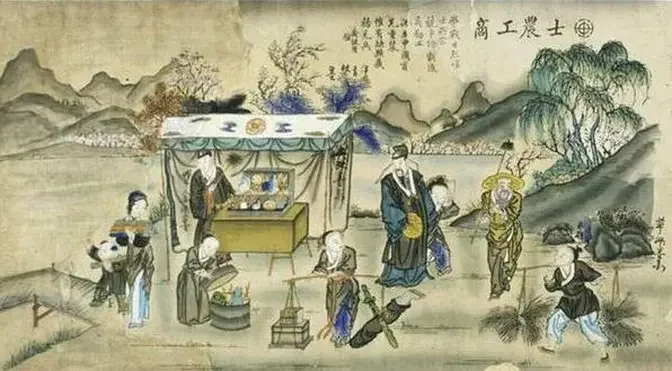
its collapse. The Han operated on a four-tier social hierarchy inherited partly from Confucian
thought. At the top were the shi, scholars and officials, the educated class who ran the
government. Below them were the nong, farmers, who were considered the backbone of the economy
and were respected accordingly. Third were the luo, artisans and craftsmen.
At the bottom, surprisingly, were the shang, merchants. In Confucian thought,
merchants contributed nothing to the actual production of goods. They just moved things
around and profited from it. So despite often being the wealthiest people in the empire,
merchants had the lowest social status and faced legal restrictions. They couldn't ride horses,
they couldn't wear silk, they couldn't hold government office.
The civil service was the engine of social mobility. If you could study and pass the
examinations, you could rise. This is genuinely significant for its time. Most ancient civilizations
determined status almost entirely by birth. Han said, your brain matters, your knowledge matters.
A bright peasant's son who mastered the Confucian classics could, in theory,
end up advising the emperor. In practice, wealthy families still had huge advantages in accessing
education. But the principle was there, and it shaped Chinese society for 2,000 years.
Chang'an, the western Han capital, was one of the largest cities in the ancient world.
Roughly comparable to Rome in scale, with a population historians estimate at around
250,000 people at its peak. It was a walled city with 12 gates, watchtowers, markets,
residential wards, and enormous palace complexes. The markets were lively and tightly regulated.
Government officials supervised prices and quality, consistent with the Confucian
suspicion of uncontrolled commerce. You could buy cooked meats, pickled vegetables, iron tools,
lacquerware, jade, silk, hemp cloth, exotic goods brought in from the Silk Road.
Confucian values structured daily life at every level. Filial piety, respect and devotion to
parents and ancestors, was considered the foundation of all virtue. If you respected
your parents, you'd respect the emperor. If you honored your ancestors, you'd maintain social
order. Tomb art from the Han period, carved stones, painted murals, frequently depicts
scenes of filial devotion. There are stories of famous paragons of filial piety,
figures who sacrificed enormous personal comfort, or even their lives for their
parents' well-being, that circulated widely as moral examples. Women's lives in Han China
were heavily circumscribed by Confucian expectations. A woman was expected to be
subordinate first to her father, then to her husband, then to her eldest son. She had little
formal legal standing independent of the men in her family. Yet, women exercised real power in
the Han court. Empress Lu Ji effectively ruled the empire for 15 years. Empress Dowager Wang
shaped the conditions that allowed Wang Mang to rise. The regencies of powerful
Empress Dowagers were a recurring feature of Han political life.
In the Eastern Han, a woman named Banjiao became one of the most influential scholars of her
generation. She was the sister of the historian Ban Gu and the general Ban Chao, and she completed
her brother's unfinished history of Western Han after his death. She taught at the imperial court,
and she wrote a book called Nu Jie, Lessons for Women, a guide to female conduct emphasizing
modesty, obedience, and education. It's a complicated legacy. On one hand, a set of
restrictions. On the other, a prominent woman insisting that women deserved to be educated at
all, in a time when that was not obvious. Han tombs tell us as much about everyday life as
any written text. The Han believed deeply in the afterlife, and wealthy families equipped
their dead with everything they might need – food, wine, lacquerware, silk, bronze vessels,
clay models of houses and servants, and farm animals. Most remarkable are the jade burial
suits – garments made from thousands of jade pieces, each sewn together with gold,
silver, or bronze wire depending on the deceased's rank. Jade was believed to preserve the body.
The suits could contain over 2,000 individual pieces. They are one of the most striking
artifacts of any ancient civilization. When Emperor Zhang died in 88 AD, the Eastern Han
entered a period from which it never truly recovered. The problem was structural,
and it had been building since the dynasty's founding. The system was designed to be run by
capable adult emperors, and it kept producing children. Emperor He came to the throne at age 10.
Emperor Shang, who technically was an emperor, died at age 1. Emperor An took the throne at 13
and preferred drinking to governing. He handed real power to the palace eunuchs who surrounded
him. Emperor Shang, Emperor Chong, Emperor Zhi. None of them ruled long enough or lived long
enough to matter. Between 88 and 146 AD, Han had seven emperors. Most of them were children.
Most real power was held by empress dowagers, their male relatives, and increasingly by the
palace eunuchs. The eunuchs deserve some explanation. In the Han court, eunuchs, men
who had been castrated and therefore could safely live within the inner imperial quarters, served as
personal attendants to the emperor. They were trusted with physical access that no other
officials had. They knew the emperor's private thoughts, controlled his household, managed who
could see him. As the emperors became younger and more dependent, the eunuchs became more powerful.
By the second century AD, senior eunuchs were appointing officials, issuing edicts in the
emperor's name, and accumulating enormous personal wealth. This created a three-way power struggle
that paralyzed the court. The eunuchs, the consort clans, and the Confucian-educated official class
who considered both of the other factions corrupt and illegitimate. When officials and students
organized to protest the eunuchs' power, emperors Huan and Ling, instead of acting against the eunuchs,
had the protesters arrested. In 166 AD, and again in 169 AD, hundreds of scholars and officials
were blacklisted, imprisoned, or executed in what became known as the Dangu Jihuo,
partisan prohibitions. The intellectual class was alienated. The best people in the empire
were being punished for trying to fix what was broken. Outside the palace, conditions were
deteriorating. Droughts and floods hit the empire repeatedly through the 170s and 180s.
Crops failed. Peasants who couldn't pay their taxes had their land seized, usually by powerful
local families who were already wealthy enough to weather the crises. The landless poor flooded the
cities or wandered the countryside. The divide between the very wealthy and the desperately poor
had never been wider. Into this situation stepped a man named Zhang Jiao. Zhang Jiao was a faith
healer and Taoist teacher who had been traveling the countryside for years, offering healing to
the sick through a combination of prayer, confession, and herbal medicine. His movement,
called the Way of Great Peace, promised that the era of Han, symbolized by the color blue,
was ending, and that a new age of great peace, symbolized by yellow, was about to begin.
He and his brothers organized followers across eight different provinces simultaneously.
In the spring of 184 AD, they rose. The followers tied yellow cloth around their heads,
yellow for the new age, yellow for the earth, yellow to identify each other when the fighting
started. Hundreds of thousands of people rose at almost the same moment, across multiple provinces.
Granaries were seized, local government offices were attacked, Han army units were routed.
The Han government's response was the decision that finished the dynasty. Unable to deploy
enough regular troops fast enough, the court authorized regional governors and powerful
local figures to raise their own armies and deal with the rebellion themselves.
The Yellow Turbans were eventually crushed. Zhang Jiao himself died before the main campaigns
ended, possibly from illness. The rebellion was over within a year.
But the warlords didn't disband their armies afterward. Why would they? They now had troops,
weapons, and regional authority. The center had proven it couldn't protect them,
so they kept what they had. In 189 AD, the Han court fell into another
succession crisis when Emperor Ling died. A general named Dong Zhuo marched his army into
Luoyang, deposed the designated heir, and installed a child of his choosing on the throne.
He then proceeded to sack Luoyang, burning parts of the city, terrorizing the population,
and forcing the court to relocate to the old western Han capital of Chang'an.
The warlords who opposed, Dong Zhuo, formed a coalition. But the coalition quickly dissolved,
as each warlord realized he was more interested in carving out his own territory
than in restoring the Han. China fragmented.
The emperor, Emperor Xi'an, who came to the throne as a child in 189 AD, became a pawn,
passed between powerful men who used his name to legitimize their own authority.
The most capable of those men was Cao Cao. He was not a warlord in the simple sense,
he was a genuinely talented administrator, a skilled general, a poet, and a ruthless
political operator who understood that controlling the emperor was more valuable than replacing him.
From 196 AD onward, Cao Cao kept Emperor Xi'an as a figurehead while effectively running the
northern half. By 208 AD, Cao Cao had consolidated control of most of northern China and set out to
complete reunification by conquering the south. He assembled a massive fleet on the Yangtze River.
His opponents, the warlord Sun Quan in the southeast and Liu Bei in the west,
formed an alliance against him. Their combined fleet met Cao Cao's at a place called Red Cliffs
in what is now Hubei province. What happened next is one of the most famous
engagements in Chinese military history. Cao Cao's northern troops were not accustomed to
fighting on water. The opposing fleet, led by the admiral Zhou Yu, used fireships,
vessels loaded with dry reeds and fat, set alight and sent sailing into Cao Cao's anchored fleet
with the wind behind them. The Han fleet burned. Cao Cao barely escaped with the remnants of his
army. The Battle of Red Cliffs in 208 AD shattered his hope of reunification. China
would remain divided. For the next 12 years, the fiction of the Han dynasty continued.
Emperor Xi'an held the throne in name. Cao Cao held the power. When Cao Cao died in 220 AD,
his son, Cao Pi, made a decision. He informed Emperor Xi'an, politely but unmistakably,
that the time had come to step down. Emperor Xi'an, who had been a puppet emperor for 31 years,
who had watched everything he ruled turn to ash around him, agreed. He surrendered the imperial
seal. Cao Pi declared the Wei dynasty. Emperor Xi'an was given an estate and a title and lived
quietly for another 14 years. He died in 234 AD at age 54. In the south, Liu Bei, who claimed
descent from the Han royal family, declared his own Han dynasty, known to history as Shu Han,
refusing to recognize the transfer of the mandate. Sun Quan eventually declared his own state of Wu.
China was now three kingdoms. The Han dynasty, the real one, was over.
The Han dynasty lasted from 202 BC to 220 AD, 422 years in total, with a brief interruption.
Today, 1.4 billion people call themselves Han Chinese. Not as a political statement.
Not because a government told them to. The term Han stopped being about a dynasty somewhere in
the last 2,000 years and became the word for a shared cultural identity. A language,
a set of values, a way of writing, a way of thinking about history and society and family.
That kind of cultural persistence is genuinely rare in human history.
The dynasty that produced it ended almost 2,000 years ago. The political model the Han established,
a centralized empire governed by an educated bureaucracy selected through examination,
operating under Confucian principles, became the template for every Chinese dynasty that followed.
The Tang, the Song, the Ming, the Qing, all of them, different as they were,
were working within a framework that the Han had built. Paper, invented or perfected during the Han,
changed the world. It travelled west through Central Asia, reached the Islamic world by the
8th century, and from there spread to medieval Europe, where it replaced expensive parchment
and made books affordable, which made literacy possible at scale, which eventually made the
printing press meaningful. The Silk Road, opened under Emperor Wu, secured by generals like Ban
Cao, functioned as the primary artery of Eurasian commerce and cultural exchange for over a
millennium. The Taishogong Shu, or Sima Qian's Shiji, written during the depths of his personal
humiliation, completed despite everything, became the model for historical writing across East Asia.
Every official dynastic history that China produced after that followed the structure
Sima Qian established. Japan, Korea, and Vietnam adopted similar historiographical traditions.
The way billions of people think about the past today owes something to a man who wrote in the
1st century BC. The Han wasn't a perfect dynasty. It had brutal emperors and incompetent ones.
It had corruption and famines and rebellions. But it built something durable enough that when
the dynasty itself ended, what it had created did not. The name survived. The culture survived.
The values survived. So, that's the entire history of the Han dynasty.
If you made it this far, thank you for watching. This took a long time to put together,
and knowing people are genuinely interested in this history makes it worth it. If you enjoyed it,
hit the like button, share, and subscribe to the channel. For more videos on the history of China,
click the video on your screen now to watch the entire history of the Tang dynasty.