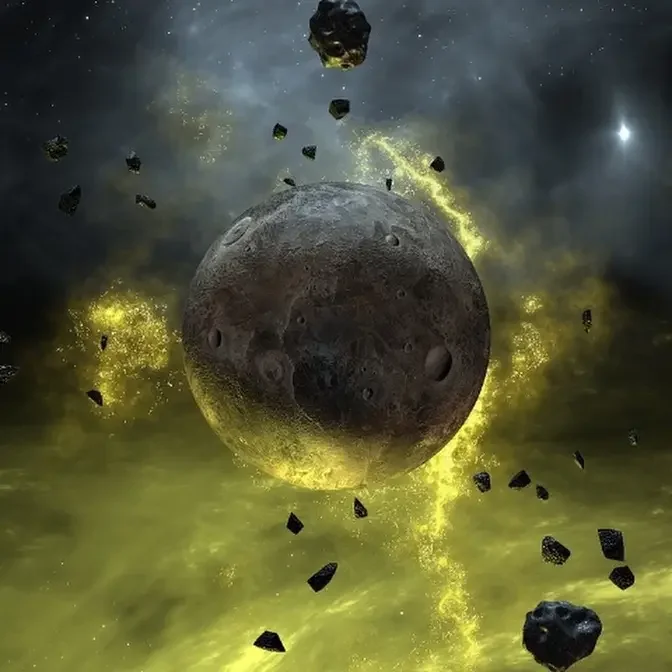
Scientists are exploring a fascinating idea that Dark Matter might not be some unknown particle, but could actually be made of black holes from a previous universe. Normally, we believe the universe began with the Big Bang, but some theories suggest there may have been an earlier universe that collapsed and then transitioned into ours. Physicist Enrique Gaztanaga proposed that certain objects, especially very dense ones like black holes, could survive this transition.
We already know dark matter exists because galaxies don’t behave as expected. Based on gravity, stars far from the center of a galaxy should move slower, but they don’t—they move just as fast as inner stars. This means there must be extra unseen mass holding galaxies together. Since we cannot see this mass, scientists call it dark matter.
Now, if ancient black holes from a previous universe are spread across space, they could provide this hidden gravity. This idea could explain both what dark matter is and why massive black holes formed so early in the universe.
Scientists are now exploring an idea that sounds almost impossible at first, but it's coming from serious research.
Some physicists are suggesting that dark matter might not be an unknown particle at all.
It could actually be made of black holes from a universe that existed before ours. In a recent study,
researchers proposed that something truly radical may have happened before the Big Bang.
Physicist Enrique Gastanaga
suggested that objects larger than about 90 meters could have survived the transition from a collapsing universe to a new expanding one.
A relic black hole is
the idea that
there might be relics,
fossils, from that collapsing phase that
somehow passed through the bouncing into our universe. A black hole has
exactly the properties of dark matter. A black hole is a very compact
object that has mass, but does not emit light. And now the James Webb Telescope
has shown something even more surprising, that even before the first big galaxies were formed,
these supermassive black holes are there. In simple terms,
this means that when a previous universe ended, not everything was destroyed. Some objects may have carried over into our universe.
And if that's true,
then what we are seeing today as dark matter could actually be the remains of that earlier cosmos.
So the real question becomes, what exactly did scientists find and how could something from another universe
survive such an extreme transition and still exist today?
Now think about this carefully. For almost a century, scientists have been chasing one invisible component of the universe, dark matter.
We know something is out there because there are effects in the universe that simply cannot be explained without assuming some hidden mass.
The first strong clue that dark matter might exist comes from how it affects the motion of stars and other celestial objects.
To understand this, think about basic gravity described by Isaac Newton in his laws of motion.
According to this idea, objects closer to a massive center, like stars near the middle of a galaxy,
should feel a stronger gravitational pull and move faster. On the other hand, stars that are far away from the center
should feel less gravity and therefore move more slowly.
This is exactly how planets behave in our solar system. The closer a planet is to the Sun, the faster it orbits.
But when scientists carefully measured the motion of stars and galaxies, they found something completely unexpected.
When they looked at stars far out at the edges of galaxies, those stars were not slowing down as predicted.
Instead, they were moving almost just as fast as the stars near the center.
This was shocking because based on visible matter alone,
there simply isn't enough mass in the outer regions of galaxies to keep those stars moving that quickly.
So what does that mean?
The only way this observation makes sense is if there is additional mass spread throughout the galaxy,
especially in its outer regions that we cannot see.
This hidden mass is not emitting or reflecting light, which is why our telescopes cannot detect it directly.
But its gravitational effects are clearly there, holding galaxies together and controlling how stars move.
And that invisible mass is what scientists call dark matter.
Evidence for dark matter is not all new.
Back in 1933, Fritz Zwicky, a Swiss astronomer, was one of the first to detect the presence of dark matter.
Zwicky studied the light emitted by the more than 1,000 galaxies that are part of the coma cluster of galaxies.
Zwicky determined the mass of the coma cluster using two methods.
One method used the velocities of the galaxies, which he determined by measuring shifts in the light they emitted.
The second calculation method determined mass using the total brightness of the cluster.
In comparing the two resulting mass estimates,
he found that the galaxy velocity measurement estimated that there is hundreds of times more mass in the coma cluster than the brightness estimate predicted.
Since the extra matter was not emitting light, he said,
if this would be confirmed, we would get the surprising result that dark matter is present in much greater amount than luminous matter.
The third area of evidence supporting the existence of dark matter comes from a study of the bullet cluster,
which is the name given to two galaxies that recently collided.
Using gravitational lensing, scientists determined the total mass of the bullet cluster, including the dark matter.
This image shows that most of the mass of the bullet cluster is not located where the source of the X-ray emissions are originating,
meaning it is not from the matter we can see.
Hence, these galaxies are composed of much more dark matter than regular matter.
For a long time, the most popular explanation was that dark matter is made of some unknown particle,
something beyond the particles we already know in physics.
Scientists built huge underground detectors, ran experiments for decades,
and even used powerful particle colliders, like Large Hadron Collider, hoping to produce or detect these particles.
But so far, nothing convincing has appeared.
That's why some physicists are starting to rethink the entire assumption.
Instead of asking what particle is dark matter, they are asking a more radical question.
What if dark matter is not a particle at all?
Now, this is where things start getting really interesting.
Some researchers are proposing that dark matter might actually be made of black holes,
not the usual black holes that form when massive stars die, but much older ones, called primordial black holes.
These are hypothetical black holes that could have formed in the extremely dense conditions of the early universe, right after the Big Bang.
In those first moments, matter wasn't spread out like it is today.
It was incredibly compressed, and small fluctuations in density could have collapsed directly into black holes, without needing stars at all.
But the idea discussed in that article pushes this even further, into something much more mind-bending.
It suggests that some of these black holes might not even belong to our universe's beginning.
Instead, they could be relics from a previous universe, a universe that existed before ours.
To understand that, you have to consider an alternative to the standard one-time Big Bang model.
There are theories like conformal cyclic cosmology, proposed by Roger Penrose, which suggests that the universe doesn't just begin and end once.
Instead, it goes through cycles.
One universe expands, ages, and eventually becomes extremely cold and empty.
Then, under certain conditions, that end state transitions into the beginning of a new universe, another Big Bang-like event.
Now imagine that process.
If a universe collapses or transitions into another phase, not everything may be erased completely.
Black holes are incredibly dense and stable objects.
They are the most extreme structures we know.
So it's possible that some of them could survive this transition, carrying over into the next cycle.
If that happens, then our universe may have inherited black holes from a previous cosmic era.
These would be like ancient leftovers, cosmic fossils from a dead universe that existed before ours.
If such relic black holes exist, they would be invisible to us except through gravity.
They wouldn't emit light, they wouldn't interact with radiation, and they would be scattered throughout space.
In other words, they would behave exactly like dark matter.
That's why this idea is so compelling.
It doesn't just introduce something new, it connects two mysteries into one.
Instead of inventing a new particle to explain the existence of dark matter, it uses something we already know exists.
Now, this idea also connects to another big puzzle that has been getting attention recently,
especially after observations from the James Webb Space Telescope.
Astronomers have discovered extremely massive black holes in the very early universe, far earlier than expected.
Some of these black holes existed just a few hundred million years after the Big Bang.
The problem is that, according to standard models, black holes grow over time by accumulating matter.
That process should take billions of years to create supermassive black holes,
but here they are already huge, almost at the beginning of cosmic history.
So the question becomes, how did they grow so fast?
One possibility is that they didn't start from small seeds at all.
Maybe they were already large, or at least already existed in some form.
If relic black holes from a previous universe were present from the beginning,
they could act as ready-made seeds, accelerating the formation of massive structures.
That would explain why we see these giant black holes so early, without needing to rewrite all of physics.
There's also another angle to this.
Some studies suggest that dark matter itself, if it is made of particles,
could influence the formation of black holes by helping matter collapse faster.
But if dark matter is actually made of black holes, then this becomes a self-consistent picture.
Black holes would not only explain dark matter, but also explain the rapid formation of other black holes.
It creates a kind of feedback loop in the structure of the universe.
Now think about the implications of this.
If even part of dark matter consists of relic black holes from a previous universe,
then our universe is not entirely new.
It contains pieces of something older, something that existed before the Big Bang.
That challenges the idea that time and existence started at a single moment.
Instead, it suggests continuity across cosmic cycles.
The Big Bang might not be the true beginning, it might just be a transition point.
That brings us to the end of this video.
We've done our best to break down this complex idea in a simple and engaging way,
and we truly hope you enjoyed it.
If you'd like to support the channel, you can do so through SuperThinks,
or by grabbing one of our James Webb telescope image printed t-shirts from our store.
And finally, a heartfelt thank you to all our channel members.
Both old and new, your support means everything to us.