
How Women Dressed in the 1800s (AI Reconstruction)
90 Video Views·May 1, 2026
Before you picture a woman of the 1800s, you probably imagine a flowing gown, a tiny waist,
and effortless elegance. But the reality of how she got dressed, what she put on her body every
single morning, was something far more complex, far more physical, and far more telling about
the world she lived in. What you're about to enter is not a costume gallery. It's a morning.
It's a woman's body. It's a set of rules that were never written down, but were worn every
single day. I've spent a long time studying women's lives across centuries, and through
modern artificial intelligence tools, I'm able to reconstruct historical paintings, fashion plates,
and written records in a way that lets me shift perspective, to zoom into the texture of a sleeve,
to feel the weight of a skirt, to step inside moments that were once frozen
in ink and pigment. What I find there, again and again, is that clothing was never just clothing.
It was identity. It was obedience. And sometimes, quietly, it was resistance.
It begins before dawn. The room is cold. The floorboards are bare wood, and the light coming
through the window is the pale gray of early morning, not yet warm enough to soften anything.
She rises from her bed and reaches first for the chemise. This thin cotton garment, loose, white,
falling to the knee, was the foundation of every woman's dress in the 1800s. Regardless of her
class, it was the only piece of clothing that touched her body directly, and because of that,
it was the piece that was washed most often. Every other layer was built on top of it,
and without it, nothing else could exist. The chemise absorbed the warmth and moisture of her
skin, protecting the outer garments, which were far more expensive and far more difficult to clean,
from daily wear. A single dress might last a woman many years, precisely because the chemise
stood between her body and the world. She pulls it over her head. The cotton is soft from repeated
washing. It settles around her quietly. There is something intimate and practical about this
moment. No ceremony. No decoration. Just a woman beginning her day, the same way her mother did,
and her grandmother before that. But what comes next is where things change,
and change with the century. By the early 1800s, something unusual was happening in women's
fashion. The stiff, heavily boned stays of the previous century had largely given way to softer,
lighter corsets. The silhouette of the moment, inspired by ancient Greece and Rome, favored a
high waistline, a flowing skirt of thin white muslin, and a body that appeared almost unstructured.
For a brief period, fashionable women could move more freely than they had in generations,
but that freedom did not last. By the 1820s, the waistline had dropped back to its natural position,
and with it came the return of the corset in a far more demanding form. Through mid-century,
corsets were reinforced with boning, sometimes whale bones, sometimes reeds, and could contain
as many as 60 to 100 individual bones sewn into the fabric. They laced up the back, and many women
required assistance to fasten them. A wooden or bone busk ran straight down the center front,
keeping the torso rigid and the posture upright. She cannot do this herself, not easily, not quickly.
Think about that for a moment. Every morning, a woman's ability to dress herself could depend
on having someone else in the room. For those who could afford it, that meant a lady's maid.
For many others, it meant a mother, a sister, a neighbor. The act of getting dressed was not
solitary. It was social, structural, and deeply embedded in the domestic world around her.
The corset shaped her. It also, in a very real sense, decided what she could do that day.
Some women fainted from the tightness, others adapted over time, their bodies slowly conforming
to the shape the garment demanded. And yet, for the middle and upper classes, appearing without
one in public was simply not considered acceptable. The corset was not just a piece of clothing,
it was a form of social order, worn against the skin. Over the corset came more, always more.
Drawers, long loose underpants split open at the center, designed so they could be managed without
removing the corset, were adopted gradually through the early decades of the century.
Before that, many women wore nothing beneath their skirts at all. Then came the petticoats.
The number of petticoats a woman wore depended on the decade and the shape that fashion demanded.
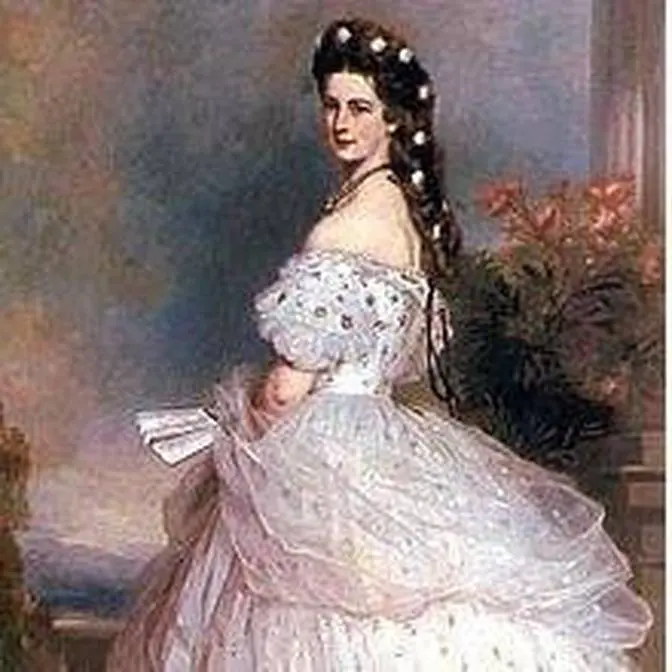
In the mid-century, with the great bell-shaped skirts at their widest,
a woman might wear up to eight starched petticoats layered one over another, building the silhouette
from the inside out. Some were corded, channels of horsehair or whalebone threaded through the fabric
to hold the skirt at a precise angle. Then, by the 1850s and 1860s, the cage crinoline arrived,
a rigid framework of steel hoops worn beneath the dress, capable of holding enormous volumes
of fabric without the burden of multiple heavy petticoats. The skirts that resulted could measure
several feet across at their widest point. Women had to learn to navigate doorways, carriages,
and stairs entirely differently. Sitting down required planning. Leaning forward required care.
Moving through a crowded room meant everyone nearby had to adjust. The weight of all of this,
the petticoats, the crinoline, the corset, the outer dress, could be extraordinary. And yet,
for a middle or upper class woman in the 1800s, this was simply Tuesday. It was simply getting
dressed. The effort was invisible, as so much of women's labor has always been. By the 1870s,
the crinoline had given way to the bustle, a padded structure worn at the back concentrating
volume behind the hips, pulling the front of the skirt flat. The silhouette changed,
but the weight did not lessen. The expectation did not soften. And through all of it, the woman
dressed. A woman's dress in the 1800s was not simply a matter of taste, it was information.
The quality of her fabric told observers her income. Cotton muslin for the modest, silk and
brocade for those of means. The cut of her sleeves told them the decade. Wide puffed sleeves placed
her in the 1830s. A tight sleeve with a small puff at the shoulder said 1890s. The presence
of black dye signaled mourning, and Victorian mourning codes were precise. A widow was expected
to wear full black for at least two years, moving gradually through half morning shades of gray,
lavender, and white before she could return to color. Even grief had a dress code. Working women
dressed entirely differently out of necessity. Factory workers, domestic servants, and women
who labored in the fields could not be encased in cage crinolines and trailing silk. Their clothing
was simpler, shorter, and darker, built for movement and for the reality of physical work.
And yet they were no less subject to the expectations of modesty and propriety.
A woman of any class who dressed improperly risked her reputation, which in that century
could cost her everything else. There was also the matter of what you wore in public versus at home,
in the morning versus the afternoon, for a walk versus for a visit. By the later decades of the
century, the rules governing appropriate dress for women had become extraordinarily complex.
Morning wear featured high necklines and long sleeves. Afternoon clothing opened slightly at
the neck. Evening wear bared the chest and arms. A woman who got this wrong was noticed. A woman who
ignored it entirely was judged. All of this without a single word being spoken. By the close of the
1800s, something was beginning to shift. Women were entering the workforce in growing numbers.
The bicycle, widely popular in the 1890s, gave women a reason to demand clothing they could
actually move in. The Rational Dress Society, founded in 1881, argued publicly that corsets
and heavy skirts were not only uncomfortable, but physically harmful, preventing women from
breathing properly, damaging their internal organs, and limiting their ability to work and move freely.
They were largely mocked by the press, but they were not wrong. The clothing of the 1800s was,
in many ways, a physical enactment of the roles women were expected to inhabit.
It immobilized, it signaled status, it required assistance, it communicated obedience,
and in fighting against it, in the slow movement toward looser waists, shorter hems, and more
practical silhouettes, women were also, quietly and persistently, fighting for something else
entirely. We look back at those gowns now and often see beauty. And there was beauty in them.
The embroidery, the silk, the precision of the construction. These were extraordinary works of
craft, made mostly by women's hands. But inside each one was a body that had to negotiate its
weight every single day. A body that woke before dawn, reached for a thin cotton chemise,
and then built itself, layer by layer, into the shape the world expected.
Some things have changed enormously. We move freely. We choose our own silhouettes.
We dress ourselves in the dark in three minutes without a second thought. But the idea that a
woman's appearance is a statement about her worth, that has not fully left us yet, if there is a time
and place you would like to see reconstructed next, a century, a country, a moment in women's
history, leave it in the comments. There are so many mornings left to enter.