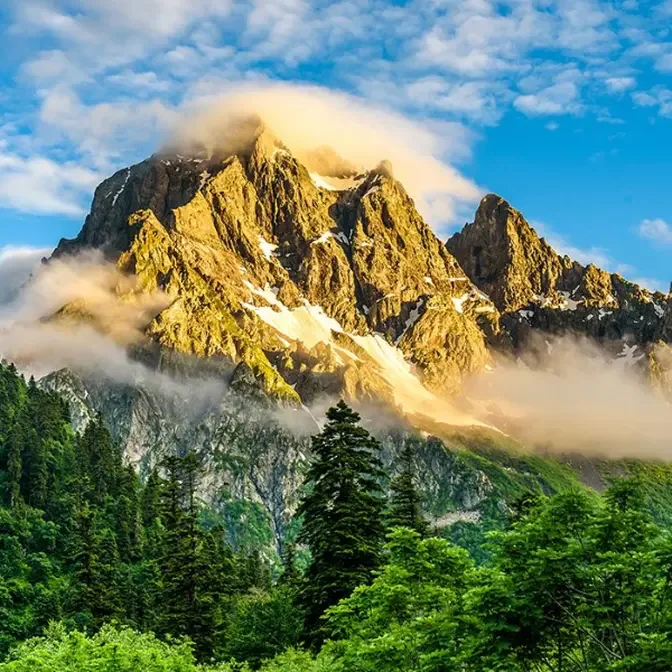
I boarded a Hi Fly A340 chartered for White Desert Antarctica (Tour Operator) to fly to the seventh continent; Antarctica. The flight time from Cape Town to Wolf’s Fang Runway in Antarctica is 5 hours and 15 minutes. Flying from 33 degrees South to 71 degrees South in latitude. Commander Carlos Mirpuri explained the Antarctic flight operating conditions and requirements.
During the flight, the founder of White Desert Antarctica Patrick explained what to expect in Antarctica. As we flew closer to Antarctica, passengers changed to winter clothing and got ready for the exploration. The Antarctic season is from mid-November to early February every year.
The weather condition was good with clear visibility for landing at Wolf’s Fang runway. The runway friction index was also sufficient to allow the airplane to stop during braking. Our A340 landed at Wolf’s Fang runway (71º 32’ 00” S 8º 50’ 00” E) around 1930 UTC time. I was lucky to observe the Antarctic landing from the jumpseat.
The runway length is 2500 m (8200') long and 60 m (196') wide. Wolf’s Fang Runway is operated by White Desert Antarctica and it’s the only blue ice runway. It takes 22 hours to groom and prepare the runway for every jet landing.
After landing, we climbed a nearby Nunatak (small mountain) and were just amazed at the pristine landscape; the white desert! The sun never set during the Antarctic summer. I also visited the newly opened Echo Camp for refreshments before the flight back. Certainly one of "The Greatest Day" in my aviation and travel memory!
For more information on Antarctica tour, visit white-desert.com
Today flying to the last continent, Antarctica.
Well I haven't flown the A340 for some time.
We touch Antarctica. What I mean by that is this is the seventh continent. It's the highest,
driest, windiest continent on the planet. Today we have minus eight degrees Celsius
which is acceptable. Two thousand five hundred fifty forty. My first time set my foot in Antarctica.
It's 10pm but it's all daylight here. Mars or somewhere.
Just stepped on board the A340. This cabin looks quite familiar if you're an Emirates frequent
flyer. You know what I mean right? You probably guessed it where this A340 come from. So actually
our flight was delayed from yesterday because I think due to weather conditioning in Antarctica
they need to make sure the weather is clear and the wind is calm for the aeroplane to land.
I was told the flight has about 40 passengers only so it's very comfortable
low for everybody to stretch out.
Very good afternoon Sam. It's very nice to have you on board. Here we are again for another flight
to Antarctica and we are today three in the cockpit as usual because of the extended duty time.
Captain Damien Volsus, First Officer Yuri Innocencio will be doing the takeoff and the
landing here in Cape Town and I will be handling the aeroplane during the landing and takeoff from
Wolfsbank. The flight time today is five hours on the way down. We have pretty good
tailwind component today and about five hours and 30 minutes on the way up.
We need to be good visibility like a visual flight rules to land there?
Of course we need to be in visual contact because there is no electronic navigation
aids in Wolfsbank and that means that we need to be in visual contact with the runway
and otherwise we cannot land. Therefore the forecast needs to be in such a condition that
we will have a high degree of probability to be able to land there. That means not only in
terms of wind component, in terms of visibility and also and most importantly in terms of
temperature because the colder the better the runway.
Well I haven't flown the A340 for some time. What a view from the window seeing the tiny
engine. Before engine for long haul for a trip to Antarctica you want to be a redundancy and
this aeroplane not only carry passenger, it carry cargo as well and enough fuel
to be able to come back as well. So A340 is a perfect choice for the Antarctica.
So we took off around 4.30 and four hour and 45 minutes to go and I think by the time we land
it's 9.30pm. It's still going to be light because I believe there is no sunsets in Antarctica during
the summer. So let's see how it goes. Hi guys I'm Yuri. I'm your first officer today. I'd like to
give you some information. Right now we are cruising at flight level 360. We are flying on
class G airspace so it's an uncontrolled airspace now. As you can see we are flying at random foot.
We created waypoints here and we are flying next waypoint will be 40 south, 014 east then
will be 45 south, 013 east. So from 5 to 5 south we have a waypoint and then even for our approach
we created here the runway and 10 miles point final and 8 miles, 6 miles, 4 miles until the
runway threshold. With me is Patrick. He's the founder of the White Desert and I've got a few
questions for you about Antarctica. So the first question is we're landing on the runway. The name
is Wolfsfang runway. Where does the name Wolfsfang come from? So Wolfsfang comes from this iconic
mountain that sits just at the end of our runway. It was named by the first Norwegian
explorers. They called it Ulvetana which basically means Wolfsfang obviously in Norwegian but it rises
1.2 kilometres straight out of the ice cap and it's like this beacon that leads us down onto
the runway. It's amazing. This mountain looks exactly like a Wolfsfang. There's no better name
for it and you see it nearly 200 kilometres away because the air is so pure in Antarctica
and it just dominates our entire camp and our entire runway. What do you expect to see on a one
day programme to see Antarctica? We touch Antarctica and what I mean by that is there's
the seventh continent. It's the highest, driest, windiest continent on the planet. It is a really
rare place even now in 2022 to get to. On the programme you're exposed to this extraordinary
landscape. It's like nothing else on earth and while we've only got three hours on the ground
we go up to this high point to get this extraordinary views. The views are like nothing
else on the planet. In fact it's as close as getting off the planet as you can be without
actually leaving earth. People want to go further to the geographic south pole. How do you get there?
So the geographic south pole is the lowest point on earth. It is still incredibly difficult to get
to and we use a plane called a DC-3 Basler. So this is the old 1940s DC-3 but it's undergone
the Basler conversion with turboprop engines and new avionics and it's basically a completely
rebuilt aircraft. And in this plane we fly five hours to a refuelling stop that we've put in at
83 degrees south and then another two hours to get to 90 degrees south, the lowest point on earth.
And at the lowest point on earth you can walk around the planet in a couple of paces.
There's no more east, south or west. The only direction on the entire planet is north.
So it's a really special place to get to even now. So on this flight I have Peter and Skok joining
me, the two South African men here. And they have a very funny story how they win a ticket to get
on board this flight. I ended up auctioning and being against my mate here, Skok. Skok is here.
So you two were bidding against each other to get this charity auction ticket? We did.
Exactly. If I just look backward from my table I would see that it was him. So we could actually
stop the being, bantering, going against each other. But nevertheless, so here we are.
He outbid me and then I equalled and got a ticket as well. And here we are on our way.
The most important thing is it went for a very good cause. The JAG Foundation,
which will help thousands of children in South Africa. So that's the most important thing.
Okay Sam, we are now at 36,000 feet, approaching 65 degrees south.
With true reference to guide us on Eddings. And we'll be landing in one hour. By this time we
should be able to see some icebergs down there. However, there's an overcast layer of clouds over
the sea today and we can't see much. Let's wait until we get closer to the coast if we see some
terrain features that would be interesting. Ladies and gentlemen, we'll be landing at Wolfspang
runway in approximately one hour and advise you to start changing into your forward gear.
We will shortly start forward the cabin temperature. Thank you. You need to go get
changed. We are landing soon. Imagine we flew from 33 degrees south down to 71 degrees south.
Imagine the temperature change from let's say 25 degrees today and came down to minus five
the Wolfspang runway. So putting my second layers on now. What's up Sam?
I got my thermals on down here. Here. Second layers on. Layers. You started sweating.
Started sweating. Getting ready. We're very fortunate, very excited to be here,
going to Antarctica. You know, it's going to be an exploration. We're going to be the first people
to set foot in certain areas of Antarctica. One of our main concerns is that we don't like the
temperature too high. It makes the runway too soft and it's not good for braking capability.
So the hottest the temperature of the runway, the worse the braking. So today we have minus
eight degrees Celsius, which is acceptable, but when it starts going above minus six,
then we stop operating because runway conditions will not be sufficiently guaranteed for the
braking that we need. 2,500. 1,020. Retard. The time is 9.54pm. We just landed at the Wolfspang
runway, 71 degrees south. It's hard to describe because I literally went speechless. It's my
first time landing on ice and the ice felt so thick. The captain told me it's 1.4km thick
to sustain the A340 and it feels like landing on asphalt. It's just so solid and it's just
the scenery taking my breath away. Just the scenery is out of this world. I've never
landed at the airport with this kind of scenery. Okay, we are parked at the gate. It was an amazing
trip, an amazing approach, always challenging. It's always a different type of approach every
time we come here. Not always the wind is the same. Today we had strong tailwinds,
quartering tailwinds down to 500 feet and then crosswinds of about 15 to 20 knots on landing.
It was an uneventful landing. We used 2,000 meters as planned. We used the first starting
pair to make a 180 degree turn back to the ramp and here we are. Our latitude is 71 degrees
30 minutes south and 8 degrees 46 minutes east and the elevation of Wolfspang is 3,650 feet
and this runway is an amazing experience for any pilot, any aviator to land on.
Every time I come here, I'm always thrilled, always
overwhelmed. Are you guys ready to trek? Let's do it. Yeah. Thank you.
Wow, it's amazing. It's my first time setting my foot in Antarctica.
It's 10pm but it's all daylight here and also we have a bachelor. You see the little DC-3
behind. That's going to take people to the geographical cell pole inside Antarctica.
So Wolfspang runway is made on glacial ice which is formed by compressed snow.
So it's not like when you melt water and refreeze it. It's made under compression
and the way it's formed, it gives it great toughness. Its fracture toughness is much
stronger than that of normal ice which is formed by freezing water and that's one of
the reasons why it's a good surface to land a plane on. So we will climb like 100 meters
either in front of us. Just in front of us. This one. It looks pretty easy right? It's a short one.
How are you my friend? I'm so good man. I can't recognize you man. Hey. I can't recognize you.
Yeah. Everyone's doing good?
You're shocked? You're shocked? Doing good?
Doing good? Okay here we go. We're going to climb.
We're walking up this hill with a bit of snow and lots of stone here and you can see we came
from quite a long way. In the distance you can still see the Airbus 340 there but the wind is
blowing. It's quite hard. Good job. Good job. You know? Almost on the top. The top is just over there.
You feel good? Yeah. It's not easy with the wind. What I enjoy the most is when I got up here to the hill
be silent and just listen to the wind blowing. It's all silent and all white in front of me.
In the foreground behind the camera you'll see a very jagged mountain. Very tall and a very weird shape.
All white like a tour in a white desert.
This is one of a kind. I can't believe I finally reached Antarctica. I never thought about it even
in my wildest dream. After the trekking we came downhill. Finally there's a car to come pick us
up. We're going to have a drink and a picnic. Look at all this little house here. We're on Mars or
somewhere. So where do the ice come from? There's plenty of ice right? Yeah.
Well life is hard isn't it? Nice food, nice drink. I think I can live here for a week at least here.
So we are on the ecocamp and you can see the sun. It's midnight now. The sun is still there. Yes.
Midnight sun. All the time yeah. And it's not going down? No going down. Just going up.
Going up again later during the day. All the time you have light in this place.
Had a short taste of Antarctica. That was wonderful. Now coming back to the return flight.
We are starting to taxi off the blocks at 2235.
Very good morning ladies and gentlemen. This is your commander speaking.
Welcome aboard. We are now lined up on runway 17. We're ready for departure. It's going to be a
southbound takeoff with a right turnout on course to Cape Town. Our cruising altitude will be 41,000
feet. That's approximately 12,200 meters. And the weather is fantastic. Cape Town is showing a
temperature of 24 degrees Celsius at this time. And the flight time will be 5 hours and 35 minutes
if possible. Thank you very much. What's the experience like today for you? Fantastic. It's
a unique once-in-a-lifetime experience. A very unique setting. And to see the never-setting sun
was fantastic. So a really unique experience I can recommend. It's 1.15am. It's still bright.
Very strange isn't it? We're still in Antarctica on the way back 5 hours to Cape Town. The sun
eventually set as we flew away from Antarctica. But a full bright moon shined on our way back.
After 5 hours, we reached the shore of Africa over the Cape of Good Hope. I hope you enjoyed
the trip together with me. Next year, I'm looking to lead a private trip to Antarctica
to relive the experience again. Thanks for watching.
100. 50. 40. 30. 20. Retard. 10. 5.