
The Combat Camera
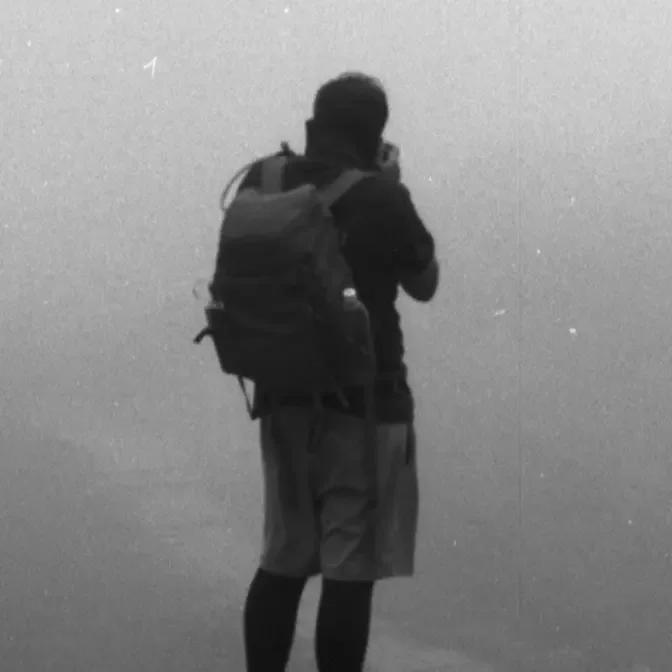
Feb 20, 2026
Start your free trial at http://squarespace.com/grainydays and use code GRAINYDAYS to get 10% off your first purchase.
prints: https://graincheck.darkroom.tech/
podcast: @mamiyamigos
instagram: @50_shades_of_jason
substack: https://substack.com/@grainydays
tunes: http://share.epidemicsound.com/grainydays
business inquiries: [email protected]
Today's episode is sponsored by Squarespace.
Hey, what's up?
Cool, I don't care.
Well, here's the video that I never thought I'd make,
because it's not often in life that you get second chances.
You may recall a video I made about two years ago
where I talked about this huge green wartime rangefinder camera
called the Graflex KE4
that I purchased in the hopes of adapting it to shoot 120 film.
Perhaps a foolish endeavor overall,
it didn't really get too far before the camera took a sh** on me.
German sh** the porn style.
The TLIDWYSV is that I sent it off to a repairman
who had it for about a year or two before his untimely passing.
And well, I was never able to track down what happened to the thing.
Until now.
I'm just gaslighting you.
This isn't the same Graflex KE4.
A very kind individual named Dylan who had seen the video
reached out and asked if I'd be interested in
using his Graflex KE4 kit for a little reunion tour.
Kind of surprising to me that there's still iterations of this camera out there that
still function.
This camera was made in the 50s
and rumor has it only 1500 of them were made.
Most of which are now being sold as, I guess,
shells of their former glory.
Which I can relate to.
With a little bit of hesitancy
because I didn't really want to be responsible
for breaking another one of these Vietnam era wartime relics.
Dylan did assure me that he has the ability to fix these
should a problem arise.
So yeah, I guess maybe it's fine.
And yeah, I guess if I did drop the camera
it would sooner shatter every bone in my foot
than, you know, cause damage to the camera.
So ultimately I said yes to a fateful reunion with this beast
and I received the full olive drab
Halliburton KE4 signal core case in the mail.
Which probably pissed off my mailman
because it's heavy as f**k.
Inside the kit was the camera with the 102.5mm Kodak lens.
Basically the nifty 50 for the system.
There was some Panatomic X film,
some Tri-X,
some empty 70mm cassettes,
an old military card,
flash unit,
which was probably one of those old,
you know, magnesium bulbs that explodes and blinds everyone.
I don't know, I didn't use it.
And finally the Kodak 205mm lens
that looks like Optimus Prime's dong.
Though sadly the trifecta of lenses was not complete.
There was allegedly another lens made for this system.
It was the wide angle.
It's a 63.8mm I believe.
But it's kind of the stuff of folk legend as far as I'm concerned.
I've never seen one pop up, well, anywhere.
I think it was Kodak's attempt at a practical joke.
Whatever, let's get down to it.
This camera natively shoots something called 70mm film.
More or less a dead format for photography these days.
It's just slightly larger than 120 medium format film.
It was a professional format though.
70mm was shot on the moon.
Or the holographic projection of the moon over the flat earth disc.
Whatever you believe.
Doesn't f***ing matter to me.
And they might have even been shooting 70mm
while they were shooting your school photo for the yearbook
because you could technically load up as much film as you want into these cassettes.
The Graflex KE4 even has a slicer in it
in case you want to cut the film early.
Or in case you're marooned in the jungle and surrounded by the enemy and need a weapon.
So I grabbed my dark bag and gave loading 70mm a spin.
Actually several spins.
I loaded up something like 8 feet of Tri-X into the cassette for the road.
It's something like 28 shots or so.
Loading the camera is easy.
Actually, that's a lie.
It is not easy.
You have to withdraw some film.
Clip it to another spool inside the cassette.
Assemble the cassette and then plop it in with tension.
Physical tension, not sexual.
I can't really imagine trying to do all this s***
while you're being shot at on the field of battle.
But I guess my generation is just soft.
With that done, praying to the analog gods that the emulsion side of the Tri-X was facing the lens,
I had some chili and ribs and coffee for breakfast that morning
with everyone's favorite, David, who would be joining me up the road that day.
I'm not going to be able to get it all in frame.
But this might actually work okay.
This light meter app only has 140.
It doesn't have 160.
That's whack.
Is that a pano camera?
It's like a 6x9 F11 1250, which is 1 200th.
Well, thankfully, the expired Tri-X wasn't too cooked, I guess.
And smoking it with more light than it needed proved to be the trick.
Developing this stuff was going to be a bit of a task, though.
I figured I couldn't ask any traditional Dippin' Dunk or Jobo-based labs to do it.
Like I said, I parsed out about 8 feet of 70mm film.
And 35mm film is about 5.5 feet long.
So that extended roll probably wouldn't fit into any common use lab developing tank.
But then again, I don't know sh** about developing.
I reached out to the homie Colton here in LA, who operates Analog Abduction.
And he said he'd give it a whirl with some special equipment that he ordered.
So a huge thank you to Colton for taking this job on.
And I think he developed an HC-110 for those of you that are curious.
Good lighting.
All right, moving on.
We didn't really get super far before we popped out for a quick photo.
After all, we were on the hunt for some downright filthy bangers.
Additionally, in the suitcase that was starting to create a dent in my trunk
were some filters that fit the weird lens thread on this system.
Among them was a yellow filter, a green filter, an infrared R72 filter.
That's cool.
And of course, a red filter.
I figured it was sunny and quite blue out there.
So let's bring out the drama with the late stage STD red filter.
Scanning this sh** was a nightmare as well.
It wasn't very convenient.
In fact, the word convenient wasn't even in the room with us.
70 mil is larger than 120.
So I had to use my 4x5 holder and sandwich the film between two A&R glass plates
because Tri-X curls more than me in the fetal position next to the toilet.
And yeah, so I did each frame one at a time.
And yeah, it was a huge thorn in my ass and took me all evening.
But realistically, it's not like I had any plans on a Friday night anyway.
With some vibrant popping yellow coastal flowers on the scene,
I decided to nuke all the color completely
and shoot some more haunted-ass crushing black and white.
The Graflex KE4 is a rangefinder supposedly inspired by the Contax II.
I mean, the engineer was brought over from Zeiss Icon to work on this.
So clearly he had a thing for rangefinder-based triangulation.
Not saying it was a sexual thing, but hey, maybe.
Anyway, usually rangefinders are a little more compact than SLRs and other styles of cameras.
But not this one, mother****er.
This thing is a beast built to withstand combat.
It makes the Pentax 6x7 look like one-ply toilet paper.
It's got shutter speeds that go all the way to 1,500th of a second.
And the Kodak Ektar 102.5mm lens is quite good for a 70-year-old, you know, piece of glass.
It's the same one that I had adapted to my Hasselblad X2D II.
And you know what?
It flares up on digital worse than my aching tentacles.
This camera is also an underground street photography beast.
I mean, it can be done for sure.
This photo of this gentleman resting up isn't too bad.
But generally, no.
The camera is huge and loud.
The antithesis of stealth street photography.
Someone might think they're literally being attacked if you fire it off next to them.
Anyway, with the fort's cannons pointed at the ocean because,
I don't know, I guess they were afraid of a potential fish invasion.
I took this shot and I like it.
Pretty simple and good dramatic lighting.
There's no light meter on this thing, so you got to go third party with it.
Or maybe just develop a technique to guess the intensity of light based on
how much of a sunburn you're getting.
What's really cool about this camera is that it's a fully mechanical camera that runs on diesel gas.
Just like my LS400.
I'm kidding about the camera.
It actually runs on you cranking the sh** out of this lever underneath the body.
At full wind, it can get about eight shots off in a row if my memory serves me.
When you smash the shutter button, conveniently located where your thumb might go,
not only does the camera fire the shutter, but it also advances your roll to the next shot.
I do wish more cameras had this clockwork spring motor drive technology,
but maybe the tech wasn't super reliable or something.
I don't know.
With the light growing more angled, we arrived at our final location for the day.
A lighthouse that Freud himself would have a field day with.
I swapped out the red filter for a yellow filter as well.
This camera takes images that I think are close to what 6x9 delivered on 120 medium format.
I did crop a lot of these to a 3.4 aspect ratio for a couple of reasons.
There was some degradation on the expired film that was just easier to crop out sometimes.
Some shots also had light leaks.
And the camera has this internal mechanical frame counter thing that imprints onto the image and
overlaps part of the corner of the negative.
Of course, I think I just work better in that aspect ratio as a whole.
Anyway, with the evening light, a beautiful golden orange fit for some beautiful color film,
I continued to capture it on Kirsch grainy ass black and white.
While I generally close the lens down to get more things in focus,
I wanted to see what this lens could do wide open.
So here's a terrible photo of an old fence post that will soon become driftwood,
or maybe even a pirate's peg leg someday.
And here's a picture of the pano goat himself, David Amell.
But speaking of goats,
let's take a minute and thank the goat of building websites and today's sponsor,
Squarespace.
There's a good chance you've heard of the award winning Squarespace before,
but did you know the team behind the website building powerhouse recently
implemented a bunch of tools that utilize groundbreaking AI to custom build the
website of your dreams?
Tools like design intelligence, which utilize revolutionary artificial
intelligence to not only perfect, but personalize your new website
down to every last cutting edge detail.
Are you a photographer like me looking to show off your work?
Get started doing so with hundreds of professionally designed templates.
Time to take your work a step further?
Great.
Sell some prints and use Squarespace's own AI to power things that are normally
kind of a drag to do yourself, like product and video descriptions,
as well as email campaigns.
It's designed to take some of that load off when crafting your new website
workspace to allocate other resources like time and critical thinking to other
more important components of your online presence.
And on the topic of selling products,
Squarespace even features preset payment infrastructures to start the flow of
economy to you in exchange for goods or services.
If you've ever dreamed of making profits,
Squarespace has you covered with payment methods such as Klarna,
Direct Debit, Apple Pay, Afterpay, and even Clearpay.
So what are you waiting for?
If you're ready to build a website, you can start a free trial today at
squarespace.com slash grainy days.
And if you use the code grainy days at checkout, you can get 10% off your first
purchase.
And that was about it.
It was closing time and the light was out the door for the day.
Like me promptly fleeing my desk at 4.58 PM.
Whatever.
I got some work that day that I actually quite like.
But damn, do I regret not taking a mirror selfie with this thing for street cred.
Graflex KE4 is very cool, but I'm not a war correspondent.
So I probably don't really need one myself.
Realistically.
It also comes with some problems in the form of 70 millimeter film.
While that format does allow for more customization,
it is not quite as convenient as 120 film is.
And it's not really like they're making 70 millimeter film anymore anyway.
Well, actually, I guess Kodak still makes IMAX stock and you might be able to get
some black and white through Ilford's special formats program.
So maybe I don't know what the I'm talking about.
I see why people don't watch my videos sometimes.
I'll probably never see my own Graflex KE4 ever again, but it's totally fine.
Or at least that's the lie I tell myself.
I felt like I finally got the closure on it that I needed
and can let that dark part of my past go.
I mean, I guess I could have just gone to therapy about it,
but dragging out my trauma all these years was pretty good too.
Anyway, this copy of the Graflex KE4 and all the 70 millimeter film
is on its way back to Dylan.
But rest assured, when World War III starts tomorrow,
I'll be sure to buy another one of these,
slam it down on the recruitment table and tell them I'm ready to shoot some f***ers.