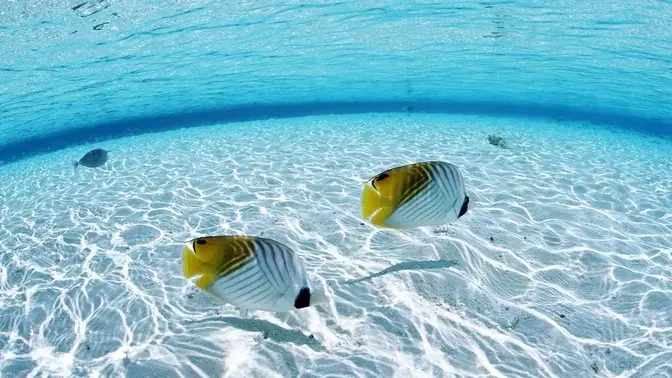
The deeper you dive into the ocean, the stranger, darker, and more terrifying the creatures become. Bright, friendly reef fish disappear and are replaced by nightmarish predators with giant teeth, glowing organs, and bodies adapted to extreme darkness and crushing pressure. In this video, we explore why deep-sea animals evolve such creepy features — from the hatchetfish with upward-facing eyes, to the ultra-black dragonfish, to the horrifying anglerfish, and the deepest fish ever found: the snailfish. Every adaptation in the deep sea has a purpose — survival. From invisibility to bioluminescence to massive jaws, these bizarre creatures reveal the secrets of evolution under extreme conditions. Dive with us into the Midnight Zone, Abyss, and Hadal Trench to uncover the science behind the scariest creatures on Earth.
If you ever dared to dive toward the bottom of the ocean, you'd quickly notice something
unsettling. The friendly, colorful fish near the surface, the ones that glide peacefully around
coral reefs, slowly begin to vanish. In their place appear creatures that look like they belong
in nightmares. Their teeth grow longer, their eyes drift into strange positions, their bodies twist
into unnatural shapes, and their behavior becomes increasingly bizarre. It's almost as if the ocean
intentionally hid these distorted creatures in the abyss, far away from everything else.
But here's the most shocking part. In the deep sea, these freakish adaptations aren't exceptions.
They're the standard. Down there, the weirdest creatures survive, and the normal-looking ones
fade away. To understand why the deep sea produces such intimidating monsters, we need to understand
a simple truth. Nothing in nature evolves for fun. Every creepy trait serves a purpose.
Consider the clownfish. Cute, colorful, and harmless. But those bright stripes are actually
a warning. Don't eat me. I live among stinging anemones. Their appearance, although adorable
to us, is a survival strategy. That's survival of the cutest. But deep underwater, cuteness
becomes irrelevant. There is no sunlight to illuminate bright colors, no coral reefs to
camouflage with, and no predators that care about visual warnings. So the evolutionary rule flips to
survival of the creepiest. The stargazer fish is a perfect example. It looks like a creature
stitched together in a lab gone wrong. Its eyes stare upward from the top of its skull,
and its entire body remains buried under sand, like a living landmine. Only its eyes and mouth
peek out, waiting for unsuspecting prey. This fish doesn't need speed or stealth. It only needs
patience and a terrifying design. It waits still, hidden beneath the sand, until prey passes close
enough for its ambush. One quick chomp, and the victim disappears into the sand. But the stargazer
is only warming up the nightmare. Deeper down in the twilight zone, sunlight fades into darkness,
leaving the water dim and ghostly. Colors lose meaning here, so fish abandon bright hues for
silvery bodies, transparent skin, or total blackness. The hatchetfish, named after its
blade-like body, is one of the twilight zone's strangest residents. Its enormous eyes tilt
permanently upward, unable to stare at predators coming from below. Instead, they scan for silhouettes
above, creatures swimming in the faint leftover blow from the surface. Every second spent looking
down here can mean life or death. To stay invisible, the hatchetfish uses bioluminescence in a clever
way. It glows from below to erase its shadow. Predators looking up see nothing but darkness.
Nature has sculpted this fish into a floating ghost, one whose entire existence is based on
avoiding detection. But deeper into the twilight zone lurks the viperfish. With fangs longer than
its head, a hinged jaw, and a mouth that glows like a lure, the viperfish behaves nothing like
the timid hatchetfish. It launches at anything it thinks is edible, even if it's not. Though only a
foot long, its long teeth and translucent body make it one of the ocean's most iconic monsters.
Strangely, the viperfish's body is covered in a unique gel-like layer instead of scales. This
helps it move silently and remain nearly invisible. But the viperfish is not the stealthiest creature
in this realm. That title belongs to the pacific black dragon, a fish so dark that it absorbs 99.95%
of light. Even other bioluminescent creatures cannot reveal it. Its skin is made of tightly
packed melanosomes, light-absorbing structures that trap and kill any photon that dares to strike it.
This level of stealth is almost unmatched in nature. It is the closest thing to a biological
black hole ever discovered. Yet even the dragonfish cannot prepare us for the horrors
waiting deeper below. In the midnight zone, sunlight disappears entirely. Total blackness
surrounds everything. Here, creatures must make their own light or embrace complete invisibility.
This is the home of the infamous anglerfish. With its glowing lure dangling from its forehead and
jagged teeth stretching outward like needles, it is the deep sea's poster child of monstrosity.
Despite looking terrifying, anglerfish are surprisingly small, often just a foot long.
Their teeth are designed to trap small prey, not pierce larger bodies. The real danger isn't the
fish, it's the depth at which it lives. Further down, the stoplight loose jaw literally unhinges
its face. Its jaw isn't attached to the rest of its skull, allowing it to snap forward like a
bear trap. Its eyes glow red and green, colors most deep sea animals can't detect. This means
the loose jaw can spotlight prey like a sniper without revealing its location. But the midnight
zone's strangest creature might be the black swallower, a fish capable of swallowing prey
twice its length and ten times its weight. After a meal, its body balloons into a grotesque sphere,
stretching beyond recognition. The swallower becomes so bloated that it often struggles to
swim, drifting upward accidentally. And yet this design allows it to survive weeks without food,
critical in a region where meals are rare. The deeper we go, the more it becomes clear the ocean
punishes any creature that cannot adapt. Up here, survival belongs not to the strongest or the
cutest, but to the strangest. What lies below the midnight zone is the abyssopelagic zone,
appropriately nicknamed the abyss. This is where the ocean floor stretches across most of Earth.
Pitch black and freezing cold. Here, creatures develop adaptations so extreme they border on
unbelievable. One of the strangest abyssal species is the wonderfish, a type of anglerfish whose
bioluminescent lure isn't on its head, it's inside its mouth. Prey swim toward the glowing light,
unaware that entering the light means entering the fish's jaws. Unlike other anglerfish that
dangle lures like fishing rods, the wonderfish keeps everything internal. Scientists believe
the reason for this bizarre placement is the absolute darkness of the abyss. A lure on the
head would cast faint shadows, but inside the mouth, it's invisible until it's too late.
Deeper still, standing motionless on the ocean floor, are the tripodfish, one of the strangest
evolutionary outcomes on the planet. These fish balance on three elongated fin rays that act like
stilts, each as long as their entire body. They don't walk, run, or swim much. Instead,
they stand in place for hours or even days, allowing the slow movement of water to bring
food to them. Movement wastes precious energy in a region where life barely holds on, so evolution
solved this problem by turning the tripodfish into a living fishing pole. Its fins are so sensitive
they can detect vibrations of tiny animals drifting past. With a quick lean forward,
it snatches them. Even stranger, tripodfish are both male and female simultaneously.
Because the abyss is so sparsely populated, finding a mate is nearly impossible,
so they simply fertilize their own eggs. After hatching, the babies drift upwards into shallower
water to feed, before slowly sinking back into the abyss as adults. Their entire lives are spent
in isolation, standing still on stilts, surviving in silence. But the abyss is not the final level.
In certain parts of the world, deep cracks in the ocean floor form trenches,
places where the sea drops even further into darkness, so crushing that almost nothing
survives. This realm, known as the Hadal Zone, extends into the deepest known point on Earth,
the Mariana Trench. Inside this alien environment lives the deepest fish ever recorded,
the snailfish. Unlike the vicious predators above, the snailfish looks like a soft gelatinous blob.
Its body has almost no bones, its skin has no scales, it doesn't even have a swim bladder,
because any gas-filled organ would explode under the pressure. The snailfish is the result of
evolution reducing a fish to the bare minimum requirements for existence. Eyes? Reduced to
simple light patches. Mouth? Small and soft since prey is tiny. Muscles? Barely there. Bones? Only
what's absolutely necessary. Everything unnecessary is stripped away. At these crushing depths,
the strongest creatures are not the ones with the biggest teeth or the fastest fins,
they are the ones who can exist with the least. The snailfish is the ultimate symbol of survival
through simplicity. The deeper we go in the ocean, the more nature seems to rewrite its own rulebook.
The creatures become strange, terrifying, or almost alien, not because they're monstrous
by accident, but because the ocean demands it. Every bizarre trait, from glowing lures to ultra
black skin to unhinged jaws, is a masterpiece carved by pressure, darkness, and scarcity.
The deep sea isn't trying to scare us, it's simply showing us what life becomes
when survival must conquer the impossible.