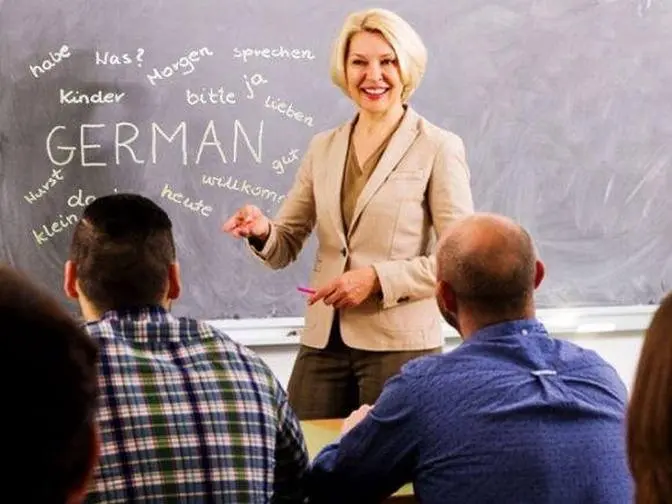
In diesem Video zeigen wir dir 9 alltägliche Phrasen mit dem Verb "haben". Perfekt, um deinen Wortschatz zu erweitern!
🔥 BLACK FRIDAY ANGEBOT 🔥 30 Tage kostenlos am DeutschCampus teilnehmen 👉 zur Anmeldung: https://tinyurl.com/p8e5ctrk
*nur gültig für Neukunden **vom 23.11. - 01.12.25
00:00 Intro 00:51 etwas im Griff haben 02:01 Black Friday Angebot 02:38 einen guten Draht zu jemandem haben 03:41 etwas satt haben 04:38 etwas auf dem Herzen haben 05:56 zwei linke Hände haben 06:46 viel um die Ohren haben 07:44 Schwein haben 08:12 mehr Glück als Verstand haben 09:00 Outro
💬 Wir sprechen in unseren Videos ganz authentisch unsere Muttersprache Deutsch. Wenn es dir zu schnell ist, kannst du jederzeit die Geschwindigkeit des Videos reduzieren oder die Untertitel aktivieren.
🚀 WERDE CAMPUS-MITGLIED 🚀
Dir gefallen unsere Videos und unsere Unterrichtsmethode? Dann werde Mitglied in unserem DeutschCampus! Du bekommst:
💻 4 Onlinekurse für Büro- und Alltagsdeutsch 🗣️ Live-Unterricht in kleiner Gruppe 📱 WhatsApp-Community mit Wochenaufgaben ✍️ individuelle Korrekturen und Feedback
Welcome to this new video.
In today's video we have some phrases with the verb to have for you.
The verb to have is probably one of the first verbs that you learned in the German language
and combined with other words it results in great phrases and phrases
and we want to look at some of them today.
So, let's go!
Before we start with the first phrase,
this video is part of our series called ECHTES DEUTSCH.
Because we want you to learn the real German language
and not just as it sounds in German lessons.
And as always, there is a PDF for this video,
which you can download for free.
Just click on the link in the video description.
There you will find all these expressions, everything we explain here in the video,
nicely summarized again and you can express it to yourself.
Okay, let's start with phrase number one.
And that is
What is a handle?
A handle is, for example, at the door.
The door handle, with which you can open the door.
And that comes from the verb to grab.
What you do with your hand is to grab.
And that is, for example, the door handle.
Okay, and when we come to this phrase now,
so having something in your grip,
that means that you can control something well,
that you have something under control,
that you can control a situation well.
So I'm just thinking of a situation like
I park somewhere
and the parking space is maybe just very, very narrow or something.
And my boyfriend asks me, do you need help?
And then I say, no, no, I have everything under control.
So I get along, I can control the car,
I have the situation under control, so to speak.
And then I say, no, no, I have everything under control.
So I have it firmly in my hand, so to speak.
Nothing can go wrong.
I have a plan, I know how it works.
I have everything under control.
Yes, exactly.
Very good.
At this point, a little note.
Our Black Friday campaign is currently running,
where you can take part in our German Campus for free for 30 days.
During this time, you can work in our four German online courses.
You can take part in our live lessons,
submit tasks and send voice messages
and get personal feedback from Laura and me.
But beware, the campaign period ends on December 1st.
You can find all the information below in the video description.
And now back to the video.
The next expression is to have a good connection to someone.
To have a good connection.
What is a connection?
A wire is a material, I would say,
that can be used for different purposes.
So you can make jewelry out of wire
or fix plants with wire in the garden or something.
So we can show you a picture of what a wire is.
And if I say now, I have a good connection to you,
it means that we have a good relationship.
We have a good connection, so to speak.
We are connected by this wire.
We have a good relationship, we get along well.
You could say, for example,
Peter has a very good connection to his colleagues
or to his boss or something like that.
Right, so maybe also a trusting relationship.
A good relationship.
The next expression is to have something to eat.
Sat means you are not hungry anymore.
So you burst right away, you are full.
And if I say, I have something to eat,
then it means that I have enough of it.
I don't want more, I have enough.
So now, for example, I don't know,
we are now in autumn in Germany,
that means it is also raining a lot.
Then I could say, I am so full of the rain,
I finally want to have summer again, for example.
There is always a bit of frustration.
You are somehow frustrated, you can't stand it anymore,
you can't hear or see it anymore.
Then you say, no, I'm fed up with it.
Yes, exactly.
Then when some politicians or parties
or someone says something all the time,
where you say, I can't hear it anymore,
I'm just fed up with what they say.
Yes, exactly.
So just not being able to bear something anymore,
having enough of something.
Then it goes on with having something on your heart.
I have something on my heart.
Yes, if we have something on our hearts,
then it actually means that something is bothering us.
So we might also like to talk about it,
because it's bothering us,
because we think about it a lot.
Do you have an example?
Well, if I notice you're maybe a little sad
or depressed, then I would ask you,
do you have something on your heart?
Are you busy? Is something oppressing you?
Exactly, so in this context you would use it.
Exactly, you can also ask someone,
what do you have on your heart?
Yes, exactly.
Maybe here's the grammatical hint.
It's the heart.
So why on the heart?
The explanation?
That's a word, the n-declination.
You may know that the n-declination
actually only applies to masculine nouns.
We've already made a video about it.
We can link it to you.
In any case, there is only one exception
in this n-declination, and that is the heart.
Exception, I mean a word that is not masculine,
namely the neutral word, the heart.
And that's why it has to end with en.
I have something on my heart.
Exactly, that means only in the nominative case
it's the heart.
Dative, accusative, the heart.
That's why on the heart.
The next expression is
to have two left hands.
To have two left hands.
So when I ask you, Laura,
do you actually have two left hands?
Then I actually mean, Laura,
how good are you in craftsmanship?
So if someone says,
Person XY has two left hands,
it simply means that this person
can't repair anything himself.
So you often have that in the context
of craftsmanship.
For example, changing a lightbulb
or hanging a picture on the wall.
And if someone can't do that,
then you say, this person has two left hands.
Exactly, someone is clumsy,
someone can't do it.
Yes, because you usually need both hands,
left and right.
And with two left hands,
it's of course not that easy.
Okay, let's move on to a body part,
namely the ears.
And that's the pronunciation,
to have a lot around the ears.
So if you say,
I have a lot around my ears,
then it actually means
that you are very busy, right?
Yes, exactly.
So for example,
I'm working right now
and you call me,
then I say, Laura,
I have a lot around my ears right now,
I'll call you back in a minute.
Yes, so yes,
I'm busy right now,
I have a lot to do,
I have a lot around my ears.
The next expression is
to have something on the box.
To have something on the box.
And with boxes,
you actually mean our head,
so that someone is, for example,
that someone is intelligent,
that someone is smart, clever.
That means,
if someone solves a problem,
then I can just say,
oh yeah,
so she solved it great,
she really has something on the box.
Yes, so someone is very smart.
Smart, clever, intelligent, exactly.
He has something on the box.
Okay, let's continue
with an animal expression.
We're talking about the pig
and the expression is
to have a pig.
To have a pig.
So if you say, for example,
I really had a pig,
or we often say that in perfect,
I really had a pig,
then it means
you were lucky.
Yes.
So maybe you ran to the bus
in the last second
and just got the bus,
then you say,
phew, phew,
I really had a pig now.
Exactly, so just be lucky.
And the last expression is
to have more luck than wisdom.
To have more luck than wisdom.
Luck is clear,
we just had that
in the last speech.
The mind,
that's what you actually mean,
the reason,
so you're reasonable.
And if a person
has more luck than reason,
then this person
actually only has luck or success
although the person
was actually perhaps careless.
So now,
or was unreasonable.
So as an example,
if a person
rides a bike without a helmet,
which is unreasonable,
and has an accident
and does not injure himself,
luckily,
then this person
has more luck than wisdom.
The cyclist
had more luck than wisdom.
Okay, so those were
our speech turns.
Feel free to write us
in the comments
what was new for you
or what you may have already known.
As I said,
you will find the links
to our German courses
to the Deutsch Campus
and also to the PDF.
You can download everything
and read it in peace.
And I would say
see you again
in one of the next videos.