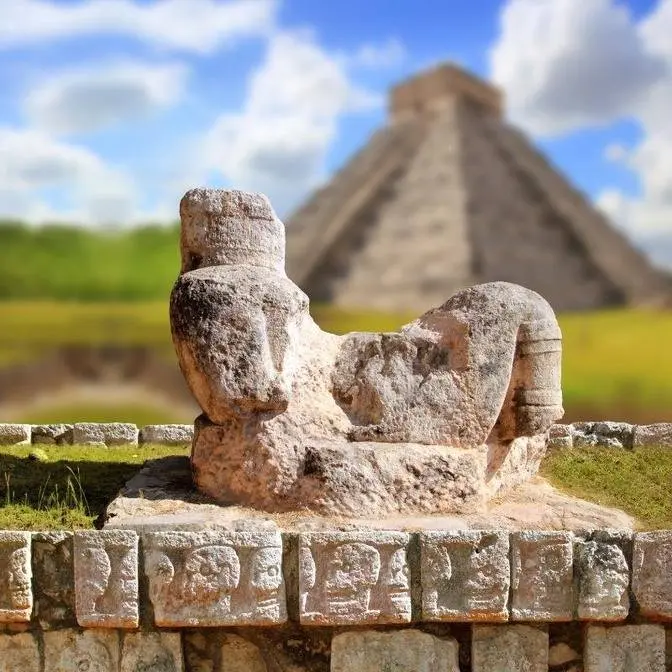
#History#Secrets Step into the fascinating world of Ancient Mysteries 🏛️ and uncover secrets that continue to baffle us to this day. From the construction of the Great Pyramids to the lost city of Atlantis, humanity has long pondered over the ingenuity and purpose behind these enigmatic creations. How did ancient civilizations achieve such remarkable feats of engineering with their limited tools? Were these wonders built solely for religious and ceremonial purposes, or do they hold hidden meanings tied to astronomical alignments? Delve into the unexplained mysteries of the Nazca Lines, Stonehenge, and the Antikythera Mechanism, and explore how modern science is striving to uncover the truth. Discover theories of advanced ancient technology, forgotten knowledge, and even extraterrestrial intervention. Join us on a journey through time as we unveil the enduring puzzles left by our ancestors. The answers might forever change our understanding of the past. By https://www.youtube.com/@HistoryFactsMysteries
History is filled with unsolved mysteries, each one tantalizing our curiosity and challenging
our understanding of the past. From forgotten civilizations to inexplicable artifacts,
these ancient puzzles have perplexed historians, explorers, and adventurers for centuries.
Some mysteries have been solved, but many remain elusive, waiting to be uncovered.
Before we begin, make sure to subscribe to History Facts and Mysteries for more
deep dives into the world's greatest secrets and enigmas.
Hit the notification bell so you never miss a new journey into the past.
The Mysterious Sacsayhuaman Stones. A Puzzle of Precision.
Located in the Peruvian Andes, the ancient site of Sacsayhuaman is famous for its enormous stone
walls, which are crafted from massive blocks weighing many tons. These stones fit together
so precisely that it's almost impossible to insert a blade of grass between them.
The precision of the stonework, combined with the fact that these massive stones were cut and moved
without the use of mortar, has led to numerous questions. The Inca Empire is traditionally
credited with the construction of Sacsayhuaman, but their method for creating such an impressive
structure remains unclear. Some believe that advanced stone-cutting techniques or even lost
technologies may have been involved. Others suggest that the site had religious or astronomical
significance, aligned with celestial events or the movements of the stars. What's even more
baffling is how these stones, which were cut in quarries far away from the site, were transported
to their final location. How did the Incas manage to move such heavy stones across rugged terrain
without the help of modern machinery? The mystery of Sacsayhuaman remains one of the most compelling
puzzles of pre-Columbian America. The Minoan Civilization. The Disappearance of a Powerful
Empire. The Minoan Civilization, which thrived on the island of Crete from around 1450-1400 BCE,
was one of the most advanced cultures of the ancient world. The Minoans are known for their
elaborate palaces, intricate artwork, and sophisticated maritime trade network. However,
despite their prominence, the civilization mysteriously vanished without a trace.
One of the most compelling theories surrounding the fall of the Minoans is the eruption of the
Thera Volcano, which occurred around 1600 BCE. The eruption, one of the largest in recorded history,
may have devastated Minoan cities with tsunamis and ash fall. Some experts believe that this
cataclysmic event triggered the collapse of the Minoan civilization, while others argue that it
was the result of invasions by other cultures, such as the Mycenaeans from mainland Greece.
However, no definitive evidence has been found to explain why the Minoans disappeared so suddenly,
and the true cause of their fall remains a mystery. The absence of written records and the
lack of archaeological evidence have only deepened the enigma surrounding this once-great empire.
The Antikythera Mechanism, The World's First Computer?
In 1901, an incredible discovery was made off the coast of the Greek island of Antikythera,
an ancient shipwreck that contained a complex and mysterious device now known as the Antikythera
Mechanism. This artifact is often referred to as the world's first computer due to its intricate
gears and wheels, which are thought to have been used to predict astronomical positions and
eclipses. The device, which dates back to around 100 BCE, is astonishingly advanced for its time.
It is made up of a series of bronze gears, dials, and inscriptions that suggest it could track the
cycles of the sun and moon, as well as the movements of the planets. The complexity of
Antikythera Mechanism suggests that the ancient Greeks had a level of technological understanding
far ahead of their time, but the precise function of the device remains unclear.
Some scholars believe it was used for astronomical calculations,
helping sailors navigate the seas. Others propose that it was an early form of an
astrological tool used for predicting celestial events and religious rituals.
The Antikythera Mechanism offers a glimpse into the advanced technology of the ancient world,
but its purpose and exact origins remain one of the great mysteries of ancient Greece.
The Lost Tomb of Cleopatra. Where Is She Buried?
Cleopatra VII, the last ruler of ancient Egypt, is one of history's most iconic figures. She was
known for her intelligence, political acumen, and dramatic relationships with Julius Caesar
and Mark Antony. After her death in 30 BCE, the location of her tomb has been a subject
of great speculation and mystery. While it is believed that Cleopatra was buried with Mark
Antony, their tomb has never been found. Historians and archaeologists have long
searched for the final resting place of these two figures, but the tomb remains elusive.
Some believe that Cleopatra's tomb may be hidden beneath the waters of Alexandria's harbor,
while others suggest that it could be located in a now-lost structure or temple.
Excavations in Egypt have turned up clues, such as inscriptions and ancient relics,
but no conclusive evidence has emerged to pinpoint the exact location.
The mystery of Cleopatra's tomb has captivated explorers and archaeologists for centuries,
with many attempting to unearth it in search of both historical and artistic treasures.
However, despite modern-day excavation techniques and technological advancements,
Cleopatra's final resting place remains a secret, adding yet another layer to the enigmatic legacy
of the Queen of Egypt. The Phaistos Disc. A Language Lost to Time.
The Phaistos Disc, discovered in 1908 in the Minoan palace of Phaistos on the island of Crete,
is one of the most perplexing artifacts in the world. The disc is made of fired clay and features
a spiral of symbols that have never been fully deciphered. The symbols are thought to represent
a form of writing, but their meaning remains a mystery. Scholars have proposed various theories
regarding the purpose of the disc, but none have been able to decode the script with certainty.
Some believe the disc may contain a form of proto-writing used by the Minoans,
while others think it could have been a religious or ceremonial object.
The symbols on the disc appear to be unique, with no known parallels in other ancient languages,
further complicating efforts to interpret it. Despite the many attempts to understand the disc,
it remains one of the most intriguing unsolved puzzles in the study of ancient languages.
Could the Phaistos Disc represent a lost language or an unknown system of communication?
Or is it simply an artifact of a lost culture whose meaning will never be fully understood?
The answer, like many ancient mysteries, is still elusive.
The Mystery of the Great Library of Alexandria
The Great Library of Alexandria, one of the most famous libraries of the ancient world,
was once home to thousands of scrolls and manuscripts, containing knowledge from across
the ancient world. Founded in the 3rd century BCE, the library was a symbol of intellectual
and cultural achievement, attracting scholars from all corners of the known world. But in the
centuries following its founding, the library was destroyed by a series of catastrophic events,
including fires and invasions. Despite efforts to preserve its contents,
much of the knowledge contained in the library was lost forever. The exact details of its
destruction remain unclear, and the fate of many of its scrolls and manuscripts is unknown.
The mystery of the lost knowledge of the Great Library of Alexandria continues to
intrigue historians and scholars. What secrets did the library hold? What knowledge was lost
when it was destroyed? The loss of the library remains one of the greatest tragedies in the
history of knowledge, and the mystery of its destruction continues to haunt our understanding
of the ancient world. Ancient mysteries offer us a window into the distant past,
where hidden truths and lost knowledge await discovery. From the advanced technology of the
Antikythera mechanism to the vanished Minoan civilization, these enigmas challenge our
understanding of history and continue to fuel our curiosity. Thank you for joining us in uncovering
these ancient mysteries. If you enjoyed this journey, don't forget to subscribe to History
Facts and Mysteries and hit the notification bell so you never miss another exploration into the
secrets of the past. We'd love to hear from you. What ancient mystery do you find the most
intriguing? Let us know in the comments below.