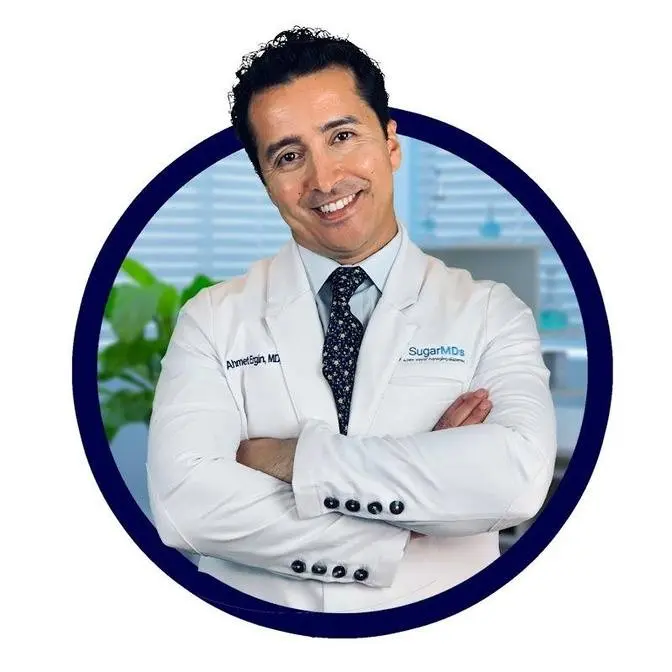
Steroids like prednisone and illnesses such as UTIs, COVID, or infections can send your blood sugar soaring—often making your usual diabetes meds less effective. In this video, I explain why steroids and stress hormones like cortisol raise glucose, block insulin, and trigger dangerous spikes. You’ll learn how to adjust safely with insulin or oral meds, what to watch for during illness, and how to prevent complications like DKA or adrenal crisis. Don’t panic—understand the physiology, monitor closely, and work with your doctor to stay in control.
🔔 Subscribe to the SugarMD newsletter and receive FREE access to ""The Ultimate Diabetes Book"" (eBook & audiobook) and ""Doctor’s Guide To Diabetic Diet"" (eBook).
For those looking to safeguard their health, Dr. Ergin also recommends high-quality B12 supplements available at SugarMDs.com. Stay informed and take control of your health with SugarMD! ____________
🩺 Who is Dr. Ergin? Dr. Ahmet Ergin is an endocrinologist with a particular interest and passion for diabetes care. Dr. Ergin earned his medical degree with honors at Marmara University School of Medicine in Istanbul, Turkey. Then, he completed his internal medicine residency and endocrinology fellowship at Cleveland Clinic in Cleveland, Ohio. He is a board-certified physician in Internal Medicine and Endocrinology, diabetes, and metabolism. He is also a certified diabetes education specialist.
⚠️︎ Disclaimer: Any information on diseases and treatments available at this channel is intended for general guidance only and must never be considered a substitute for the advice provided by your doctor or other qualified healthcare professionals. Always seek the advice of your physician or other qualified healthcare professionals with questions you may have regarding your medical condition.
If you have ever been on steroids like
prennazone or if you have had a nasty
UTI or COVID or a dental infection or
any kind of major stress to your body
and suddenly your blood sugar is out of
control. In this video, we're going to
talk exactly about that because what
most people don't realize is that your
normal diabetes medication routine may
not work during stress or steroid
treatment. But the solution is not to
panic. The solution is to understand
what's happening and know what
adjustments are actually safe and
effective. Let's get right into it. Now,
why do steroids and illness raise blood
sugar? Well, when you take steroids,
especially oral ones like prennazone, it
mimics your body's stress hormone, which
is cortisol. And cortisol is the boss
when it comes to raising blood sugar. It
tells your liver, hey, dump more sugar
into the blood, please. It blocks the
insulin. It tells your fat cells to
store more fat and it makes your muscles
insulin resistant. So now even the
insulin you do have is not working
properly. That's why after starting
steroids, even just for 3 to 5 days,
maybe the next day even, your glucose
can spike through the roof. And guess
what? The same thing happens when your
body is under physical stress like
fever, like infection, maybe even
emotional stress. Your body dumps out
cortisol. Same chain reaction. This
applies to steroid use for asthma,
allergies, autoimmune flares or back
pain, you name it. So, it's commonly
used, right? infection sometimes will do
that without taking steroids, UTI,
pneumonia, COVID, physical trauma or
surgery, even intense anxiety or pain.
So if you have been doing fine on your
meds and then suddenly your blood sugar
is like hitting 250 or 300 after
starting steroids or getting sick, that
is why. So what do you do with your
medications? Let's break it down based
on your treatment type. So, if you're on
insulin, for example, already, here's a
blunt truth for you. You will probably
need way more insulin during steroid use
or serious illness. A lot more. Now, in
my clinic, when someone is on a high
dose of steroids, like 40 milligram of
prenazone or more, I often have to
double their rapid acting insulin like
the Novalog, Himmolok, Fiasp, Blisspro,
Ospart. That's before the meals. Why?
Because steroids hit postmeal blood
sugar hard. Some people also need more
long acting like basil insulin right
too. But meal time insulin is usually
where the biggest adjustments happen. Of
course, you don't do this blindly. You
test often. I tell people check fasting.
Check 2 hours after each meal. Check
before bed. This lets you catch spikes
and act fast. If you are on a pump, for
example, insulin pump, you will probably
need a temporary basil rate increase and
higher bololises. I typically tell my
patients that if you're on a very high
dose of steroid, go ahead and whatever
the pump is telling you, double it up.
And yes, always talk to your doctor
before making major insulin adjustments.
You know, don't just take my advice and
apply immediately, but I'm just giving
you an idea and understanding, you know,
what should happen. Like for example, if
your doctor says, you know, oh, just
take two more units of insulin and then
you're taking 20 units, that is only 10%
increase. And you can question your
doctor like, are you sure that 10%
you're telling me will do anything
because I'm on such a high dose
steroids? Dr. Urgen, Sugar MD said that
he sometimes double the dose. Then they
may like, oh maybe, yeah, maybe let's do
that. You know, to be honest with you,
it's all about experience. So if you
have an endocrinologist, you will
definitely be in a much better shape
when you are getting advice in these
crazy situations. Steroids change the
game quite a bit, right? And most people
need extra insulin to stay in that
range. That is the bottom line. Now once
the steroid is stopped or tapered down,
your blood sugar will usually come down
too. So don't forget that you double the
insulin. Don't stay doubled after the
steroids are over or if the illness is
over. you need to be ready to reduce
that insulin to avoid a low number. And
to do that, you need to be monitoring
very closely. So, if you're on pills,
let's talk about your own pills, right?
You're not on insulin, you're on pills,
you're on supplements only, whatever,
right? Or you're just on lifestyle, you
know, like you're doing everything
great, you don't even need supplements
and you know, and then next thing you
know that they give you steroids and
you're like, "What happened? I was doing
like 90 100, now I'm in the 300s." This
is where people get in trouble. Now
medications like metformin GLP1s like
ozampic monjaro trolicity or DPP4
inhibitors like Genevia or Trogenta
might not be strong enough to fight the
steroid effect and metformin helps with
insulin sensitivity. Yes, but steroids
cause insulin resistance that is so much
bigger and stronger than what metformin
can fix. So popping extra metformin is
definitely not going to do it. So GLP1s
like ozampic or Mjaro you know they will
help a little but again they're not
going to stop the liver from dumping so
much sugar with the steroids as GLT2
inhibitors like jardines or fara yes
they do to lower blood sugar a little
bit but at that point once blood sugars
are hitting 250 nothing these
medications can do for you at that point
and then they can cause dehydration
because they are basically trying to
dump sugar and water with it and then if
you're just relying on that mechanism
then you will be in trouble with
dehydration. So be cautious with those
especially when you're ill. So what's
the best move, right? Well, sometimes
your doctor may temporarily add a rapid
acting insulin just for the steroid
course. So if you're someone who get
prescribed steroids for this and that
all the time, you might as well keep
some short acting insulin at home for
those days. Not for daily use, but not a
bad idea, right? Because it may happen
over the weekend. Doctor may not be
available. You don't want to go to the
emergency room. Now you're stuck. You
don't want to be in that position. If
you do that with the insulin, right? So
just a couple days or maybe a week or
two, a month, whatever you're on,
however long you're on these
medications. That way you're not trying
to force pills to do a job that they
cannot really handle. Now other times
they will increase your current meds.
But don't guess, you know, just get some
guidance. Now what about let's say
you're having a UTI or a urine tract
infection. Even if you're not on
steroids, an infection like UTI,
especially if you're elderly, will raise
your cortisol and adrenaline quite a
bit. That means your blood sugar will go
up, insulin needs will increase. And
people often make the mistake of
skipping insulin when they are sick or
not eating much which actually should be
the opposite because when you are sick
you're again you're not eating but your
liver is dumping so much glucose because
of the cortisol and stress hormones and
you're skipping insulin saying that oh
I'm not hungry or I don't eat well and
you wonder why is your blood sugar so
high. Yeah that's dangerous to do even
if you are eating less your liver is
making so much sugar. So especially
basil insulin if you're on lantis you
know levir to tracea whatever stay on
them sometimes more than usual the dose
wise so the rule is don't stop insulin
during illness okay when it comes to
short acting insulin yes yeah short
acting insulin can be tricky so you may
want to take like maybe one/ird of what
you usually take but long acting insulin
you don't want to skip on that and then
you don't want to skip your meds unless
your doctor tells you unless you're in
the hospital they're treating you
differently and whatnot and Most
importantly, you got to watch your blood
sugar closely every four hours minimum.
And if you use a CGM, watch it like a
hawk. Illness can cause major swings and
you will not know it unless you look for
it. Now, what about DKA? Diabetic
ketoacidosis, which is the most feared
acute complication of type 1 diabetes
because it kills people. Now, if you
have type 1 diabetes or even type two
with longstanding insulin use, let's say
you've been type two diabetic for 30
years, you have been on insulin for 10
years, you are even with type two
diabetes, you are still at risk of DKA.
Type one is definitely a lot higher
risk. So, when you are sick or under
stress and insulin is low or not working
well, your body breaks down fat for
fuel. Now, that creates ketones. Now, in
a small amount of ketones are okay. But
in this situation, if your blood sugar
is over 240, you're feeling sick. That
means your body is making way more
ketones than you can handle. So, if the
ketones are moderate or high, well,
guess what? That's an emergency. You
need more insulin, more fluids, and you
may need medical care, more
electrolytes, and whatnot. DKA is not
just a type 1 diabetes thing anymore.
Like I said, it can happen in stressed
out type twos as well, especially here's
a trick or tip for you. SGLT2
medications that fara and jardians, you
know, one of the dreaded complication of
those medications are actually DKA if
nobody ever told you. What if you have
an adrenal insufficiency, right? So,
let's flip the script now. If you're on
long-term steroids or you have Addison's
disease, as you know, if you're on
long-term steroids after a month or two,
your body stops making steroids. So, at
that point, you know, you're not much
different than Addison's disease, which
is an autoimmune destruction of adrenal
gland. Now, you know, your body cannot
make cortisol. So, when you get sick,
you cannot really mount a proper stress
response. This means during and any
illness or UTI or fever even dental
surgery you actually need to increase
your steroid dose. That's paradoxical
sounds right because I mean look
steroids are necessarily evil. You need
that. So when you're sick your body has
to make steroids. If you are not making
steroids at all inside you have to
provide that. Now it will still raise
your blood sugar but you know we talked
about how to take care of that. So most
of the time if you're adrenal
insufficient you're going to double up
your hydrocortisone prennazone during
moderate illness and the severe illness
maybe triple. If you're vomiting then
you need to go to emergency take a
steroid shot and whatnot. It's not a bad
idea to keep one on hand as well because
without the extra steroids during
illness you could go into what we call
adrenal crisis and that's
lifethreatening. So the takeaway is that
if you are steroid dependent always have
a plan for sick days. Double your dose
when needed and call your doctor if
you're unsure. Now, what about blood
pressure or blood thinners? Well,
steroids raise the blood sugar, but they
also raise blood pressure and can cause
water retention. So, if you are on blood
pressure meds, keep checking your
numbers. You might need a little bump in
dosage while on steroids for blood
pressure and whatnot. Also, if you take
warpherin or other blood thinners,
steroids can actually mess with your
INR. So, let your anti-coagulation
clinic know if you start or stop a
steroid. Now, these are not diabetes
meds, but they still get affected by
that stress response or steroid
administration. So, let's wrap things up
a little bit, right, with a clear
message. If you're prescribed steroids,
if you are sick, if you are stressed,
your blood sugar is going to go up. It's
not your fault. It's physiology, but
ignoring it is dangerous. So, check your
blood sugar more often. Don't skip your
meds. Expect to need more insulin and
talk to your doctor about a temporary
plan. If you are on oral meds only, know
that they might not be enough at all. If
you have adrenal issues like adrenal
insufficiency of any kind, double that
steroid dose during stress, this is not
the time to wing it. In my clinic, I
have seen patients keep their blood
sugar totally under control during the
steroid use because we doubled their
meal time insulin and monitored closely.
And when the steroid course was over, we
stepped it back down. Simple, effective,
and safe. That's all you need to know.
Now work with your healthcare provider
and have a plan ready before you need
it. Okay, thanks for watching today.
Subscribe, hit that bell button, and we
will see you in the next