
4 Benefits of Cashew Nuts and 2 Interesting Facts
Superfood Evolution presents
Cashew Nuts!
4 Benefits and 2 Interesting Facts
Cashew nuts are curved, half-moon shaped kernels,
typically a light yellow or ivory color when unroasted.
Native to the tropical Amazonian climates of Brazil and Venezuela,
they have long been grown and utilized throughout Latin America.
The cashew tree was introduced by the Portuguese colonists
in the 16th century to parts of India, especially Goa.
It was then spread across the Indian Ocean to regions of Africa
such as Mozambique, which was once a leading producer.
Cashew cultivation is likewise common in areas of Southeast Asia
like Indonesia and the Philippines.
Most commercial cashews today come from Vietnam, India, and the Ivory Coast.
Also called cashew in Portuguese and anacardo in Spanish,
cashews, anacardium occidental, are in the same family as sumac,
mango, pistachio, and poison ivy.
2 Unique and Interesting Facts About Cashews
Fact number one, cashews grow different than other nuts.
Cashews grow a bit different than other types of nuts.
They are botanically speaking actually seeds
that instead of growing inside the fruit, hang from the bottom of it.
Encased within a hard shell,
the cashew nut grows at the end of the yellow or reddish fruit called a cashew apple.
Although considered an accessory fruit,
it is edible and utilized in many cashew growing countries.
In both Goa and Mozambique, the cashew apple is used to make an alcoholic beverage
called fenny in India and mucha kelly in Africa.
Fact number two, cashews are always shelled and most all are heat treated.
Unlike other nuts such as walnuts, pistachios, and Brazil nuts,
cashews are never sold enclosed in their shells.
This is because the shell layer contains a caustic resin
that needs to be removed to make them edible to eat.
This substance is related to toxic uroshio oil also found in poison ivy.
Unshelled cashews are therefore roasted, high pressure steamed,
and cracked to remove the shell oil called cashew nut shell oil or CNSL.
The kernel inside the shell is covered by a testa or husk
which is peeled to reveal the cashew nut.
While the term raw cashews is often used commercially,
99% of all cashews are heat treated.
However, a raw cashew does not go through further roasting techniques
like nuts that are labeled roasted or dry roasted which is a common practice.
A very small percentage are considered truly raw cashews as they undergo non-heat processing
by freezing and stabilizing the oil in the shell for easy removal.
Four benefits of cashew nuts.
Benefit number one, one of the best tasting nuts.
Cashews are probably one of the world's most favorite nut varieties,
neck and neck with pistachios.
This is likely due to their crunchy yet buttery texture and sweet flavor.
The ideal combination of fat to carbohydrate ratio
is basically what accounts for its favored taste profile.
Cashews are a high carb food and mostly composed of simple sugars and starch
rather than dietary fiber.
While compared to other nuts, they aren't significantly high in fat.
Cashews provide the perfect creamy consistency and mouthfeel.
Cashews and pistachios are actually in the lower range at about 46% fat
while macadamia nuts average in the higher range at about 76% fat.
They have a moderate amount of protein, about mid-range compared to other nuts and seeds.
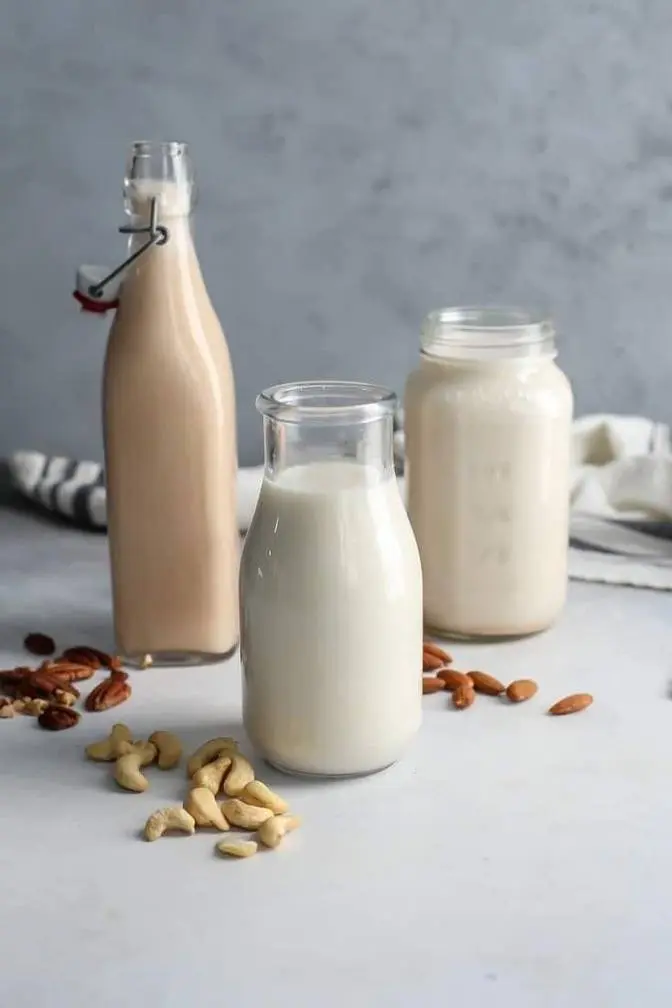
Benefit number two, makes great vegan dairy products.
Although the cashew on its own is nothing like dairy,
when soaked and blended it makes a thick and creamy milk.
This is because cashews contain a good amount of starch content which increases its viscosity.
One ounce of raw cashews contains about 9.2 grams of carbohydrates.
Of this total, they have approximately 1.7 grams of sugar,
only 0.9 grams of fiber, and a whopping 6.6 grams of starch.
This is by far one of the highest in total starch than any other seed or nut type.
For example, the equivalent number of pistachios are only 0.5 grams of starch,
macadamia nuts are only 0.3 grams of starch, and almonds are only 0.2 grams of starch.
In a culinary sense, their versatility when making plant-based dairy products
is unsurpassed by any other nut variety.
As a result, raw unsalted cashews have become a go-to nut when making nut milk,
nut and seed cheeses, as well as no-bake cheesecakes and other desserts like vegan ice cream.
If you're wanting to make a dairy-free cheese sauce or gravy, cashews are often a preferred solution.
Benefit number three, high in copper.
Cashews are known to contain a significant amount of the mineral copper,
with one ounce coming in at approximately 0.6 milligrams or 31% of the daily value for copper
based on a 2,000-calorie adult diet.
They are the second highest next to sesame seeds.
Usually, about 16 to 18 cashew nuts are equivalent to about a one-ounce serving size.
The benefits of cashews and their copper nutrient
may be helpful for the formation of red blood cells,
as well as for the absorption and synthesis of iron.
Copper is also important for various enzymatic reactions,
bone maintenance, and is a necessary nutrient for tissue repair
as it stimulates immune functions and is involved in elastin and collagen development
beneficial to the skin.
Copper is one of the trace nutrients that play a role in the production of enzymatic antioxidants.
Likewise, cashew nuts are also relatively good sources of magnesium,
phosphorus, manganese, zinc, iron, and selenium.
The top vitamins in cashews include vitamin K, thiamine, and vitamin B6.
Benefit number four, cashew nuts for a heart-healthy diet.
Cashews are considered to be a heart-healthy option to include in a health-promoting diet.
That's because they are rich in monounsaturated fats like oleic and
palmitoleic acids that are linked to reducing LDL cholesterol.
Another nutrient they are especially high in is the plant sterol known as beta-cytosterol,
also found in pumpkin seeds.
Beta-cytosterol has been studied for its possible influences
on reducing prostate enlargement or benign prostatic hyperplasia,
as well as blood cholesterol levels.
Other rich sources of beta-cytosterol include pistachios, avocados, and cacao.
For more on how to use cashews, visit the card link above or the description box of this video.
Precautions.
Cashews should, of course, be avoided by those who have allergic reactions to tree nuts.
Also, it's best to avoid cashews for those on a low-oxalate or ketogenic diet.
Consult your nutritionist or healthcare provider before adding cashews to your diet
if you are pregnant, nursing, are taking prescribed medications, or have a serious medical condition.
Thanks for watching!
For much more on the cashew, as well as links to top quality sources,
be sure and investigate the links in the description box below this video.
Please support the channel by giving this video a thumbs up if you found it useful.
And be sure and check out these other informational videos.