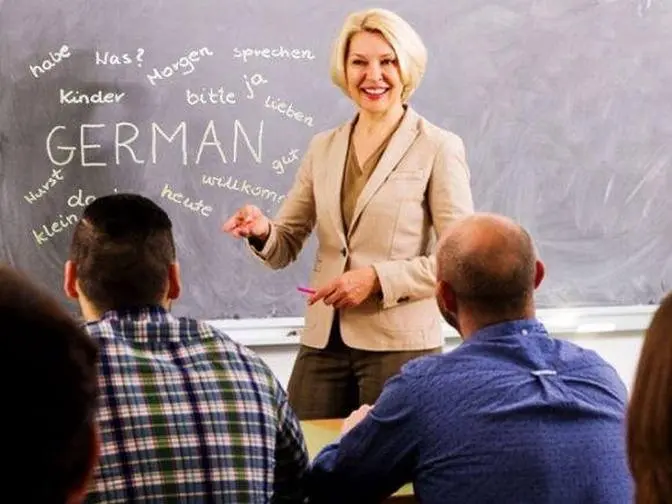
[00:00:00]: Begrüßung und Vorstellung der Lehrerin [00:02:10]: Fünf Tipps zur Verbesserung der Sprechfähigkeit [00:02:53]: Schritt 1: Vokabeln im Alltag [00:05:00]: Bedeutung des Wortschatzes für Kommunikation [00:08:03]: Nutzung des aktuellen Kursangebots [00:08:40]: Schritt 2: Wörter im Kontext lernen [00:12:01]: Beispielgespräch zur Übung [00:12:29]: Schritt 3: Grammatik im Kontext anwenden [00:16:18]: Schritt 4: Verbindung der Sinne beim Lernen [00:18:51]: Schritt 5: Trau dich! [00:19:00]: Sprechübungen und Abschluss
💛 Bleibt dran und bleibt fleißig! 💛 Deine Deutschlehrerin Natalia
Hello and welcome to a new YouTube video.
My name is Natalia and I am your German teacher.
We are what we speak.
Or maybe even better,
we feel how we speak.
In your mother tongue you may be humorous,
talkative and self-confident.
People like your relaxed and funny way.
You like to chat with the mailman,
the other parents when you pick up your child from kindergarten
or the nice saleswoman in your favorite bakery.
You feel comfortable and are a part of society
and can be just as you are through language
and how you feel.
Language is an important part of our personality.
If we don't speak a language correctly
and can understand it,
we often have the feeling that we can't be the person we really are.
I know this problem very well.
Especially at the beginning it was so exhausting
when you had to think for such a long time for very simple sentences in everyday life.
I felt so stupid and was impatient with myself.
But that only made me more insecure and I spoke even less.
Do you know this feeling too?
You actually want to speak German self-confidently and fluently,
but you don't know how.
You only learn to speak by speaking.
You can do this, for example, with a tandem partner you meet regularly
or with a private German teacher
who supports you every week while learning.
But there is another option to learn German
and to learn to speak,
and that is with my intensive courses,
which are very targeted and structured
to prepare you for different conversational situations.
You can choose your variant and stick to it.
This is very, very important.
In this video, I will show you five simple tips
with which you can quickly and effectively improve your speaking skills.
No matter if you are a beginner or already have prior knowledge.
With only 10 minutes of practice every day,
you will soon be able to speak German better and more self-confidently.
You're probably wondering now,
but Natalia, how does that work?
I'll explain that in five simple steps.
So let's go!
Step one, words are the basis.
Here is an example from everyday life.
Imagine you are sitting in a cafe and want to order something.
The waiter comes and asks you for your order.
But without the right vocabulary for coffee, milk or without sugar,
you will hardly be able to order what you actually want.
That's frustrating.
Or you meet your friendly neighbor in the elevator.
She smiles at you and you want to start a conversation.
But you don't have the right words to have a short small talk.
Maybe you just ask, how are you?
And then the neighbor answers, very long.
And unfortunately you don't understand anything.
Did she tell you that she was at a party?
Or something with her family?
So you just heard the words invite and Saturday,
but you don't understand the context.
Did she invite you?
You smile kindly back, but you stay quiet.
A little embarrassing.
She probably even thinks now that you are impolite,
because you don't thank her for the invitation.
In your mother tongue you are not at all shy,
but relaxed, open and always polite.
But in German you suddenly lack the words to be as you really are.
This can be quite challenging and frustrating.
Why do we need the vocabulary when speaking?
This is exactly why the vocabulary is so important when speaking.
Words are the basis to be able to speak in a foreign language.
With every new word you learn, you become more secure
and can express yourself more freely and more precisely.
Be it to understand a question and to answer it.
Language lives on the words you know
and they are the key to real communication with other people in everyday life.
So you will soon feel much better in your new home
and can finally show who and how you really are.
A great example of the same situation
can be found in the fifth lesson in my A2 course.
In this lesson, everything revolves around the topic of leisure, friends and family.
In module 2, in task 1a, for example,
you will first learn new words and expressions that you need for this topic.
The pictures, the audios and the transcription
help you to understand the new words and sentences well.
Let's listen to it directly.
But now I would like to celebrate this special day together with my family and my friends.
We are having a big party in my garden.
And who did she invite?
Exactly!
She is celebrating her 30th birthday
and did not invite you, but her family and friends.
So we write directly in the text field
THE BIRTHDAY
Correct!
In the tasks 1b and 1c,
these words and sentences from the audios
are repeated and practiced again.
We have been together for a couple of years now.
But now I would like to celebrate this special day together with my family and my friends.
The vocabulary and speech are always chosen
so that they often occur in real situations, in real conversations.
So you have the right tool
to understand keywords and sentences on this topic
and can quickly form sentences that fit this topic.
The modules always help you
to build and expand your vocabulary to a specific everyday topic.
This way you feel safe when speaking,
because you understand much more
and can soon conduct conversations in German yourself.
You only have a few days
to use the biggest offer of the year.
Now you can save up to 50%
when registering for my intensive courses.
Click on the link below this video
to view the offers.
When buying two or three intensive courses,
you get up to two crash courses for free.
All information about the Black Friday offer
can be found on the website below this video.
Just click on the link and sign up.
Let's move on to step 2.
Step 2.
Practice reading and listening to speak.
Words alone do not make a sentence.
They are like individual puzzle pieces.
We have to combine the words together,
i.e. bring them into a meaningful context
so that they result in a big whole,
like in a puzzle.
That's why it can happen
that you may know many individual words
and already know your vocabulary very well,
but as soon as you read a text or hear a conversation,
you don't understand anything at all.
This happens to many students.
That's why it's all the more important
that we don't learn new words separately,
i.e. individually,
If you are in a conversation with your neighbor,
you have to understand the context.
Individual words may give you an idea
of what the conversation could be about.
But if you only understand individual words
like Saturday and invitation,
you only know roughly what your neighbor is talking about.
Only the context of the words
helps you to really understand the sentence
without having to guess the rest.
Are you asking yourself now,
but Natalia, what does reading or hearing
have to do with speaking?
A lot.
You will notice that you make it easier to speak
if you have often heard or read the words in the context,
i.e. in the context.
Because our brain loves repetitions and connections.
Learning individual words is not efficient
and also not so authentic.
Nobody speaks in individual words.
We have to connect the words together
so that a big, complete puzzle is created
and we can get a feeling for the right sentence structure
and the sentence melody.
If you read and hear a lot in German,
you don't have to look for words for a long time during a conversation.
Because that is embarrassing and frustrating.
The words will soon fall into your head much faster
and you can speak more fluently.
For example, in my intensive courses,
we hear and read in every lesson.
So we practice understanding hearing and reading in every lesson.
You hear conversations and read texts
in which the new words are used.
The puzzle is therefore put together,
as in this task here.
The individual words
that you learned in the vocabulary tasks before
now appear in context in an authentic conversation.
This is how you learn how the new words are used in everyday life
and how they sound in real sentences.
Oh, hello Ivana and Samir.
Nice to meet you both here.
Well, are you already looking forward to the weekend?
Hi Clara.
Oh yes, finally weekend.
I had a very stressful week
and am now totally looking forward to the free days.
You improve your understanding of hearing and reading,
which prepares you for safe speaking.
There are always tasks to do
so that you don't just hear something,
but work directly with the vocabulary, with the structures.
Step number three.
Grammar makes the small but fine difference.
You already know that repetition and learning in context
are our helpers when speaking.
It's actually very similar to vocabulary.
We can imagine individual grammar topics
as puzzle pieces again.
Do we learn them separately?
Maybe we understand them,
but we can't apply them.
And that's what it's all about when speaking.
Use the language actively to become understood.
So you want to learn the grammar to use it
and not just to have the knowledge.
That's why we also have to learn the grammar in context.
So we connect the vocabulary and the grammatical structures.
Ta-da!
It already makes a click in our brain.
You know a lot of new words to make an appointment,
invite someone, or plan your weekend.
What plays a particularly important role here?
Exactly, the time.
So you have to plan exactly
when you want to meet someone.
It's not just wrong if you say
we'll meet at 2 p.m.
It also leads to stupid misunderstandings.
Because when exactly should it be 2 p.m.?
It makes a big difference
whether we meet at 2 p.m., before 2 p.m.
or after 2 p.m.
So we also need grammatical knowledge
to be able to say exactly and correctly
what we also want to express.
Only in this way can we avoid misunderstandings.
We are still in lesson 5.
As you may have noticed,
the grammar was already hidden
in the exercise for listening comprehension,
which we briefly listened to.
So your brain already learns unconsciously.
In the course, there is also a grammar module
with a detailed video
where I give you many grammar phenomena
and many grammar explanations.
Under the video there are exercises,
a lot of exercises.
The exercises are divided into three stages,
i.e. light, medium and heavy.
In these exercises you repeat your vocabulary again.
You don't practice dry grammatical structures.
You learn in context,
to expand the puzzle piece by piece.
Let's go to exercise 3.
In this exercise there are, for example,
sentences that you already know from the module.
Here you should now choose
the correct temporal preposition.
Am Freitag bin ich mit meiner besten Freundin verabredet.
Am Freitag.
Überprüfen? Richtig!
Und schon hast du einen korrekten Satz
und kannst deiner Freundin erzählen,
dass du deine Mutter heute um 14 Uhr treffen wirst.
Ich treffe meine Mutter um 14 Uhr zum Mittagessen.
Überprüfen? Richtig!
Also, jetzt kannst du diesen Satz
auch in deinem Gespräch verwenden.
Schritt Nummer 4.
Verknüpfe deine Sinne miteinander.
Wir erinnern uns, unser Gehirn liebt Verknüpfungen.
Dementsprechend ist es auch besonders effektiv,
wenn wir unsere Sinne miteinander verbinden.
Sehen, hören und sprechen.
Je mehr Sinne wir beim Sprechen mit einbeziehen,
desto besser können wir uns nämlich
an die neuen Informationen erinnern.
Wenn du also zum Beispiel Freunde zum Kochen eingeladen hast,
dann nutze die Gelegenheit
und übe deinen Wortschatz ganz aktiv.
Du könntest ihnen eine Einkaufsliste auf WhatsApp schicken
und hinter jedes Wort ein passendes Emoji setzen.
So hast du das Wort schon mit einem Bild verbunden.
Oder du bittest deine Freunde,
dir eine Einkaufsliste als Sprachnachricht zu schicken.
Du kannst die Einkaufsliste dann
als Wort oder Emoji aufschreiben,
um zu überprüfen, ob du auch an alles gedacht hast.
Also, du verknüpfst ganz viele Sinne miteinander.
Ein anderes gutes Beispiel dafür
sind Wortschatzkarten,
die du in jeder Lektion findest.
Hier gibt es zu jedem neuen Wort
ein passendes Bild und ein Audio,
das du dir anhören kannst.
Das Wort ist die Einweihungsparty.
Du siehst die Bilder,
hörst die Aussprache,
und kannst die Vokabel bzw. den Beispielsatz
dann wiederholen.
Durch das Nachsprechen
prägst du dir die korrekte Aussprache ein
und trainierst gleichzeitig dein Sprachgedächtnis.
Das ist ganz wichtig.
Diese Wiederholungen machen dich sicherer
und bereiten dich darauf vor,
die neuen Vokabeln später flüssig und ohne Nachdenken zu verwenden.
Und das Beste,
du kannst die Wortschatzkarten
so oft wiederholen, wie du möchtest.
Morgens beim ersten Kaffee,
im Zug, auf dem Weg zur Arbeit
oder abends vor dem Einschlafen.
So trainierst du deinen Mund ganz gezielt
und ohne peinliche Zuhörer
auf die korrekte Aussprache der deutschen Wörter.
Also zu guter Letzt
trau dich aktiv zu sprechen,
denn unser Mantra lautet
Sprechen lernst du nur, indem du auch sprichst.
Das ist sehr wichtig.
Ob mit deiner Nachbarin im Aufzug
oder mit deinen Freunden auf WhatsApp
nutze jede kleine Gelegenheit, um zu sprechen
auch wenn es gerade am Anfang ein wenig Mut dazu braucht.
Je mehr du sprichst,
desto sicherer wirst du dich fühlen.
Wir haben schon gesehen, wie wir den neuen Wortschatz
und die Grammatikstrukturen im Kontext
also in echten Sätzen
und authentischen Gesprächen anwenden.
Das Beste kommt wie immer zum Schluss.
Am Ende jeder Lektion gibt es eine große Sprechübung,
ein Video mit mir
in dem wir aktiv sprechen
und zusätzlich dazu findest du oft noch kleinere
Sprechtrainings zum Nachsprechen und Wiederholen.
Lass uns direkt einmal kurz reinhören
und nachsprechen.
Im Modul 2 ganz am Anfang
haben wir eine Sprechübung.
Jetzt bist du dran?
Tennis klingt super!
Ich komme gerne mit. Wann sollen wir uns treffen?
Super gemacht! Hat es Spaß gemacht?
Na, hast du jetzt auch Lust bekommen
endlich Deutsch sprechen zu können?
Mit diesen 5 Tipps schaffst du die perfekte Grundlage
um das Sprechen gezielt zu üben.
So wirst du sicherer
und kannst schon bald fließend Deutsch sprechen.
Wie du siehst, alle Module, alle Grammatikthemen
sind in allen Intensivkursen
miteinander verbunden.
Es ist sehr wichtig im Kontext zu lernen
und das machen wir Schritt für Schritt
in jedem Intensivkurs.
Ich hoffe du hattest heute ganz viel Spaß mit mir.
Denk daran, dass die Black Friday Aktion
nur noch ein paar Tage andauert.
Wenn du jetzt anfangen möchtest an deinem Deutsch zu arbeiten
dann klicke auf den Link unter diesem Video
melde dich an und fange heute an.
Das Jahr ist fast vorbei.
Es wird Zeit, dein Deutsch zu verbessern.
Bleib dran und bleib fleißig!
Tschüss!