
Planting a BLUE Cascading Hydrangea😍 Seeding Blue & Strawberry Corn, Planting Tecoma Chicklet Gold
228 Video Views·Jun 23, 2025
Today we're planting a Blue Cascading Hydrangea, Seeding Blue & Strawberry Corn, and Planting Tecoma Chicklet Gold. I've been impatiently waiting to get my hands on Proven Winner's new Fairytrail Fresco hydrangea. WOW! This has to be the most beautiful blue hydrangea I've ever planted in the garden! We're also seeding blue corn and strawberry corn. I plan to grind the blue corn for tortillas and use the strawberry corn for fall decor. We'll end our garden vlog chatting about a a noninvasive shrub that looks like trumpet vine but is actually a north American native plant called tecoma chicklet gold.
Good morning, friends.
I hope you're having a great day out there in your gardens.
Well, it's going to be a great video
because today we're going to be planting a hydrangea
that I've been dying to get my hands on
ever since I saw it on the Proven Winners
Color Choice Shrub catalog, I think it was last year.
This is the Fairy Tail Fresco Cascading Hydrangea.
This is a mop head hydrangea
that literally gets blooms at every single node.
So when you plant it in a container or even in the ground,
it literally has a cascading garland-like effect
and it blooms so profusely
that you almost can't even see the leaves.
Like most mop head hydrangeas,
this is hardy in zones five through nine.
This particular variety fresco gets 3 1⁄2 feet
to 4 feet tall and 4 1⁄2 feet wide.
I've seen so many beautiful pictures of this hydrangea
planted in a container.
All my containers are full right now
and none of them are in part shade,
which is what this kind of hydrangea wants.
So instead of planting it in a pot,
we're going to try it in the landscape together.
I've reserved a very special spot
in the driveway garden for this.
It's going to be right next to where you park your car
when you come to my house.
And I just can't wait to see this hydrangea
covered in blooms, trailing all over the place,
and really just to have this incredibly
magical hydrangea in the garden.
You'll see that it's blooming blue at the moment
and at my house where the soil is more acidic
and aluminum is readily available to my plants,
this will stay blue.
If you had a more basic soil, it would be pink,
but you could easily change that.
But I can't wait to get this in the ground.
But actually before we do that,
I want to plant up some blue corn and some pink corn.
And we're even going to plant another shrub
that's not already in my zone, but that is so beautiful.
I still couldn't resist trying it.
You know, even though I live in an Amish community
where there is corn growing all around me,
I still enjoy growing my own corn.
And in the past, I've only grown corn that we eat,
yellow and white corn.
And there's so many wonderful varieties
that I've tried over at Plain and Fancy Farm.
I'll put all of my recommended varieties
on the screen right here.
But this year at my house, I want to try two new varieties.
This one, let's see here.
I'm using my old camera.
I have to get used to the focus.
We're going to plant this one today.
It's a blue corn that you can grind down
and use for tortillas.
It's a hundred days to maturity.
And then this one called strawberry popcorn.
It says the ears are two to three inches long
and they have dark red jewel-toned kernels.
And they can be used as popping corn
or as ornamental corn in the fall.
Each stock produces two to four ears.
So you might be wondering, Danielle,
why in the world are you starting your corn in cells?
And the primary reason is that I am not ready
to plant these in the ground
because I don't have that raised bed clear yet.
It's going to replace the bed
that's currently full of lisianthus.
So I'm going to start these in cells,
let them grow on outside,
just right next to the raised bed for about three weeks.
If I've done my calendar math correctly,
in three weeks, the lisianthus should be blooming.
I'm just going to do one cut on the lisianthus
and then clear that bed.
And then we'll be able to pop this really fun corn
in the ground.
But you know what?
Why not start it in cells?
It's just so fun to grow anything from seed.
So let's give it a try.
If you've never grown corn before,
it's incredibly easy.
I grew tons of corn over at Plain and Fancy.
I wish, I wish I had more pictures of that farm
when I managed it,
but I'll try to find what I can and put it on the screen.
But I had one ginormous row of corn in the back.
I was growing it in blocks.
And I've done it here in raised beds.
And what I like to do is fill the whole raised bed
with corn.
That really helps with pollination.
Corn is pollinated by the wind
and that's why you see it being recommended
to grow it in blocks.
Also, I think it just looks beautiful growing in blocks.
And also then it helps the corn not to fall over
and stay up without any support.
So what I'm doing is just taking a pen
and making about a one inch hole in all of these cells.
We'll do one tray of the blue hoppy corn
and one tray of the, what was it called?
Let's see, strawberry popcorn.
I wanted to say pink popcorn.
My grandma would always use pens and pencils
to plant anything at her house.
And she would do a lot of her planting in her basement.
And I always remember that she had this mug
full of pens and pencils next to her telephone.
You know, it was an old rotary phone.
And whenever you would go and pull out a pen or a pencil
to take a note for her that someone had called,
the front end would always be super dirty
because that's the way she started all her seeds.
She always used a pen.
And it's really great too
if you want to make a deeper hole,
like for corn or sunflower,
something that goes down by about an inch.
So let's do this strawberry popcorn first.
Just pop one seed in each hole.
I'm not going to worry about overseeding these.
If one or two don't take, I can always pop a new seed in.
It only takes corn about a week to germinate.
And it's going to be 96 degrees today.
The humidity is 95%.
Is my hair like a complete frizz ball right now?
I bet it is.
I curled it for you guys today,
which was such a silly thing to do
because it immediately fell out and became all poofy.
Hence the hat, right?
Here's a look at the trays before I cover them back up.
And now what I like to do is just pinch the soil
right over the seed.
Right now I have the cells in watertight trays,
but since I'm going to be leaving these trays outside,
I'm going to switch them to trays that have drainage holes
so that they're not sitting and soaking in water.
Like I say, the weather is going to be crazy hot,
but earlier this week it was cold and rainy.
I'm getting bit on my leg right now,
which reminds me that I want to try and add
some mosquito dunks into the rain barrel monthly this year
and see if that helps with the huge mosquito problem
that I have here.
I've also tried to trim the shrubs up,
trim the trees up a little bit
just to get a little more airflow into the property.
And I talked to one of my professors about the big problem
that I had with Asian tiger mosquito here.
And what he told me is that they can even reproduce
in rotting trees, a rotting log
that you have on your property,
anything that holds even just the slightest bit of moisture,
they can reproduce there.
So it's not like some of the other mosquitoes
where you might need a bowl of standing water
or you have an old tire that's collecting water.
I don't know.
Let me know if you have Asian tiger mosquito
and if you've been able to control it one way or another.
But I got rid of all of the running water on the property
with the exception of the alfresco fountain.
I'm changing that weekly and I have the rain barrel.
So hopefully by putting the mosquito dunks in there,
we'll take care of the mosquito problem.
So I'll switch these out to trays with drainage,
but now let's go ahead and dive back in to hydrangea land.
Now that we got that corn planted up,
let's head over to the driveway garden
and plant up that beautiful cascading hydrangea.
Now these hydrangeas, like I said,
are hardy in zones five through nine.
So they are able to survive my winter here in zone seven.
I never want to prune a mophead or a serrata hydrangea.
And the fairy trail mophead hydrangeas are in fact a mophead
so we never want to prune them.
When you prune a mophead or a serrata hydrangea
that blooms only on old wood,
you essentially remove all of those blooms.
And since a cascading hydrangea is going to bloom
all along the stem at every single leaf node,
if you would go ahead and prune that shrub back at all,
you'd be removing all of those gorgeous flowers.
So I think it's actually great to have this kind of hydrangea
because you really just stick it in the ground,
get it watered in well, get it established,
and then you never have to worry about it again.
You never have to touch it.
You never have to prune it.
If any bloom heads remain come next spring,
you can just go ahead and deadhead the plant.
But I did want to stand here in my hydrangea room
where I'm surrounded by lots of different
primarily smooth hydrangeas,
just to show you the difference.
Every single hydrangea that you see around me right here,
I can go ahead and prune it down in the fall or the spring,
whatever my heart desires.
So there is that difference.
Panicle and smooth hydrangeas,
you can go ahead and prune.
Mountains, serrata, and mop heads,
you want to just leave them alone, deadhead if necessary.
Okay, let's head over to the driveway garden
and get planting.
You might not be able to see it,
but my husband's truck is right here.
He has the first parking spot in our driveway.
So when he pulls in and gets out of his truck,
he'll be greeted with this
gorgeous fairy tale fresco hydrangea.
I'm choosing this spot primarily because it's part sun.
It never gets direct sun at any point in the day.
So I don't have to worry about the leaves scorching,
the bloom scorching.
And sometimes what happens in my areas
with big leaves planted in too much sun
is that they just kind of melt down when it gets really hot.
And then they perk back up in the morning.
And I do have a mop head hydrangea
on the other side of our house
that does get full blazing afternoon sun.
And that hydrangea is completely fine.
But what happens is when it gets to be July and August,
and we're living in the nineties,
once it hits mid-afternoon,
that plant just sulks, the leaves flop over,
and it just looks like it's suffering.
Every morning it bounces back and looks as good as new,
but it does go through that cycle of melting down
and bouncing back when it is planted in too much sun here
in South Central Pennsylvania.
I wanna dig a wide hole, but not a deep hole
because hydrangea roots extend outward.
Say I wanted to dig up this plant in five years,
I'd want to dig out an even bigger hole
and the root system would have expanded outwards,
but not downwards.
Also, the reason why I don't want to dig out
a really deep hole and then backfill it
with really nice loose soil or non-native soil
is because then a lot of times those plants can sink,
especially if you live in a climate like I do
where we get a lot of rain, you're gonna have settling.
So I never like to dig the hole deeper than the pot itself.
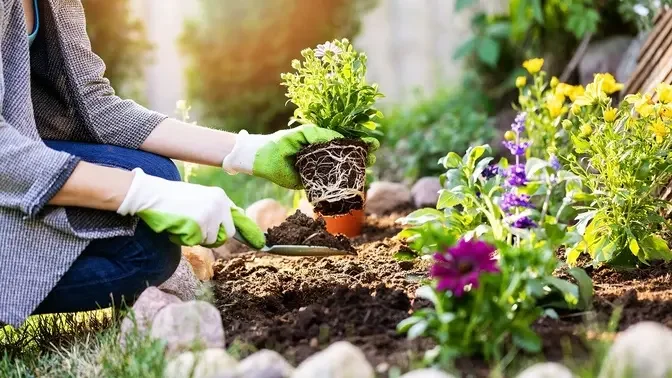
So I just like to stick the plant in the hole
and see if it's deep enough.
And you can see that this plant actually hasn't even started
to use the base of that soil.
So I can take it out and see where the actual height is.
And that looks perfect, nice and even with the soil surface,
but you see now I can backfill with all of this soil.
That's now gonna be nice and loose
because I've just dug it up.
The roots are gonna have a nice,
easy time of extending outwards.
I never add anything into the hole,
just native soil when it comes to shrubs,
trees, and perennials.
I cannot wait to see this Fairy Trail Fresco Hydrangea
in full bloom.
I can't wait to watch it grow over the next few years.
The rule of thumb with any newly planted tree,
shrub, or perennial is sleep, creep, leap.
The first year it sleeps,
meaning that you don't see a lot of growth above ground.
The second year it creeps, meaning you'll see some growth.
And that's when it's putting down
a lot of fabulous roots for you.
On the third year it leaps by, I would say, 2028.
Wow, that sounds weird to say 2028, doesn't it?
By 2028, this beautiful shrub
will basically encompass this entire area.
And I will be sure to share updates with you.
Oh my gosh, you guys, it is so crazy hot right now.
I'm gonna quickly grab this new shrub
that I'm gonna treat as an annual from the porch
and show it to you.
And I think I might plant it off camera
because I feel like I'm dripping in sweat, dirt,
and I feel like my hair is a ginormous frizz ball.
Gracie came out here to say hello.
You can see her tail right here.
So here's the other plant that I wanna show you today.
It's called a Tacoma.
This one is Tacoma Chiclet Gold.
It gets beautiful, bright,
I mean, really, really bright yellow flowers,
about three to six feet tall,
three to four feet wide, zone eight through 11.
Now I'm here in zone seven.
They're recently pushed up to a seven from a zone six B.
So I'm gonna treat this as an annual vine.
I'm gonna plant it underneath my mailbox
and let it scramble up the mailbox.
You might notice that this looks like a trumpet vine.
And my understanding is that
it's a non-invasive shrub trumpet vine.
Now, if you heard trumpet vine
and had a minor heart attack, me too.
I didn't know I was receiving this plant.
And when I unboxed it
and saw that it looked just like trumpet vine,
I thought, oh no.
But then I found out
that there are non-invasive trumpet vines.
So I'm excited because I do love trumpet vine blooms.
I love this yellow color,
but I definitely don't want the invasive trumpet vine
on my property because trumpet vine in Pennsylvania
is on our invasive plant species list.
So I'm gonna get this one planted up.
Sorry, friends, I'm not gonna do it on camera
for safety reasons,
you know, with it being my mailbox and everything.
Well, friends, thanks so much for hanging out with me
in the garden today.
I'm really excited to spend more time out here with you
in the days and weeks to come.
And I hope you're staying nice and cool
and planting some more hydrangeas.
Let me know if you are.
What kind are you planting?
I'm feeling like maybe tonight I need to go down
to Ken's Gardens and treat myself
to a fairy trail green hydrangea.
Have you seen that one?
That one looks amazing.
Might have to pop over there when my husband's not looking.
Bye, friends.