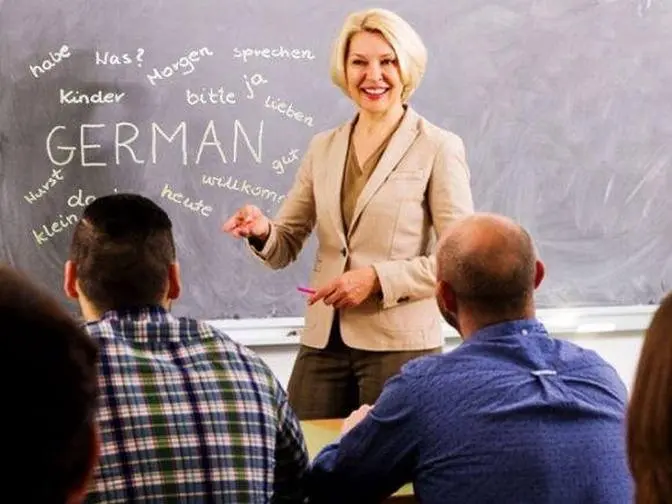
Step 1: Go to https://tinyurl.com/mw54n8a9 Step 2: Sign up for a Free Lifetime Account - No money, No credit card required Step 3: Start speaking German the fast, fun and easy way!
After watching this video you will know how to use basic greetings in German. These Can Do lessons are about learning practical German skills. Each lesson brings you closer to natural, fluent German.
If you are an absolute beginner German learner, this video is made for you. This is THE place to start if you want to start learning German.
Also, please LIKE, SHARE and COMMENT on our videos! We really appreciate it. Thanks!
Welcome to Can Do German by GermanPod101.com.
Hallo zusammen! Ich heiße Katrin Preußler. Hi, everyone! I'm Katrin Preußler. In this
lesson, you'll learn how to greet someone at different times of the day.
Expand your vocabulary with our Core 2000 Words eBook. It's free and packed with essential
expressions that you'll use on a daily basis. Start building your vocabulary today.
Click the link in the description below to download your free German eBook before it's gone.
This is Finja Fischer, the Lee family's German teacher. Her schedule for the day is
Mark Lee at 9 o'clock a.m. Karen Lee at 12 o'clock p.m. Ben Lee at 6 o'clock p.m.
Listen to the greeting exchange between the three pairs. Pay attention to the time of day.
Once more with the English translation.
Good morning, Miss Fischer.
Good morning, Mr. Lee.
Good day.
Good evening.
Good evening, Ben.
Let's take a closer look at each of these expressions.
In the first conversation, do you remember how Mark says,
Good morning, Miss Fischer?
Let's start with
which translates as
Good morning.
Note
can be used until around noon.
Next is
Miss in this context.
This is an honorific used for women.
Finally, the teacher's family name.
Together
All together
Good morning, Miss Fischer.
When including a person's name in a greeting.
Note
Using the person's family name in a greeting may come across as more formal.
Do you remember the teacher's response?
First is
Next
Mr. in this context.
This is an honorific used for men.
Finally, Mark's family name.
Pronounced in German.
All together it's
Good morning, Mr. Lee.
Note
This exchange is formal.
In the second conversation, which takes place at noon.
Do you remember how Karen says good day?
Meaning good day.
Note
that Karen's greeting is slightly less formal as she doesn't say the teacher's name.
Note
can be used from around noon until dusk.
The teacher's response is the same.
This can translate as hello or good day.
Is a common way to greet people during the day.
You can use it in formal and less formal situations.
In the third conversation, which takes place in the evening at 6 p.m.
Do you remember how Ben says good evening?
Good evening.
Is a common way to greet people during the evening and at night.
In both formal and less formal situations.
Do you remember the teacher's response?
First is
Next is Ben's name pronounced in German.
Together it's
Good evening, Ben.
Note
that the teacher addresses Ben by his first name as he's younger.
This makes the greeting sound more informal.
The expressions you have learned in this lesson are actually shortened forms of longer expressions.
Guten Morgen is a shortened form of
I wish you a good morning.
Guten Tag is a shortened form of
I wish you a good day.
Guten Abend is a shortened form of
I wish you a good evening.
These extended forms are simply for your general knowledge.
Let's look at the greetings once more.
Listen and repeat or speak along with me.
Guten Morgen, Frau Fischer.
Did you notice the last greeting?
Wondering how you can master these conversations even faster?
Here's how.
One.
Read along.
You get the lesson conversation and translations inside our dialogue tool
so that you see each word as you hear it and understand it all.
Two.
Practice speaking.
By shadowing what you hear,
you can also record and compare yourself with native speakers with our voice recording tools.
And three.
Take our assessment tests and see how much you remember.
These tools are part of our Can Do course.
Just click the link in the description to get them.
Hello.
For informal situations, you can just use the greeting
at any time of the day.
is the most common greeting in German.
However, it's only suitable for informal situations,
such as when greeting friends or relatives.
It translates as
Let's review.
Respond to the prompts by speaking aloud.
Then repeat after me, focusing on pronunciation.
Ready?
Do you remember how Mark says
and how Karen says
Do you remember how to say
Do you remember how Mark addresses Ms. Fischer?
Let's practice.
Imagine you're Ben Lee and you're attending your morning class.
Respond by saying,
Good morning.
Ready?
Listen again and repeat.
Let's try another.
Imagine you're Mark Lee and you're attending your afternoon class.
Respond by saying,
Good day, Ms. Fischer.
Ready?
Listen again and repeat.
Let's try one more.
Imagine you're Karen Lee and you meet your neighbor in the evening.
Respond by saying,
Good evening.
Ready?
Listen again and repeat.
This is the end of this lesson.
Now, here's what you can do to cement this conversation in your head.
Review the conversation with our dialogue tool and lesson transcripts.
Study the key words and phrases with our spaced repetition flashcards.
Review the key grammar and cultural tips inside the lesson notes.
And test yourself with our assessment tests.
So click the link in the description right now
and sign up for your free lifetime account to access our CanDo course.
Now you know how to use basic greetings in German.
That's all there is to it.
Keep practicing and move on to the next lesson.