
Facts About the Moon for Kids | What is the Moon? | Science Lesson for Kids | Twinkl USA
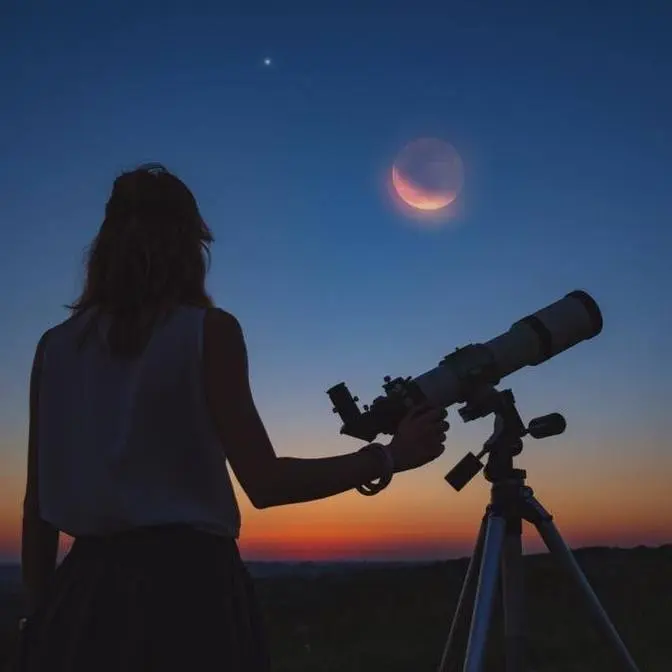
The moon is Earth's only natural satellite and has fascinated humanity for thousands of years.
It's the fifth largest moon in the solar system and the brightest object in our night sky.
Though it appears to shine, the moon doesn't produce its own light.
What we see is sunlight reflecting off its surface.
The moon is about 384,400 kilometers to 138,855 miles
away from Earth and has a diameter of roughly 3,474 kilometers to 1,159 miles,
making it about one-fourth the size of Earth.
Its gravity is only about one-sixth as strong as Earth's,
which means you'd weigh much less if you stood on the moon.
The moon's surface is rocky and covered in dust.
It features mountains, deep craters formed by asteroid impacts,
and vast flat plains called maria latin for seas.
These maria are actually ancient lava flows that filled giant basins billions of years ago.
Because the moon has no atmosphere, it has no weather or wind,
and its surface has remained unchanged for millions of years.
One of the most well-known things about the moon is its phases.
As it orbits Earth, different parts of the moon are illuminated by the sun,
giving rise to the cycle of phases, new moon, crescent,
first quarter, gibbous, and full moon then it goes in reverse.
This entire cycle takes about 29.5 days and is called a lunar month.
The moon also causes tides on Earth.
Its gravitational pull affects Earth's oceans,
causing the water to bulge out on the side closest to the moon and the side farthest from it.
This results in high and low tides,
which play an important role in the rhythm of life on our planet.
One fascinating fact is that the same side of the moon always faces Earth.
This is because the moon is tidally locked,
meaning it rotates on its axis in the same amount of time it takes to orbit Earth.
As a result, we never see the far side from the ground.
Scientists believe the moon formed around 4.5 billion years ago, shortly after Earth itself.
The leading theory, called the Giant Impact Hypothesis,
suggests that a Mars-sized body collided with the early Earth
and the debris from that collision eventually formed the moon.
In 1969, the moon became the first celestial body beyond Earth visited by humans.
During NASA's Apollo 11 mission,
astronauts Neil Armstrong and Buzz Aldrin landed on the moon while Michael Collins orbited above.
Armstrong's famous words,
that's one small step for man, one giant leap for mankind,
marked a historic moment in space exploration.
In total, six Apollo missions landed on the moon between 1969 and 1972.
Since then, space agencies around the world have continued studying the moon using robotic missions.
Plans are now underway to return humans to the moon
and even establish lunar bases for future missions to Mars.
The moon remains an object of wonder,
a scientific treasure, and a stepping stone to the broader universe.