
ALMOND MILK VS. COCONUT MILK - WHICH IS HEALTHIER?!
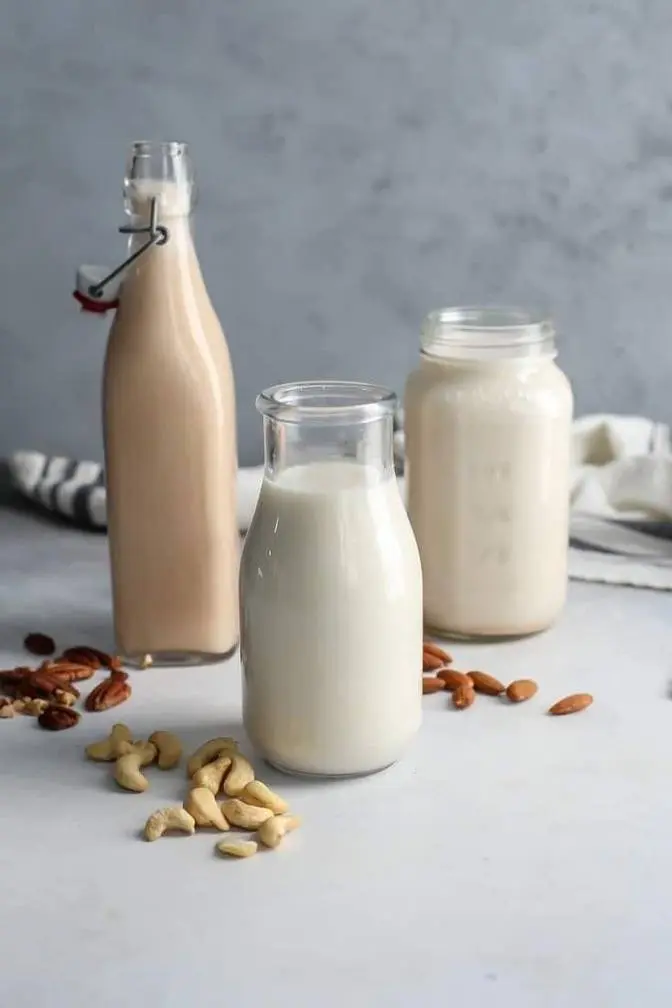
Almond milk.
Coconut milk.
Which one is healthier?
You probably heard some conflicting information regarding both of these different dairy-free
milks.
So I'm going to be unpacking the differences between the two, whether or not one is healthier
than the other.
All the details you need to know when making your milk decision in today's video.
Alright guys, if you don't know who I am, my name is Autumn and I'm a certified clinical
nutritionist with my master's in nutrition and human performance.
On my channel, I'm always talking about the different ways that you can use food and lifestyle
changes in order to feel good again.
And today we are talking all about milks, specifically almond and coconut.
I've used both of these pretty extensively.
I mean, I actually grew up as a vegetarian, fun fact, for about the first 10 years or
so of my life, I didn't really have any type of animal-based products and specifically
also milks.
I wasn't vegan, but my family didn't really have any dairy.
I'm very familiar with the world of milks, like with a Y.
With these two different milks, I'm going to stop doing that.
With these two different milks, the almond milk and coconut milk, there's actually a
lot of similarities on why people are choosing them.
So first, we're going to the similarities of these two.
Obviously, they're both dairy-free and they're also both vegan.
So if you're on a plant-based diet, then both of these are really great options for you.
They also are both made in a similar way, except that almond milk is a lot more time-consuming
to make.
So with almond milk, typically you have to soak it for about 24 hours.
Then you have to blend it in a high-speed blender and strain out the pulp where you're
just left behind with the milk.
Same thing goes for coconut milk, except that it's a lot easier.
In fact, I'll be coming out with a video soon on exactly how to make it.
So make sure you subscribe so that you can get alerted on when that video comes out.
But the processes are both very similar.
Another thing that both of these have in common is that you have to look out for similar things
with both of them.
Because most of these are kept in the non-refrigerated section and they have to last longer than
four days, there's a lot of stabilizers, emulsifiers, additives, natural flavors, maybe even artificial
flavors, sugars, all of these things where if you were to look at the ingredients label
on either one of these, depending on the brand, it can be pretty long when really it should
only be two ingredients, either coconut and water or almonds and water and that's it.
That's when you start to have to become like a nutrition detective and figure out what
all of these different ingredients are and whether or not it's actually going to hurt
your health or be beneficial for your health.
Usually it's not going to be good for you.
And the original formula for most almond milks and coconut milks contain sugar.
So in order to get a unsweetened version where it's just the base type of almond milk
or coconut milk, you specifically have to seek out unsweetened almond milk or unsweetened
coconut milk.
And that can be a little confusing for people because most of the time you would assume
original shouldn't have added sugar, right?
It should say sweetened if it has added sugar, but no, that's not the case.
Original is a sweetened one.
You have to specifically look for unsweetened for both of these.
Okay, so let's specifically look at almond milk right now.
Now if you're buying it, there's a lot of different brands.
There's Silk, Whole Foods has their own brand, Diamond.
There's honestly so many now, couldn't possibly list them all, but there's a lot.
The thing with almond milk is that it's typically fortified.
So that basically means that they're adding in nutrients.
So this may be adding in more vitamin E, adding in vitamin D, possibly even adding in some
calcium.
So it's not natural in the almond milk that these vitamins and minerals are in there.
They're actually being added in.
And when you make the almond milk on your own, it's totally free of all of these preservatives
and things that can be a little detrimental for your health.
But when you're buying it in a grocery store, nearly 100% of the time, it's going to have
these preservatives.
It's not organic.
It's going to have pesticides in it.
And these additives are typically added to extend the shelf life.
If you were to make that milk on your own, it really only lasts about four days in the
fridge.
That's not sustainable for most companies, any companies really, especially to mass produce
it.
So they add in a bunch of those emulsifiers, stabilizers, preservatives in order to make
it last longer on the shelf, especially at room temperature.
Now, many of the almond milks, and I believe all the nut milks actually, used to use carrageenan
as a stabilizer, but there's been a lot of negative reports about carrageenan.
So they started to switch over to gellan gum, is it gellan, gellan, gellan gum?
Anyway, another same thing, just different type of gum, different type of stabilizer.
So although they are using a different stabilizer, it's still adding in all of these different
preservatives, stabilizers in order to extend shelf life.
Now, like I mentioned earlier, it also typically adds natural flavors.
And like I've talked about before, natural flavors aren't necessarily natural, and it
can be a whole host of different chemicals that, yeah, they're derived from plants or
different types of natural compounds, but they're out of their original form.
The word natural really can be debated here.
Now let's move on to coconut milk.
It's actually pretty funny because many of the brands that make almond milk also make
coconut milk, along with hazelnut milk, hemp seed milk, cashew milk, oat milk, probably.
Now, here's the thing with these pre-packaged, pre-made nut milks, there's a lot of the same
concerns that you have to look out for with coconut milk as almond milk.
It's not that one is necessarily better than the other for you.
It's where you're getting these milks from that matters the most.
That's why I always just like to make my own milk, especially if you're making coconut
milk.
It's super simple.
It's ridiculous how simple it is.
And you actually know everything that's going into the product, and you don't have to worry
about stabilizers, emulsifiers, and all of that.
Plus, it ends up being less expensive too.
Or I'll just use water sometimes as the base of my smoothie if I'm feeling really lazy
because honestly, making coconut milk is so easy.
If you have approximately five to seven minutes, you have enough time to make coconut milk
from start to finish.
If you want a smoothie recipe, I recommend you check out this video on my blueberry hemp
smoothie, one of the A&P's favorites.
If you love all the science-backed information on how you can feel your best, make sure you
subscribe right here.
I come out with new videos every Tuesday and Thursday.
Alright guys, thanks so much for watching, and I'll see you in my next video.
Bye.