
The Pharos Lighthouse
#Archaeology#archaeological artifacts
Welcome, my name is Dr. George Sparks and you are watching Bible
Interact TV. Today I'm going to share with you something that I feel is exciting.
Many people collect lighthouses, little model lighthouses, over hundreds of varieties to choose
from. I think one in particular stands out the most and it is called the Pharos Lighthouse of
Alexandria. It was built over 2,300 years ago and it stood for almost 1,500 years before it was
actually destroyed by earthquakes. That's what I'd like to share with you today, so stick with me
and let's have some fun. The story of the Pharos starts with the founding of the city of Alexandria
by the Macedonian conqueror Alexander the Great in 332 BC. Alexander started at least 17 cities
named after himself, Alexandria, at different locations in his vast domain. Most of them
disappeared, but Alexandria in Egypt thrived for many centuries and it is even prosperous today.
Alexander himself died in 323 BC and the city was completed by his predecessor Ptolemy Sostar,
the new ruler of Egypt. Ptolemy authorized the building of Pharos in 290 BC and then when it
was completed some 20 years later, it was the first lighthouse in the world and the tallest
building in existence except for the Great Pyramid of Egypt. Both of these ancient man-made
constructions were not passed in height into the building of the Eiffel Tower in 1887.
We have two pictures, the Pyramids of Giza I'm sure you're familiar with and also
the Eiffel Tower and remember the pyramids were probably about 400 feet high. The lighthouse of
Alexandria, sometimes called the Pharos of Alexandria, was a lighthouse built by the
Ptolemy kingdom and stood between ancient records say 394 to 449 feet tall and those do vary in
ancient records as basically also listed as one of the seven wonders of the ancient world.
It was one of the longest surviving ancient wonders after the Great Pyramid which still
stand until 1480 when the last of the remnant stones were used to build a citadel or actually
a fortress on that exact location and site. There were three stages each built on top one another.
The building material was stone faced with white marble blocks cemented together with lead mortar.
The lowest level of the building which sat on a 20 foot high stone platform was probably about
240 feet high and 100 feet square at base shaped like a massive box. The door to the section
of the building wasn't at the bottom of the structure but part way up and it reached
it was reached by a 600 foot ramp supported by massive arches. Inside this portion of the
structure was a large spiral ramp that allowed materials to be pulled to the top
using animal drawn carts. Here's another picture of an artist's reconstruction of
the Lighthouse of Alexandria. This was a mausoleum built representing the lighthouse.
A more modern representation showing you different levels and the statues surrounding
the lighthouse as well as a statue of Poseidon at the very apex of the structure.
On the top of the first section was an eight-sided tower which is probably about 115 feet in height.
On the top of the tower was a cylinder that extended up another 60 feet with a fire that
provided the light burn. On the roof was a large statue probably the god of the sea Poseidon.
Here we have a few coins the lighthouse coin of Alexandria from the second century
AD. So at this time the lighthouse has already stood for 500 years before these coins were
actually struck. The first one Antonin Pius and the second one Commodus. I was hoping to
actually bring that coin of Commodus here to show you a very good example of it. I think just as
good as the quality in the picture. However I couldn't get it. But if you stay with the program
I'm going to share with you some really nice artifacts at the end. Close-up of some of the
ancient coins of pharaohs. Here you can see the statues at the different levels especially
possibly one of Poseidon at the top. And also we have mosaic representations. This one from the
century AD. Once again you can see the god Poseidon at the top along with another statue.
The second one of a mosaic as you can see the different levels of the lighthouse. Of course
the largest is at the bottom supporting the others like a like a birthday cake if you will.
This last one right here is a lantern. A lantern isn't a lamp it actually holds the lamp. So that
opening that you see the very large square opening is where they would place the lamp.
The little holes around it perforating the terra cotta were there to let air flow through it but
not too much as if to put out the light of the lamp which would be inside. The very hole at the
top of the lamp or this lantern was used so was there so it could be actually hung when it was
being used. The interior of the upper two sections had a shaft with a dumbwaiter that was used to
transport fuel up to the fire. The staircases allowed visitors and the keepers to climb to
the beacon chamber at the top. There according to reports a large curved mirror perhaps made of
polished bronze was used to project the fire into a beam. So it's a fire light projected into a beam
of light. It was said that ships could detect the light from the tower at night or the smoke from
the fire during the day up to 100 miles away. That's probably greatly exaggerated. Other historians
such as Josephus stated that it could be seen about 35 miles. Other historians mentioned 50 miles
and also the historian Josephus states that the Jewish Septuagint was actually written
on the island of Pharos. We have that tradition as well. An ancient bronze lamp. Here we have a lamp.
I'm going to show you another one in the artifacts today. A mirror of the ancient world which is
usually metal but was highly polished. Another form of a mirror was mercury that was actually
used or implanted behind glass. If you're familiar with some of the Roman traditions of gods
we have one which was the Narcissus. The Narcissus was actually viewing himself into a pool of water
but also holding a mirror. So a mirror could be also used as a symbol sometimes of vanity.
Here we have another artifact of a mirror. This is actually like a compact. You've got two handles
and then it opens up so you have a place to hold it. Of course a female some makeup on one side but
and then a polished mirror on the other. So it's kind of like what we would say today an ancient
compact case. The lighthouse was apparently used also as a tourist attraction. Food was sold to
visitors at the observation platform at the top of the first level. A smaller balcony provided
an outlook from the top of the eight-sided tower for those that wanted to climb or make the
additional climb. The view from there must have been spectacular seeing that it might have been
as high as 300 feet above the sea level. So how was the lighthouse of Alexander actually destroyed?
So the destruction. How then did the world's first lighthouse end up at the floor of the
Mediterranean Sea? Most accounts indicate that it like many other ancient buildings
was the victim of earthquakes. It stood for 1,500 years apparently surviving a tsunami that
hit the eastern Mediterranean in 365 AD with only minor damage. After that however trimmers
might have been responsible for cracks that appeared at the structure at the end of the 10th
century and required restoration that lowered the height of the building by as much as 70 feet.
Then in 1303 AD a major earthquake shook the region that put Pharaoh's permanently out of
business. Egyptian records indicate that the final collapse occurred in 1375.
The ruins remained on the site for some time until around 1480 when much of the building stones
were used to construct a fortress or citadel on the island's exact site where the
lighthouse once stood. Here we have pictures of the citadel and fortress used from the stones of
the Alexandria lighthouse. In 1994 French archaeologists discovered some remains of
the lighthouse on the floor of Alexandria's eastern harbor. The ministry of the state
of antiquities in Egypt has planned as late as 2015 to turn the submerged ruins of the ancient
Alexandria including those of Pharaoh's into an underwater museum. Wouldn't that be kind of
nice for a trip if you took classes in scuba diving and you also visited the remains of
Pharaoh's where the citadel stood and then you went out into the harbor which I think is possibly
only like 30 maybe 60 feet deep at the max so that's not that far down to actually scuba dive
and see the ancient remains of one of the seven wonders of the ancient world I think that would
be pretty fantastic. Here we have an underwater archaeologist and he is looking at an ancient
sphinx. One thing we found out also about some of the structures being uncovered in the harbor
was that they moved some ancient Egyptian you can say statues around Pharaoh's the lighthouse
for decoration so the sometimes such as the sphinx and other monuments were much much older than the
lighthouse but they were actually moved there to decorate the lighthouse for cosmetic purposes
maybe to make it look more Egyptian. Here once again an underwater view you can see a
scuba diver in the background and possibly some ancient columns looks like he's scuba diving
around a giant chess set like those look like little palms and then we have some blocks
the block in the center facing up you can see a little ridge around the outside of the stone
and we call that a boss where they finish it down supposed to be a type of decoration boss b-o-s-s
so around the stone is a boss so if you ever hear that term used this is what they're talking about
and this is what it's used how it's being seen. Other stones you can see the long stones
the depending on where they are placed in a structure where they're placed long ways facing
towards you so you got the narrow end of the stone facing towards you and then if they're
in facing toward your breath you're seeing the length of the stone we got two terminologies
for that if you can see just the front part of the stone the narrow part of the stone if you will
that's called the header and then if you see the length of the stone that's called the stretcher
so just think of stretch the top of the stone facing towards you header the length of the stone
a stretcher the decoration around the stone is called a boss here we have a column facing
towards you once again you can see scuba divers scuba divers in the background
at this vast underwater today an underwater museum so right now if you would you join me
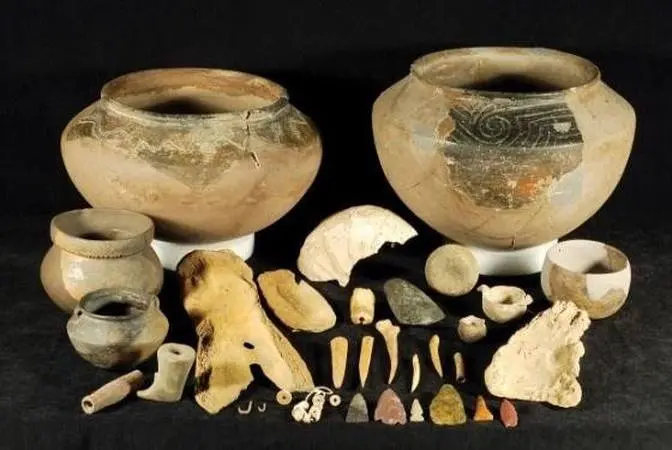
over at some of the artifacts that i have sitting out dating from the greek period and
also the hellenistic period and roman period so we can date them probably around 500
hellenistic period 300 roman period 100 to around 200 and also the byzantine period so
600 a.d so let's go over to the the room of a thousand artifacts and i'll show you what we have
this first vessel that i have is actually called a lucky toast
it's possibly used to store perfume you can see this checkerboard display right here design
very very common artistic design in the ancient world the type of base that we have it's kind of
an odd base it's not really what i would call ring base but it's not really a flat base and
it's not really a fluted base so we just just call it a different base but this is a base on
what we call lucky toast what they would use for a stopper maybe stone cork cloth and here we have
a drinking cup the handles are on the top so this is what we would call a sky phos on both sides is
a picture of an owl probably representing the goddess athena and then on the base we do have
a ring base here once again what is the ring base well if i would wet this slightly wet it make it
moist and lay it down on a cloth let it sit pick it up and you picked up the cloth you would see a
ring so this means a ring base if it was completely flat if we put some moisture on it and laid it
down on the cloth and picked up the cloth you would see a big circular structure and this would
be called a flat base we could say a flat ring base but so we got a ring base and then you could
have a flat base this comes from the hellenistic period so beginning with alexander the great
so we're dating this to at least the third century bc this would be used to store perfume
it has what we call black slip on it used for decoration over the black slip we have these
different types of ring designs black and it looks like maybe at one time white but however
right now it looks gray but for the type of artifact that you're seeing here is called a
spindle bottle looks like a little spindle bottle right and here we have a flat base
can you see the flat base so once again if i wet this and lay it down on a piece of paper and pick
it up you're going to see a little flat disc if i'd wet this particular sky foes and laid it down
on a piece of paper and picked up the paper you would see a ring a ring base what is this one
we called it a different base meaning i'm not sure all right now let's look at some hellenistic
plates usually hellenistic plates are i would say actually kind of like poorly made in some
common instances i mean the common pottery used it's not really spectacular here we have a red
slip on the back of it looks like it's either a black slip or it's just been burned okay
but if you look at the slip itself you can see where it just looks like it's been dipped
it looks like it's just run over this thing looks like it has drip marks so it's not that
well designed so maybe because it's common they would just dip it in a stain or a slip and let
it dry or drip dry and this is the this is the design from that period however if you can see
the sides of this vessel i'll hold it like this here you can see a curvature the curvature is
made on the potter's wheel and we call this carination a carinated vessel means it's curved
and it's going to have different types of curvatures usually around you can say the
mid section of the vessel you'll see the curvature whether it be a bowl
or maybe some type of dipper juglet okay i'll show you another plate very common to what we
might have today once again if you look right here you'll see how it's red you can see this
slip but down here the slip is missing like it was just dipped set out to dry and that's it
if you look very carefully you can see where it's actually been spun on the potter's wheel you can
see the potter's marks over here you can see the different wheel indications this shows up
pretty much in the Hellenistic period you see these imprints where they are pressing down on
the clay it shows up even more it's thicker and deeper during the Herodian period the Roman period
and then we get to the Byzantine period these gyrations in the pottery where the wheel marks
where they're pressing down the clay is even thicker and harder in the Byzantine period
once again let's flip this over a ring base a ring base the red color is called the slip
because of the design and the way that is presented in other words it's it's just not
that well made it's very good indication that this is of course the Hellenistic period okay
now we'll put these two together the slip the darkness of the slip possibly where it was burned
also the potter's marks where they were pressing down the clay was spun on the wheel
and also a ring base so here's easier to see in the center you can see a depression
possibly used to hold a cup a saucer and a cup this one really doesn't have a carinated design
on it like we would see with the smaller vessel however it does have a ring base but this one's
kind of cool just because it does have that little center place where you can put your cup if you
two different periods I'll be cheating so something like that it would be neat to have
the cup that went with it though that'd be that would be a nice display so we could put these
dishes on top stack them Hellenistic period with the spindle bottle on the top
now let's look at something else in the lecture of Pharaoh's lighthouse I mentioned that the
light was projected into a beam by it had to be extremely large
piece of polished bronze polished bronze so we didn't have mirrors like you have today which
really gave you a good reflection of yourself in the new testament I believe it's the apostle
Paul that says and it's just a short phrase we dimly look into a mirror so when it says we dimly
look into a mirror sometimes we think of ourselves in a contemporary situation looking into a
contemporary mirror which gives a good reflection but you can see by the mirrors of the ancient
culture that you got to maintain a very highly polished surface to give any type of reflection
now this is a bronze mirror but it has silver plating it might have had some kind of cover
on it a place that you would place the box they found I think it was in a book called the cave of
letters written by Yagel Yadin in the cave of letters they found a lamp but the lamp was also
in a box it was a very decorative box but understand it's going to take a lot of polishing
and in a humid environment right this would tint over pretty quickly so they probably
kept it in a box and handled it just by the you can see this end piece right here which would
have had a handle attached to so a wood handle has since deteriorated and rotted off so you
got to think of this as actually having a thicker handle attached to it highly polished and this is
a small lamp I have seen them probably about four times the size but this is very similar
to the lamp that was excavated in the cave of letters the book is out of print but I'm sure
you could Amazon or Google it and say cave of letters it's an easy read it's an easy read
nice pictures from that time period I think is dated to the 1970s or 80s but an ancient lamp
and this dates to the Roman period the Roman period so let's go back over some times just
by looking at them once you get an eye for pottery you can pretty much tell what time
period you're in so this is more of your ancient Greeks not the time of Alexander the Great a
little bit further back all right and it's called a lucky toast a lucky toast used for storing
possibly perfumes a vessel for drinking the handles are on the top think of high and it's called
Scyphos a Scyphos now we're into the time of Alexander the Great I only have a few pieces
of course this is and these are common from that period and it's good to know the common pottery
because if you're at an excavation or maybe you bump into a tomb that's what you're possibly
going to find common pottery so you want to know your lamps your different shapes and sizes and
decorations of lamps once you get an eye for lamps you can pretty much generally broadly date that
at the archaeological time period and then common pieces like the spindle bottle
if you saw this you say instantly Hellenistic period and then once again these types of
vessels carinated design carinated remember it means curvature ring base you look at it and say
but the the slip on it the tint the red slip with the dark tint on the bottom and it looks like it's
looks like somebody just dipped it in this in a dried kind of like you're drying dishes
on you know like on a rack and you just left it there and you think like but you know that's not
that impressive Hellenistic period although Hellenistic period as well as the Greek period
when you want to look at some fine pottery that's there as well okay then we get to the Roman period
and once again if you want to look at an archaeological dig on record where they find
uh I'm going to get via another archaeological terminology in situ if they say in situ i s i t
a in situ or i s i t u um means the place of its origin in other words they're going to photograph
it and you're going to see it uh where it is as they have located it so it's not moved it didn't
come from an antiquity dealer no you're going to see it as it was in the excavation in situ so if
you want to see a lamp that was found in situ by a very popular Israeli archaeologist and general
Yael Yadin look up the book get it it's probably just maybe a couple bucks uh the cave of letters
the cave of letters so here we have once again a silver lamp bronze overlaid with silver put that
way very cool though very cool and we got a little bit over a minute left and I left the best for
last from the Byzantine period fourth century remember that the lighthouse of Alexandria
existed for some 1500 years here is a Roman yeah Roman Byzantine Byzantine period bronze lamp
you can see a fish's tail you can see the cross ah obviously Christian right but look in the center
this is the handle well this is the lid right here you would put the spout put the spout probably
like a little wick of cloth goes here hopefully you can see that here's the lid where you open it
up and you can put your oil you can set the centerpiece it looks like a piece sticking up
that's where it actually fits into the lamp stand so this is all made of bronze extremely rare this
is a very unique experience to handle this a bronze lamp alone can be a very cool experience
a bronze lamp with a stand even cooler but look at this what's in the center of it
a lighthouse the lighthouse possibly of Alexandria if you can see where it has these little one two
three four five six yeah six sides in the you can say at the top or a higher structure to the
lighthouse over the base possibly representing the eight-sided structure but it does represent it
a hexagon instead of an octagon shape and the lighthouse beacon on the top isn't that cool
kind of goes with the theme you are the light of the world except a city on a hill cannot be hid
but yet it's represented in an ancient oil lamp bronze oil lamp my name is Dr. George Sparks
it's been a privilege thank you for your time Bible Interact uncovering the mysteries of the
at Bible Interact dot tv you will penetrate the scriptures of the bible at our store you're just
one click away from owning your favorite books dvds or study guides earn a degree from our
university and watch hundreds of video presentations from biblical scholars archaeologists and
theologians by subscribing to Bible Interact you'll find all the resources you'll need so why
not subscribe today go to www.bibleinteract.tv you'll be glad you did interested in studying
more about the temple the messiah or what God's plan is for our future no problem we've got you
covered with more than 200 dvds books and workbooks you'll find the answers you've
been searching for Bible Interact uncovering the mysteries of the kingdom of God